






You are here
Elizabeth Gurley Flynn
 So it is with the quality. Take the case of Frederic Sumner Boyd, in which we should all be deeply interested because it is evident Frederic Sumner Boyd is to be made "the goat" by the authorities in New Jersey. That is to say, they want blood, they want one victim.
 The second form of sabotage is to deliberately interfere with the quality of the goods. And in this we learn many lessons from our employers, even as we learn how to limit the quantity. You know that every year in the western part of this United States there are fruits and grains produced that never find a market; bananas and oranges rot on the ground, whole skiffs of fruits are dumped into the ocean.
 Elizabeth Gurley Flynn, a leader in the Industrial Workers of the World and later Communist Party USA, was a
 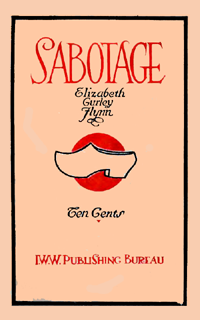 Originally published as SABOTAGE, THE CONSCIOUS WITHDRAWAL OF THE WORKERS' INDUSTRIAL EFFICIENCY, in October, 1916, by the IWW publishing bureau, in Cleveland, Ohio. It was later withdrawn from the IWW's official litearture. The pampahlet originally sold for 10 cents.
The Fine Print I:
Disclaimer: The views expressed on this site are not the official position of the IWW (or even the IWW’s EUC) unless otherwise indicated and do not necessarily represent the views of anyone but the author’s, nor should it be assumed that any of these authors automatically support the IWW or endorse any of its positions.
Further: the inclusion of a link on our site (other than the link to the main IWW site) does not imply endorsement by or an alliance with the IWW. These sites have been chosen by our members due to their perceived relevance to the IWW EUC and are included here for informational purposes only. If you have any suggestions or comments on any of the links included (or not included) above, please contact us.
The Fine Print II:
Fair Use Notice: The material on this site is provided for educational and informational purposes. It may contain copyrighted material the use of which has not always been specifically authorized by the copyright owner. It is being made available in an effort to advance the understanding of scientific, environmental, economic, social justice and human rights issues etc.
It is believed that this constitutes a 'fair use' of any such copyrighted material as provided for in section 107 of the US Copyright Law. In accordance with Title 17 U.S.C. Section 107, the material on this site is distributed without profit to those who have an interest in using the included information for research and educational purposes. If you wish to use copyrighted material from this site for purposes of your own that go beyond 'fair use', you must obtain permission from the copyright owner. The information on this site does not constitute legal or technical advice.
 This site is not the official webpage of the Industrial Workers of the World.