You are here

climate justice

Why I Choose Optimism Over Despair: An Interview With Noam Chomsky (excerpt)

Noam Chomsky interviewed by C.J. Polychroniou - Truthout, February 14, 2016

...You have defined your political philosophy as libertarian socialism/anarchism, but refuse to accept the view that anarchism as a vision of social order flows naturally from your views on language. Is the link then purely coincidental?

It's more than coincidental, but much less than deductive. At a sufficient level of abstraction, there is a common element - which was sometimes recognized, or at least glimpsed, in the Enlightenment and Romantic eras. In both domains, we can perceive, or at least hope, that at the core of human nature is what [Russian anarchist Mikhail] Bakunin called "an instinct for freedom," which reveals itself both in the creative aspect of normal language use and in the recognition that no form of domination, authority, hierarchy is self-justifying: Each must justify itself, and if it cannot, which is usually the case, then it should be dismantled in favor of greater freedom and justice. That seems to me the core idea of anarchism, deriving from its classical liberal roots and deeper perceptions - or beliefs, or hopes - about essential human nature. Libertarian socialism moves further to bring in ideas about sympathy, solidarity, mutual aid, also with Enlightenment roots and conceptions of human nature.

Both the anarchist and the Marxist vision have failed to gain ground in our own time, and in fact it could be argued that the prospects for the historical overcoming of capitalism appear to have been brighter in the past than they do today. If you do agree with this assessment, what factors can explain the frustrating setback for the realization of an alternative social order, i.e., one beyond capitalism and exploitation?

Prevailing systems are particular forms of state capitalism. In the past generation, these have been distorted by neoliberal doctrines into an assault on human dignity and even the "animal needs" of ordinary human life. More ominously, unless reversed, implementation of these doctrines will destroy the possibility of decent human existence, and not in the distant future. But there is no reason to suppose that these dangerous tendencies are graven in stone. They are the product of particular circumstances and specific human decisions that have been well studied elsewhere and that I cannot review here. These can be reversed, and there is ample evidence of resistance to them, which can grow, and indeed must grow to a powerful force if there is to be hope for our species and the world that it largely rules.

While economic inequality, lack of growth and new jobs, and declining standards of living have become key features of contemporary advanced societies, the climate change challenge appears to pose a real threat to the planet on the whole. Are you optimistic that we can find the right formula to address economic problems while averting an environmental catastrophe?

There are two grim shadows that loom over everything that we consider: environmental catastrophe and nuclear war, the latter threat much underestimated, in my view. In the case of nuclear weapons, we at least know the answer: get rid of them, like smallpox, with adequate measures, which are technically feasible, to ensure that this curse does not arise again. In the case of environmental catastrophe, there still appears to be time to avert the worst consequences, but that will require measures well beyond those being undertaken now, and there are serious impediments to overcome, not least in the most powerful state in the world, the one power with a claim to be hegemonic.

In the extensive reporting of the recent Paris conference on the climate, the most important sentences were those pointing out that the binding treaty that negotiators hoped to achieve was off the agenda, because it would be "dead on arrival" when it reached the Republican-controlled US Congress. It is a shocking fact that every Republican presidential contender is either an outright climate denier or a skeptic who opposes government action. Congress celebrated the Paris conference by cutting back [President] Obama's limited efforts to avert disaster.

The Republican majority (with a minority of the popular vote) proudly announced funding cuts for the Environmental Protection Agency - one of the few brakes on destruction - in order to rein in what House Appropriations Committee Chairman Hal Rogers called an "unnecessary, job-killing regulatory agenda" - or in plain English, one of the few brakes on destruction. It should be borne in mind that in contemporary newspeak, the word "jobs" is a euphemism for the unpronounceable seven-letter word "pr---ts."...

Read the rest of the interview, here.

Why I've no regrets about going to prison for shutting down Heathrow airport

By Ella Gilbert MSc - Mashable, February 23, 2016

Editors Note: Ella Gilbert MSc (as well as several other members of the #Heathrow13) are dues paying members of the IWW. for more details about the struggle, please visit Plane Stupid.

Update from the Guardian:

Six women and seven men have avoided jail for trespassing at Heathrow, following a protest against the possible expansion of the airport.

The activists, dubbed the Heathrow 13, were given sentences of six weeks suspended for 12 months, meaning they would not have to go to prison immediately.

They had been found guilty in January of aggravated trespass and entering a security-restricted area of an aerodrome. They had been warned by district judge Deborah Wright to expect a custodial sentence.

Read more...

For more on the sentencing of the Heathrow 13, see also:

LONDON — Today I’ve been packing my bag for prison.

That sentence never gets less weird. It’s a task that most people will never have to do, or even think about doing, so it’s been a learning curve. Take this for example: you can’t take black clothes into prison. This is a serious problem for someone whose entire wardrobe is black.

If you’re wondering why I’m having to do this, here’s why: on Wednesday, myself and 12 others from direct action network Plane Stupid will be sentenced to “almost inevitable” (in the words of the judge) custodial sentences for our part in a direct action that happened last year.

In July, the #Heathrow13 occupied one of Heathrow’s runways for six hours: the longest airport occupation in the UK to date, and the most high profile. We managed to stop 25 planes and in so doing prevented the emission of hundreds, if not thousands, of tonnes of greenhouse gases into the atmosphere.

Aircraft are hugely polluting machines. They spew out air pollutants like particulate matter and nitrogen oxides that cause serious health effects for wildlife and for people living in the local area, as well as climate-damaging greenhouse gases. I’m sure I don’t need to explain that greenhouse gases cause climate change by trapping heat in the atmosphere, causing temperatures to rise and altering the way the climate functions. Carbon dioxide is the most obvious of these warming gases, but many others are also emitted by plane exhausts, such as oxides of nitrogen, which trigger the formation of ozone when emitted at altitude, and water vapour. All of these have a significant warming effect, especially when emitted at aircraft cruising altitude, several kilometres above the ground.

One of the major problems with aviation is that it cannot really be decarbonised. It takes a lot of energy to fly a heavy metal object full of people at hundreds of miles an hour across the world. Unfortunately, the technology is not yet there to allow planes to fly using hydrogen or electric fuel cells, which means that for now at least, jet fuel is very much fossil fuel based. Although efficiency improvements can reduce some of its impact, demand for aviation is enormous and any efficiency improvements are vastly outstripped by the rapid growth in passenger volumes. Many airlines, incl. United, are experimenting with biofuel blends as a possible transition fuel of sorts. But most biofuels are no better for the climate than oil. It’s not a serious solution.

What this means is that aviation is still a heavily polluting industry and will probably continue to be so for many years to come. However, action needs to be taken to combat climate change – something recognised in law by the UK’s 2008 Climate Change Act. This stipulates that UK emissions must be reduced by 80% from 2005 levels before 2050. That’s a big cut, but it might be possible if every sector in the UK economy makes aggressive and sustained reductions in their emissions.

However, aviation is being given something of a free ride – a proposed third runway at Heathrow, which would emit another 9 million tonnes or so of CO2 per year (emissions on a par with the whole of Kenya). We cannot build new runways if we are to prevent climate change –- and doing so undermines all of our other efforts to reduce emissions across the board.

Interviewed: The Rules' Alnoor Ladha on the Promises and Perils of Global Economic Activism

Alnoor Ladha interviewed by Anna Bergren Miller - Shareable, February 18, 2016

The Rules is a worldwide network of activists working to transform the politico-economic structure undergirding global inequality. The network, which actively supports individual social movements while operating as a think tank, advocates radical reform focused on five strategic areas: money, power, secrecy, ideas, and the commons.

Last month, I spoke over Skype to The Rules founder Alnoor Ladha. Ladha filled me in on how The Rules operates on the ground, and on his own journey from reformer to revolutionary. We also spoke about the role of the city in neoliberalism, the part the sharing economy can play in rewriting "the rules," and why Donald Trump is emblematic of the challenges faced by anti-capitalist activists.

ABM: Tell me about The Rules. What is it?

AL: The Rules is a network of activists, writers, researchers, journalists, coders, hackers, and artists focused on addressing the root causes of inequality, poverty, and climate change. We don't focus on the traditional development model, which is based on aid, charity, and sympathy. We focus [instead] on the drivers of these injustices, which are things like the tax justice system, the global economic operating system—essentially the rules that ensure that the current state of pillage and destruction is the logical outcome.

We do that in two ways. We have a campaigning arm, that supports and works with social movements from around the world—peasant movements, farmer movements, women's rights groups, indigenous groups—as well as a think-tank arm, that tries to get more progressive and radical ideas into the mainstream media.

What are your objectives, both short- and long-term?

On the campaigning side, a lot of it is about helping groups articulate how all oppression is connected. So we're not fighting a lands-rights struggle in India, and a tax-justice struggle in Kenya, and a climate struggle in Venezuela. These are all linked to the same driver—the same nemesis, if you will. Which is the logic of the neoliberal capitalist system.

When we connect the dots like that, from a media perspective, a storytelling perspective, and a campaigning perspective, it helps expose the bigger picture at work. That's a lot of what the campaigning work is about. And also linking these civil-society groups with each other. We're trying to build that organizing infrastructure.

What brought you to this work? Did you have an epiphany moment, or was it more of an evolution in your thinking?

You know, it's funny. I think part of the journey for me has been like a removal of veils.

I was socialized by the Canadian education system. Things are pretty good in Canada for the average person. And no one looks at the historical reasons why that is the case. So I think when you start going on the journey of understanding privilege, you start having these veils systematically removed.

My dad was exiled from Uganda in the early 1970s by Idi Amin. So I was sensitive to power, and interested in understanding political power. But I was never an activist in that traditional sense from a young age. I wasn't some kind of child prodigy. I was just curious and interested.

As I became more curious, I started to question the structures behind the system. Once you start to understand, for example, that Canada's wealth is dependent on resource extraction and, historically, is a byproduct of the British colonial system, then you start understanding [why you were] taught this certain version of history.

Going to university in Canada, this idea [existed] that somehow we should be grateful for the jobs we're given. But [there was] no real explanation of the debt-based financial system that requires us to work these bullshit jobs.

I started as a reformist in many ways, because I believed the Western myth of progress, which is: everything's getting better, and if we could just make slight tweaks in this current system, things would be better.

I was really interested in the idea of social enterprise for a couple of years. Then when you start to ask, "Who are things getting better for, and in what way are they getting better?" you realize that that Western myth of progress is total bullshit.

Of every dollar of wealth created, 93 cents goes to the top one percent since 1998. You can see why we're told that the only model for any social change is more economic growth, more foreign direct investment, more GDP increase. Very few people benefit from that, but those are the same people who dictate what economic policy and theory is.

Understanding that every dollar of wealth creates inequality, and every dollar of wealth heats up our planet—because we have a fossil fuels extractive-based system—you realize that there's no way that reforming this current system is going to change the quality of life for the majority of humanity. Quite the opposite. The more we improve the system, the more we're keeping in a vampiric system whose logical outcome will be the destruction of the planet.

Who Wins From “Climate Apartheid”?: African Climate Justice Narratives About the Paris COP21

By Patrick Bond - New Politics, Winter 2006

The billion residents of Africa are amongst the most vulnerable to climate change in coming decades, and of special concern are high-density sites of geopolitical and resource-related conflicts: the copper belt of the Democratic Republic of the Congo and mineral-rich African Great Lakes stretching into northern Uganda, western Ethiopia (bordering the Sudanese war zone), Madagascar and smaller Indian Ocean islands, and the northern-most strip of Africa and West Africa including Liberia and Sierra Leone (recent sites of diamond-related civil war and then Ebola epidemics). In other words, the African terrains hardest hit by war and economic looting are going to be sites of climate stress and socio-political unrest, according to the University of Texas project researching vulnerability for the U.S. Pentagon (Busby et al 2013).

The lost opportunity to change this map at the United Nations Framework Convention on Climate Change (UNFCCC) summit in Paris, December 2015, is tragic. In the 2015 Pew Research world public opinion survey, a near majority of those surveyed—46 percent—identified climate as a threat about which they were “very concerned,” the highest score of any issue in the poll (economic crisis was second). But where it counts most, in the top two polluting countries, the percentage of people who name climate as a major threat is just 42 in the United States and 19 in China (Carle 2015). And even if consciousness rises faster from below, global elites apparently remain too paralyzed to take necessary actions to keep temperature increases below 1.5 degrees Celsius, the point at which runaway, catastrophic climate change is likely to take off (Bond 2012, Klein 2014). Going into the Paris UNFCC Conference of the Parties (the 21st, COP21), the French hosts estimated that the combined declarations of voluntary commitments would warm the planet by 3 degrees Celsius this century, but this is a vast understatement given the likelihood of runaway climate change once a 2-degree tipping point is reached.

The annual UNFCCC Conference of the Parties (COP) has been held in Africa thrice: in 2001 in Marrakech, 2006 in Nairobi, and 2011 in Durban. But the critical moment that defined Africa’s future climate crisis was in December 2009 in Copenhagen. The negotiations at COP15 were diverted one night into a room where five leaders—from the United States and the group of Brazil, South Africa, India, and China (BASIC)—agreed on a side deal, the Copenhagen Accord. That was the source of Africa’s major problems in climate negotiations for years thereafter, including at the Paris COP21.

The fortnight-long COP talk-shops are typically sabotaged by U.S. State Department negotiators, recently joined by brethren governments in Australia and Japan, with Canada a loyal co-polluter prior to the October 2015 election (and probably long after, given the national elites’ commitment to exploiting the Alberta tar sands). Initial hopes that the Brazil-Russia-India-China-South Africa (BRICS) bloc might make a difference in world climate policy as well as address undemocratic global financial governance have since been dashed, not only because of BASIC’s 2009 alliance with Barack Obama (Bond and Garcia 2015). Individually, they are each failing to grapple with new responsibilities to decarbonize their economies.

The world’s largest single emitter is China, even if in per capita terms it is far lower than the Northern countries. Beijing claims to have recently reduced coal consumption are dubious given notorious undercounting (probably by 15 percent). The Communist Party leadership decided upon an upward trajectory of greenhouse gas emissions at least through the 2020s. The Chinese standpoint that they need more emissions to “develop” is contradicted by a stark reality: Recent U.S. and European claims to be slowing their emissions rely upon their corporations and consumers outsourcing large amounts of emissions to new production sites, mostly in East Asia. According to the Intergovernmental Panel on Climate Change, “A growing share of CO2 emissions from fossil fuel combustion in developing countries is released in the production of goods and services exported, notably from upper-middle-income countries to high-income countries” (Hawkins 2014). In the case of China, the amounts of such outsourcing are vast, having risen from 404 million tons of CO2 in 2000 to 1.561 billion tons in 2012.

Moreover, BRICS leaders have all endorsed carbon markets, the capitalist strategy for offsetting local emissions by buying someone else’s carbon allowances. Initially, from 2005-2012, these took the form of United Nations “Clean Development Mechanism” (CDM) opportunities to sell often-corrupt and gimmick-ridden “emissions credits” as contributing to emissions mitigation (Bond, Dada and Erion 2009). 

In recent years, after the BRICS no longer qualified for CDMs, seven Chinese cities started their own carbon markets, with Brazil and South Africa likely to follow in a few years. Moreover, China’s attempts to control emissions in future appear certain to foster faith in dangerous techniques such as nuclear energy, hydropower, and untested carbon-capture-and-storage technology.

The strongest efforts to address climate change from the North are in Europe, where in October 2014 a new goal of 40 percent greenhouse gas reduction from 1990 levels by 2030 (not including the carbon outsourcing of hundreds of millions of tons per year) was sought—far too low according to most scientists, but far ahead of goals set by other historic pollution sites. In a late-2014 deal between China and the United States, the latter’s goal was only 15 percent reduction by 2025 (from 1990 levels).

In short, very little reason for hope on climate or other aspects of environmental stewardship can be found in any of the major countries’ governments. There is, of course, the exception of Cuba, which by compulsion began a strong decarbonization strategy once Russian-subsidized oil became unavailable after 1990. But the good examples that were anticipated in 2008-2011 from left-leaning Latin American countries—Bolivia, Ecuador, and even oil-rich Venezuela—subsequently soured, as each turned to more intense hydrocarbon “extractivism,” albeit with nationalist redistributive ends instead of multinational corporate profiteering. 

When the September 2014 United Nations special leadership summit on climate was preceded by a march of 400,000 people with strong messages of anger about elite procrastination, nothing more than vague promises were offered. The array of global and national power appears as difficult to affect as ever, what with unprecedented corporate influence—including of fossil fuel companies—over policymakers, and with further awareness that major restructuring of vast industries will be needed. 

Going back to 2009, the US+BASIC meeting in Copenhagen not only “blew up the UN,” as Bill McKibben (2009) of 350.org put it, in terms of evading the more democratic process. The Copenhagen Accord also promised only inadequate and voluntary emissions cuts. Japan, Russia, Canada, and Australia subsequently announced they would withdraw earlier commitments made under the Kyoto Protocol. 

By November 2015, the (voluntary) Intended Nationally Determined Contribution (INDC) statement of the G20 countries confirmed huge barriers to reaching the required emissions cuts. According to Climate Action Tracker (2015), “None of the G20 INDCs are in line with holding warming below 2°C, or 1.5°C.” The agency rated the following contributions as “inadequate”: Argentina, Australia, Canada, Indonesia, Japan, South Korea, Russia, Saudi Arabia, South Africa, and Turkey, with the INDCs of another set—Brazil, China, India, the EU, Mexico, and the United States—also “not consistent with limiting warming to below 2°C either, unless other countries make much deeper reductions and comparably greater effort.” 

Together we’re unstoppable: why this is the year to turn the tide

By Rosa Fields - Red Pepper, February 10, 2016

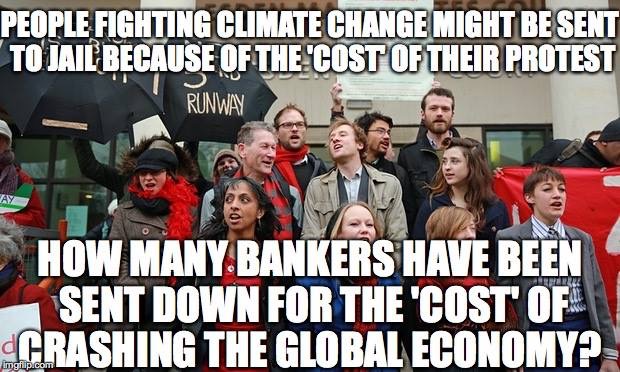
The #Heathrow13 will ‘almost inevitably’ be sent to prison on 24 February for occupying the northern runway of Heathrow airport. They took this action, which led to 25 flights being cancelled, to protest against the building of a third runway at Heathrow airport, as recommended by the Davis Commission less than a fortnight previously. The fact is, we can't build any new runways in the face of climate change. It's that simple.

In going to jail, the #Heathrow13 will be the first climate activists in the UK to be given a custodial sentence. Given the seriousness that a prison sentence implies, it would be easy to let this scare us from taking the necessary action that our movements need. That would be a mistake, for now is the time for exactly the opposite. Now is the time to escalate things and given the amount of outrage towards this sentencing, as well as the love and support that is being shown to Plane Stupid, it seems like there is a real possibility of such an escalation.

Kill King Capital

By Paul Street - CounterPunch, February 9, 2016

“If you’re going to shoot the king, don’t miss,” Niccolò Machiavelli wrote in The Prince (1505). “The injury that is to be done,” Machiavelli added, “ought to be of such a kind that one does not stand in fear of revenge.”
Ralph Waldo Emerson wrote something similar in his journal in September of 1843: “Never strike a king unless you are sure you shall kill him.”

I first ran across a version of this sentiment many years ago (exactly where I do not recall) while I was researching some U.S. Black and labor history.[1] As I recall it was more class-specific, something along these lines: “if a peasant takes up arms against the king, he’d better well kill him.” The idea was that a high noble might be able to get away with challenging the king but a peasant certainly could not. If peasants and artisans were going to rebel, they’d better make a full revolution of it.

“No Desire to Get Rid of the Profit Motive”

Nowadays I think the aphorism applies to capital and the capitalist class. Take Bernie Sanders. He has called himself a “democratic socialist” and campaigns against “the billionaire class,” drawing large and approving crowds. He has taken more than a few at least rhetorical shots at the king, which in the U.S. is big capitalist and corporate-financial power – what Edward S. Herman and David Peterson have called the “the unelected dictatorship of money.”

In reality, however, Sanders, for all his sloganeering about “revolution,” has not remotely proposed that we figure out how to kill the king of capitalism. Sanders is at most a social democratically inclined New Deal liberal. His vision for America is one in which commanding heights economic decisions and ownership remain firmly in private, profit-taking hands while the government intervenes to a limited extent with the purpose of partially regulating some business activities and distributing income and wealth and social benefits in a more egalitarian and humane – less neoliberal – way. And as Bill Blum recently argued:

“Social democrats and democratic socialists [like Bernie Sanders] have no desire to get rid of the profit motive. Last November, Sanders gave a speech at Georgetown University in Washington about his positive view of democratic socialism, including its place in the policies of presidents Franklin D. Roosevelt and Lyndon B. Johnson. In defining what democratic socialism means to him, Sanders said: ‘I don’t believe government should take over the grocery store down the street or own the means of production.’”

“I personally could live with the neighborhood grocery store remaining in private hands, but larger institutions are always a threat; the larger and richer they are the more tempting and easier it is for them to put profit ahead of the public’s welfare, and to purchase politicians. The question of socialism is inseparable from the question of public ownership of the means of production. The question thus facing ‘socialists’ like Sanders is this: When all your idealistic visions for a more humane, more just, more equitable, and more rational society run head-first into the stone wall of the profit motive … which of the two gives way?” (William Blum, “Is Bernie Sanders a Socialist?”)

Answer: the profit motive. The “private sector” (I use quote markets because Big Business draws heavily on public subsidy and protection while wreaking monumental and multi-dimensional havoc on public experience) still rules under Bernie’s recommended “political revolution.” He can call himself a socialist but he says nothing about the need for a social revolution to expropriate the expropriators and remove the masters of wealth and property from the disastrous private ownership and control of economy, society, politics, and culture – from private/corporate ownership and control of the means of production, finance, distribution, and communication.

The vast global U.S. military Empire – intimately bound up with American capitalist class power at home and abroad – also continues under Sanders’ “revolution.” He doesn’t even take rhetorical shots at King Capital’s evil twin imperialism. Sanders is strikingly mute on the Pentagon system, no small silence given the devastatingly destructive impact of the nation’s giant military industrial complex on social and environmental well-being within and beyond the U.S. “homeland.”

Why we need unions! #HeartUnions

By Admin - A Green Trade unionist in Bristol, February 3, 2016

We are often told that unions have become irrelevant to modern society, or worse that they are in some way negative.

No institution is perfect, but trade unions do amazing work standing up for their members in the workplace and increasingly in the community (see for example the role unions played locally in helping block the environmentally and medically damaging biomass facility in Avonmouth).  Many of us are given negative perceptions of trade unions because of how they are portrayed in the press (usually only ever mentioned if they’ve been forced into industrial action and then only described as militants needlessly causing trouble) and the legacy of the 1970s.

People who are against unions often argue that in the past ‘over mighty union barons’ ‘held the country to ransom’ and would strike ‘at the drop of a hat’. There may be some small germs of truth in this, but this is a gross exaggeration and is in part the result of attempts to undermine the legitimacy of unions and collective action.  Even if this had been the case the situation in modern Britain is so far removed it makes such comparison meaningless.

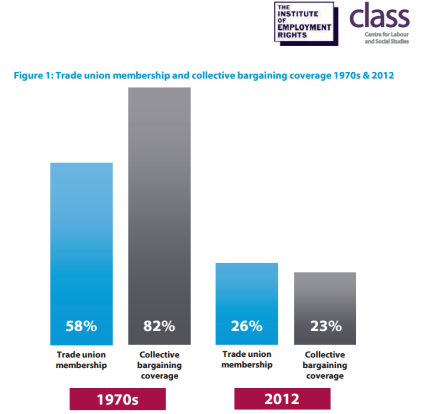
Today union membership is at a historic low (though it has moderately increased in recent years), as is the power and influence of unions in our society.  They’re even marginalised in the Labour party these days (though this could change under Corbyn).  We already have some of the most restrictive trade union laws in the ‘democratic’ world which are about to get even more restrictive with the governments draconian new strike legislation, making union action very difficult.  Furthermore, no worker ever takes the decision to strike and lose pay lightly (especially with the financial hardship of recent years), and with unions so comparatively weak and increasingly defensive the situation has to be pretty bad before they feel forced to resort to striking.

No New Runways!

By Ella Gilbert MSc - IWW Environmental Unionism Caucus, January 30, 2016

Last week thirteen members of UK direct action group Plane Stupid were found guilty of aggravated trespass and unlawfully entering a restricted area of an aerodrome for their part in an action last July. The #Heathrow13 occupied Heathrow airport’s northern runway for a record-breaking 6 hours, preventing hundreds, if not thousands, of tonnes of CO2 from being emitted. The action took place shortly after the release of the Davies Report, a government-commissioned report on airport expansion in the Southeast that recommended a third runway be built at Heathrow.

There are many issues here: for one thing, the Prime Minister David Cameron promised in a pre-election manifesto not to build a third runway, “no ifs, no buts”. The recommendation for a third runway therefore represents another massive U-turn on the part of the Conservative government, who also once claimed to be part of the ‘greenest government ever’. Meanwhile, the Tories have scrapped subsidies for wind energy, removed feed-in tariffs and support for small-scale community energy projects and given the go-ahead to grant fracking licenses. All of their actions are in direct opposition to the Climate Change Act 2008, a radical piece of legislation that requires the UK to reduce emissions by 80% relative to 1990 by 2050. If we are to meet these (legally binding) targets, aviation cannot be allowed to continue to emit as it does. 

Yet Heathrow is just part of the problem. Building a runway anywhere in the UK will be massively damaging to the environment. Indeed, the Davies Commission investigated three options for expansion, none of which was not to expand at all. This is revealing of the government’s priorities: they would rather lock up peaceful activists and profit from human suffering than lose out on the £7bn a year that Heathrow apparently contributes to the UK economy.

Aviation cannot be readily decarbonised, and is one of the most polluting industries around. The emission of pollutants at cruising altitude makes their effects more pronounced and contributes considerably to climate change. On the ground, emissions of air pollutants like particulate matter and NOx cause severe respiratory illnesses and deaths in the local area. Within the 32km surrounding Heathrow, 31 deaths per year are directly attributable to emissions of NOx from aircraft.

Flying is also a preserve of the wealthy – in the UK, 70% of flights are taken by 15% of people, and only 5% of people globally have ever flown at all. This is a clear demonstration of global and national inequality. The whims of rich leisure flyers are prioritised over the lives and livelihoods of poor people who have to breathe toxic pollutants and lose their homes to rising seas. Aviation also enjoys a privileged status – aviation is not included in any climate negotiations or legislation and aircraft fuel and tickets are exempt from VAT. Imagine that – we live in a country where tampons are considered a luxury item and taxed as such, while a flight to a ski resort is not. The cost of meeting climate targets is never passed on, and airlines continue to get a free ride for exploiting us.

Exploitation is big business. Exploitation of the environment, of resources and of workers. Corporations like Heathrow Airport Ltd. are making billions from an industry that is contributing to premature deaths in the local area and around the world. And of course, it is the poorest people who get hit the hardest, and hit first.

In a capitalist society, a few people control the means of production, and they use this to exert their influence on the majority of people, profiting from their labour. This is a story of inequalities: Heathrow has the power and clout of the judicial system, financial backing, and a PR company behind them, whereas ordinary people have nothing but their bodies and their intellect at their disposal. Direct action is one way of redressing this vast imbalance and wresting back some control.

It scares those in power to think that people might begin to take things into their own hands and make change. That is why an example is being made here. The #Heathrow13 may soon be the first UK climate prisoners, but they certainly won’t be the last. To paraphrase Howard Zinn - action outside the law is essential to democracy. You’ll never change outdated laws without breaking them. We must challenge the capitalist status quo that abuses natural resources and people in equal and devastating measure with what means we have. It will take the sacrifices of thousands of normal people to break oppressive structures that exploit people and the environment, but the tide is turning.

An Injury to One is an Injury to All!: Solidarity with Heathrow 13 activists

By Plane Stupid - Dorsett IWW, January 27, 2016

Among thirteen defendants threatened with incarceration are two members of our One Big Union. Fellow Workers  Ella Gilbert from Norwich and Bec Sanderson from Machynlleth. We express our solidarity and admiration for their courage. An injury to one is an injury to all!

Read Ella Glibert's account of the trial:

More information at Plane Stupid

#Heathrow13 Trial Verdict

Monday, January 20th, 2016, London – Today in Willesden Magistrates Court, the thirteen Plane Stupid activists who occupied Heathrow’s north runway for six hours on the 13th of July last year were all convicted of aggravated trespass and being airside without lawful authority. The Judge has asked them all to return in 3 weeks on the 24th February for sentencing and has advised all defendants to prepare for immediate custodial sentences.

The thirteen defendants released the following statement, in response to their convictions:

Today’s judgement demonstrates that the legal system does not yet recognise that climate defence is not an offence. We took action because we saw that it was sorely needed. When the democratic, legislative and processes have failed, it takes the actions of ordinary people to change them.

We are very grateful for all the messages of support and solidarity we have received from all over the world, and are immensely proud of the action we took to combat emissions from aviation. Climate change and air pollution from Heathrow are killing people now, and the government’s response is to spend millions making the problem bigger. As long as airport expansion is on the agenda, Plane Stupid will be here. We’re in it for the long haul.

Most of the defence’s witness evidence was not heard in court, and none of the witnesses were allowed to appear in court. John McDonnell was not heard in full due to the Judge having already accepted the points he was addressing, and therefore ruling the statement irrelevant.

  • Her ruling on John McDonnell’s evidence is available here
  • And John McDonnell’s full statement is available here

Statements from three local residents from the Heathrow area were read out, detailing the debilitating and life-threatening medical conditions they were suffering from as a consequence of living near to the airport.

Character references for the defendants were also read out in court, from a variety of public figures including High Court Judge Peter Jackson and a long list of barristers and solicitors.

Alice Bowes-Larkin, one of the UK’s leading climate scientists, and a specialist in the climate impacts of aviation, submitted a statement which was read to the court. It mentioned that Heathrow “is the airport with the highest CO2 contribution in the world in terms of combined international and domestic flights” and “this puts Heathrow expansion at odds with the UK Government’s commitment to avoiding a ‘well below’ 2’C target, unless a major programme of efficiency and biofuel development are delivered in tandem.”

  • Sian Berry, the Green Party’s candidate for the London mayoral elections, came to court to support the defendants, despite her evidence having been ruled as inadmissible by the judge. Her statement is available here
  • George Monbiot’s statement was also ruled inadmissible, and is available here
  • Writing on how the activists will be seen in the future, he said:

They will be regarded not as outlaws and subversives, but as democratic heroes. Succeeding generations, struggling with the impacts that our government’s failures to take action on climate change bequeathed them, are likely to be amazed that they could have been seen in any other light.

In all, of the ten defence witnesses, only four had their evidence allowed, and none were permitted to appear in court.

The runway occupation, under the banner of anti-aviation expansion group Plane Stupid and the first on a Heathrow runway, lasted six hours and delayed or cancelled dozens of flights. The activists, who are all pleading not guilty, are accused of aggravated trespass and trespassing airside without authority.

Apocalypse on Trial

By Stephyn Quirke - Street Roots News, January 21, 2016

Video: Delta5 Defendents and supporters sing a version of I've Been Working on the Railroad by Railroad Workers United organizer and IWW member, J.P. Wright in honor of the links of solidarity they forged with railroad workers during their struggle.

On Jan. 15, Snohomish County Judge Anthony E. Howard handed down sentences to five people who say our political system is rigged to destroy the planet.

The trial was the latest in a series of protests against the increasing volumes of fossil fuels traveling through the Pacific Northwest, bound for Asian markets, despite the considerable damage to regional eco-systems already resulting from climate change, including ocean acidification, loss of snowpack in the Cascades, rising stream temperatures and summer deadzones along the coast.

In September 2014, Abby Brockway, Patrick Mazza, Jackie Minchew, Mike LaPointe and Liz Spoerri locked themselves to a 20-foot tripod at the BNSF railroad’s Delta yard in downtown Seattle. Dubbed the Delta 5, their protest was designed to draw attention to the danger of crude oil on rail lines in the Pacific Northwest, and to their contribution to irreversible climate change.

In a historic and highly anticipated trial that lasted four days, the Delta 5 were allowed to argue that their action was the lesser of two evils when compared to the status quo. In court shorthand, it’s called the necessity defense. Specifically, the Delta 5 presented evidence and legal arguments showing that their occupation of BNSF property was necessary to protect the public’s safety, calling numerous expert witnesses who testified to the public health risks of oil trains, both in their immediate risks to neighborhoods and to the damages climate change is bringing to Washington state. They included Richard Gammon, professor of chemistry and oceanography at the University of Washington, and Fred Milar, a hazardous-materials expert and former consultant to the railroad industry.

In another groundbreaking lawsuit concluded in November, King County Superior Judge Hollis Hill ruled that the state of Washington had a constitutional duty to uphold the public trust in natural resources and that this created a binding obligation for the state to protect the atmosphere for future generations. In an unusually dire ruling, Hill said, “Survival depends upon the will of their elders to act now, decisively and unequivocally, to stem the tide of global warming … before doing so becomes first too costly and then too late.”

One of the elders in that room was Abby Brockway. Reflecting on the trial, she recalled, “Everybody wants to kick the can down the road. … They said, ‘Well, the Legislature’s supposed to do it,’ and they’re saying ‘No, ecology’s supposed to do it,’ so nobody wants to try.”

Andrea Rodgers, who represented eight youth plaintiffs in the November climate lawsuit, who in turn brought the lawsuit on behalf of future generations, explained: “What Judge Hill said in our case is really important for the world to know: that the climate crisis is real, it’s happening now, and the government in Washington state is not doing anything to address it. And they need to step up and protect the fundamental rights of these people. … People are starting to speak out and defend their own rights in a variety of ways, and hopefully the judges of the justice system will catch up with that.”

Pages

The Fine Print I:

Disclaimer: The views expressed on this site are not the official position of the IWW (or even the IWW’s EUC) unless otherwise indicated and do not necessarily represent the views of anyone but the author’s, nor should it be assumed that any of these authors automatically support the IWW or endorse any of its positions.

Further: the inclusion of a link on our site (other than the link to the main IWW site) does not imply endorsement by or an alliance with the IWW. These sites have been chosen by our members due to their perceived relevance to the IWW EUC and are included here for informational purposes only. If you have any suggestions or comments on any of the links included (or not included) above, please contact us.

The Fine Print II:

Fair Use Notice: The material on this site is provided for educational and informational purposes. It may contain copyrighted material the use of which has not always been specifically authorized by the copyright owner. It is being made available in an effort to advance the understanding of scientific, environmental, economic, social justice and human rights issues etc.

It is believed that this constitutes a 'fair use' of any such copyrighted material as provided for in section 107 of the US Copyright Law. In accordance with Title 17 U.S.C. Section 107, the material on this site is distributed without profit to those who have an interest in using the included information for research and educational purposes. If you wish to use copyrighted material from this site for purposes of your own that go beyond 'fair use', you must obtain permission from the copyright owner. The information on this site does not constitute legal or technical advice.