

You are here

ecosocialism

How Science is Telling us All to Revolt: Is our relentless quest for economic growth killing the planet? Climate scientists have seen the data; and they are coming to some incendiary conclusions

By Naomi Klein - New Statesman, October 29, 2013

In December 2012, a pink-haired complex systems researcher named Brad Werner made his way through the throng of 24,000 earth and space scientists at the Fall Meeting of the American Geophysical Union, held annually in San Francisco. This year’s conference had some big-name participants, from Ed Stone of Nasa’s Voyager project, explaining a new milestone on the path to interstellar space, to the film-maker James Cameron, discussing his adventures in deep-sea submersibles.
But it was Werner’s own session that was attracting much of the buzz. It was titled “Is Earth F**ked?” (full title: “Is Earth F**ked? Dynamical Futility of Global Environmental Management and Possibilities for Sustainability via Direct Action Activism”).

Standing at the front of the conference room, the geophysicist from the University of California, San Diego walked the crowd through the advanced computer model he was using to answer that question. He talked about system boundaries, perturbations, dissipation, attractors, bifurcations and a whole bunch of other stuff largely incomprehensible to those of us uninitiated in complex systems theory. But the bottom line was clear enough: global capitalism has made the depletion of resources so rapid, convenient and barrier-free that “earth-human systems” are becoming dangerously unstable in response. When pressed by a journalist for a clear answer on the “are we f**ked” question, Werner set the jargon aside and replied, “More or less.”

There was one dynamic in the model, however, that offered some hope. Werner termed it “resistance” – movements of “people or groups of people” who “adopt a certain set of dynamics that does not fit within the capitalist culture”. According to the abstract for his presentation, this includes “environmental direct action, resistance taken from outside the dominant culture, as in protests, blockades and sabotage by indigenous peoples, workers, anarchists and other activist groups”.

Serious scientific gatherings don’t usually feature calls for mass political resistance, much less direct action and sabotage. But then again, Werner wasn’t exactly calling for those things. He was merely observing that mass uprisings of people – along the lines of the abolition movement, the civil rights movement or Occupy Wall Street – represent the likeliest source of “friction” to slow down an economic machine that is careening out of control. We know that past social movements have “had tremendous influence on . . . how the dominant culture evolved”, he pointed out. So it stands to reason that, “if we’re thinking about the future of the earth, and the future of our coupling to the environment, we have to include resistance as part of that dynamics”. And that, Werner argued, is not a matter of opinion, but “really a geophysics problem”.

Plenty of scientists have been moved by their research findings to take action in the streets. Physicists, astronomers, medical doctors and biologists have been at the forefront of movements against nuclear weapons, nuclear power, war, chemical contamination and creationism. And in November 2012, Nature published a commentary by the financier and environmental philanthropist Jeremy Grantham urging scientists to join this tradition and “be arrested if necessary”, because climate change “is not only the crisis of your lives – it is also the crisis of our species’ existence”.

Climate Change and Capitalism

By Michael Roberts - Originally published at The Next Recession, September 28, 2013

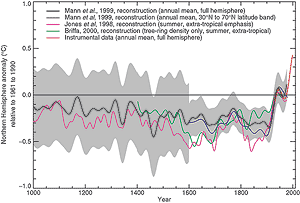
The 5th report by the International Panel for Climate Change (IPCC) was released this weekend. The IPCC brings together hundreds of scientists in the field of climate change to cooperate in drawing up a comprehensive analysis of the state of the earth’s climate and forecasts about its future.  The IPCC report raised its estimate of the probability that human activities, led by the burning of fossil fuels, are the main cause of global warming since the mid-20th century to “extremely likely”, or at least 95 percent, from “very likely” (90 percent) in its previous report in 2007 and “likely” (66 percent) in 2001.

The IPCC said that short periods are influenced by natural variability and do not, in general, reflect long-term climate trends.  So the argument of those whom deny global warming is man-made or is not getting worse cannot rely on the recent slowing of the rise in average atmospheric temperatures in the last 15 years.  The IPCC went on to say that temperatures were likely to rise by between 0.3 and 4.8 degrees Celsius (0.5 to 8.6 Fahrenheit) by the late 21st century.  Sea levels are likely to rise by between 26 and 82 cm (10 to 32 inches) by the late 21st century, after a 19 cm rise in the 19th century.   In the worst case, seas could be 98 cm higher in the year 2100.

The IPCC estimates that a doubling of carbon dioxide concentrations in the atmosphere would lead to a warming of between 1.5 and 4.5 degrees Celsius (2.7 and 8.1F), lowering the bottom of the range from 2.0 degrees (3.6F) estimated in 2007 report. The new range, however, is the same as in other IPCC reports before 2007.  It said the earth was set for more heatwaves, floods, droughts and rising sea levels from melting ice sheets that could swamp coasts and low-lying islands as greenhouse gases built up in the atmosphere.

The IPCC admitted that it was still unclear about the causes for the slowdown in climate change in the past 15 years, but insisted that the long-term trends were beyond doubt and that a decade and a half was far too short a period in which to draw any firm conclusions. The temperature rise has slowed from 0.12C per decade since 1951 to 0.05C per decade in the past 15 years – a point seized upon by climate skeptics to discredit climate science.  Professor Stocker said:

“People always pick 1998 but that was a very special year, because a strong El Niño made it unusually hot, and since then there have been a series of medium-sized volcanic eruptions that have cooled the climate.”

Explaining a recent slower pace of warming, the report said the past 15-year period was skewed by the fact that 1998 was an extremely warm year with an El Nino event – a warming of the ocean surface – in the Pacific.  It said warming had slowed “in roughly equal measure” because of random variations in the climate and the impact of factors such as volcanic eruptions when ash dims sunshine, and a cyclical decline in the sun’s output.

But the deniers of climate change and manmade global warming remain unconvinced. Professor Judith Curry of the Georgia Institute of Technology in Atlanta responded by saying that “Well, IPCC has thrown down the gauntlet – if the pause continues beyond 15 years (well it already has), they are toast.” But Rajendra Pachauri, chair of the IPCC, retorted that the reduction in warming would have to last far longer - “three or four decades” – to be a sign of a new trend.  And the IPCC report predicted that the reduction in warming would not last, saying temperatures from 2016-35 were likely to be 0.3-0.7 degree Celsius (0.5 to 1.3 Fahrenheit) warmer than in 1986-2005.

The Conflicts Between Ecology and Capitalism

By John Bellamy Foster - excerpt from Chapter 6 of The Vulnerable Planet - used by permission of the author

Four laws of ecology

In order to understand the ecological impact of these trends, it is useful to look at what Barry Commoner and others have referred to as the four informal laws of ecology:

Capital Blight: Reflections on the August 3rd, 2013 Protest in Richmond, California

By x344543 - August 11, 2013

Disclaimer: The views expressed here are not the official position of the IWW (or even the IWW’s EUC) and do not necessarily represent the views of anyone but the author’s.

On Saturday, August 3, 2013, I--along with approximately 3500 others--attended the Summer Heat: Together we Can Stop Climate Chaos rally, jointly organized by 350.org and a coalition of local environmental and social justice groups.

The coalescing of these forces reflected a confluence of several factors, including:

  • The struggle of a predominantly people of color community to wrangle some justice for the environmental and economic transgressions committed by the Chevron corporation, which has for all intents and purposes run Richmond like a company town (and this corporation's refinery--a piece of the once ubiquitous Standard Oil monopoly--actually existed before the town which we now call Richmond was established);
  • A massive explosion and fire that occurred at the refinery a year previously, which investigations later revealed was due to corroded pipes, which refinery workers complained about to management, but were allowed to let stand, lest the company's profits be lessened by so much as a penny;
  • Chevron's connection to the extraction of tar sands from Alberta and elsewhere which represent a form of "extreme energy" which endangers the environment, workers, and communities along the transport routes of this stuff (whether by train, truck, ship, or pipeline), and has already caused massive devastation and death in Kalamazoo, Minnesota; Lac Megantic, Quebec, and Mayflower, Arkansas, just to name a few places; and
  • The increasing realization that continued unabated use (and increased use) of fossil fuels (and for that matter, capitalism in general) has the human race on a collision course with doom, because (capitalist) human caused global warming--which has already progressed past the dangerous two degrees Celsius threshold that gives 350.org its name--will almost certainly condemn the human race, and quite likely all of the Earth, to a Venus like end, and must be stopped...yesterday.

Due to the participation of my fellow IWW Environmental Unionism Caucus members, Elliot and Ryan, an idea that they planted as a seed blossomed into a sizable labor contingent, composed of over thirty unions--including the Bay Area IWW General Membership Branch--that endorsed the rally and participated as an organized force in one way or another. The idea became so popular within the coalition organizing this particular campaign, that 350.org hired an organizer, Brooke Anderson, to make it happen--which she did to great effect. Ultimately 208 participants, including all three of us, my wife, 350.org spokesman Bill McKibben, ILWU Local 6 president Fred Pecker, and Richmond's mayor, Gayle McLauglin.

The event began with a meet-up at the Richmond BART station--the Bay Area's principal public transit system--an electric heavy rail network, whose union workers--represented by various ATU and SEIU Locals were embroiled in a nasty labor dispute with the agency's management and had (before the date of the rally) engaged in a one-week strike. Due to my efforts, and in no small part because I am a transit worker myself, a ferryboat deckhand at another one of the Bay Area's public transit systems, I suggested to Anderson that she make overtures to the BART workers as workers who work as part of the solution to capitalist fossil-fuel driven climate change; she agreed. At the other end of the equation, as a member of the rank and file opposition caucus, Transport Workers Solidarity Committee, to which several rank and file members from the various BART unions have since joined, I pushed for the committee to reciprocate; they did.

As one would expect, corporate media coverage of the event, while extensive, was overall mediocre to atrocious.

Green and Red in the Frame

By Ewan Kerr - Scottish Left Review #77, July & August 2013 (used by permission of the author).

“Outside party politics new social movements, including environmental, anti-cuts and feminist groups, have not come together sufficiently with the old, defensive organisations of the working class to produce the coalition that might make them an effective political force” (S Hall, The Guardian 2 April 2013)

As the above quote by Stuart Hall illustrates, contemporary social movements and progressive organisations face an on-going problem: they struggle to form effective and inter-movement forms of organisation and collective action. It is widely recognised now that the political left’s main failings are by in large a result of the often fragmented identities of different groups. This in itself should not be cause for concern, as left-wing political theory and action depends upon the mantra of unity in diversity. It can though prevent groups who share a natural affinity with each other from organising coalitions which are both effective and long term, while also limit the ability to develop strategies for deeper and more meaningful co-operation. Some explanation for such divisions I believe can be found through an examination of a well-established approach to coalition forming, that of framing. Framing, in essence, seeks to align values, ideology and activities in order to construct common viewpoints and form a stronger sense of collective identity.

Featured in the last issue of SLR was an excellent article by David Eyre, which offered a useful introduction to the idea of framing. The article provided a concise and tidy description and explanation of framing, although focused very much upon values on a national basis, and efforts to change people’s attitudes. This brief article seeks to build upon this, and offer an example drawn from labour-environmental coalition building. This will involve two distinct discourses which are used to frame such blue-green coalitions, that is the Jobs Vs. The Environment dilemma and Just Transition. Each illustrates that though the creation of frames groups can either be framed as having mutually exclusive or inclusive interests, which on one hand can act as a barrier to potentially prevent effective coalition work, or on the other facilitate co-operation though the creation of a discourse which appeals to the deep seated interests of both environmental organisations and organised labour groups. As Jakopovich (2009) states in his 2009 article Uniting to Win;

“The construction of shared experiences and common or complementary perceptions of interest… is at the heart of more successful and permanent coalition building.”

That past efforts towards co-operation between environmental and labour organisations have often been characterised by conflict and distrust is an unfortunate reality. On the face of it, it’s difficult to understand how two groups who subscribe to many of the same values have such acrimonious relations. Burgman’s (in 2013’s Trade Unions in the Green Economy) evaluation of this is lengthy, but worth quoting in full:

“Capitalist economies are characterised by the underuse of labour resources and overuse of environmental resources. Corporations tend to both reduce labour costs and to use the cheapest production methods possible, regardless of ecological consequence. Thus employment options are restricted at the same time as the planetary environment is degraded.”

18 Theses on Ecosocialism

By the collective - Conferences for Ecosocialism, February 2013

I. What is Ecosocialism?

1. A concrete and radical alternative.

Ecosocialism is not a utopia with which reality should comply. It is the reasoned human answer to the double impasse in which humanity is now locked because of the modes of production and consumption of our times which are exhausting human beings and the environment. This calls for radical thinking and political action, in the sense that we must go to the root causes. We are thus fighting the two driving forces of the current system: capitalism and productivism. Capitalism imposes the commodification of everything for new sources of profit. It is therefore responsible for widening the gap in social inequality and for the ongoing globalization, liberal and destructive of liberty. Social and environmental dumping prevail, with the relocation of pollution and damage to ecosystems. Productivism (seeking ever greater production) depletes natural resources and disrupts the climate. The consumerist ideology is its corollary. It raises material accumulation to the rank of a law, with big publicity stunts to generate needs which can never be satisfied. We point at the real culprits of that system: the global financial oligarchy, governments subjected to multinational lobbies without democratic control, ideologists of “free and undistorted” competition, green capitalism and free trade. On the other side, ecosocialism is an alternative to overcome the crisis and pose human interest as a priority: sharing wealth without delay, founding a new economy based on real needs and the moderation of consumption, preserving the climate, the ecosystem and its biodiversity.

Tragedy of the Commons Versus Common Ownership

By A Johnston - Socialism or Your Money Back, May 3, 2011

In 1968 an American biologist Garrett Hardin invented a parable to explain why, in his view, common ownership was no solution to the environmental crisis and why in fact it would make matters worse. This was sweet music to the defenders of capitalist ownership of the means of producing wealth, and Hardin’s parable was soon incorporated into the arsenal of anti-socialist arguments.

Called "The tragedy of the commons", his parable went like this: Picture a pasture open to all, assume its a pasture to which all herdsmen have free access to graze their cattle. In these circumstances, it is to be expected that each herdsman will try to keep as many cattle as possible on the commons. Such an arrangement may work reasonably satisfactorily for centuries because tribal wars, poaching and disease keep the numbers of both man and beast well below the carrying capacity of the land. Finally, however, comes the day of reckoning, that is, the day when the long desired goal of social stability becomes a reality At this point, the inherent logic of the commons remorselessly generates tragedy.

As a rational being, each herdsman seeks to maximise his gain. Explicitly or implicitly, more or less consciously, he asks "What is the utility to me of adding one more animal to my herd?" This utility has one negative and one positive component.

  • 1. The positive component is a function of the increment of one animal. Since the herdsman receives all the proceeds from the sale of the additional animal, the positive utility is nearly +1.
  • 2. The negative component is a function of the additional overgrazing created by one more animal. Since, however, the effects of overgrazing are shared by all the herdsmen, the negative utility for any particular decision-making herdsman is only a fraction of -1.

Adding together the component partial utilities, the rational herdsman concludes that the only sensible course for him to pursue is to add another animal to his herd. And another; and another… But this is the conclusion reached by each and every rational herdsman sharing a commons. Therein is the tragedy. Each man is locked into a system that compels him to increase his herd without limit—in a world that is limited. In the end, its carrying capacity would be exceeded, resulting in environmental degradation. Ruin is the destination towards which all men rush, each pursuing his own best interest in a society that believes in the freedom of the commons. Freedom in the commons bring ruin to all.

Hardin's solution to this tragedy of the commons is "mutual coercion". An appeal to conscience, he argues, is altogether futile. Mutual coercion can be effected through, as it were, enclosing the commons and instituting a system of private property which will enforce a sense of responsibility among herdsmen as to the appropriate number of cattle their land can provide for without resulting in overgrazing. Since they cannot encroach on land owned by other herdsmen, the consequences of keeping too many cattle will be exclusively borne by them. This knowledge will therefore deter them from acting irresponsibly in the first place. Governments drew from Hardin’s theorising was that in existing cases where producers had rights of access to a “common-pool resource” the solution was either to privatise the resource or to subject the producers to outside control via quotas, fines and other restrictions.

What Every Environmentalist Needs to Know About Capitalism

By Fred Magdoff and John Bellamy Foster - Monthly Review, March 2010

Disclaimer: The views expressed here are not the official position of the IWW (or even the IWW’s EUC) and do not necessarily represent the views of anyone but the author’s.

For those concerned with the fate of the earth, the time has come to face facts: not simply the dire reality of climate change but also the pressing need for social-system change. The failure to arrive at a world climate agreement in Copenhagen in December 2009 was not simply an abdication of world leadership, as is often suggested, but had deeper roots in the inability of the capitalist system to address the accelerating threat to life on the planet. Knowledge of the nature and limits of capitalism, and the means of transcending it, has therefore become a matter of survival. In the words of Fidel Castro in December 2009: “Until very recently, the discussion [on the future of world society] revolved around the kind of society we would have. Today, the discussion centers on whether human society will survive.”1

I. The Planetary Ecological Crisis

There is abundant evidence that humans have caused environmental damage for millennia. Problems with deforestation, soil erosion, and salinization of irrigated soils go back to antiquity. Plato wrote in Critias:

What proof then can we offer that it [the land in the vicinity of Athens] is…now a mere remnant of what it once was?…You are left (as with little islands) with something rather like the skeleton of a body wasted by disease; the rich, soft soil has all run away leaving the land nothing but skin and bone. But in those days the damage had not taken place, the hills had high crests, the rocky plane of Phelleus was covered with rich soil, and the mountains were covered by thick woods, of which there are some traces today. For some mountains which today will only support bees produced not so long ago trees which when cut provided roof beams for huge buildings whose roofs are still standing. And there were a lot of tall cultivated trees which bore unlimited quantities of fodder for beasts. The soil benefitted from an annual rainfall which did not run to waste off the bare earth as it does today, but was absorbed in large quantities and stored in retentive layers of clay, so that what was drunk down by the higher regions flowed downwards into the valleys and appeared everywhere in a multitude of rivers and springs. And the shrines which still survive at these former springs are proof of the truth of our present account of the country.2

What is different in our current era is that there are many more of us inhabiting more of the earth, we have technologies that can do much greater damage and do it more quickly, and we have an economic system that knows no bounds. The damage being done is so widespread that it not only degrades local and regional ecologies, but also affects the planetary environment.

Pages

The Fine Print I:

Disclaimer: The views expressed on this site are not the official position of the IWW (or even the IWW’s EUC) unless otherwise indicated and do not necessarily represent the views of anyone but the author’s, nor should it be assumed that any of these authors automatically support the IWW or endorse any of its positions.

Further: the inclusion of a link on our site (other than the link to the main IWW site) does not imply endorsement by or an alliance with the IWW. These sites have been chosen by our members due to their perceived relevance to the IWW EUC and are included here for informational purposes only. If you have any suggestions or comments on any of the links included (or not included) above, please contact us.

The Fine Print II:

Fair Use Notice: The material on this site is provided for educational and informational purposes. It may contain copyrighted material the use of which has not always been specifically authorized by the copyright owner. It is being made available in an effort to advance the understanding of scientific, environmental, economic, social justice and human rights issues etc.

It is believed that this constitutes a 'fair use' of any such copyrighted material as provided for in section 107 of the US Copyright Law. In accordance with Title 17 U.S.C. Section 107, the material on this site is distributed without profit to those who have an interest in using the included information for research and educational purposes. If you wish to use copyrighted material from this site for purposes of your own that go beyond 'fair use', you must obtain permission from the copyright owner. The information on this site does not constitute legal or technical advice.
