You are here

energy transition

Hoodwinked in the Hothouse

From the Introduction:

Desperate to avoid climate regulation that may affect profits, polluting corporations are working hand-in-hand with governments, presenting a dizzying array of false solutions that deepen inequalities in our societies. There is a clear agenda: Manage the climate crisis without compromising profits, the power structures or the economic system that got us here, even if that means exacerbating the problem. Wall Street financiers, the synthetic biology industry, “green” venture capitalists and a host of others are jumping on the “we care about the climate, too!” bandwagon.

These actors have reduced one of the clearest consequences of an unsustainable system into a mere technical problem that can be “efficiently” dealt with through market-based solutions. This market fundamentalism diverts attention away from the root causes of the problem, encouraging us to imagine a world with price tags on rivers, forests, biodiversity and communities’ territories, all in the name of “dealing with the climate crisis.” At the heart of all false solutions is an avoidance of the big picture: the root causes.

False solutions are constructed around the invisible scaffolding that maintains the dominant economic, cultural and political systems—the idea that economic growth is both desirable and inevitable; that progress means industrial development; that Western science and technology can solve any problem; that profits will motivate and the markets will innovate. Most of us in the Global North, whether sensitized to it or not, are participants and, at times, even take comfort in this world view. Sadly, many find it easier to imagine the end of the world than the end of a globalized economy built upon the unsteady legs of expanding empire, ecological erosion and exploitation of workers and communities.

We can take steps, large and small, to stop the climate crisis. What we cannot afford to do is go down the wrong road. Hoodwinked in the Hothouse is an easy and essential guide to navigating the landscape of false solutions—the cul-de-sacs on the route to a just and livable climate future.

--Gopal Dayaneni, Movement Generation: Justice and Ecology Project

PDF File

Replace Hazelwood Primer

By David Spratt - Climate Action Moreland, June 2015

Hazelwood Power Station (HPS) was built between 1964 and 1971, and comprises 1542 megawatt (MW) of capacity over eight generators. It was privatised by the Victorian Liberal Party Kennett government in 1996 for $2.35 billion.If HPS had stayed in public hands, it would likely have been decommissioned in 2005, but in 2004 the Bracks Labor government extended its operations till 2031, allowing Hazelwood to move a road and a river to access 43 million tonnes of brown coal deposits in a realignment of the mining licence boundaries. The owners have a 30-year mining licence due for renewal in 2026.HPS and the land on which it operates are owned by the Hazelwood Power Partnership. Since 7 June 2013, the four partners have been subsidiaries of International Power (Australia) Holdings Pty Ltd. This company is in turn jointly owned by subsidiaries of Engie (formerly GDF Suez SA) (72 per cent ownership) and Mitsui & Co Ltd (28 per cent ownership). Engie is a global energy company with corporate headquarters in France. Mitsui & Co Ltd is a global trading company with corporate headquarters in Japan.Currently HPS produces more than 10,000 gigawatt hours (GWh) of energy annually and is supplied with up to 18 million tonnes of coal each year from the adjacent Hazelwood mine, releasing around 16 million tonnes of greenhouse gases annually. Today HPS provides approximately 21 per cent of Victoria’s baseline electricity supply.

The Victorian Government has expressed a desire (though it does not yet have a policy) for a significant expansion of renewable energy in Victoria. This has widespread community support and must be done quickly and at a large scale because climate change is already dangerous. Scientists warn that two degrees Celsius of warming could occur in just two decades, so preserving a safe climate and a healthy future requires rapid de-carbonisation.

Expanding renewable energy requires coal-generating capacity to be removed from the market because oversupply is crowding out and preventing new investment. The Australian energy market operator says there are about eight gigawatts of surplus generating capacity across the national market, equivalent to five Hazelwood power stations. This includes up to 2.2 gigawatts of brown coal generation that is no longer required in Victoria in 2015, which is greater than Hazelwood’s capacity. Power companies have been lobbying government for capacity to be reduced, and senior Victorian energy department bureaucrats are aware of the need to close coal power stations in order to roll out renewables.

The Victorian Government has committed to being a leader on climate change. Closing down excess coal generation is a key test of the government’s climate credentials. Coal-fired power stations are the world’s largest source of planet-warming carbon dioxide emissions. Victoria cannot make the necessary emissions reductions without addressing the operations of Hazelwood and/or Yallourn power stations.

Hazelwood power station is old, unsafe and dirty. Based on emissions intensity, it is the third-dirtiest coal power station in the world and the dirtiest in Australia, releasing around 16 million tonnes of greenhouse gases annually, almost three per cent of total Australian greenhouse emissions. The Hazelwood majority owner, Engie (formerly GDF Suez), owns the third-most polluting coal-power station fleet in the world. The full – health and carbon pollution – social costs of Hazelwood totalling $900 million per year are borne by the community, rather than the plant’s owners.

A steady stream of local jobs can be created in the Latrobe Valley with the rehabilitation of mines and decommissioning of plant, which will require a significant workforce stretching well over a decade. The Latrobe Valley needs a strong jobs package and an economic transition plan and new industries because the move from coal to clean wind and solar renewable energy is now both urgent and inevitable.

Hazelwood power station and mine are a health hazard to local residents, exemplified by the autumn 2014 mine fire. The owners of Hazelwood have abused their social licence and forfeited the right to profit from a power station that is now a major health hazard – both to local people and to all peoples who face the uncertainties of living in a hotter and more extreme climate.

In July 2010, the Victorian Labor government promised to start shutting Hazelwood and passed climate legislation providing the reserve power to regulate emissions from existing brown coal-fired generators. Restoring the government’s capacity to regulate emissions would be complementary to actions being taken by other governments, including in the United States and Europe.

Read the report (PDF).

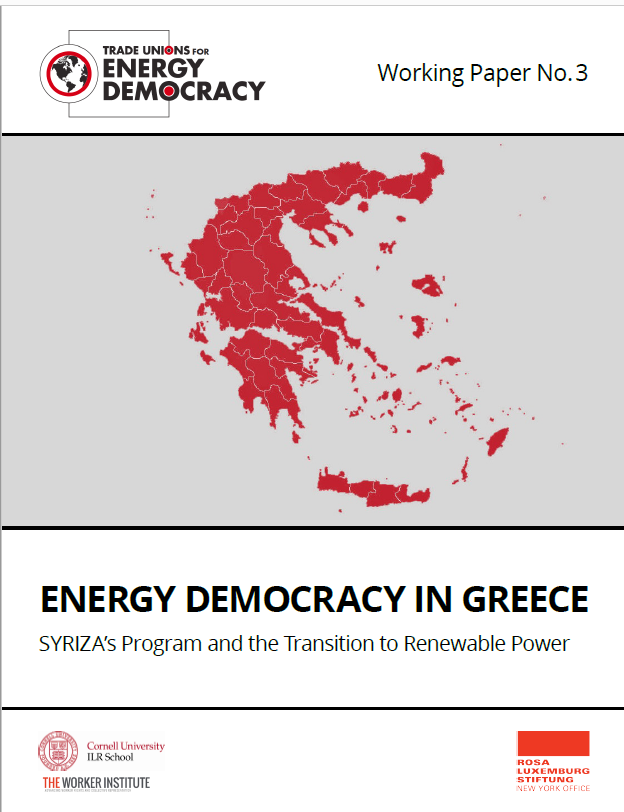
(Working Paper #3) Energy Democracy in Greece: SYRIZA’s Program and the Transition to Renewable Power

By Sean Sweeney - Trade Unions For Energy Democracy, February 4, 2015

Since the financial crisis of 2008 and the subsequent “Great Recession,” governments have mostly scaled back or deemphasized their climate protection and “green” commitments. Lack of public funds and concerns about growth, competitiveness, and unemployment are frequently cited as explanations for this apparent loss of both ambition and urgency. The “green growth” narrative that colored various countercyclical “stimulus” spending packages from 2009-10 has been largely abandoned.

This has in turn slowed the deployment of renewable energy and thrown the UN climate negotiations into paralysis. During the recent talks in Lima (COP 20) it became clear that a global climate agreement seems very unlikely to emerge from the “deadline COP” in Paris in late 2015.

The goal of this paper is to show how economic crisis and austerity, which today serves as the perfect cover for inaction and reversals on climate protection and ecological sustainability, could actually spur a radical departure from the slow and stuttering progress of the recent past. The paper looks at the opportunities for such a departure in Greece, a country mired in debt, high unemployment, and on the receiving end of a full-blown austerity program. But Greece is also a country where the radical Left could soon be in power led by a party, SYRIZA, that’s committed to nothing less than the “ecological transformation of the economy.”

But how can such a transformation be carried out? How can a country like Greece—facing enormous challenges—be an ecological leader and perhaps an exemplar for a new course? Can a SYRIZA or SYRIZA-led government break new ground in terms of fusing a viable leftgreen project in the face of crushing odds?

Download (PDF).

Europe's energy transformation in the austerity trap

By Béla Galgóczi - European Trade Union Institute, 2015

Our planetary limits demand a radical transition from the energy-intensive economic model based on the extraction of finite resources, which has been dominant since the first industrial revolution, to a model that is both sustainable and equitable.

Unfortunately however, energy transformation in Europe has, after a promising start, fallen hostage to austerity and to the main philosophy underpinning the crisis management policies in which overall competitiveness is reduced to the much narrower concept of cost-competitiveness. Regulatory uncertainty, design failures built into incentive systems, and unjust distribution of the costs, have also contributed to the reversal of progress in energy transformation currently observable across Europe.

In this book three country case studies highlight the different facets of these conflicts, while additional light is thrown on the situation by an account of the lack of progress in achieving energy efficiency.

By way of conclusion, a mapping of the main conflicts and obstacles to progress will be of help in formulating policy recommendations. Ambitious climate and energy policy targets should be regarded not as a burden on the economy but rather as investment targets able to pave the way to higher employment and sustainable growth. It is high time for this perception to be recognised and implemented in the context of Europe’s new Investment Plan, thereby enabling clean energy investment to come to form its central pillar. A shift in this direction will require an overhaul of the regulatory and incentive systems to ensure that the need for just burden-sharing is adequately taken into account.

Read the report (Link).

Star Power: The Growing Role of Solar Energy, in America

By Judee Burr and Lindsey Hallock, Frontier Group and Rob Sargent, Environment America Research & Policy Center, Environment America - Publication, November 2014

America could meet its energy needs by capturing just a sliver of the virtually limit-less and pollution-free energy that strikes the nation every day in the form of sunlight. With solar installation costs falling, the efficiency of solar cells rising, and the threats of air pollution and global warming ever-looming, solar power is becoming a more attractive and widespread source of energy everyday.

Solar energy is on the rise across the country.The amount of solar photovoltaic (PV) capacity in the United States has tripled in the past two years. More than half of all new U.S. electricity generating capac-ity came from solar installations in the first half of 2014, and the United States now has enough solar electric capacity installed to power more than 3.2 million homes.

Read the report (Link).

Low carbon jobs: The evidence for net job creation from policy support for energy efficiency and renewable energy

By Will Blyth, Rob Gross, Jamie Speirs, Steve Sorrell, Jack Nicholls, Alex Dorgan, and Nick Hughes - UK Energy Research Center, November 2014

‘Green’ sectors account for as many as 3.4 million jobs in the EU, or 1.7% of all paid employment, more than car manufacturing or pharmaceuticals. Given the size of the green jobs market, and the expectation of rapid change and growth, there is a pressing need to independently analyse labour market dynamics and skills requirements in these sectors. What is more controversial is the question of whether policy driven expansion of specific green sectors actually creates jobs, particularly when the policies in question require subsidies that are paid for through bills or taxes. There are strong views on both sides of this debate. Politicians often cite employment benefits as part of the justification for investing in clean energy projects such as renewables and energy efficiency. Such claims are often backed up by project or sector-specific analyses. However, other literature is more sceptical, claiming that any intervention that raises costs in the energy sector will have an adverse impact on the economy as a whole.

The UKERC Technology and Policy Assessment (TPA) theme was set up to address such controversies through comprehensive assessment of the current evidence. This report aims to answer the following question:

“What is the evidence that policy support for investment in renewable energy and energy efficiency leads to net job creation in the implementing regions?”

The focus on net jobs here is important: whilst it is clear that jobs can be created at a local scale by spending money on new infrastructure projects, other jobs may be displaced if the new project provides activities or services that would otherwise have been provided elsewhere in the economy. Analysis of net jobs therefore needs to take account of both jobs created and jobs displaced.

Read the report (PDF).

How the Walton Family is Threatening Our Clean Energy Future

By Stacy Mitchell - Institute for Local Self-Reliance, October 2014

Critical fights over the future of our energy system are underway in dozens of states, with far-reaching implications for both climate change and our economy. At issue is the recent, rapid expansion of rooftop solar, which is revolutionizing who owns and profits from electricity generation. Rather than power production being monopolized by utilities, more and more households are becoming energy producers themselves. This transition is saving families money and driving the creation of tens of thousands of well-paying jobs.

But rooftop solar threatens the profits of utilities and the companies that supply them with energy. These powerful interests have gone on the offensive and are campaigning to weaken policies that enable rooftop solar in multiple states. They have begun to score wins, including a pivotal victory in Arizona, where regulators granted the state’s largest utility, APS, the right to impose new fees on households with rooftop solar. The fees have undermined the economics of rooftop solar, dramatically slowing installations and causing widespread job losses.

Read the report (PDF).

The Effect of Natural Gas Supply on US Renewable Energy and CO2 Emissions

By Christine Shearer, et. al. - Environmental Research Letters, September 9, 2014

Increased use of natural gas has been promoted as a means of decarbonizing the US power sector, because of superior generator efficiency and lower CO2 emissions per unit of electricity than coal. We model the effect of different gas supplies on the US power sector and greenhouse gas (GHG) emissions. Across a range of climate policies, we find that abundant natural gas decreases use of both coal and renewable energy technologies in the future. Without a climate policy, overall electricity use also increases as the gas supply increases. With reduced deployment of lower-carbon renewable energies and increased electricity consumption, the effect of higher gas supplies on GHG emissions is small: cumulative emissions 2013–55 in our high gas supply scenario are 2% less than in our low gas supply scenario, when there are no new climate policies and a methane leakage rate of 1.5% is assumed. Assuming leakage rates of 0 or 3% does not substantially alter this finding. In our results, only climate policies bring about a significant reduction in future CO2 emissions within the US electricity sector. Our results suggest that without strong limits on GHG emissions or policies that explicitly encourage renewable electricity, abundant natural gas may actually slow the process of decarbonization, primarily by delaying deployment of renewable energy technologies.

Read the report (PDF).

Integrated life-cycle assessment of electricity-supply scenarios confirms global environmental benefit of low-carbon technologies

By Edgar G. Hertwich, et. al. - National Academy of Sciences of the United States, September 3, 2014

Decarbonization of electricity generation can support climate-change mitigation and presents an opportunity to address pollution resulting from fossil-fuel combustion. Generally, renewable technologies require higher initial investments in infrastructure than fossil-based power systems. To assess the trade offs of increased up-front emissions and reduced operational emissions, we present, to our knowledge, the first global, integrated life-cycle assessment (LCA) of long-term, wide-scale implementation of electricity generation from renewable sources (i.e., photovoltaic and solar thermal, wind, and hydropower) and of carbon dioxide capture and storage for fossil power generation. We compare emissions causing particulate matter exposure, freshwater eco-toxicity, freshwater eutrophication, and climate change for the climate-change-mitigation (BLUE Map) and business-as-usual (Baseline) scenarios of the International Energy Agency up to 2050. We use a vintage stock model to conduct an LCA of newly installed capacity year-by-year for each region, thus accounting for changes in the energy mix used to manufacture future power plants. Under the Baseline scenario, emissions of air and water pollutants more than double whereas the low-carbon technologies introduced in the BLUE Map scenario allow a doubling of electricity supply while stabilizing or even reducing pollution. Material requirements per unit generation for low-carbon technologies can be higher than for conventional fossil generation: 11–40 times more copper for photovoltaic systems and 6–14 times more iron for wind power plants. However, only two years of current global copper and one year of iron production will suffice to build a low-carbon energy system capable of supplying the world’s electricity needs in 2050.

Read the report (PDF).

(Working Paper #2) Climate Change and the Great Inaction: New Trade Union Perspectives

By Sean Sweeney - Trade Unions For Energy Democracy, September 2014

This paper has been written for unions and unionists who are perhaps in the early stages of their engagement with climate change and who feel they might benefit from knowing “the story so far” in terms of trade union involvement.

But it is also being written with an eye to the future, to generate discussion that may help unions develop the kind of compelling ideas and proposals that can lead to an increase in membership engagement and climate activism. A global movement demanding immediate and effective action on climate change is urgently needed, and unions can play an important and potentially decisive role. However, part of the process of building such a movement will require taking stock, in broad terms, of what has been learned with regard to past efforts both practically and at the level of ideas and core theoretical assumptions.

This paper focuses mainly on the UN level, where the level of union activity has been very significant and worthy of examination. It will be clear from what follows that the climate politics of the international trade union movement has reached an impasse–the same is also true of other movements who have fought for a global climate agreement and have seen their hopes shattered. But this is more than a problem of barking up the wrong tree, or of the wrong set of persons sitting in the seats of power at the wrong time. The “green economy” framework that has informed trade union policy on climate change and sustainability has also reached a political dead end. This is obvious at the UN level and increasingly obvious at the level of the nation state, one or two exceptions notwithstanding. Once regarded as inevitable, the green economic transition as imagined by the more far—sighted wing of the political and corporate establishment now borders on the impossible.

In following how unions have engaged the UN’s climate process, it is also possible to observe and reflect on how the trade union discussion has shifted from the days of the “triumph of the market” neoliberal globalist moment in the early 1990s to the present time, when the impacts of the Great Recession (and the need for jobs) are still all too evident in many parts of the world. In the early 1990s neoliberal capitalism was wiping the floor with unions. Unions of course remain under attack and very much on the defensive. But, in common with other social movements, unions have in recent years begun to engage in a deeper questioning of the political economy of capitalism from both a climate and environmental standpoint and from a socioeconomic perspective. Can politics significantly alter the systemic and profoundly unsustainable features of capitalism, particularly unlimited growth, accumulation, and consumption? In the light of the world leaders’ “great inaction” on climate change, this has to be the key question that lies at the heart of the trade union debate in the period ahead.

Download (PDF).

Pages

The Fine Print I:

Disclaimer: The views expressed on this site are not the official position of the IWW (or even the IWW’s EUC) unless otherwise indicated and do not necessarily represent the views of anyone but the author’s, nor should it be assumed that any of these authors automatically support the IWW or endorse any of its positions.

Further: the inclusion of a link on our site (other than the link to the main IWW site) does not imply endorsement by or an alliance with the IWW. These sites have been chosen by our members due to their perceived relevance to the IWW EUC and are included here for informational purposes only. If you have any suggestions or comments on any of the links included (or not included) above, please contact us.

The Fine Print II:

Fair Use Notice: The material on this site is provided for educational and informational purposes. It may contain copyrighted material the use of which has not always been specifically authorized by the copyright owner. It is being made available in an effort to advance the understanding of scientific, environmental, economic, social justice and human rights issues etc.

It is believed that this constitutes a 'fair use' of any such copyrighted material as provided for in section 107 of the US Copyright Law. In accordance with Title 17 U.S.C. Section 107, the material on this site is distributed without profit to those who have an interest in using the included information for research and educational purposes. If you wish to use copyrighted material from this site for purposes of your own that go beyond 'fair use', you must obtain permission from the copyright owner. The information on this site does not constitute legal or technical advice.