

You are here

energy transition

From Banks and Tanks: A Strategic Framework for a Just Transition

By MG Collective - Movement Generation Justice and Ecology Project, January 2017

Just Transition is a framework for a fair shift to an economy that is eco-logically sustainable, equitable and just for all its members. After centuries of global plunder, the profit-driven, growth-dependent, industrial economy is severely under-mining the life support systems of the planet. An economy based on extracting from a finite system faster than the capacity of the system to regenerate will eventually come to an end—either through collapse or through our intentional re-organization. Transition is inevitable. Justice is not.
Just Transition strategies were first forged by labor unions and environmental justice groups who saw the need to phase out the industries that were harming workers, community health and the planet, while also providing just pathways for workers into new livelihoods. This original concept of Just Transition was rooted in building alliances between workers in polluting industries and fence-line and frontline communities. Building on that history, Just Transition to us represents a set of aligned strategies to transition whole communities toward thriving economies that provide dignified, productive and ecologically sustainable livelihoods that are governed directly by workers and communities.

A Just Transition requires us to build a visionary economy for life in a way that is very different than the economy we are in now. Constructing a visionary economy for life calls for strategies that

democratize, decentralize and diversify economic activity while we damper down consumption, and (re)distribute resources and power. Just Transition initiatives shift the economy from dirty energy to energy democracy, from funding highways to expanding public transit, from incinerators and landfills to zero waste, from industrial food systems to food sovereignty, from gentrification to community land rights, and from rampant destructive development to ecosystem restoration. Core to a Just Transition is deep democracy in which workers and communities have control over the decisions that affect their daily lives.

Read the report (English PDF) | (Spanish PDF).

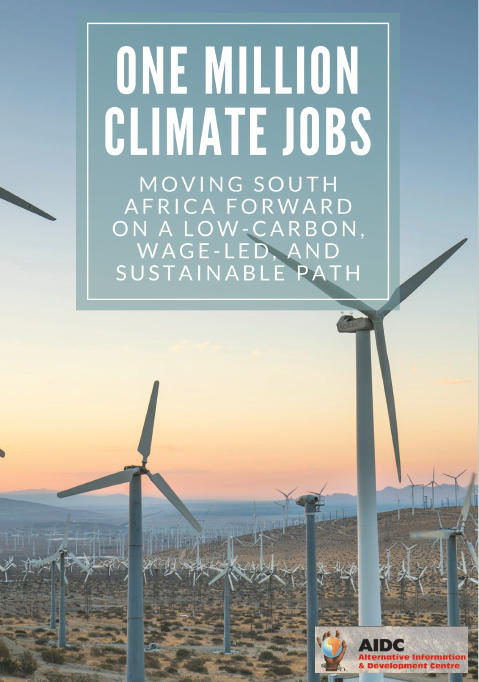
One Million Climate Jobs: Moving South Africa Forward on a Low-Carbon, Wage-Led, and Sustainable Path

By Brian Ashley, et. al. - One Million Climate Jobs - December 2016

The One Million Climate Jobs Campaign is an alliance of labour, social movements and popular organisations in South Africa that is campaigning for the creation of a million climate jobs as part of a collective approach to the crisis of unemployment and climate change. The Campaign was launched in 2011 and since then has been mobilising thousands of South Africans around real solutions to slowing down climate change, protecting the natural environment, improving the quality of life for all and moving towards a sustainable development path. Climate change will exacerbate inequality and poverty because it reduces access to food, water, energy and housing. Thus it is vital that social justice struggles around these issues incorporate struggles around climate change.

This booklet is a follow-up, six years later, to the first booklet that was produced in 2011. It is based on well- researched solutions for how South Africa can immediately begin a just transition, away from the Minerals-Energy Complex that continues to dominate the South African capitalist economy, to a low carbon economy in which the basic needs of communities are met in an equitable, sustainable and affordable way.

It recognizes that in these six years there have been many developments – for instance, renewable energy is now firmly established as part of the energy mix (although still a minor part); retrofitting buildings, and the development of environmentally friendly construction methods, is being developed, and the Rapid Bus Transit system is being slowly implemented in some municipalities.

But most of these solutions are being pursued within the logic of the market. It is not possible, we would argue, within these market parameters, to respond adequately to the enormous challenges facing us – what is needed is a publicly-driven solution for the shift to a sustainable, low-carbon future. The research that this booklet is based on begins to set out what such a transition could look like. We hope that it will be an important contribution to the ongoing work of building a political movement to struggle around these issues.

Download (PDF).

Reclaiming Alberta’s Future Today

By Regan Boychuk and Brent O’Neil - Reclaiming Alberta’s Future Today, November 3, 2016

As the first step towards reducing Alberta’s dependence on fossil fuels as our primary source of income we must embrace our current environmental deficit. We must admit that climate change is real and that man-made contributions to global warming can be reduced.

After 100 years of exploration we must acknowledge that our provinces conventional oil and gas resources have been depleted. Technically speaking our low hanging fruit has been plucked and what is left is 444,000 oil and gas wells, 430,000 km of pipe lines (the distance to the moon is 384,000 km), 30,000 oil and gas facilities, 900 km of oil sands development, 220 km of tailing ponds, and a 11.2 million ton sulfur pile that dwarfs the great pyramids of Egypt.

Tackling this shameful legacy will be the biggest environmental cleanup project undertaken to date. It will take 1000 rigs 50 years and every willing Canadian to clean up our mess. This change in industry requires a paradigm shift in thinking. Our province no longer see the economic benefit from drilling new conventional oil wells as it once did. The real opportunity for Albertans will come from cleaning up our mess.

No longer can we tackle climate change with taxes and levy’s. We need to start making a real reduction in man-made emissions so our future generations have the same opportunities we once did.

Read the report (PDF).

Job Growth in Clean Energy: Employment in Alberta’s emerging renewables and energy efficiency sectors

By Binnu Jeyakumar - Pembina Institute, November 2016

Alberta has a meaningful plan to enable the growth of a clean energy industry, with commitment to 30% of electricity generated by renewable sources by 2030, and phasing out pollution from coal-fired generation. A portion of the anticipated revenues from the province’s economy-wide carbon levy will be used to enable these efforts. This provides a great opportunity for sustainable employment growth in the clean energy sector. This is in line with the global trends of declining investment and employment in the coal industry, while investment and employment in the renewable sector expands.

The Pembina Institute has conducted an analysis of the employment potential in the renewable energy and energy efficiency sectors in Alberta. Data was collected through literature reviews and from organizations involved in development of projects. The analysis used conservative estimates where there was uncertainty. The results are nevertheless encouraging and paint a positive picture for Albertans.

  • In Alberta, investing in renewable sources of electricity and energy efficiencyalone would generate more jobs than those lost through the retirement of coalpower ( Figure 1).
  • With a high and sustained pace of renewables growth, there are sustained levelsof employment for those engaged in related equipment installations.
  • Additional investment in community energy can increase the employmentpotential by 30-50%.
  • Long-term investments in modernizing infrastructure, the grid and ourelectricity system will result in further job creation with a wide diversity of skills,and in fields that are likely to see sustained growth.

Read the report (Link).

Sharing the challenges and opportunities of a clean energy economy: Policy discussion paper A Just Transition for coal-fired electricity sector workers and communities

By staff - Australian Council of Trade Unions - November 2016

The ACTU is primarily concerned with workers, their rights, their welfare and their future. A just and civil society is one where everyone shares in the wealth of the nation but it is also one where economic costs are equally shared.

Transitioning an industry is a massive economic and social disruption. History shows that this has often been done poorly in Australia, with workers and communities bearing the brunt of such transitions - suffering hardship, unemployment and generations of economic and social depression.

Research in the textiles, clothing and footwear (TCF) and car manufacturing industries shows, for example, that only one third of workers find equivalent full time work following their retrenchment, while one third move into lower quality jobs (lower wage, lower job status or into part-time and casual work) and one third are locked out of the labour force altogether.

International experience however shows that a transition can be done equitably, achieve positive outcomes for workers, save communities and forge new areas of industrial growth and prosperity.

Australia is currently facing one such transition in the coal-fired electricity sector. If Australia manages this transition well, the nation would have a structured and equitable approach that could apply to any industry undergoing similar change in the future.

At last year’s Paris climate conference, Australia alongside 194 countries, committed to limit global warming to less than 2°C above pre-industrial levels. As part of this historic agreement, unions successfully achieved recognition of the need for a ‘Just Transition’ that supports the most affected workers obtain new decent and secure jobs in a clean energy economy.

While Australia’s international obligations will require a range of complementary policies that focus on emission reduction across a number of sectors of the economy, as the largest contributor to Australia’s emissions, effective reform of the electricity sector has been identified as a key step in tackling climate change.

Download (PDF).

An Energy Revolution is possible: Tax havens and financing climate action

By Patrick Hearps and Sam Cossar-Gilbert - Friends of the Earth, September 2016

This report is the technical report that supports Friend of the Earth International’s summary report with recommendations and general analysis, also entitled ‘An energy revolution is possible’.

The aim of this analysis is purely to calculate an investment cost of providing several regions of the developing world with 100% renewable electricity, and to compare those amounts with government revenue lost through tax havens globally, in order to highlight the need for economic and climate justice.

Read the report (PDF).

The Sky’s Limit: Why the Paris Climate Goals Require a Managed Decline of Fossil Fuel Production

By Greg Muttitt, et. al. - Oil Change International, et. al., September 2016

In December 2015, world governments agreed to limit global average temperature rise to well below 2°C, and to strive to limit it to 1.5°C. This report examines, for the first time, the implications of these climate boundaries for energy production and use. Our key findings are:

  • The potential carbon emissions from the oil, gas, and coal in the world’s currently operating fields and mines would take us beyond 2°C of warming
  • The reserves in currently operating oil and gas fields alone, even with no coal, would take the world beyond 1.5°C
  • With the necessary decline in production over the coming decades to meet climate goals, clean energy can be scaled up at a corresponding pace, expanding the total number of energy jobs.

One of the most powerful climate policy levers is also the simplest: stop digging for more fossil fuels. We therefore recommend:

  • No new fossil fuel extraction or transportation infrastructure should be built, and governments should grant no new permits for them
  • Some fields and mines –primarily in rich countries –should be closed before fully exploiting their resources, and financial support should be provided for non-carbon development in poorer countries
  • This does not mean stopping using all fossil fuels overnight. Governments and companies should conduct a managed decline of the fossil fuel industry and ensure a just transition for the workers and communities that depend on it.

In August 2015, just months before the Paris climate talks, President Anote Tong of the Pacific island nation of Kiribati called for an end to construction of new coal mines and coal mine expansions. This report expands his call to all fossil fuels.

Read the report (PDF).

Breathing in the benefits: How an accelerated coal phase-out can reduce health impacts and costs for Albertans

By Benjamin Israël, Kim Perrotta, Joe Vipond, Leigh Allard, and Vanessa Foran - Pembina Institute, September 2016

With the phase-out of coal power announced by the provincein November 2015, Albertans stand to avoid significant health impacts caused by coal pollution. By extension, afurtheraccelerated phase out of coal power facilities would both hastenand amplify those avoided health impacts.The health benefits and costs savings in avoided health outcomes would be significant, and should be consideredin the government’s planning of the coal phase-out from now to 2030.

While the provincial government has announced a coal phase-out, they have not yet released a transition schedule. This analysis assesses the relative benefits of an accelerated stepwise transition away from coal, as proposed by the Pembina Institute,versus the back-loaded phase-out that otheranalyses haveposited.

In 2012, when the federal government finalized its coal regulations that —in effect —reduce electricity generation from coal plants, Environment Canada(as it was called at that time)estimated considerable health impacts would be avoided, usinghighly regarded modelling techniques. Logically, thesesignificantbenefits from reducing coal necessarily mean that the use of coal for power generation causesconsiderablehealth impacts in the first place.

By extrapolating the health benefit results from Environment Canada’s analysis, this report highlights the full impact of coal-fired generation in Albertaand indicates attainable benefits associated with the province’s coal phase- out.When the federal government weakened its proposed coal regulations back in 2012 in response to lobbying from some coal generators, allowing coal plants to continue unabated longer than first proposed,it left health savings on the table. Alberta can now grasp these savings byaccelerating our transition away from coal-fired electricity.

Read the report (PDF).

Life After Coal: Pathways to a Just and Sustainable Transition for the Latrobe Valley

By Anne Martinelli, et. al. - Environment Victoria - September 2016

The Latrobe Valley has a proud history of supplying the electricity that powers Victoria. But coal-burning power stations are ageing and –responding to climate change – the world is moving rapidly to cleaner energy sources. In this shifting context, the Latrobe Valley faces inevitable change. The question is: how will that change be managed?

With recent news that Hazelwood power station may close as early as in April 2017, there is a narrow window of opportunity to ensure that the Latrobe Valley prospers during the transition to a cleaner economy, rather than suffers as it did during previous economic changes.

A ‘just transition’ is a framework for managing the shift towards such new economies, with a focus on inclusive participation for those affected and a fair distribution of the costs and benefits of change.

This report explores what a just, and well-managed, transition process for the Latrobe Valley might look like. As experience from around the world has shown, when industrial change does arrive it can come very quickly, and being unprepared is costly.

In South Wales, UK, where there was little transition planning prior to the 1980s coal-mine closures, the damaging economic and social consequences have been profound and long-lasting. By contrast, Rochester, New York, which started planning its transition two decades before the city’s main employer – Kodak – collapsed, the situation has been more positive.

The first closure of one of the four large coal-burning power stations in the Latrobe Valley could be as early as 2017, and the rest could quickly follow. Tangible action and funding to develop an alternative economic future is required now.

For the Latrobe Valley to successfully achieve a just transition, two equally important processes must occur: (1) an orderly and planned transition away from coal; and (2) a collaborative and inclusive transition towards a sustainable local economy.

Read the Report (Link).

Divestment Done! and Divestment To Do: the Norwegian Government Pension Fund and Coal

By Heffa Schücking - Urgewald, Future in our hands, and Greenpeace Norway, Summer 2016

(in 2015), the Norwegian Parliament took a historic decision to move the Government Pension Fund Global (GPFG) out of thermal coal. The Parliament determined that companies should be excluded if they “base 30% or more of their activities on coal, and/or derive 30% of their revenues from coal.”1Thiswas an important break-through as the 30% threshold established a new benchmark for divestment actions of large investors. Only months after the Norwegian decision, the world’s largest insurance company, Allianz, undertook a coal divestment action of its own based on the GPFG’s 30% threshold.2And other investors such as KLP and Storebrand, which had already undertaken divestment actions, have now tightened their thresholds to keep up with the trail blazed by the Norwegian Parliament.

This briefing provides a “snapshot” of how the world’s largest coal divestment action (was progressing by 2016). To this end, we have analyzed the GPFG’s holdings list from December 31st 2015 as well as the implementation guidelines laid out by Norway’s Finance Ministry. Although the divestment action is not due to be completed until the end of 2016, we wish to draw attention to some weaknesses that could diminish the scope and impact of the Storting’s decision if they are not addressed.

Read the text (PDF).

Pages

The Fine Print I:

Disclaimer: The views expressed on this site are not the official position of the IWW (or even the IWW’s EUC) unless otherwise indicated and do not necessarily represent the views of anyone but the author’s, nor should it be assumed that any of these authors automatically support the IWW or endorse any of its positions.

Further: the inclusion of a link on our site (other than the link to the main IWW site) does not imply endorsement by or an alliance with the IWW. These sites have been chosen by our members due to their perceived relevance to the IWW EUC and are included here for informational purposes only. If you have any suggestions or comments on any of the links included (or not included) above, please contact us.

The Fine Print II:

Fair Use Notice: The material on this site is provided for educational and informational purposes. It may contain copyrighted material the use of which has not always been specifically authorized by the copyright owner. It is being made available in an effort to advance the understanding of scientific, environmental, economic, social justice and human rights issues etc.

It is believed that this constitutes a 'fair use' of any such copyrighted material as provided for in section 107 of the US Copyright Law. In accordance with Title 17 U.S.C. Section 107, the material on this site is distributed without profit to those who have an interest in using the included information for research and educational purposes. If you wish to use copyrighted material from this site for purposes of your own that go beyond 'fair use', you must obtain permission from the copyright owner. The information on this site does not constitute legal or technical advice.
