You are here

energy transition

Energy Democracy: Taking Back Power

By Johanna Bozuwa - Next System Project, February 27, 2019

Executive summary

Electric utility (re)municipalization is gaining popularity as a strategy to shift away from a reliance on fossil fuel extraction in the context of combating climate change. Across the world—from Berlin to Boulder—communities have initiated campaigns to take back their power from investor-owned (private) utilities and create publicly owned and operated utilities. Moreover, such efforts are increasingly taking on the perspective and language of energy democracy.

Energy democracy seeks not only to solve climate change, but to also address entrenched systemic inequalities. It is a vision to restructure the energy future based on inclusive engagement, where genuine participation in democratic processes provides community control and renewable energy generates local, equitably distributed wealth (Angel, 2016; Giancatarino, 2013a; Yenneti & Day, 2015). By transitioning from a privately- to a publicly owned utility, proponents of energy democracy hope to democratize the decision-making process, eliminate the overriding goal of profit maximization, and quickly transition away from fossil fuels.

Utilities are traditionally profit-oriented corporations whose structures are based on a paradigm of extraction. Following the path of least resistance, they often burden communities who do not have the political or financial capital to object to the impacts of their fossil fuel infrastructure. Residents living within three miles of a coal plant, for instance, are more likely to earn a below-average annual income and be a person of color (Patterson et al., 2011); similar statistics have been recorded for natural gas infrastructure (Bienkowski, 2015).

These utilities are in a moment of existential crisis with the rise of renewables. From gas pipelines to coal power plants, their investments are turning into stranded assets, as political leaders and investors realize that eliminating fossil fuels from the energy mix is paramount to creating healthy communities and stemming climate change.

Unfortunately, often publicly owned utilities in the United States have similar energy generation profiles to their privately owned counterparts (American Public Power Association, 2015). This paper explores the extent to which publicly owned utilities are reticent to take on the new energy paradigm and evaluates their ability to provide energy democracy compared to investor-owned utilities.

The Sky's Limit: Why Denmark Must Phase Out North Sea Oil and Gas Extraction

By Bronwen Tucker, et. al. - Oil Change International, September 2019

Over the past thirty years, Denmark has positioned itself as a global climate leader through its policies to support wind power, district heating, and energy efficiency, amongst other actions.5Building on this, in June 2019, the newly elected Danish government committed to a new climate target of reducing emissions 70 percent below 1990 levels by 2030, surpassing its previous goal of 40 percent by 2020.

However, Denmark’s plans to expand North Sea oil and fossil gas extraction undermine this record of climate action. This is because the potential carbon emissions from the oil, gas, and coal in the world’s currently operatingfields and mines would already fully exhaust and exceed carbon budgets consistent with the Paris goals. Simply put, we cannot afford to bring new extraction online — in Denmark or anywhere else.

This report applies these stark global carbon budget limits to the outlook for oil and gas production in Denmark. We find that Denmark’s plans to allow new North Sea oil and gas projects in the 2020s and 2030s would undermine its aspirations of climate leadership. The carbon dioxide (CO2) emissions from burning Danish-produced oil and gas would be substantial, overtaking Denmark’s total expected domestic CO2 emissions from energy by mid-2025 (see Figure 1, with details on the domestic reduction curves in Section 1). In other words, if current plans to expand North Sea extraction are left unaddressed, Denmark will either (a) meet its domestic emissions targetsbut export oil and gas with associated emissions that overshadow this domestic progress, or (b) fail to meet its emissions targets and continue to consume more oil and gas domestically than is Paris-aligned.

Source: Oil Change International analysis based on data from Rystad UCube, Danish Energy Agency, and 92 Group.8There is a cumulative 665 million tonnes (Mt) of CO2 associated with Danish oil and gas between 2019 and 2050. Of these potential CO2 emissions, 401 Mt of CO2 would come from new projects yet to be developed that would peak between the mid-2020s and mid-2030s. This means over 60 percent of anticipated emissions related to Denmark’s oil and gas extraction in the coming decades are not yet committed — the projects they are associated with will either require new licenses from the Danish government or final investment decisions (and final government approval) to be developed.

Read the report (PDF).

Equitable Building Electrification: A Framework for Powering Resilient Communities

By Carmelita Miller, Stephanie Chen, Lisa Hu, and Isaac Sevier - Greenlining Institute, 2019

Building electrification is gaining traction as California’s most affordable and effective tool to reduce greenhouse gas emissions from homes and buildings—responsible for roughly a quarter of the state’s emissions—while improving air quality and helping the state meet its climate goals, including a net-zero carbon economy and 100 percent clean electricity by 2045.

While building electrification has promising benefits for residents and for the state, it must be pursued equitably— ensuring that environmental and social justice communities can benefit, rather than being left with polluting and increasingly expensive gas appliances. It will require intentional policymaking and a planned transition for environmental and social justice communities to gain access to the major benefits of electrification, including cleaner air, healthier homes, good jobs and empowered workers, and greater access to affordable clean energy and energy efficiency to reduce monthly energy bills.

This Equitable Building Electrification Framework explains the steps the state must take to ensure that electrification helps close the clean energy gap in California and provides relief to millions of residents facing energy insecurity in the current system.

Read the report (PDF).

A Vision for a Sustainable Battery Value Chain in 2030: Unlocking the Full Potential to Power Sustainable Development and Climate Change Mitigation

By staff - World Economic Forum, 2019

The need for urgent and more intensive actions against climate change is broadly recognized. In support of this agenda, this report presents a simple yet profound vision: a circular, responsible and just battery value chain is one of the major near- term drivers to realize the 2°C Paris Agreement goal in the transport and power sectors, setting course towards achieving the 1.5°C goal if complemented with other technologies and collaborative efforts.

With the right conditions in place, batteries are a systemic enabler of a major shift to bring transportation and power to greenhouse gas neutrality by coupling both sectors for the first time in history and transforming renewable energy from an alternative source to a reliable base. According to this report, batteries could enable 30% of the required reductions in carbon emissions in the transport and power sectors, provide access to electricity to 600 million people who currently have no access, and create 10 million safe and sustainable jobs around the world.

This report provides a quantified foundation for a vision about how batteries can contribute to sustainable development and climate change mitigation over the coming decade. The analysis underscores that this opportunity can only be achieved sustainably through a systemic approach across social, environmental and economic dimensions. It outlines key conditions and presents recommendations to realize this potential.

Read the report (Link).

Why Ecosocialism: For a Red-Green Future

By Michael Löwy - Great Transition Initiative, December 22, 2018

The capitalist system, driven at its core by the maximization of profit, regardless of social and ecological costs, is incompatible with a just and sustainable future. Ecosocialism offers a radical alternative that puts social and ecological well-being first. Attuned to the links between the exploitation of labor and the exploitation of the environment, ecosocialism stands against both reformist “market ecology” and “productivist socialism.” By embracing a new model of robustly democratic planning, society can take control of the means of production and its own destiny. Shorter work hours and a focus on authentic needs over consumerism can facilitate the elevation of “being” over “having,” and the achievement of a deeper sense of freedom for all. To realize this vision, however, environmentalists and socialists will need to recognize their common struggle and how that connects with the broader “movement of movements” seeking a Great Transition.

Introduction

Contemporary capitalist civilization is in crisis. The unlimited accumulation of capital, commodification of everything, ruthless exploitation of labor and nature, and attendant brutal competition undermine the bases of a sustainable future, thereby putting the very survival of the human species at risk. The deep, systemic threat we face demands a deep, systemic change: a Great Transition.

In synthesizing the basic tenets of ecology and the Marxist critique of political economy, ecosocialism offers a radical alternative to an unsustainable status quo. Rejecting a capitalist definition of “progress” based on market growth and quantitative expansion (which, as Marx shows, is a destructive progress), it advocates policies founded on non-monetary criteria, such as social needs, individual well-being, and ecological equilibrium. Ecosocialism puts forth a critique of both mainstream “market ecology,” which does not challenge the capitalist system, and “productivist socialism,” which ignores natural limits.

As people increasingly realize how the economic and ecological crises intertwine, ecosocialism has been gaining adherents. Ecosocialism, as a movement, is relatively new, but some of its basic arguments date back to the writings of Marx and Engels. Now, intellectuals and activists are recovering this legacy and seeking a radical restructuring of the economy according to the principles of democratic ecological planning, putting human and planetary needs first and foremost.

The “actually existing socialisms” of the twentieth century, with their often environmentally oblivious bureaucracies, do not offer an attractive model for today’s ecosocialists. Rather, we must chart a new path forward, one that links with the myriad movements around the globe that share the conviction that a better world is not only possible, but also necessary.

The Ruhr or Appalachia: Deciding the Future of Australia’s Coal Power Workers and Communities

By Peter Sheldon, Raja Junankar, and Anthony De Rosa Pontello - CFMMEU Mining and Energy, December 3, 2018
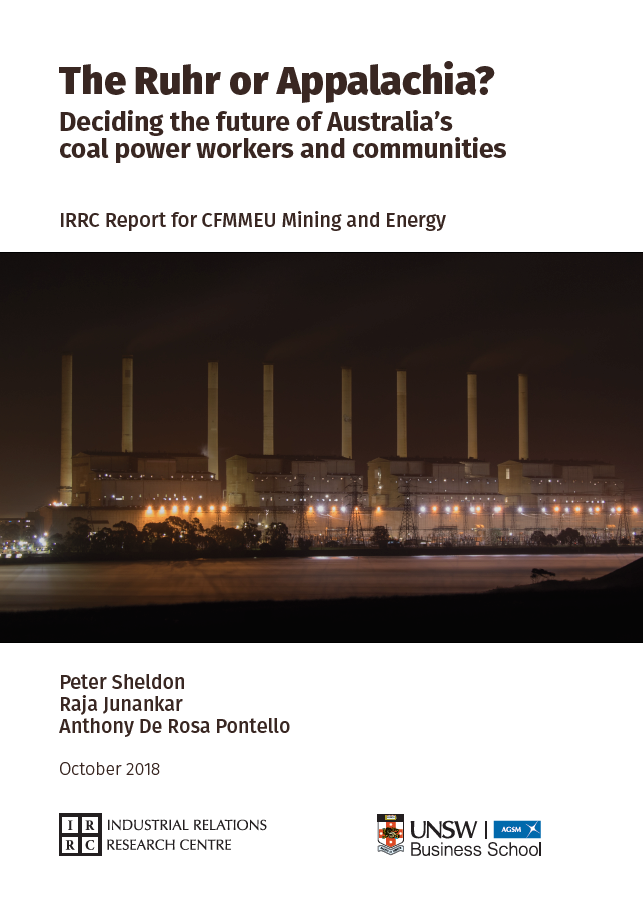
Australia’s coal-fired power stations will all close in the next two or three decades. We know this because the companies that operate the 23 power stations currently operating nation-wide have told us so.

Despite the empty rhetoric of some, it is unlikely that the economic case for investing in new coal-fired power stations in Australia will stack up. Those who currently own and operate coal power stations have no plans to build new ones.

The bad news is that the transition in how we produce power will bring great change to the workers and communities we have relied on to provide Australian homes and industry with reliable energy over many decades.

The good news is that we have the lead time to make smart decisions about what that change looks like—or at least, we now have the lead time after being caught unprepared by earlier closures, including Hazelwood in 2017.We have the choice to manage this structural economic change so that individuals, families and regions aren’t abandoned to unemployment, low-value jobs, poverty and associated health and social decline. Even better, we have the evidence about what works to deliver just transitions for coal power workers and communities, with skills, jobs, opportunities and hope for the future.

Communities grow around power stations and the mines that supply them. They are unique communities bonded in many cases by history, geography, difficult and dangerous working conditions and good unionised jobs. They are also uniquely vulnerable in their heavy dependence on the coal power industry.

This analysis of transitions in resource economies internationally and here in Australia provides valuable insights into the ingredients of success and the wide scope of outcomes.The Appalachian region in the United States is a heart-breaking story of industry transition characterised by short-term, reactive and fragmented responses to closures of coal mines, resulting in entrenched, intergenerational poverty and social dysfunction.

Compare this with the transition away from a heavy reliance on coal mining in Germany’s Ruhr region, where forward planning, investment in industry diversification, staggering of mine closures and a comprehensive package of just transition measures delivered a major reshaping of the regional economy with no forced job losses.

Central to these vastly different outcomes is the presence of a national, coordinated response. To this end, a major recommendation of this report is the establishment of a national, independent statutory authority to plan, coordinate and manage the transition.

In the energy debate to date, the impact of the transition on workers and communities has been almost completely ignored. This is an omission we can’t afford. After all, the costs of investing in a Just Transition need to be balanced against the costs of doing nothing and abandoning whole communities to a bleak future.

While global trends suggest that Australian export coal for steelmaking and energy production will be in demand for decades to come, coal-fired power generation in Australia is winding down. On the information available, there are no excuses for not taking action to protect the best interests of those affected.</p.

I thank Peter Sheldon and the team at UNSW Sydney’s Industrial Relations Research Centre for this important piece of work. I call on all power industry stakeholders to engage with its findings and consider how we can work together to deliver a Just Transition for coal power workers and communities.

Read the report (PDF).

Climate Stability, Worker Stability: are they compatible?

By Dr. Louise Comeau, JD, PhD and Devin Luke - Adapting Canadian Work and Workplaces to Respond to Climate Change, December 3, 2018

It appears we face a low- carbon transition dilemma. On the one hand, climate change solutions, like greenhouse gas regulation and carbon pricing, raise concerns about potential job displacement for workers in traditional energy sectors like oil and gas production and fossil-fuel generated electricity. Hence the calls for just transition. Our research, however, suggests that this blame may be at least partially misplaced. Energy workforce changes are currently affected by broader societal changes relating to fuel-cost differentials (i.e., natural gas cheaper than coal), automation, and the societal transition to non-unionized, unstable and lower-paying work. Greenhouse gas regulations and carbon pricing are certainly not the only driver of workforce change, and likely not, at least currently, not the primary driver.
Should proponents of renewable energy, energy efficiency and the low-carbon transition address these broader societal trends? If so, how? Is the solution to focus on collective responses such as energy cooperatives, public sector ownership of renewable energy supply, utility-scale and managed energy efficiency programs, rather than market- based, privatized solutions? These questions are worth answering. Our goal with this study was to better understand the training needs associated with renewable energy and energy efficiency job projections. There appears, however, to be a greater need to better integrate climate change and low-carbon economy discussions into a broader discourse on the nature of work.

Read the report (PDF).

Beyond Coal by 2030

By Florent Marcellesi and Joanna Flisowska - Green European Journal, November 29, 2018

The COP24 climate talks in Katowice, Poland are set to start on December 2. This year, the negotiations follow a clear warning from the global climate science community, which highlighted in the recent IPCC report that urgent steps are needed to slow global warming. Without action, the world faces the grim prospect of extreme weather events and a massive loss of species. Florent Marcellesi, Green MEP, and Joanna Flisowska, coal policy coordinator at Climate Action Network Europe, discuss COP, the energy global transition, and the gender dimension of climate change.

Green European Journal: In a matter of days, almost 200 countries will meet in Katowice, a city at the heart of a Polish coal mining region, to try and finalise the details of how the Paris Agreement will be put into force. Increasingly, the main timeline for taking steps to keep the global temperature rise well below 2 degrees, preferably to 1.5, now seems impossible. Where are we going into the talks?

Joanna Flisowska: The objective of limiting temperature rise to 1.5 degrees was in the Paris agreement from the very beginning. But with the latest Intergovernmental Panel on Climate Change (IPCC) report, we found out just how urgent it has become to act on climate change. The report brings the impact of climate change beyond the 1.5-degree mark to light and shows how disastrous and far-reaching it will be.

Florent Marcellesi: The IPCC report is a tipping point. We can now clearly say that we have to go faster and act with greater ambition for two main reasons. First, the drastic consequences if we do not. In Spain, from now to the end of the century the soil could become a desert and Spanish people could end up as climate refugees. Second, the opportunities. Achieving the 1.5-degrees limit means people living healthier lives and the creation of new and better jobs. Climate change will have negative consequences for the economy and for identity, traditions, and culture too as it disrupts ways of life. But we must turn it into an opportunity and act with commitment to achieve the goals of the Paris agreement.

The IPCC report sets out some potential pathways for the world to stabilise global warming at 1.5 degrees. These depend on an unprecedented effort to cut fossil-fuel use, among which coal is a particularly high source of carbon emissions. How can we transition from coal to clean energy sources?

Joanna Flisowska: The way forward is somewhat different depending on whether we look at the global perspective or the EU one. The EU has to consider its historical contribution to today’s climate change and must therefore reduce emissions even faster than the rest of world. According to many scientific studies, the fastest and most effective way to stay on the path to 1.5 degrees is to phase out coal by 2030 at the latest. This assessment is certainly true and is why environmentalists are emphasising that coal has to be phased out in order for the EU to reduce its emissions in a timely and cost-effective manner. Today’s reliance on coal can be overcome through renewables, investments in energy efficiency, storage, and with better management of electricity networks.

Florent Marcellesi: We are phasing out of coal for two reasons. The first is economic: coal is not profitable right now. Many plants are closing simply because it cannot compete with renewables. But second, we need to phase out coal well before 2040 for ecological reasons. The IPCC was very clear on that point and, for Europe, a coal phase-out has to mean 2030 at the latest. In some countries like Spain, coal plants must be closed even earlier by 2025.

Working Together for a Just Transition

By David Powell, Alfie Stirling and Sara Mahmoud - New Economics Foundation, November 2018

This short pamphlet has been produced to launch the New Economics Foundation’s new programme of work on the 'just transition'. Our interest is in the practicality of change: the policies, processes, narrative and investment needed to accelerate the UK’s progress on 'just transition', here and now. Over the coming months and years we will be working at local and national levels to explore what is needed to build common cause and provide the right mixture of incentives and critical challenge to all parties to help unlock a new momentum for a 'just transition' for the UK.

It has been produced in association with the Friedrich-Ebert-Stiftung’s London Office, part of the international network of FES. The London office was established in 1988 to promote better understanding of British- German relations. FES's work in the United Kingdom focuses in particular on the exchange of ideas and discussion on the following topics: common challenges facing Germany, the United Kingdom and the European Union; economic and social policy; experiences gained from differing regional and local policies and practices; and a continuing dialogue between politicians as well as between the trade unions in both countries.

Read the report (PDF).

Just cuts for fossil fuels? Supply-side carbon constraints and energy transition

By Philippe Le Billon and Berit Kristoffersen - Economy and Space, November 2018

Reducing greenhouse gas emissions has generally been approached through demand-side initiatives, yet there are increasing calls for supply-side interventions to curtail fossil fuel production. Pursuing energy transition through supply-side constraints would have major geopolitical and economic consequences. Depending on the criteria and instruments applied, supply cuts for fossil fuels could drastically reduce and reorient major financial flows and reshape the spatiality of energy production and consumption. Building on debates about just transitions and supply constraints, we provide a survey of emerging interventions targeting the supply of, rather than the demand for, fossil fuels. We articulate four theories of justice and selection criteria to prioritize cuts among fossil fuel producers, including with regard to carbon-intensity, production costs, affordability, developmental efficiency, and support for climate change action. We then examine seven major supply-constraint instruments, their effectiveness, and possible pathways to supply cuts in the coal, oil and gas sectors. We suggest that supply cuts both reflects and offers purposeful political spaces of interventions towards a 'just' transition away from fossil fuel production.

Read the text (PDF).

Pages

The Fine Print I:

Disclaimer: The views expressed on this site are not the official position of the IWW (or even the IWW’s EUC) unless otherwise indicated and do not necessarily represent the views of anyone but the author’s, nor should it be assumed that any of these authors automatically support the IWW or endorse any of its positions.

Further: the inclusion of a link on our site (other than the link to the main IWW site) does not imply endorsement by or an alliance with the IWW. These sites have been chosen by our members due to their perceived relevance to the IWW EUC and are included here for informational purposes only. If you have any suggestions or comments on any of the links included (or not included) above, please contact us.

The Fine Print II:

Fair Use Notice: The material on this site is provided for educational and informational purposes. It may contain copyrighted material the use of which has not always been specifically authorized by the copyright owner. It is being made available in an effort to advance the understanding of scientific, environmental, economic, social justice and human rights issues etc.

It is believed that this constitutes a 'fair use' of any such copyrighted material as provided for in section 107 of the US Copyright Law. In accordance with Title 17 U.S.C. Section 107, the material on this site is distributed without profit to those who have an interest in using the included information for research and educational purposes. If you wish to use copyrighted material from this site for purposes of your own that go beyond 'fair use', you must obtain permission from the copyright owner. The information on this site does not constitute legal or technical advice.

