

You are here

green syndicalism

Below & Beyond Trump: Power & Counter-Power in 2017

By Black Rose Anarchist Federation - It's Going Down, December 23, 2017

This analysis was developed by ongoing discussions among members of the Black Rose / Rosa Negra (BRRN) Anarchist Federation’s Analysis and Strategy Committee and sent as a discussion document to our August 2017 convention, where it generated deep discussion and further feedback.  It is organized into four sections: an analysis of ruling class power, an analysis of social movements, a statement of basic organizing principles in light of the current moment, and some suggestions for the federation moving forward.

Its main points are that we see real potential to build popular power and social anarchism in the coming period. The U.S. ruling class is fractured, the political terrain has shifted dramatically, and there is mass discontent with corporate politics as usual. This provides numerous opportunities for pro-organizational revolutionary anarchists to intervene as social movements arise. At present the mass discontent is being channeled by the institutional left – unions, non-profits, and other institutions traditionally aligned with the Democrats — into explicit reformism and electoral politics. We argue for promoting independent social movements outside of the institutional left while putting forward within new and existing social struggles the need to advance class struggle, collective direct action, direct democracy, and a vision of libertarian socialism.

Climate Crisis and the State of Disarray

By William C. Anderson - ROARMag, December 2017

We are indebted to the Earth. Our gracious host has provided us with more than enough resources to live, grow and prosper over time. But throughout history, and especially in the modern capitalist era, some have let their desire for more become a perilous dedication to conquest. The urge to make other humans, wildlife and all parts of nature submit to the will of markets, nations and empires is the rule of the day. Today, anything associated with nature or a true respect for it is regarded as soft. That which is not vulturous like the destructive economics of the reigning system is steamrolled to pave the road to unhinged expansion.

This logic of expansion and conquest undoubtedly changes the relationship between humans and their environment. In this context, the “debate” over climate change actually becomes a matter of human survival. Those who entertain climate change as a question at all have already, maybe unknowingly, chosen a side. The fact is that climate change will create more refugees and forced human migrations; it will lead to the murder of environmental activists around the world and start new resource wars; it will spread disease and destabilize everything in its path — and more. Unless capitalism’s unquenchable thirst for natural resources and the fossil fuel combustion that powers it is abandoned, the Earth will be forced to do away with humans cancerously plundering the carbon energy it has stored over millions of years of natural history.

What is most unfortunate is that capitalism, which has multi-layered discriminations encoded within it — racism, sexism, classism, and so on — affects how thoroughly people are capable of bracing for the damages wrought by climate change. Though nature is indiscriminate in its wrath, the sustained ability to protect oneself from rising temperatures and natural disasters is a privilege not all can afford. Those who are already harmed under the pitiless whims of capital are doubly hurt by the lack of protection afforded to them for life in an increasingly turbulent environment. The Global South is much more likely to feel the brunt of climate change, despite contributing much less to causing it. But even in the world’s wealthiest nations, the poor and working classes are much more vulnerable to ecological devastation.

If the people who understand the gravity of the situation want this state of affairs to cease, then the system of capitalism and the egregious consumption of the so-called First World itself must cease. That which puts all of us at risk cannot be tolerated. The vast satisfactions in wealth hoarded by a few does not outweigh the needs of the many suffering the consequences every day, as the Earth deals with malignant human behavior. The systemic drive towards excess that is pushing the planet’s carrying capacity to the brink must be brought to a halt throughout the world, but especially in the empire that exemplifies excess best: the United States of America.

Organizing on a Sinking Ship: The Future of the Climate Justice Movement

By Kevin Buckland - ROARMag, December 2017

Climate change rarely comes up at the top of the list when people are asked about issues that concern them most. While this is not surprising, it is nonetheless disturbing considering the gravity of the climate crisis. Yet the key problem of our collective negligence of the climate crisis is reflected in the question itself, rather than the answer. Let us be clear: climate change is not an “issue.” Rather, it is now the entirety of the biophysical world of which we are part. It is the physical battleground in which every “issue” is played out — and it is crumbling.
The global justice movement is one of the many actors trying to maneuver on this battlefield, and the direction it is headed in is reshaping the narratives, tactics and structures that comprise it, hinting at the future of social movement organizing on a radically transformed planet. The rules of the game have changed: welcome to the Capitalocene — goodbye to “activism-as-usual.” As the climate changes, so must movements if they are to withstand, even thrive, inside the coming cataclysm of winds, waves and wars.

Movement Cultures in the Capitalocene

As our planet rockets into a new geological epoch, we find ourselves on unfamiliar terrain. The only thing that is certain is that no one knows what will happen, and no one is in control. The rest of our lives will be defined by an exponential ecological entropy that will increasingly destabilize both the economic and political foundations upon which the modern world has been built. All bets are off. The collapse will be anything but boring.

The Capitalocene is defined partly by a disappearance of spaces of refuge: there is no escaping this problem, and nowhere to hide. We’re all in the same boat. But the boat has crashed into a drifting iceberg, and is sinking fast. Our response to the climate crisis has been to rearrange deckchairs on the Titanic, but whatever we are doing, it isn’t working. It’s time to try something new. On a sinking ship, one’s logic and frames of references must change, just as the traditional frames of the left must evolve in the emerging context of crisis. The struggle is no longer to organize the deck-chairs so that we can ensure equal access for all. Rather, the most critical question now becomes: “How can we best organize ourselves to turn as many of these deck-chairs into life rafts?”

Perhaps as obvious as the climate crisis itself has been the inability of social movements to properly organize around it. For years, the climate movement has been trapped between two discordant discourses: between changing light-bulbs and global revolution. On one hand, any action can seem minuscule and ineffective compared to a crisis as big as the entire world. On the other, deep systemic change can seem far too slow for the urgency of the crisis we face. Yet one cannot “fight climate change” in the absence of such structural transformations, for the climate crisis is itself the result of an extractivist logic based upon an exploitative relationship with the world around us. Long before the industrial revolution, the emerging capitalist world-system was fueled by the exploitation of women, people of color and entire ecosystems.

The climate crisis is the ultimate symptom of this extractivist dynamic, and is an entirely new species of crisis that requires our movements to enact an entirely different logic — including entirely different values, morals, assumptions and strategies — if we are to confront it. Confronting climate change means confronting the system and the culture that has caused it, and providing a scalable alternative. More than merely constructing a new politics to confront the “issue” of climate change, the task of the left in the Capitalocene is to cultivate new processes for engagement in politics. The culture of organizing itself becomes key.

If movements in the Capitalocene are to effectively confront this crisis, it means enacting an alternative set of values and organizational principles. The legacy may have less to do with solar panels and community gardens than with incubating scalable organizing cultures that can be shared with allies, volunteers and partners in ways that improve access to justice as we move together into an exponentially tumultuous future. It may just be these cultures, being incubated now inside globally connected movements, that will write the next chapter of human history.

Cultural revolution is not only desired; it is needed. If we fail to offer scalable discursive, tactical and structural alternatives to the extractivist logic that has created the climate crisis, capitalism may itself transform the coming wave of disruptions into its own benefit, exacerbating existent inequalities for every social and ecological “issue” as it strengthens its stranglehold of the future on a rapidly destabilizing battleground. History is speeding up. It’s time to play to win.

Defying Dystopia: Shaping the Climate Future We Want

By Nick Buxton - ROARMag, December 2017

We live in an age of dystopias on demand. Whether it’s Black Mirror, The Hunger Games or The Handmaid’s Tale, there is no limit to satiating our desires for dark, apocalyptic visions of the future. Unfortunately the scariest experience does not involve the world of the imaginary; it just requires reading the latest climate science.

In one such piece in July 2017, New York Magazine managed to pull together all the possible worst-case climate scenarios in a longread called “The Uninhabitable Earth.” Through interviews with climate scientists, it painted a world of bacterial plagues escaping from melting ice, devastating droughts and floods so frequent they are just called “weather,” and biblical-like tableaus of entire nations on the move. The piece is bleaker than the darkest of sci-fi, because there is no way of dismissing it as fiction.

Facing our fears of climate crisis is one of the biggest challenges we face as activists. Not a week goes by without warnings of an “ice apocalypse” or a “point of no return.” We are bombarded with bleak visions of the future. And it’s a challenge that we continue to struggle with — one we have mainly filled with demands for action. For a long time, the answer was to provide easy actions that people could take so they could feel empowered. But it was soon evident that no amount of energy-saving lightbulbs was going to halt the capitalist juggernaut. Now the answer, from the left at least, is that we must confront capitalism to overcome climate change. Yet this can hardly be described as an easy win, or likely to allay our fears of a dangerous future.

In the anxious void, we have often not engaged or challenged the visions of the future described by climate scientists or environmentalists. And I don’t mean questioning the science, but assessing their expectations of humanity’s response to those climate impacts. Do they accurately describe how people behave in the face of disaster? Do they countenance the idea that people might respond in a way that doesn’t fit the model of the dystopian dog-eat-dog world? Is it possible that their expectations actually serve the purpose of those determined to repress alternative futures?

Seymour Melman and the New American Revolution: a Reconstructionist Alternative to a Society Spiraling into the Abyss

By Jonathan Feldman - CounterPunch, December 29, 2017

American Capitalism in Decline

On December 30, 1917 Seymour Melman was born in New York City.  The 100th anniversary of his birth helps bring his intellectual legacy into focus.  Melman was the most significant reconstructionist thinker of the 20th Century, championing alternatives to militarism, capitalism, and social decay by advancing a systematic counter-planning program for disarmament and economic democracy.  His legacy remains of critical importance because today the United States is currently a society in which the economic, political and cultural systems are spiraling into an abyss.  Economic and social reconstruction is the idea that planned alternatives to the incumbent mechanisms for organizing economic, political and cultural power exist in alternative institutional designs and matching systems to extend these designs.

The economic realities are well-known, defined by an economic system in which the richest 1% of the population controlled 38.6% of the nation’s wealth in 2016 according to the Federal Reserve.  The bottom 90% controlled only 22.8% of the wealth.  This wealth concentration is well-known and is linked to financialization of the U.S. economy which is matched by deindustrialization and the decline of the “real economy.” Melman analyzed this problem tied to Wall Street hegemony and managerial attacks on worker’s power in his classic 1983 study Profits without Production.  Here Melman illustrated how profits –and thus power—could be accumulated despite the decline of industrial work and manufacturing.  In fact, the rise in administrative overheads associated with the over-extension of managerial power actually helped reduce both the competiveness and competence of U.S. firms.

In politics, the Republican Party has emerged as a Trojan Horse society, helping to defund the welfare state and advancing the aims of the predatory warfare state.  The 2018 defense bill signed by President Trump allotted about $634 billion for core Pentagon operations and allotted an addition $66 billion for military operations in Afghanistan, Iraq, Syria and elsewhere.  More money was available for troops, jet fighters, ships and other weapons, even though there are millions of U.S. citizens living in poverty (40.6 million in 2016).  Melman addressed the problem of the enduring post-war militarism of the U.S. in perhaps his most famous book, The Permanent War Economy, first published in 1974.  The subheading of that book was “American Capitalism in Decline.”  This economy emerged as way to consolidate the military largess bestowed on aerospace, communications, electronics and other war-serving industries, not to mention universities, military bases and associated institutions serving the military economy.  This corporatist system, linking the state, corporations, trade unions and other actors was described by Melman in Pentagon Capitalism: The Political Economy of War, a 1971 book which showed how the state was the top manager who used its procurement and managerial power to direct these various “sub-managements.”

In culture, we see the reign of post-truth politics, in which politicians knowingly lie in order to advance political objectives and ideology makes facts irrelevant.  A report by David Leonhardt and colleagues in The New York Times found that “in his first 10 months, Trump told nearly six times as many falsehoods as Obama did during his entire presidency.”  The problem, however, is that the underlying system of U.S. governance has been based on many bipartisan myths.  Melman’s career was based on trying to uncover such myths.

One such myth embraced by both the Republican and Democratic Parties was the idea that military power can be used without any limits.  In Vietnam, Iraq and Afghanistan, the U.S. tried to defeat guerilla operations in which the opposing military was embedded in civilian zones.  Attacking such areas deflated the U.S. military’s legitimacy with the projection of military power undermining U.S. political power in the region being attacked.  In Vietnam, the U.S. lost politically and a backlash against that war triggered a domestic revolt.  In Iraq, the toppling of Hussein pushed Iraq into the Iranian orbit, a country which is nominally a principal adversary of U.S. elites. In Afghanistan, the U.S. continues to fight its longest war with thousands dead and “no end in sight.”  When it comes to terrorism, Melman saw terrorist actions as tied to alienation, individuals cut off and remote from social integration.  Clearly social inclusion could remedy such a situation, but economic decline and an absence of solidarity simply compounded terrorist threats (whatever the diverse origins).

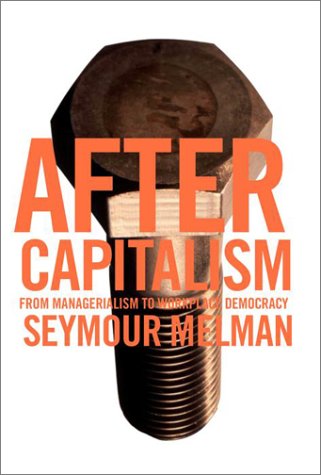
Another key myth was the ability to organize and sustain a “post-industrial society.”  A report in Industry Week (August 21, 2014) noted that between 2001 and 2010, the U.S. economy shed 33% of its manufacturing jobs (about 5.8 million), which represented a 42% decline when controlling for the increase in the workforce.  After controlling for increased in the working-age population during this period, Germany lost only 11% of its manufacturing jobs.  While scholars debate whether trade or automation and productivity is more significant in causing such job loss, automation in a nation state serving to protect the domestic organization of work will clearly preserve more manufacturing jobs than others.  In fact, the integration of automation and cooperative workforces can preserve jobs, a point made by Melman in his last great work, After Capitalism: From Managerialism to Workplace Democracy.  Melman’s support for the domestic anchoring of jobs through proactive investments in civilian infrastructure including sustainable forms of alternative energy and mass transportation also belied the associated myths of globalization and free markets—both of which failed to automatically yield a proactive welfare state responsive to maintaining full and sustainable employment.

(Working Paper #11) Trade Unions and Just Transition

By Sean Sweeney and John Treat - Trade Unions for Energy Democracy, January 2018

In late 2015, after more than a decade of tenacious lobbying of government negotiators, union representatives led by the International Trade Union Confederation (ITUC) succeeded in getting the phrase “Just Transition” into the preamble to the Paris Climate Agreement negotiated at COP21. The text affirmed “the imperatives of a just transition of the workforce and the creation of decent work and quality jobs in accordance with nationally defined development priorities.”

More than two years have passed since COP21, and calls for a Just Transition have emerged from all corners of the global progressive community. Once more or less exclusively a trade union priority, calls for a Just Transition increasingly appear, in varying forms, in the campaigns of major environmental organizations, climate justice and green NGOs, and indigenous and farmers’ movements. However unevenly, Just Transition has begun to feature in discussions around national politics and policy, and unions increasingly refer to the current period as Just Transition’s “implementation phase.”

The Need for an Integrated and Transformative Politics

Unions for the most part understand that they must strive to develop a Just Transition politics that somehow addresses the immediate concerns of workers while keeping the need for a transition of the entire economy in view. A transition that is “just” from the perspective of workers or “the workforce,” but which fails to help achieve the needed socioeconomic transformation, will ultimately accomplish little to address pressing climate-related and broader ecological concerns. Alternatively, policies aimed at driving a socioeconomic transformation that are robust enough to achieve climate and environmental targets, but which ignore the impact on workers in specific locations or industries, risk being unable to secure the support from workers that such a transformation requires in order to be successful.

Social Dialogue” or “Social Power”?

In this eleventh TUED Working Paper, we argue that, in order to effectively achieve this full range of aims, the international trade union movement must collectively formulate and pursue a comprehensive, integrated approach. Doing so requires a sober examination of the origins and current state of debates over Just Transition.

Unions at all levels of the international trade union movement recognize that a broad transformation of our economy and society is urgently necessary. But the insistence on keeping “Social Dialogue” at the center of such discussions holds trade union debates captive to the narrative of the liberal business establishment, and to a very narrow and de-mobilizing interpretation of Just Transition. Anchored in the particular realities of post-war Europe, Social Dialogue has been effectively elevated to the status of an official ideology in recent years–one that is increasingly out of step with both the challenges facing workers and their organizations, and the pressing demands for action posed by the climate and ecological crisis more broadly.

This paper makes the case for a different and more expansive trade union conversation-one that can address worker-focused concerns while advancing deeper socioeconomic transformation. We call this the “Social Power” approach. This approach is guided by the belief that a Just Transition cannot be accomplished without a deep restructuring of the global political economy. Existing power and ownership relations must be challenged and changed. This is, of course, an extremely difficult task. But if this does not occur, then the vast majority of the world’s working people will never see anything vaguely resembling a Just Transition. We can at least begin by openly acknowledging that this needs to be our movement’s long term goal and then organize accordingly.

The paper offers examples from around the world that illustrate how this new approach is cohering within day-to-day trade union struggles, as well as at the level of ideas across the political left.

Download the full paper here.

From Automation to the Gig Economy: Mapping Capital’s Networks

By the collective - It's Going Down, December 12, 2017

Listen Here - link

From Trump tweeting about how low unemployment is to patting himself on the back for a ‘roaring’ stock market, we are bombarded daily with news about how great “our” economy is doing. So how can the economy be doing well, but so many American workers are barely getting by? Moreover, many Americans are having to work a variety of jobs in order to put food on the table and pay their rent, as the cost of living continues to climb while wages stay stagnant. As the saying goes, “someone is gettin’ rich, but it sure isn’t me.” 10 years after the Great Recession, and the gap between rich and poor has grown even wider, while wealth has accumulated into fewer and fewer hands. Meanwhile on the horizon, automation seeks to amplify this process while at the same time the elites are signalling a push to gut basic programs for the poor, the elderly, and the infirm.

Wanting to know more about the forces causing this reality, in this episode, we catch up with two people involved in the Global Supply Chains, which works to map the strengths and weaknesses of modern capitalism and looks at ways in which working-class people could possibly take action at choke points, leveraging the maximum amount of power.

In the first part of the podcast, we begin the conversation with a discussion about the massive transfer of wealth in the wake of the Great Recession, the rise of the ‘precariat,’ the growth of the service sector and the gig economy, and how capitalists in big cities are literally running out of workers as gentrification pushes out more and more wage earners. We then discuss economically, what has taken place under Trump over the last year, looking at both the “economic nationalism” of Bannon and the tough talk by Trump to leave behind neoliberalism. Lastly, we discuss the growing push towards automation and robotization and what this signals for everyday people.

We then switch gears and discuss the work of Global Supply Chains, and how this work can inform both current anti-capitalist workers struggles as well as environmental battles taking place against resource extraction.

As both tech capital and gentrification rearranges the world around us, pushing millions into the margins while working us harder and longer for less and less money, we find our lives becoming more and more precarious. In this context, we need to find ways of analyzing and understanding the networks of power, energy, and capital in ways benefit our struggles on the ground.

Finding Pathways to a Better Future: Part 1: Where Have We Been?

By John Foran - Resilience, December 14, 2017

Unlike other ecosocialists, I have long argued that the path to radical social transformation called for the formation of the most inventive social movement the world has ever seen.  But as a scholar of twentieth-century revolutions and twenty-first century movements for radical social change, I have started to come around to the idea that the urgency of the crisis in which we find ourselves, and the lack of adequate action on all sides (myself very much included) means that we need to consider the necessity of imagining something akin to a new kind of party.  What if we rejected the binary between movement and party, elections and direct action, acted upon the urgency of the mandate for thinking in new ways, and embraced a creative synthesis of the two?  This essay will explore our predicament and the prospects for ways out of it along these lines.

The world as we know it is crashing around us.  The signs are evident, and they are everywhere:  intense, extreme storms, floods, drought, heat, rain, fire, and winds – nothing is as it was.  Politicians don’t know what to do, and the actions of so many of them seem downright cruel, vacuous, or incompetent.  The devastation of war, military operations, policing, lethal drones, and physical attacks roll over populations entirely innocent of any crime.  The slow grind of debt, privation, and daily exploitation wears on more than half of Earth’s human inhabitants.  Non-human creatures are dying out in record numbers as Earth’s systems are polluted, contaminated, and wracked by the endless extraction of fossil fuels, minerals, and the loss of healthy soil and water.

We are called, therefore.  To what, we do not know exactly.  In the face of the Anthropocene and the climate crisis, militarism and inequality, and a widespread lack of political voice it is hard to know what to do.  Very hard.

Yet it is precisely this question, this existential challenge, to which we must bring our imaginations and love, in search of the greatest transformation we are capable of conjuring up – a Great Transition of all our systems – to something whole and nourishing for the planet and for the generations of Earthly creatures to come.

The good news is that millions – perhaps billions – of us know the score, and are ready to rise or already rising to the call.  Transition initiatives, intentional communities, networks of educators, activists, and ordinary people, social movements large and small, streets of neighbors, and here and there political groupings have all emerged in recent years, determined both to block the machinery of death and to create the means of life.

It is to these beginnings of hope that we should now turn our attention.  To continue with business as usual is to slowly sink into chaos.  The time is now and the agents are us, and those around us, in every corner of the Earth.  To turn away is to go extinct. We must rise.

Technologies that multiply inequalities

By Gabriel Levy - People and Nature, December 18, 2017

Review: The Bleeding Edge: why technology turns toxic in an unequal world by Bob Hughes (Oxford: New Internationalist, 2016)

How is it that the internet – a technology with such powerful, democratic potential – hovers over us like a monster that intrudes and spies, interferes in our collective interactions and thought processes, force-feeds us corporate garbage and imposes new work disciplines? What happened?

Bob Hughes, by thinking both about how computers work and how society works, offers compelling insights about these and other questions.

One of Hughes’s riffs on technological themes starts with the Forbes web page about Marc Andreessen, one of the world’s richest men, who in 1994 released the first version of the Netscape Navigator browser. Microsoft distributed Netscape with the Windows operating system, making Andreessen an instant multi-millionaire.

When Hughes visited the page, he found 196 words of information about Andreessen (last week, when I looked, there were only 81). Hughes found (and so did I) about another 1000 words of promotional and advertising material.

Behind those words lay a HTML page with 8506 words, or 88,928 characters. The promotional material multiplied the capacity required by the page 88 times – and that was not including the graphics. Including these, the page took about three-quarters of a megabyte of memory.

In the mid 1990s, Netscape Navigator made such advertising displays easy. It allowed web pages to create “cookies” on users’ machines to monitor the information that they enter, and enabled them to record and monitor information used in commerce. It effectively buried the principle, with which Tim Berners-Lee and other founders of the internet began, that the system would base itself on a huge mountain of identifiable text-only documents.

Hughes describes how Netscape Navigator and other developments opened the way for the dotcom bubble on the world’s stock exchanges, in 1997-2000, and a new technological leap, Web 2.0. This made possible live search functions, interactive social media, and the proliferation of online auction, booking, commercial and banking sites.

“Web 2.0 was created under pressure from increasingly powerful e-business interests, against principled resistance from the World Wide Web Consortium, whose founding principles included a commitment to making the Web accessible to all, including the visually handicapped and the blind, and in as many different ways as possible”, Hughes writes (p. 226).

The interactivity of the modern web is linked with an obsession among those who control it with speed – the computer-crunching power that allows pages to be updated and re-rendered instantaneously.

Refusing the Fascist Future: An Interview with Shane Burley

By Anti-Fascist News - It's Going Down, December 17, 2017

So where did the Alt Right come from?

The Alt Right really comes from a few converging political movements, both inside and outside the U.S.  The real beginnings of this goes back to France in the 1960s when a number of far-right intellectuals laid the groundwork to “rebrand” fascist ideas using the language of the left.  The European New Right, led by figures like Alain de Benoist and Guillume Faye, used the language of the New Left, appropriated the arguments of post-colonialist and national liberation movements, and attempted to engage in a type of “cultural struggle” as proposed by Italian Marxist Antonio Gramsci.  Their ideas really were to pick up where the German Conservative Revolutionary movement and Radical Traditionalist thinkers like Julius Evola left off and argue for a going after the culture with nationalist values.  If they change the way that Europeans think about the world, and think about themselves, maybe this can allow a radical shift in politics down the line.

They argued that they were “anti-colonialist” and that white European nations had been “colonized” by forced of “globalist” capitalism and modernity.  Their argument was then for “Ethnopluralism,” a sort of “nationalism for all peoples,” that could then fight the destructive elements of modern multiculturalism, internationalism, and capitalism.  This approach avoided racial slurs, violent white nationalist politics, and the baggage of fascist political parties, and really laid a heavy intellectual groundwork for a new generation of fascists who wanted to appear as academics rather than Klansman.

The next is really paleoconservatism, a sort of far-right American conservatism that defined itself in opposition to the hawkish foreign policy of the neoconservatives that were coming into power inside the GOP in the 1980s.  They saw themselves as a part of the “Old Right,” which was likely a fantasy rather than a reality, which was isolationist, traditional, and America First.  The paleocons were aggressively conservative on social issues, especially in reaction to queer rights and the AIDs crisis of the 1980s, and were reactionary on racial issues.  Pat Buchanan was the best known of these figures, though he was moderate by their standards.

Pages

The Fine Print I:

Disclaimer: The views expressed on this site are not the official position of the IWW (or even the IWW’s EUC) unless otherwise indicated and do not necessarily represent the views of anyone but the author’s, nor should it be assumed that any of these authors automatically support the IWW or endorse any of its positions.

Further: the inclusion of a link on our site (other than the link to the main IWW site) does not imply endorsement by or an alliance with the IWW. These sites have been chosen by our members due to their perceived relevance to the IWW EUC and are included here for informational purposes only. If you have any suggestions or comments on any of the links included (or not included) above, please contact us.

The Fine Print II:

Fair Use Notice: The material on this site is provided for educational and informational purposes. It may contain copyrighted material the use of which has not always been specifically authorized by the copyright owner. It is being made available in an effort to advance the understanding of scientific, environmental, economic, social justice and human rights issues etc.

It is believed that this constitutes a 'fair use' of any such copyrighted material as provided for in section 107 of the US Copyright Law. In accordance with Title 17 U.S.C. Section 107, the material on this site is distributed without profit to those who have an interest in using the included information for research and educational purposes. If you wish to use copyrighted material from this site for purposes of your own that go beyond 'fair use', you must obtain permission from the copyright owner. The information on this site does not constitute legal or technical advice.
