You are here

green syndicalism

Hog Farms, Toxic Water, and Toxic Prisons in Texas

By Comrade Malik - It's Going Down, May 7, 2018

Political prisoner and member of IWOC Keith “Malik” Washington bring us an in-depth breakdown of the intersections of hog farming, mass incarceration, and environmental destruction.

“The pre-eminence of environmentalism in the 21st century is a novel political and historical development. Ecology is a new body of scientific description and knowledge upon which social, economic, political and ethical ideas and practices have become premised. Ecosystem science suggests that political, social, and economic arrangements must be compatible with, and ideally optimize, natural ecological processes. Harming ecosystems is considered ethically, politically, and ecologically wrong.”Graham Purchase, Green Flame: Kropotkin and the Birth of Ecology 1)

When a persyn says that they are a “water protector,” an animal and plant lover, they more often than not identify with being classified as an environmentalist. However, if you live in the United States of Amerika, you must become an expert in biology, water analysis, and be proficient in identifying poisons and pathogens which routinely appear in your immediate environment, your food, and your water supply.

More specifically, you must actually transform yourself into a private investigator. For who is able to decipher and figure out the complex and conspiratorial relationships which currently exist between capitalist corporate entities who persistently pollute the environment, and federal and state agencies? Government departments who have been commissioned to protect the people, our land, air, and water from being corrupted and exploited by these immoral and unethical corporate capitalist entities. Our planet and our health is in peril and total jeopardy.

What I have discovered is that the State of Texas has conspired with the Texas Commission on Environmental Quality to downplay and cover-up toxic and contaminated water supplies in State-run prisons as well as the rural communities which have found themselves in close proximity to these toxic sites. It is not just the prisoners in Texas who are suffering the ill effects.

I have also discovered that what is happening in Texas is not unique. I’ve learned of another imprisoned environmentalist in the State of Pennsylvania who is housed at a prison known as Frackville. The prisoner’s name is Bryant Arroyo and he has uncovered the exact same custom, policy, and corrupt government practices in his state.

In a recent essay published in Socialist Viewpoint magazine, Arroyo stated “In general, Pennsylvania Department of Corrections (DOC) knows it has a water crisis on its hands. The top agencies like the PA Department of Environmental Protection (DEP) and EPA know about this open-secret and have conspired to deliberately ignore most, if not all, of the prisoners’ official complaints. DEP has received four drinking water violations from the EPA. But the underlying problem is money, money, and more money.” 2)

Bryant Arroyo cites money as the underlying problem. I find that quite remarkable, because recently I have been studying the spending habits of Scott Pruitt, the director of the U.S. Environmental Protection Agency. 3) As I see it, Pruitt and his cronies have aggressively forced roll-backs of anti-pollution measures. Simultaneously, Pruitt has conspired to line the pockets of close associates and other cronies. $100,000 a month for private jet memberships, bullet proof vehicles, and bulletproof desks?

Pruitt has been so busy squandering and wasting tax payer dollars that he has virtually ignored environmental disasters taking place in plain sight! Senator Sheldon Whitehouse from Rhode Island has begun to investigate Pruitt’s careless spending. My question is, when will the Environmental Protection Agency start doing some protecting of the environment?

Capitalism Is Killing the Earth: An Anarchist Guide to Ecology

By JohnWarwick, et. al. - Anarchist Federation, 2018

We are in a period of crisis that we in MEDCs cannot yet see. The signs are there if you look hard enough but at the moment the water is still flowing, the crops are still reliable the ski lifts are still running. The first wave of climate refugees are trying to make their way into Europe but they are being dismissed as "economic migrants" or those displaced by war. In all likelihood, MEDCs will not feel the effects of climate change for some time; our relative wealth will push the impacts onto those who haven't the means to adapt or whose local climates were less temperate to begin with. The longer we wait to act, however, the bigger the coming crunch will be.
Collectively, MEDCs are responsible for the overwhelming majority of cumulative carbon emissions and will have to radically change their energy and transport systems if an ecological disaster is to be avoided. Who will bear the brunt of the costs and who will get rich from this process is sadly predictable. The working class in MEDCs and most people in LEDCs will pay for the fossil fuel addiction and growth-at-all-costs model of the capitalist system. We have already begun to see this happen in the black, working-class communities devastated by natural disasters in the USA and flooding killing thousands in Bangladesh.

Capitalism relies on constantly increasing accumulation of profits. This has been achieved historically by appropriations (a polite term for thefts) both internal and external to the nation state. Internally, in Europe from the fifteenth century onwards, this has followed the model of stealing common land from the people to create a proletarian class dependent on wage labour to support itself. Externally, this expansion was tied to a move outside Europe's borders to exploit natural resources and labour in other locations. Thus colonialism and capitalism were, from the beginning, linked to processes of resource extraction and accumulation.

Capitalism is now in crisis; with so few areas beyond its reach, there are no easy sources of growth to appropriate, and the ability of the earth's ecosystems to accommodate further growth is being seriously questioned. How then to continue growth and profit? In MEDCs, we are seeing a fresh attack on workers? rights, with more precarious jobs, lower pay and poorer social care. In LEDCs, the neoliberal development model is pushed with privatisation and financial deregulation extracting the most profit for the capitalists.

We write this pamphlet to discuss the environmental problems that capitalism has created, with a focus on climate change and the false solutions offered up to us. There has been wider understanding of environmental issues since mainstream publications such as Silent Spring, Gaia and An Inconvenient Truth; however, an anti-capitalist critique has been lacking.

Read the report (PDF).

The Plan (Documenatary)

By Steve Sprung - The Plan, May 2018

Full Length Version:

THE PLAN is a two-part film essay - Part 1 (120mins) Part 2 (90mins). It tells the story of the Lucas workers alternative plan in the context of its time and in relation to the challenges we face today.

The two parts are suitable for screening together, with an intermission, or on consecutive occasions.

Richmond IWW May Day Platform

By Joe Sabo - Richmond IWW, April 25, 2018

May Day in Richmond this year has been organized as a celebration of working people and worker’s power. We will meet at Abner Clay park in Richmond at 5pm for a people’s banquet, music, comradery and other awesome events! This celebration has been collectively organized by the Richmond chapters or Organizing for a Free Society, Democratic Socialists of America, and the Richmond IWW General membership branch.

The following platform was penned collectively by the various representatives of each of the aforementioned groups and has been approved via consensus:

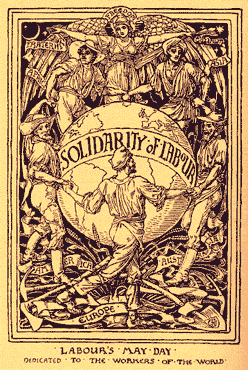
May 1st is International Workers’ Day. Unlike other holidays, it is not a day to commemorate bloody wars for empire. It is not a day for shopping. May Day is a day for the vast majority of us who must labor for the profit of a tiny minority. May Day is a day without borders, where workers of all countries unite in celebration of our collective potential and power, recognizing the capitalist bosses and their state as our common enemy, and liberation as our common goal. May Day is a day to reconnect with a more sustainable form of existence, for workers to share in the abundant harvest that is the product of our collective social labor.

May Day is widely celebrated throughout the world with protests, boycotts, sabotage, and strikes against a system of exploitation: it is a day without work. May Day is not recognized as a holiday by the rulers of the USA, though it originates in our country. However, despite this lack of “official” recognition, working people have always celebrated May Day. Before the capitalists kicked the peasantry off the land and privatized every aspect of our lives, May Day was a day to celebrate the fertility and abundance of the earth with communal singing, dancing, loving, eating, and drinking.

After capitalism began to spread its reach throughout the world, May Day became a day of working class resistance: on May 4, 1886, immigrant workers in Chicago went on strike for the eight-hour day, better working conditions, and higher pay. In response, the government arrested and executed 7 working class activists – the Haymarket Martyrs – in 1887. Since then, anti-capitalist workers have chosen the 1st of May to commemorate and continue their struggle for liberation. On May Day 2006, when millions of immigrant workers went on strike against workplace injustice and racist immigration policies in the USA, we were once again reminded of the real spirit of May Day.

May Day 2018 is a day of struggle against fascism and imperialism, and a day of celebration to affirm the value of life against the killers of the earth. We mobilize on May Day against white supremacy and in defense of Black Lives, Muslims, immigrants, and all indigenous people and people of color. We mobilize on May Day against mass incarceration and in defense of prison abolition. We mobilize on May Day against heteropatriarchy and in defense of queer and trans lives and reproductive freedom. We mobilize on May Day against the capitalist exploitation of the working class, against slavery and unpaid labor, and against the destruction of our environment. We mobilize on May Day because another world is possible.

Our goal is to foster collaboration among the multiple autonomous organizations and projects operating in the city of Richmond, Virginia. We hope that May Day can be an opportunity for horizontal exchange of diverse ideas and experiences, and to form bonds based on common affinities and commitment to revolutionary struggle.

Third Memorandum or Grexit: What are the implications for the Future of Greece’s Energy System?

By Sean Sweeney - Trade Unions for Energy Democracy, July 18, 2015

Disclaimer: The views expressed here are not the official position of the IWW (or even the IWW’s EUC) and do not necessarily represent the views of anyone but the author’s.

Presentation, July 18, 2015, Democracy Rising conference, Athens, Greece

Third-Memorandum-or-Grexit-word document (full presentation)

It is understandable that this conference, Democracy Rising, should be deeply engaged in the intense political debates going on in Athens and all over the world about the decision by the Syriza government to sign the Third Memorandum and not walk down the Grexit road.

So the future of Greece’s energy system is not exactly the stuff of intense coffee-shop conversations going on right now. But energy will be at the heart of the struggles in Greece in the years ahead, Memorandum or Grexit. Energy poverty has grown with austerity and recession, and Syriza has taken measures to protect the poorest and most vulnerable from, for example, electricity disconnections.

But it is clear that the structure of Greece’s energy system also needs to change. The “Institutions”, through the Memorandum, have a clear sense of what restructuring energy means for them—full-on privatization. However, a left restructuring would seek to address two major challenges: firstly, Greece’s dependence on fossil fuel imports and, secondly, how to take advantage of its potential to generate large amounts of renewable energy. I will return to this later.

Unions in the Americas call for “Energy Sovereignty and Democratization”

By Sean Sweeney - Trade Unions for Energy Democracy, June 3, 2014

Disclaimer: The views expressed here are not the official position of the IWW (or even the IWW’s EUC) and do not necessarily represent the views of anyone but the author’s.

The Trade Union Confederation of the Americas (TUCA)  has released a major policy instrument, the Development Platform for the Americas (English version here) or Plataforma de Desarrollo de las Americas (PLADA).  Spanish original is here. The report was released in Santiago, Chile, at a meeting with Chilean president Michelle Bachelet on May 6 in the presence of more than 5,000 trade unionists and friends.

The year-long process of discussion and debate leading to the launch of PLADA reflects growing support among unions and social movements for democratic control of energy and other strategic sectors as well as the need for governments to halt the for-profit exploitation of the commons.

TUCA is the largest regional workers´ organization in the Americas.  It represents more than 50 million workers belonging to 53 national trade union organizations based in 23 countries. TUCA is the regional structure of the International Trade Union Confederation. A number of TUCA affiliates participate in TUED, from Argentina, Canada and the United States.

PLADA calls on the region’s various social and political forces to “work together to build alternatives in the battle for a new hegemony.” The document is structured around four pillars or dimensions – political, economic, social and environmental – which will be geared towards achieving sustainable development.

Why Unions Need to Join the Climate Fight

By Naomi Klein, September 3, 2013. Source: Naomi Klein

Disclaimer: The views expressed here are not the official position of the IWW (or even the IWW’s EUC) and do not necessarily represent the views of anyone but the author’s.

Naomi delivered the following speech on September 1, 2013 at the founding convention of UNIFOR, a new mega union created by the Canadian Autoworkers and the Canadian Energy and Paper Workers Union.

I’m so very happy and honoured to be able to share this historic day with you.

The energy in this room – and the hope the founding of this new union has inspired across the country – is contagious.

It feels like this could be the beginning of the fight back we have all been waiting for, the one that will chase Harper from power and restore the power of working people in Canada.

So welcome to the world UNIFOR.

A lot of your media coverage so far has focused on how big UNIFOR is – the biggest private sector union in Canada. And when you are facing as many attacks as workers are in this country, being big can be very helpful. But big is not a victory in itself.

The victory comes when this giant platform you have just created becomes a place to think big, to dream big, to make big demands and take big actions. The kind of actions that will shift the public imagination and change our sense of what is possible.

And it’s that kind of “big” that I want to talk to you about today.

The Poverty of Luxury Communism

By QQ - LibCom.Org, April 5, 2018

A spectre is haunting Europe and the US, the spectre of... productivist national protectionism from the Left. QQ and Mike Harman respond to Novara Media and Jacobin Magazine.

"One form of wage labour may correct the abuses of another, but no form of wage labour can correct the abuse of wage labour itself." – Marx (Grundrisse)

Recent articles in Jacobin Magazine and Novara Media represent a growing trend of social democratic insistence that the state is the best chance for solving climate change and myriad other problems. This trend is taking several forms, a retreat from a consistent anti-borders position to one that sees no-borders as horizonal; a call for nationalisation of large-scale industries as a way to fix climate change and provide jobs; and for alternative ownership models like workers co-operatives to be supported by the state. In all cases premised on a strategy of state-capture via elections.

On the 26 February, Jeremy Corbyn told an audience in Coventry that Britain “cannot be held back inside or outside the EU from taking the steps we need to support cutting edge industries” nor can Britain be held back from “preventing employers being able to import cheap agency labour”. Although Corbyn caught heat from some of his more radical supporters, much of the criticism didn’t go beyond highlighting his poor judgement using ‘clumsy’ language. That the tone rather than the content of the speech was under scrutiny, provides an insight into the direction that the Labour party is heading in. It suggests we are not merely revisiting a party that feigns reluctance in appeasing racist sentiment, in an attempt to recover voters that abandoned them a long time ago. Rather, to “support cutting edge industries” it requires labour unified by a common bourgeois identity – Britishness, with a return to the nativist labourism that dogged the workers movement up until the '80s. Rhetoric may vary between explicit conservative bigotry, nativist labourism or metropolitan neoliberalism, but all of these exact violence via border controls, whether at the level of the EU or the UK. Capitalist production relies on the control of labour power.

This politics of a seemingly bygone age not only demonstrates the fundamental limit of parliamentary socialism but is woven into the intellectual fabric of the left as a whole. Illustrative of this is Aaron Bastani’s “Fully Automated Green Communism”. Although not unique in its Keynesian ambitions glamourized in communist pretence, it provides us with a useful case study of the thought processes and wholesale misunderstandings underpinning the ‘radical’ project presented by the Labour party.

Broadly speaking, Bastani’s piece is an appeal to grassroots green activists to ‘scale-up’ (an insistence made by other members of the Novara outfit and the Inventing the Future crew), in that the best way to avert climate change is to utilise the state. Whether he personally subscribes to the climate catastrophe speculated in the piece is uncertain, however he certainly believes that the public spirit around climate change could be an effective vehicle in exercising his demand-side economic theories. The post-war period of “a competing utopia [and] countervailing geopolitical forces” was a huge boon to the arms industry and consequently for the wider economy (i.e. the internet began its life as U.S. military tech), and it is thought that climate change can serve the same function as the Cold War. There are specific reasons why a likeness cannot be drawn between preparing for a world war and climate change (that we will address later), but more broadly Bastani makes the classic mistake of thinking that the purpose of an economy is to allocate resources to meet consumption needs, when in reality the purpose of the economy is to produce capital.

Bringing Back The Lucas Plan

By Felix Holtwell - Notes from Below, March 30, 2018

“We got to do something now, the company are not going to do anything and we got to protect ourselves”, proclaimed a shop steward at Lucas Aerospace when filmed by a 1978 documentary by the Open University.

He was explaining the rationale behind the so-called Alternative Corporate Plan, better known as the Lucas Plan. It was proposed by shop stewards in seventies England at the factories of Lucas Aerospace. To stave off pending layoffs, a shop steward committee established a plan that outlined a range of new, socially useful technologies for Lucas to build. With it, they fundamentally challenged the capitalist conception of technology design.

Essentially, they proposed that workers establish control over the design of technology. This bottom-up attempt at design, where not management and capitalists but workers themselves decided what to build, eventually failed. It was stopped by management, sidelined by struggling trade unions and the Labour Party, and eventually washed over by neoliberalism.

The seventies were a heady time, the preceding social-democratic, fordist consensus ran into its own contradictions and died in the face of a triumphant neoliberalism. With it, experiments such as the Lucas Plan died as well. Today, however, neoliberalism is in crisis and to bury it we should look back to precisely those experiments that failed decades ago.

On Consumerism, Capitalism, and Ecosocialism

By Sebastian Livingston - Hampton Institute, March 29, 2018

This piece is intended to be an introduction to an ecosocialist approach to production and consumption. What we have today is a hegemonic obsession with mass production that is catastrophic to the evolutionary processes which allow the biosphere to uphold life as we know it. Capitalist modes of production based upon endless economic expansion and mass consumption disrupt the equilibrium of ecosystems by reshaping the metabolism of nature which regulates earth systems. Within this article I will discuss some issues that I see as problematic in achieving an ecological society and address possible solutions. This is not intended to provide a critique of consumers, my aim is to develop an assault on the hegemonic creation of consumer culture and its devastating impact in maintaining the status quo. This is not an outline for revolution, it is merely my attempt to put forth issues as I see them and contribute to the discussion about the construction of consumer culture as a barrier to achieving social transformation.

"Once upon a time the working class had nothing to lose but its chains; but now it has been absorbed within capitalism, is a prisoner of consumerism, and its articles of consumption own and consume it." -Michael A. Lebowitz

We have the productive means to fulfil our material needs and to liberate ourselves from alienated labor. However this idea is incompatible with capital which does not aim to address real human needs beyond what is required to reproduce itself. Rather capitalism is contingent upon the realization of wealth accumulation, an endless expansion that is based upon the production and consumption of alienated products. This mass production is a fundamental problem that restricts our ability to create an ecological society by being the unshakable cause of most of the environmental problems we face today.

Pages

The Fine Print I:

Disclaimer: The views expressed on this site are not the official position of the IWW (or even the IWW’s EUC) unless otherwise indicated and do not necessarily represent the views of anyone but the author’s, nor should it be assumed that any of these authors automatically support the IWW or endorse any of its positions.

Further: the inclusion of a link on our site (other than the link to the main IWW site) does not imply endorsement by or an alliance with the IWW. These sites have been chosen by our members due to their perceived relevance to the IWW EUC and are included here for informational purposes only. If you have any suggestions or comments on any of the links included (or not included) above, please contact us.

The Fine Print II:

Fair Use Notice: The material on this site is provided for educational and informational purposes. It may contain copyrighted material the use of which has not always been specifically authorized by the copyright owner. It is being made available in an effort to advance the understanding of scientific, environmental, economic, social justice and human rights issues etc.

It is believed that this constitutes a 'fair use' of any such copyrighted material as provided for in section 107 of the US Copyright Law. In accordance with Title 17 U.S.C. Section 107, the material on this site is distributed without profit to those who have an interest in using the included information for research and educational purposes. If you wish to use copyrighted material from this site for purposes of your own that go beyond 'fair use', you must obtain permission from the copyright owner. The information on this site does not constitute legal or technical advice.

