You are here

green syndicalism

Indonesian Uber Drivers Fight Back with Anarcho-Syndicalism

By staff - Black Rose Anarchist Federation, January 30, 2018

As the “uberization” of the US economy continues, along with it is an ever precarious workforce struggling to make ends meet in the dog-eat-dog world of the so-called “sharing economy.” This trend is the same around the world, with Uber claiming to have more than two million drivers in over 80 counties across the globe now.
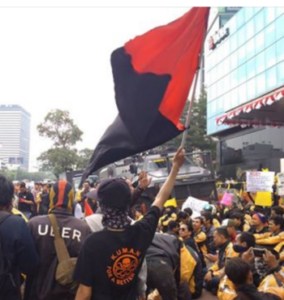
In Indonesia these conditions are little different. But radical unionists are hoping to change this and are organizing to take back their dignity, better pay and conditions and for great control over their work and lives. Kommunitas Uber Mainstream, abbreviated KUMAN which means ‘bacteria,’was formed by three Uber motorcycle drivers in the Spring of 2017. They have since crafted a list of 14 demands, led four one-day strikes and have grown to a membership of 6,000 drivers. All but two are male in the male dominated field of drivers. KUMAN is structured horizontally with regional sections meeting regularly in parks or other available spaces to discuss strategy and in turn chose delegates to larger general meetings. The union has no dues and supports itself largely by sale of stickers and t-shirts. Drivers can become members by proving they are an active driver and answering three basic questions: 1. What’s your perspective on this group?, 2. Are you a freedom fighter or a loser? and 3. What do you know about what working with Uber is like? KUMAN works together with Persaudaraan Pekerja Anarko-Sindikalis (PPAS), the two-year old anarcho-syndicalist initiative in Indonesia and an affiliate of the International Workers Association (IWA). The majority of the union has decided to adopt the ideas and strategies of anarcho-syndicalism for their struggle, although other political tendencies exist within the union.

KUMAN is continuing to escalate the fight for justice at Uber, with more strikes and actions planned. We hope that this interview will help inspire solidarity with their cause, so that workers around the world will answer KUMAN’s next call for action and join in putting pressure on Uber. We particularly hope that other rideshare and sharing economy workers will learn from the experiences we share here and connect with KUMAN drivers to build international networks of struggle and organization.

We were excited to be able to talk with Enrique, an Uber driver from Jakarta, Indonesia who was one of the initial three founders of KUMAN. We were also joined by Ricardo, originally from Surabaya, Indonesia but now living in Melbourne, Australia. He works in retail grocery and is active with the Anarcho-Syndicalist Federation – IWA. The interview was conducted by Jesus, a Los Angeles based healthcare worker with Black Rose/Rosa Negra. The three sat down together in a cramped Hong Kong hostel room to talk about the situation of Uber drivers in Indonesia now and how anarchist ideas are being applied to build workers power among drivers in Indonesia.

Please note that for purposes of translation, clarity, and length this interview has been heavy edited.

Crimethinc Podcast #61: The Olympia Train Blockade

“There’s No Trick”

By Jamie McCallum - Jacobin, January 22, 2018

“We are worried, but we are ready to fight,” says Barbara Madeloni, president of the Massachusetts Teachers Association (MTA). “We are more ready than ever, actually.”

With 110,000 members, the MTA is the largest union in the state, a status that could soon change once the Supreme Court hands down its anticipated ruling against unions in Janus v. AFSCME [the American Federation of State, County, and Municipal Employees]. That decision would allow public-sector workers — some of whom are currently mandated to pay “fair share” fees if they opt out of full-fledged union membership — to receive union representation and benefits without paying anything. This would expand right-to-work conditions to the entire public sector in the United States, a crisis even for a movement that is accustomed to crises. Say the word “Janus” to union organizers and they say things like “devastating,” “catastrophic,” “cataclysmic,” and “fucked.” And “organize.”

Two years ago, unions escaped with a victory in a similar case, Friederichs v. California Teachers Association, only because the timely death of Justice Antonin Scalia resulted in a 4-4 decision. But no one is counting on a favorable court ruling this time around; hence, a call to arms.

Update on #OperationPUSH in Florida Prisons

By IWOC - It's Going Down, January 19, 2018

Photo from @IWW_IWOC, features banner that was put up at solidarity demonstration at facility where two ex-prison Florida guards who were found guilty of belonging to the Ku-Klux-Klan, and were plotting to kill a black inmate after his release. 

It’s been a hard silence for the past 5 days since Operation PUSH launched a statewide prisoner strike in the FL Department of Corrections prison system (FDOC or FDC) coinciding with Martin Luther King Day.

Information from prisoners is coming in at a much slower pace than people on the outside had anticipated, but reports are slowly and steadily making their way through the walls, despite many obstacles.

Thus far, we’ve heard from prisoners that there has been active participation or repression of some sort in the following prisons: Santa Rosa, Jackson, Gulf, Hamilton, Avon Park, Franklin, Holmes, Everglades, Reception and Medical Center at Lake Butler, Liberty, Lowell, Columbia, Florida State Prison, Suwannee, Calhoun, and Martin. (The list is growing by the day.)

Strike Repression

A common theme among report backs is the attempt by the DOC to sever communication in order to create the perception of inactivity and break the spirits of those participating in the strike. Key contacts inside have reported being threatened by administration with harsher retaliation if correspondence with advocacy groups such as Fight Toxic Prisons and Incarcerated Workers Organizing Committee continues.

According to prisoner reports, some facilities have shut off state phone service as of Tuesday, January 16. A Security Threat Group (STG) investigator employed at a prison in the panhandle confirmed that multiple prisons across the state were placed on lockdown in preparation for the strike. Shakedowns have occurred where independent means of communication were confiscated and their alleged owners/users were thrown in solitary confinement.

We’ve heard reports that widespread investigations are occurring for anyone who has received or sent mail to organizations offering support on the outside and certain individuals are being labelled a “security threat” for doing so which can result in heightened custody levels, which means a loss of privileges, and continued harassment by the STG unit. One prisoner was told, “As long as you communicate with these people you’re always going to be labelled a security threat and you’re always going to be put under investigation.”

Given the past two years of prisoner organizing in Florida, it’s understandable that there is an expectation to hear of something distinct on the inside marking the start of the strike.

The Invention of Capitalism: How a Self-Sufficient Peasantry Was Whipped into Industrial Wage Slaves

By Yasha Levine - Transcend, January 22, 2018

Our popular economic wisdom says that capitalism equals freedom and free societies, right? Well, if you ever suspected that the logic is full of shit, then I’d recommend checking a book called The Invention of Capitalism, written by an economic historian named Michael Perelmen, who’s been exiled to Chico State, a redneck college in rural California, for his lack of freemarket friendliness. And Perelman has been putting his time in exile to damn good use, digging deep into the works and correspondence of Adam Smith and his contemporaries to write a history of the creation of capitalism that goes beyond superficial The Wealth of Nations fairy tale and straight to the source, allowing you to read the early capitalists, economists, philosophers, clergymen and statesmen in their own words. And it ain’t pretty.

One thing that the historical record makes obviously clear is that Adam Smith and his laissez-faire buddies were a bunch of closet-case statists, who needed brutal government policies to whip the English peasantry into a good capitalistic workforce willing to accept wage slavery.

Francis Hutcheson, from whom Adam Smith learned all about the virtue of natural liberty, wrote: ”it is the one great design of civil laws to strengthen by political sanctions the several laws of nature. … The populace needs to be taught, and engaged by laws, into the best methods of managing their own affairs and exercising mechanic art.”

Yep, despite what you might have learned, the transition to a capitalistic society did not happen naturally or smoothly. See, English peasants didn’t want to give up their rural communal lifestyle, leave their land and go work for below-subsistence wages in shitty, dangerous factories being set up by a new, rich class of landowning capitalists. And for good reason, too. Using Adam Smith’s own estimates of factory wages being paid at the time in Scotland, a factory-peasant would have to toil for more than three days to buy a pair of commercially produced shoes. Or they could make their own traditional brogues using their own leather in a matter of hours, and spend the rest of the time getting wasted on ale. It’s really not much of a choice, is it?

But in order for capitalism to work, capitalists needed a pool of cheap, surplus labor. So what to do? Call in the National Guard!

Faced with a peasantry that didn’t feel like playing the role of slave, philosophers, economists, politicians, moralists and leading business figures began advocating for government action. Over time, they enacted a series of laws and measures designed to push peasants out of the old and into the new by destroying their traditional means of self-support.

New Forms of Worker Organization: The Syndicalist and Autonomist Restoration of Class Struggle Unionism (Ness)

By Henry Laws - LibCom.Org, January 19, 2018

This is the first book to compile workers’ struggles on a global basis, examining the formation and expansion of radical unions in the Global South and Global North.

Bureaucratic labor unions are under assault. Most unions have surrendered the achievements of the mid-twentieth century, when the working class was a militant force for change throughout the world. Now trade unions seem incapable of defending, let alone advancing, workers’ interests.

As unions implode and weaken, workers are independently forming their own unions, drawing on the tradition of syndicalism and autonomism—a resurgence of self-directed action that augurs a new period of class struggle throughout the world. In Africa, Asia, the Americas, and Europe, workers are rejecting leaders and forming authentic class-struggle unions rooted in sabotage, direct action, and striking to achieve concrete gains.

The tangible evidence marshaled in this book serves as a handbook for understanding the formidable obstacles and concrete opportunities for workers challenging neoliberal capitalism, even as the unions of the old decline and disappear.

Read the report (PDF).

Excerpt from the new book, ‘On Anarchism: Dispatches from the People’s Republic of Vermont’

By David Van Deusen - It's Going Down, January 18, 2018

What follows is an excerpt from the new book On Anarchism: Dispatches From The People’s Republic of Vermont. Dispatches contains works written by David Van Deusen, and in some cases, the Green Mountain Anarchist Collective. This excerpt is the introduction to a strategic plan that was put forward by the Green Mountain Anarchist Collective in 2004. The proposal, until now, how never been made available to the public.

The Old Socialist Labor Hall, Barre, Vermont 2004 – The current social and political dynamic within North America, and much of the western industrialized world, is one of both growing hope and an escalation of capitalist oppression.[1]  While workers are being attacked by the forces of capital, and while the U.S. ruling class embarks upon imperialist campaigns of war, conquest, and cultural-political-economic homogenization, a mass movement is building within the very walls of the empire.

The 1999 Battle of Seattle witnessed the coming together of a great and diverse new American left.  As the anti-globalization movement matured, culminating in the 70,000-100,000 strong Battle of Quebec City in 2001, a mass anti-capitalist, pro-democracy movement was in full swing.  This momentum was effectively stalled due to the hesitation demonstrated on the part of the left immediately following the tragic September 11th terrorist attacks on the Twin Towers, and the four civilian jetliners.

However, momentum against the empire not only became reinvigorated, but grew to massive proportions with the people’s movement against the imperialist invasion of Iraq.  Let us not forget the more than half-a-million people who marched in opposition through New York City on February 15th.  Nor should we forget the tens-of-thousands of others who marched in hundreds of other North American cities and small towns.[2] Let us also remember the 13 million people who took part in sister demonstrations across the world, making February 15th, 2003, the largest day of global protest in the history of humankind.

While we did not succeed in stopping the war, we did, temporarily, make the neo-conservative’s scale back their rhetoric about invading other nations such as socialist Cuba, communist Korea, Ba’ath controlled Syria, and Islamic Iran. And like in the streets of Seattle, DC, and Quebec, this opposition included millions of union workers (i.e. U.S. Labor Against The War), socialists, anarchists, students, environmentalists, and many others.  In short, while the audacity of the ruling class grows, so too does our movement towards socialism and direct democracy. It is with this in mind that NEFAC must begin to up the ante, and develop a coordinated strategy with the end goal of popular victory.

What is this popular victory?  While it would be arrogant to state exactly what a post-capitalist, democratic, socialist world would look like (as this will be defined by the people themselves), we can, at minimum, say that it will be one where communities are organized by directly democratic assemblies, industry and agriculture will be coordinated by directly democratic unions, and all people will have (among other things) access to food, housing, healthcare, higher education, childcare, jobs, and social security.

Inmates Launch Month-Long Strike to Protest 'Slavery Conditions' in Florida Prisons

By Julia Conley - Common Dreams, January 14, 2018

Inmates in Florida's prisons launched a month-long strike on Monday in protest of the state's use of "modern day slavery" within its correctional facilities.

In a statement released by the Campaign to Fight Toxic Prisons, one of several advocacy groups supporting the movement, the state's prisoners urged the prison population to refuse all work assignments during the strike:

We are encouraging prisoners throughout the DOC to band together in an effort to demand payment for work performances...Our goal is to make the Governor realize that it will cost the state of Florida millions of dollars daily to contract outside companies to come and cook, clean, and handle the maintenance. This will cause a total BREAK DOWN.

African-Americans make up about a third of Florida's prison population, despite accounting for only about 17 percent of the state's overall population. Calling their movement Operation Push, after Rev. Jesse Jackson's 1970s campaign to improve the economic status of African-Americans, the state's inmates are fighting against the Department of Corrections' price-gouging practices and Florida's elimination of parole as well as its use of unpaid labor by prisoners.

Florida is one of five states that offers no payment to inmates for their work—from washing prison uniforms and cooking meals to completing maintenance work and serving on cleanup crews after Hurricane Irma hit the state last September.

"There's a word for that, it's called slavery," Paul Wright, executive director of the Human Rights Defense Center, told the Guardian. "Some states might say they pay 10 cents a day, or 15 cents an hour, or whatever, but here they make it pretty clear they don't pay prisoners anything, they're not going to, and prisoners are totally enslaved at every level."

On top of receiving no compensation for their work, inmates—and their families—have to come up with money to afford food and other items sold in prisons.

"We can no longer allow the state to take advantage of our families' hard earned money by over-charging us," wrote the inmates in their statement. "Take for example: one case of soup on the street cost $4.00. It costs us $17.00 on the inside. This is highway robbery without a gun. It's not just us that they’re taking from. It's our families who struggle to make ends meet and send us money—they are the real victims that the state of Florida is taking advantage of."

Black Lives Matter, several local chapters of the Democratic Socialists of America, and Florida State University's NAACP chapter are among more than 100 groups that have announced their support for the movement. Many of the groups planned to hold a rally with inmates' friends and families at the state's Department of Corrections on Tuesday.

Florida Gears-Up to Offer Solidarity to #OperationPush

By staff - It's Going Down,

On January 15th, prisoners in Florida are set to take action against prison slavery across the state.

According to Fight Toxic Prisons:

[T]hese prisoners plan to initiate a work stoppage or “laydown” beginning Monday, January 15th, coinciding with MLK Day, in nonviolent protest of conditions in FL prisons. They are calling it Operation PUSH.

Their primary demands are clear and concise: end prison slavery, stop price gouging, and fully return parole. They believe these issues have directly created the overcrowding that is responsible for the deplorable conditions in Florida prisons.

Their statement also raises other major issues that need to be grappled with, including the death penalty, voting rights and environmental health conditions.

Prisoners themselves have also issued a statement about their reasons for organizing the action:

We are currently forming a network agency within D.O.C. We are asking all prisoners within the Department of Corrections to take a stand by laying down starting January 15, 2018, until the injustice we see facing prisoners within the Florida system is resolved.

We are calling on all organized groups as well as religious systems to come together on the same page. We will be taking a stand for:

1. Payment for our labor, rather than the current slave arrangement
2. Ending outrageous canteen prices
3. Reintroducing parole incentives to lifers and those with Buck Rogers dates

Along with these primary demands, we are also expressing our support for the following goals:

• Stop the overcrowding and acts of brutality committed by officers throughout FDOC which have resulted in the highest death rates in prison history.
• Expose the environmental conditions we face, including extreme temperatures, mold, contaminated water, and being placed next to toxic sites such as landfills, military bases and phosphate mines (including a proposed mine which would surround the Reception and Medical Center prison in Lake Butler).
• Honor the moratorium on state executions, as a court-ordered the state to do, without the legal loophole now being used to kill prisoners on death row.
• Restore voting rights as a basic human right to all, not a privilege, regardless of criminal convictions.

Also, Haitian prisoners in Florida have issued a statement in support of Operation PUSH, both the Final Straw and Kine Line have released interviews with organizers involved with the Incarcerated Workers Organizing Committee (IWOC) about supporting the strike, and IGD’s Bloc Party was able to conduct an interview with an incarcerated organizer, which you can read here.

Post Tax-Bill: Let’s Get Down To Business

By Anonymous Contributor - It's Going Down, December 26, 2017

A lot of debate over political and economic issues surrounding the latest GOP tax bill has flooded social media, news outlets, and propaganda outlets lately. It’s certainly troubling to think about; “cost-cutting” legislation that doesn’t pay for itself has historically had disastrous effects on the working class and on the economy as a whole. To make matters worse, the bill is a barely disguised christmas present of millions of dollars to large corporations, lobbyists, and the richest Americans who pushed this bill through the republican party. I’m sure by now you’ve figured out that this bill is going to be even more disastrous than the failed tax cut bills from previous administrations. The income inequality in America has become a horrendous giant that continues to grow day by day, and Donald Trump is about to feed it steroids. While the rich get richer and the poor get poorer, the structure of our capitalist system is quietly teetering on the brink of collapse. When the next economic crash arrives, several extremely dangerous deficit bubbles like student loan debt, unfunded pensions, healthcare costs, and many others are going to pop at once. However, the most damaging of these bubbles is arguably the growing income inequality gap. It’s simple math, we cannot continue with this broken system. The rich are literally running out of wealth to steal from the working class.

Even now we see minimum wage jobs not yielding enough wealth to afford even the most basic of family needs like housing, food, and education. When the poor and working class can no longer be monetarily exploited, the last block at the base of the economic jenga tower will be pulled. The economy will tank like it never has before, and the tax overhaul has just accelerated this process tenfold. This issue coupled with the fact that our planet is entering self destruct mode makes our future seem very grim indeed.

The incredibly irresponsible actions of government officials in Washington have certainly set future generations up for failure. The exploitation of the working class has been written into law yet again, but we didn’t need it to be law for us to know it is already widespread. Institutions like consumerism, the market economy, racism, wage slavery, labor laws, and lobbying have already made inequality as American as baseball. I think it will be very interesting to see how the government reacts when the wealth gap reaches its climax. Our elected officials will be forced to choose between allowing a full-blown crisis to unfold or dramatically change the structure of American society and our “free market.”

Since capitol hill has repeatedly shown its ability to be sold out and used as a tool by elites, we cannot trust them to do the right thing in such a dire situation. Who knows what kind of deal corporate elites would attempt to barter with politicians in order to save their fortune, all we know is that it will be very ugly. Even if the government decided to bail out the people, it would be furiously debated in the house and senate as to how to carry out such a task. It’s not like reshaping the United States is the most partisan issue anyway. It would likely take weeks for Washington to make a semi-competent solution and even then it might not actually be a solution. The point is, it will be out of the peoples control as to what to do next, which is exactly what got us into this mess in the first place. Allowing a broken government to make decisions for all citizens in such a desperate time is irresponsible and dangerous. By the looks of how quickly the government is becoming incompetent, they may not even be capable of making any decisions.

To say a regime change is necessary would be obvious. Anarchists and other leftist activists have been saying that for years, I’m just the latest. Even though a “revolution” might prevent the impending collapse of American society, this will probably not happen. The apathy of many Americans along with our unbelievable ignorance prevents us time and time again to fix what’s broken. The possibility of regime change will arise only when our nation falls. It is imperative that the people and the working class decide what the appropriate change is. If not, exploitation is bound to continue for years to come. We would be fools not to take this opportunity, even though the opportunity comes in the form of crisis.

Pages

The Fine Print I:

Disclaimer: The views expressed on this site are not the official position of the IWW (or even the IWW’s EUC) unless otherwise indicated and do not necessarily represent the views of anyone but the author’s, nor should it be assumed that any of these authors automatically support the IWW or endorse any of its positions.

Further: the inclusion of a link on our site (other than the link to the main IWW site) does not imply endorsement by or an alliance with the IWW. These sites have been chosen by our members due to their perceived relevance to the IWW EUC and are included here for informational purposes only. If you have any suggestions or comments on any of the links included (or not included) above, please contact us.

The Fine Print II:

Fair Use Notice: The material on this site is provided for educational and informational purposes. It may contain copyrighted material the use of which has not always been specifically authorized by the copyright owner. It is being made available in an effort to advance the understanding of scientific, environmental, economic, social justice and human rights issues etc.

It is believed that this constitutes a 'fair use' of any such copyrighted material as provided for in section 107 of the US Copyright Law. In accordance with Title 17 U.S.C. Section 107, the material on this site is distributed without profit to those who have an interest in using the included information for research and educational purposes. If you wish to use copyrighted material from this site for purposes of your own that go beyond 'fair use', you must obtain permission from the copyright owner. The information on this site does not constitute legal or technical advice.