By Zebedee Parkes - Green Left Weekly, February 17, 2017
 My generation has never experienced a below average temperature. The last time the global temperature was below average was in February 1985.
The recent heatwaves across Australia ushered in a new record-breaking summer: every year for the past decade has been hotter than the last.
Meanwhile our political leaders — privileged white men in suits — brought coal into parliament and made jokes while they and their corporate mates continue to burn our collective future.
We are already getting a taste of what our future holds if we do not take urgent action.
Extreme bushfires have burnt down entire towns across Australia in the past couple of years. Pacific islands are already becoming uninhabitable due to rising sea levels. Climate change-induced droughts in Syria destroyed its agriculture and helped create the conditions that led to the civil war. Floods in Pakistan in 2011 affected 5.4 million people, destroying crops and leaving millions displaced, forced to live in makeshift shelters without access to safe drinking water. The Himalayan glaciers are already melting, potentially leaving 2 billion people across Asia without sufficient drinking water.
The consequences of climate change will only get worse if we do not make serious changes rapidly. Already the Artic Sea ice is melting, which could mean sea level rises of 3–5 metres, making many coastal cities uninhabitable.
This ecological crisis is the result of human activity. Because of a constant drive for profits, corporations are felling the Amazon rainforest at an alarming rate to create cattle pastures for beef production. The Amazon forest is one of the most crucial in the world in terms of soaking up carbon dioxide.
When we desperately need to reduce emissions, corporations, often backed and funded by governments, continue to build major fossil fuel projects, such as the Adani coalmine, poison our water and destroy farmland with gas fracking projects and pursue unsustainable projects that are destroying crucial ecosystems, such as the Beeliar Wetlands and the Great Barrier Reef.
No matter how urgent the need for action on climate change, corporations and their governments refuse to change.
Solar power is now cheaper in some parts of the world than fossil fuels. In Australia, scientific studies show we have the capacity to have 100% renewables in 10 years. Yet the government continues to give billions a year in subsidies to fossil fuel corporations — money that could be going to renewable energy.
Since the international climate talks in Paris in December 2015, when the world cried out for serious climate action, Australia’s big four banks have poured $5.6 billion into fossil fuels. Governments and the fossil fuel industry are not going to change their destructive practices unless we force them to.
To do this and give ourselves a chance of a future we need to change our economic system. Right now eight men own more wealth — and all the privileges and power that go with it — than the poorest 50% of the Earth’s population.
For serious climate action to be a reality we need a society where the majority of people — workers, farmers, students, the poor, First Nations people and refugees, the victims of climate change — are making decisions in the interests of our collective future.
To achieve this will take a gigantic struggle. But it also presents an opportunity to change the world. As Naomi Klein, author of Capitalism vs the Climate said: “I think climate change can be the catalyst we need … In a world where profit is consistently put before both people and the planet, climate economics has everything to do with ethics and morality.”
If we address climate change, we can begin to construct the kind of world we want to live in.






 As soon as barricades are destroyed in the Hambacher Forest they have been rebuild often even right behind bulldozers and before cops left the forest. This friday was no exeption but for the fact that this time also bread and roses have been put up in the place of destroyed barricades protecting the forest. This is connected not just with not continuing the resistance on an empty stomach but also with "Stones Are Our Breads and Barricades Our Dinner Tables." action that happened during this cutting season. It was also inspired by 1912 Breads and Roses Textile Strike and Riots in Lawrence Massachusetts which were organized by women and united over 30 different ethnic groups and also used workplace sabotage. The striking mothers with their children were brutally attacked by police at a train station as the kids were being sent to live with supporters when due to the prolonged strike the families could no longer feed them themselves. This resulted in international solidarity and finally with congressional hearings, positive workplace pay increase settlements, changing of work conditions and eventual shortening of the work week itself.
 Frequently lost in the arguments over financial costs and benefits when it comes to pollution is the cost to human health. Not only illness and respiratory problems but premature death. To put it bluntly: How many human lives should we exchange for corporate profit?
 In the early days of the Trump administration, we are seeing Trump’s utilization of executive orders to initiate and/or implement a wide array of right-wing policies. He is starting to make troubling organizational moves, such as the appointment of Steve Bannon- the former executive chairman for Breitbart News, a platform for the Alt-Right- to his National Security Council. We are seeing the emboldenment of the far right and the rising possibility of international warfare with nuclear capable countries such as China. Many are feeling overwhelmed and questioning the best way to resist. None of us has the power to resist these attacks individually; but we do have the power to resist collectively.
 In The Anarchist Roots of Geography, a “proverbial call to nonviolent arms,” Simon Springer discusses some of the past, present, and future relationships between anarchism and geography. He mobilizes the thought of Pierre-Joseph Proudhon, Peter Kropotkin, Elisée Reclus, and Lev Tolstoy to denounce global capitalism and oppression—declaring, with Kropotkin, that anarchism is “what geography ought to be”—while also affirming the more contemporary approaches of Saul Newman and Todd May, who have advanced the idea of “post-structuralist anarchism” in opposition to classical approaches through a turn to thinkers like Michel Foucault, Gilles Deleuze, Félix Guattari, Jacques Derrida, and Judith Butler, among others. Springer therefore presents his own perspective as amounting variably to “anarchism without adjectives” or “post-anarchism,” neither of which is the same. The former refers to the synthesist approach favored by Voline and others in opposition to the anarcho-communist Platformism advanced by Nestor Makhno, Peter Arshinov, and other exiled militants following the defeat of the Russian Revolution. Post-anarchism, a more recent development, integrates the nihilism, irrationalism, and defeatism of postmodern analyses in expressing opposition to social revolution and universalism as “totalizing narratives.” In this way, while The Anarchist Roots of Geography provides many compelling insights, it itself presents a synthesis of a number of anarchist or anarchistic approaches that cannot so readily be melded together.
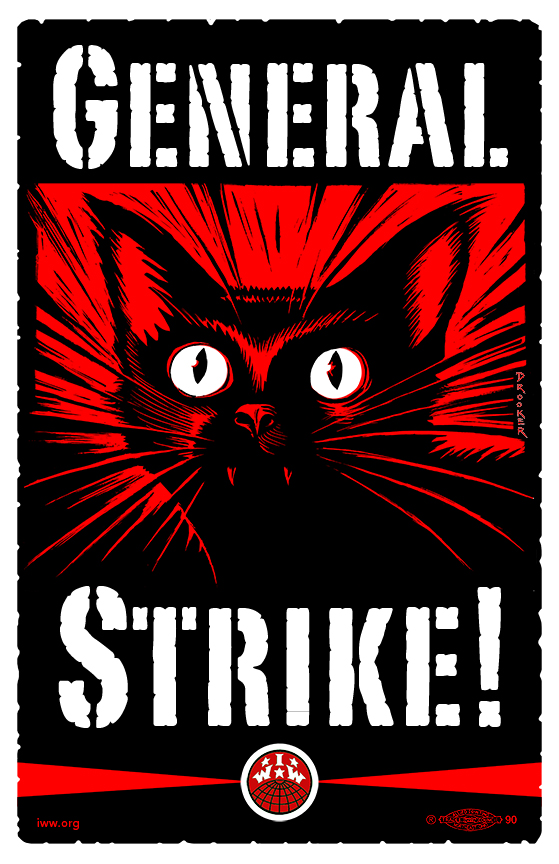 Shop steward Tomas Mejia sensed something was different when 600 janitors streamed into the Los Angeles union hall February 16—far more than for a regular membership meeting. Chanting “Huelga! Huelga!” (“Strike! Strike!”), they voted unanimously to strike on May Day.
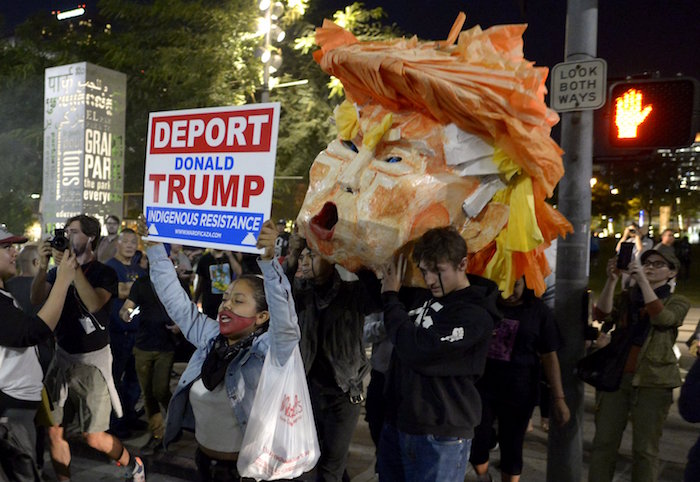 It is impossible not to notice the foreboding and despair many people express as they witness the first months of Trump’s presidency. The list of grievances grows longer with each passing day, and make no mistake, there are real human consequences to every appointment, executive order, and tweet.
 Poverty blights the lives of billions of people throughout the world: in developing countries, where it is acute, and industrialised nations, where it’s hidden but growing. It rises out of social injustice, makes exploitation and abuse inevitable, brings death and disease, robs people of opportunity and dignity, feeds anger and resentment.
 March 20, 2017 —
  Meredith Burgmann's pioneering work on the history of the New South Wales branch of the Australian Builders Labourers' Federation. During the 1960s and 1970s the NSWBLF introduced limited tenure of office for union officials, tied officials' pay to the minimum industry wage, introduced highly democratic forms of decision-making, and pursued militant industrial tactics. The union was also notable for its aggressive support of other social groups, most notably through the placing of "Green Bans" where members prevented work from taking place on environmentally or socially destructive projects.
 This site is not the official webpage of the Industrial Workers of the World.