You are here

green syndicalism

The 21st Century Doesn't Need a New Deal: It Needs a New Economic Model

By C.J. Polychroniou - Truthout, August 6, 2016 © Truthout 2016; reused by permission.

In today's global economy, neoliberalism reigns supreme, organized labor is in deep retreat and public debt has shot through the roof. In the face of these crises, is a global 21st century remaking of the 1930s-era New Deal what people on the left should be fighting for?

Contemporary progressive parties, such as Syriza in Greece and Podemos in Spain, have rallied around the idea of a "new New Deal," while the European Citizen's Initiative for a "New Deal 4 Europe" appears to have the backing of both Labor and Green party leaders in several European countries. In the US, Bernie Sanders has also been a strong advocate of this idea as the way out of our troubles.

However, a closer look at the history of the 1930s-era New Deal reveals that a new New Deal would do little to solve the underlying problems of capitalism and could even delay efforts to combat climate change through its emphasis on boosting growth via a new era of state capitalism.

Although New Deal-style programs have the potential to alleviate poverty in the short term, they are deeply limited by the core constraint that the raison d'être of active state intervention in a capitalist regime is none other than to save capitalism. Moreover, any program in the mold of President Franklin D. Roosevelt's New Deal would also be limited by its failure to give workers a greater say in decision-making.

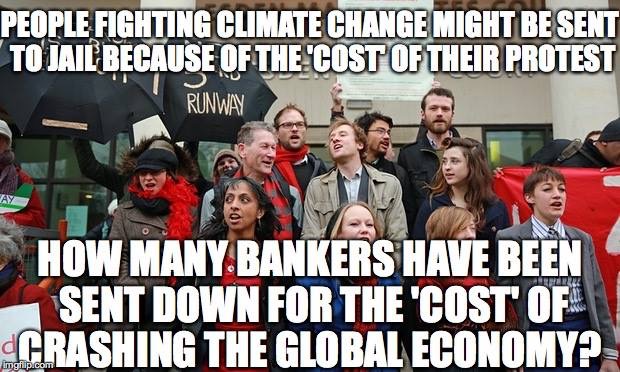
Plane Stupid stands in solidarity with #BlackLivesMatter's #ShutDown

By Paula - Plane Stupid, August 6, 2016

[On the morning of Friday, August 5, 2016] #UKBlackLivesMatter carried out a series of actions across the UK following a call for a #ShutDown.

Their actions were highlighting that for Black and Brown people, every day is a crisis in a system based on White Supremacy. That racism can be felt in many different ways, from the extreme brutality inflicted by police and state violence, which has resulted in 1,562 people losing their lives in police custody in the last 20 years; to the abhorrent detention of people fleeing war-zones; to the subtle and insidious forms of racism such as Black people being up to 37 times more likely to be stopped and searched. #BlackLivesMatter call for a #ShutDown of racism, and only by taking disruptive direct action are their voices beginning to be heard. Business as usual is a crisis. Therefore, we must #ShutDown.

By no small coincidence, some of these actions affected two major UK airports: Heathrow and Birmingham. For us the links between our struggles are clear. Expanding aviation, which is driving climate chaos, is part of the same way of thinking that is driving racism in the UK. Politicians and businessmen want to expand aviation to make more money for them and their friends. Also, the majority of flights in the UK – over 70% -  are taken by a rich minority of the population – just 15%. Globally, just 5% of people have ever taken a flight. The rich minority benefit, whilst other people pay the cost. This can be through losing their homes and or suffering pollution which affects their health locally and globally. The rich want to profit at the cost of other peoples' lives and communities.

Climate change is already killing 300,000 people a year and this will only get worse. The effects of climate change aren't colour blind, as it is primarily Black, Brown and indigenous people in the Global South who feel the effects first and hardest. The UN estimates there will be 75 million climate refugees by 2030. We're already able to see the effects, for instance, in Syria. It is only because those in power don't consider these lives to matter that they can make such life destroying decisions. The rich in the Global North benefit whilst the Global South pays the price. This is Climate Colonialism. This is Environmental Racism.

Our movements have a lot to learn from one another and have so much in common. Fundamentally, systemic change is needed to bring an end to both racism and climate change. People of colour's struggles have much to teach us, historically and in the present day, about what it means to be affected by these issues and how to fight back. #BlackLivesMatter are bringing these issues to the fore, and showing the rest of us that direct action is necessary to bring about change. It's time to #ShutDown.

Food, Labour and Ecology

By "Lucy Parsons" - Vancouver IWW, July 28, 2016

Separating food production from the global commodities market is a key component of, and a crucial first step towards achieving both social and of course ecological sustainability. Prior to the collapse of the Soviet Union, Cuba had been relying on sugar cane as a cash crop which they used for trade with Soviet bloc (and a few other) countries in return for food and consumer goods. After the collapse of the USSR, Cubans had to radically reimagine their food production strategies which in the end resulted in possibly the most sustainable food production systems on earth – all this without relying on global trade networks and the flawed logic of comparative advantage and structural adjustment which plagued so many of Cuba’s neighbours during the 80’s and 90’s.

From a western, urban perspective however, this means establishing an inclusive and secure culture of urban agriculture and perhaps most importantly, a culture of local eating. Beyond the obvious (hello, climate crises!) steps in this direction help to A) resolve what Marx described as the town/country antithesis and B) develop a sense of social capital among workers who can reconstruct themselves as something like urban farmers (key links in the food and sustainability chain), rather than underutilized wage labourers – alienated from both the process and product of their labour.  

For some perspective on this issue, we need to take a step back into the 19th century, where Marx observed that cities and rural communities had between them a kind of metabolism – wherein cities consumed food and other raw materials produced in towns and villages (which despite their importance in the creation of wealth, remain much poorer than cities) and indeed consumed people insofar as peasants were being separated from their means of subsistence by the enclosure movement and advances in agricultural technology etc. and forced to find work in the growing industrial centers of England. While this metabolism is less stark now than it might have been in Marx’s day, it still very much exists: much of the food that is consumed in our cities comes from abroad, and agricultural regions remain an important source of immigration into Canadian cities (e.g. the Punjab and other Asian agricultural regions).  

As it stands, the relationships many people have to food production is often mediated through the lens of the McJob which thrive on alienating workers from the process of production through an at times breathtakingly sophisticated division of labour. Equally breathtaking, is of course the veritable omnipresence of fast food advertising and the ubiquitous presence of many of these bands in our collective cultural psyche. All this together goes a long way in terms of deepening unhealthy misconceptions commonly held around food (misconceptions which are of course very profitable!); and indeed the immediate relationships between food, ecology and the environment. Establishing at least some measure of local (and ideally) worker control over what we eat is important and will require the cooperating and coordination of workers at every level of the supply chain – from farms (urban or otherwise) to the grocery store stock room right to the restaurant floor.

There are however a number of organizations which are working to address some of these issues from both the rural, and the urban perspective:

This post was informed in large part by Paul Burkett’s book “Marx and nature: a red and green perspective”.

Tunisia: on the frontlines of the struggle against climate change

By Hamza Hamouchene - ROARmag, July 28, 2016

Kerkennah is a group of islands lying off the east coast of Tunisia in the Gulf of Gabès, around 20km away from the mainland city of Sfax. The two main islands are Chergui and Gharbi. When approaching the islands by ferry, one is struck by a curious sight: the coastal waters are divided into countless parcels, separated from one another by thousands of palm tree leaves. This is what Kerkennis call charfia, a centuries-old fishing method ingeniously designed to lure fish into a capture chamber from where they can be easily recovered.

As the land is arid, agricultural activity is limited to subsistence farming. For the islanders fishing is one of the key economic activities, but for big multinational corporations it is the exploitation of oil and gas.

Despite a new article in the Tunisian constitution stipulating state sovereignty over natural resources and transparency in the related contracts, oil and gas companies continue to garner obscene profits and enjoy impunity. At the same time, local communities continue to shoulder the externalized social and environmental costs of this industry.

The Kerkennah archipelago is being doubly dispossessed and doubly threatened: first by the effects of disruptive global warming and second by the extractive operations of oil and gas companies, bent on making super-profits at the expense of the archipelago’s development. Caught in the intricate web of capitalist globalization, the collision between neoliberalism and climate change is potentially disastrous for the people of Kerkennah.

The centrality of externalities to economic understanding

By Brian Davey - Credo, July 31, 2016

What economists call “externalities” are not unusual or a special case, they are ubiquitous. They are rooted in private property and the relationships of market society. The way in which non market societies protect bio-diversity through totem arrangements is described.

Private property means that a single owner has the right to do with a resource as s/he sees fit. However, what they decide about these “resources” affect communities of people and communities of species (eco- systems). Very often, the effects are not positive. John Ruskin, a 19th century art critic who also wrote on economics, coined the term “illth” to describe the destructive effects imposed on society and the environment by the economy of his day.

Economists have had to adjust their theories and have come up with the concept of “externalities”, that is, the benefits or costs of an allocation decision that arise for non-owners. In a later chapter I critically examine the idea that these externalities can be managed by those people affected by them coming to a deal with those causing them. This would involve finding “the right price” for the externality and then doing a trade. The purpose of this chapter is to look at the institutional and property relationship contexts in which these “externalities” arise, and thus, to show how and why, in some kinds of society, there are no “externalities”.

The word “externality”, conveys the impression that this is a footnote to economic theory, a sort of additional point. Actually, externalities are ubiquitous. There cannot be any kind of resource allocation decision involving matter or energy without externalities. “The economy” is embodied and embedded in physical and energetic processes in the physical world.

It involves “stuff” processed by energy conversions. This stuff, the matter, can neither be created nor destroyed, though it can change its form. Likewise, energy changes its form when used. It follows from this that what are used as “economic resources” must have come from somewhere originally where these resources had an original function and/or were part of some other system or structure. These resources must also go somewhere after they are embodied in products and/or where they are wholly or partly turned into wastes. Extracting resources from places has consequences and dumping wastes and pollution has consequences. Over several centuries, this extraction and dumping has usually been out of, and back, into the commons.

Inside The Green Economy: Promises And Pitfalls In 9 Theses

By Lili Fuhr, and Barbara Unmüßig - The Leap, July 1, 2016

In their new book Inside the Green Economy–Promises and PitfallsThomas Fatheuer, Lili Fuhr, and Barbara Unmüßig of the Heinrich Böll Foundation set out to explore the underlying assumptions, hypotheses, and propositions of the green economy and to spell out their consequences in the real world. The authors call for radical realism and the courage to recognize the complexity of the global crises. They assert that the great task will be to continue the project of modernity, embracing the latest knowledge about planetary boundaries as well as the old vision of broad democratic participation and an end to poverty and injustice.

1. The green economy is an optimistic vision of fossil-fuel phase-out in an economy assumed to become greener via technology and efficiency

In the mainstream imagination, the green economy wants to break away from our fossil-fueled business-as-usual. It’s a nice, optimistic message: the economy can continue to grow, and growth can be green. The green economy even hopes to become a driver of more growth. Yet reconciling climate change mitigation and resource conservation with economic growth in a finite and unjust world remains an illusion. With its positive associations, the term “green economy” suggests that the world as we know it can continue much as before thanks to a green growth paradigm of greater efficiency and lower resource consumption.

However, anyone making such a promise must deliberately downplay complexity and have powerful faith in hoped-for miracles of the market economy and technological innovation, while at the same time ignoring social inequality and not wanting to tackle existing economic and political power structures. The green economy is thus a matter of faith and selective blind spots.

It can only be a realistic option for the future if it recognizes planetary boundaries, overcomes social and political injustice and ensures the radical reduction and fair distribution of emissions and resource consumption.

2. Fixing the failure of the market by enlarging it: instead of rethinking business, the green economy wants to redefine nature

The green economy redefines the idea of the primacy of economics as the conclusive answer to current crises. It responds to the multiple crises with more economics. Economics has become the currency of politics, say its advocates. Consequently, they intend to correct the failure of the market economy by enlarging the market. The green economy thus wants the market to encompass things that have previously been beyond its scope by redefining the relationship between nature and economy.

The result is a new version of the concept of nature as natural capital and the economic services of ecosystems – and not a transformation of our way of doing business. Instead of rethinking business, the green economy wants to redefine nature by measuring and recording it, assigning it a value and putting it on the balance sheet – based on a global, abstract currency of carbon metrics.

This hides the many structural causes of the environmental and climate crisis from view and no longer fully takes them into account in the search for real solutions and viable pathways. The consequences of such an approach are also reflected in new market mechanisms for trading biodiversity credits. In many cases, they do not prevent the destruction of nature but merely organize it along market lines.

The green economy reduces the needed fundamental transformation to a question of economics and gives the impression that it can be implemented without major upheaval and conflict.

Post-Growth and Post-Extractivism: Two Sides of the Same Cultural Transformation

By Alberto Acosta; Translated by Dana Brablec - Alternautas, June 4, 2016

Marx said that revolutions are the locomotive of world history. But perhaps things are very different. It may be that revolutions are the act by which the human race travelling in the train applies the emergency brake.

Walter Benjamin (1892-1940)

Mainstream thinking – embedded within capitalist globalisation – leads us to accept the impossibility to imagine an economy that does not promote growth, as much as a world without oil, mining and agribusiness is impossible. Within this mainstream thinking, we can find people from every political stance, from neoliberals to socialists.

Reality, however, is that we must overcome such views, that is the great task of this moment. On the one hand, we must rethink the question of economic growth, and free ourselves from its shackles before we enter into a global socio-environmental debacle with unforeseeable consequences. On the other, it is increasingly urgent to move from an extractivist perspective focused on the demands of capital, towards a view that prioritises a dignified life to its fullest extent and enables the construction of structurally democratic societies. This task puts the capacity of critical thinking to test, as well as the capacities of our societies, states, and that of social and political organisations to engage in innovative and creative thinking.

Closing the door to this debate would entail closing the door on democracy itself.

Anthropocene vs Capitalocene: a Reflection on the Question, “What Have I Done?”

By Chris Burnett - Counterpunch, May 13, 2016

The International Union of Geological Sciences (IUGS) has yet to recognize, for scientific reasons, our current geological epoch as the Anthropocene, or “Age of Humans”. The term was coined by Paul Crutzen and Eugene Stoermer in 2000 due to the fact that humans are changing the face of the planet, and are clearly responsible for the current 6th mass extinction event and climate disruption. Eco-radicals – black-red-green – might prefer the term Capitalocene, or the “Age of Capital”.

The former implies that humanity is an undifferentiated whole while the latter suggests that capital, and its system of class and power relations, are the real problem, the real driving force that has altered the planet so extensively. I prefer the latter, of course, for political reasons.

There is no substitute for understanding the historical forces of capitalism that has brought us to the edge. The logic of capitalism is grow or die, and we are all being dragged towards the die part. We need targets of accountability, and we need remedies for the dispossessed. There is a biological debt that must be paid by the most rapacious among us.

But yet, I am still sympathetic to the Anthropocene label because it makes me feel personally responsible. The collective “we”. There is something unsettling about it, and we all need to be immediately unsettled. It puts the burden of action on all of us, and counterintuitively, might pull us out of our comfortable anthropocentric worldview. Eco-radicals rightly put the blame at the doorstep of capitalism and the state, but we should all feel personally responsible, in our collective guts.

There are approximately 150-200 species going extinct everyday. The background rate of the normal extinction process is roughly one to five species a year. We are at 1,000 to 10,000 times the background rate today due to human activities. As far as the last members of a doomed species might be concerned, humans are responsible, not just the capitalist class. To them, it is the Anthropocene. Might your perspective on this issue be determined by which side of the axe you are on?

If I were to anthropomorphize those lost species, they might provide us an analogy to chew on. They might say, “imagine the surviving members of countless families murdered from bombs dropped by Bush, or assassinated with drones sent by Obama. Do you think they would care about the internal political dynamics of the US after such a tragedy?”

From the survivors perspective, it is the US government, the US Empire system, that killed their relatives. Our friends pondering this analogy for us might just make the same argument in regards to the human race: “yes, okay, we understand there are class distinctions. But, from our perspective, you are the problem. You are that system.”

I am reminded of Noam Chomsky’s use of the word “we” when discussing the crimes of empire. I recall feeling defensive when he implied we all had responsibility, because, well, I opposed imperialism! But I think he was right. In his 1967 essay, The Responsibility of Intellectuals, he writes, reflecting on Dwight Macdonald’s question as to what extent the people are responsible for their own government’s crimes,

“We can hardly avoid asking ourselves to what extent the American people bear responsibility for the savage American assault on a largely helpless rural population in Vietnam… As for those of us who stood by in silence and apathy as this catastrophe slowly took shape over the past dozen years – on what page of history do we find our proper place? Only the most insensible can escape these questions.”

Continuing at the end of the essay,

“Let me finally return to Dwight Macdonald and the responsibility of intellectuals. Macdonald quotes an interview with a death-camp paymaster who burst into tears when told that the Russians would hang him. “Why should they? What have I done?” he asked. Macdonald concludes: “Only those who are willing to resist authority themselves when it conflicts too intolerably with their personal moral code, only they have the right to condemn the death-camp paymaster.” The question, “What have I done?” is one that we may well ask ourselves, as we read each day of fresh atrocities in Vietnam – as we create, or mouth, or tolerate the deceptions that will be used to justify the next defense of freedom.”

That is the question we are all faced with today, “What have I done?”, as we observe fresh atrocities committed against the biosphere and all life on this planet. Only those that resist authority and capitalism have the right to condemn our modern death-camp paymasters.

Bay Area IWW Environmental Unionism Caucus: Three Years and Going Strong

By x344543 - IWW Environmental Unionism Caucus, May 3, 2016; image by Jon Flanders.

The Bay Area IWW Environmental Unionism Caucus was cofounded in February 2013 by three members of the Bay Area IWW General Membership Branch. The group also helped launch the IWW EUC proper shortly after that.

The Bay Area IWW EUC quickly launched ecology.iww.org as well as the EUC social media presence on Facebook & Twitter.

Initially, the group joined in anti-Keystone X-L protests in the Spring of 2013, but also played a minor role in helping organize a labor contingent at the August 6, 2013 "Summer Heat" protest against Chevron in Richmond, CA (on the one year anniversary of the refinery fire which injured several union workers and sent 15,000 residents to the hospital seeking medical care).

Following that event, members of the Bay Area EUC helped launch the Richmond based Sunflower Alliance with several other local working class climate justice and frontline community activists. That group focuses primarily on climate & environmental justice campaigns in the Contra Costa County (northeast Bay Area) refinery corridor, which is one of the most industrial communities in all of California. That group--thanks in part to the presence of IWW members (but also do to the contributions of others) remains very class conscious and continually reaches out to the workers in the fossil fuel projects that it targets, with some degree of success.

Likewise, the Bay Area EUC also helped found and remains active in the Bay Area chapter of System Change not Climate Change (SCnCC). Thanks to open and friendly dialog, that group which is predominantly Eco-socialist is still inclusive of and welcoming to green-syndicalists and remains nonsectarian and inclusive. That group has organized several climate justice marches and rallies (with the help of others) which have included substantial rank & file Union member participation.

In February 2015, the Bay Area EUC, along with the aforementioned groups, Communities for a Better Environment, Movement Generation, the California Nurses Association, and the local chapter of the Sierra Club organized community support for striking refinery workers at the Tesoro refinery in Avon, CA (near Martinez) in Contra Costa County. There was a substantial "green" solidarity presence on the picket lines due to these efforts.

While this was happening, Bay Area IWW EUC members, along with Railroad Workers United, 350, the Sunflower Alliance, and SCnCC helped organize three "Railroad Workers Safety Conferences" that included railroad workers, striking refinery workers, and climate justice activists dialoging on common issues. The conferences were held in Richmond, Olympia, and the Great Lakes region, and were very successful. The website railroadconference.org has the information. More conferences may follow.

Since the conclusion of the railroad conferences, members of the Bay Area EUC have been involved in the "No Coal in Oakland" campaign, which seeks to prevent coal from being exported from a new bulk exports terminal being developed in Oakland by anti-Occupy capitalist, Phil Tagami (that group doesn't oppose the terminal or export of other (non fossil fuel) commodities; just coal). That group has a very strong union member participation, and has managed to get 21 unions (including four ILWU locals, the SEIU port workers local, and Bay Area IWW) to oppose coal exports. These efforts led to the Alameda County AFL-CIO CLC passing a resolution against coal exports (in the face of Teamsters and Building Trades support for coal exports) and the subsequent creation of a "green caucus" of the CLC.

The Bay Area EUC has also participated in conferences organized by the group "Bay Localize" that seek to have unions and clean power advocates work together on Community Choice Aggregation campaigns that challenge the dominance of capitalist investor owned utilities (primarily PG&E).

Bay Area EUC members have also participated in campaigns to save Knowland Park (in the southeast Oakland hills) from creeping privatization); to prevent the eviction of a homeless encampment at the Albany Bulb on the east bay shore; and in the "Occupy the Farm" campaign in the Gill Tract of Albany (northwest of Berkeley).

With the support of Bay Area EUC members, Railroad Workers United passed a resolution on "Just Transition"; those same members are hoping to get the ILWU to pass a similar resolution.

Finally, our group has participated in or organized several showings of Darryl Cherney's film, "Who Bombed Judi Bari?"

Most of these groups, campaigns, and efforts have been well covered on ecology.iww.org.

Getting Trade Readjustment Allowance for Shalefield Workers

By Alex Lotorto - IWW Local 570, April 22, 2016

In 1974, The Trade Adjustment Act was passed, establishing a benefit for workers separated from their jobs due to foreign trade, Trade Readjustment Allowance (TRA). Here is a brochure from the Department of Labor with an overview of the program (Link).

The TRA benefit has been modified over the years, but currently includes extended unemployment benefits (normal unemployment compensation only extends 26 weeks), free retraining, relocation assistance if workers find jobs outside of their area, an Obamacare credit to purchase health insurance, and assistance to workers over 50. See here for specifics (Link).

It's not ideal and is a pittance compared to what workers were compensated before the downturn in shale gas production driven by both overproduction in North America and foreign imports of oil from OPEC nations. However, in lieu of any sound just transition policy to help energy sector workers after boom and bust cycles like the one we're facing nationally, TRA is worth pursuing.

For any shalefield workers who need an ally or assistance in applying for TRA benefits, the Northeast Pennsylvania Workers' Help Line is accessible to support this effort: (570) 478-3IWW or (570) 478-3499Petitioners may receive assistance in preparing the petition at their local American Job Center, by contacting the U.S. Department of Labor in Washington, D.C. at 202-693-3560 (Main Number).I took some time today to research the possibility of shalefield workers obtaining Trade Readjustment Allowance and found many recent decisions denying workers across the country laid off due to the downturn in production.

Pages

The Fine Print I:

Disclaimer: The views expressed on this site are not the official position of the IWW (or even the IWW’s EUC) unless otherwise indicated and do not necessarily represent the views of anyone but the author’s, nor should it be assumed that any of these authors automatically support the IWW or endorse any of its positions.

Further: the inclusion of a link on our site (other than the link to the main IWW site) does not imply endorsement by or an alliance with the IWW. These sites have been chosen by our members due to their perceived relevance to the IWW EUC and are included here for informational purposes only. If you have any suggestions or comments on any of the links included (or not included) above, please contact us.

The Fine Print II:

Fair Use Notice: The material on this site is provided for educational and informational purposes. It may contain copyrighted material the use of which has not always been specifically authorized by the copyright owner. It is being made available in an effort to advance the understanding of scientific, environmental, economic, social justice and human rights issues etc.

It is believed that this constitutes a 'fair use' of any such copyrighted material as provided for in section 107 of the US Copyright Law. In accordance with Title 17 U.S.C. Section 107, the material on this site is distributed without profit to those who have an interest in using the included information for research and educational purposes. If you wish to use copyrighted material from this site for purposes of your own that go beyond 'fair use', you must obtain permission from the copyright owner. The information on this site does not constitute legal or technical advice.