Noam Chomsky interviewed by C.J. Polychroniou - Truthout, February 14, 2016
...You have defined your political philosophy as libertarian socialism/anarchism, but refuse to accept the view that anarchism as a vision of social order flows naturally from your views on language. Is the link then purely coincidental?
It's more than coincidental, but much less than deductive. At a sufficient level of abstraction, there is a common element - which was sometimes recognized, or at least glimpsed, in the Enlightenment and Romantic eras. In both domains, we can perceive, or at least hope, that at the core of human nature is what [Russian anarchist Mikhail] Bakunin called "an instinct for freedom," which reveals itself both in the creative aspect of normal language use and in the recognition that no form of domination, authority, hierarchy is self-justifying: Each must justify itself, and if it cannot, which is usually the case, then it should be dismantled in favor of greater freedom and justice. That seems to me the core idea of anarchism, deriving from its classical liberal roots and deeper perceptions - or beliefs, or hopes - about essential human nature. Libertarian socialism moves further to bring in ideas about sympathy, solidarity, mutual aid, also with Enlightenment roots and conceptions of human nature.
Both the anarchist and the Marxist vision have failed to gain ground in our own time, and in fact it could be argued that the prospects for the historical overcoming of capitalism appear to have been brighter in the past than they do today. If you do agree with this assessment, what factors can explain the frustrating setback for the realization of an alternative social order, i.e., one beyond capitalism and exploitation?
Prevailing systems are particular forms of state capitalism. In the past generation, these have been distorted by neoliberal doctrines into an assault on human dignity and even the "animal needs" of ordinary human life. More ominously, unless reversed, implementation of these doctrines will destroy the possibility of decent human existence, and not in the distant future. But there is no reason to suppose that these dangerous tendencies are graven in stone. They are the product of particular circumstances and specific human decisions that have been well studied elsewhere and that I cannot review here. These can be reversed, and there is ample evidence of resistance to them, which can grow, and indeed must grow to a powerful force if there is to be hope for our species and the world that it largely rules.
While economic inequality, lack of growth and new jobs, and declining standards of living have become key features of contemporary advanced societies, the climate change challenge appears to pose a real threat to the planet on the whole. Are you optimistic that we can find the right formula to address economic problems while averting an environmental catastrophe?
There are two grim shadows that loom over everything that we consider: environmental catastrophe and nuclear war, the latter threat much underestimated, in my view. In the case of nuclear weapons, we at least know the answer: get rid of them, like smallpox, with adequate measures, which are technically feasible, to ensure that this curse does not arise again. In the case of environmental catastrophe, there still appears to be time to avert the worst consequences, but that will require measures well beyond those being undertaken now, and there are serious impediments to overcome, not least in the most powerful state in the world, the one power with a claim to be hegemonic.
In the extensive reporting of the recent Paris conference on the climate, the most important sentences were those pointing out that the binding treaty that negotiators hoped to achieve was off the agenda, because it would be "dead on arrival" when it reached the Republican-controlled US Congress. It is a shocking fact that every Republican presidential contender is either an outright climate denier or a skeptic who opposes government action. Congress celebrated the Paris conference by cutting back [President] Obama's limited efforts to avert disaster.
The Republican majority (with a minority of the popular vote) proudly announced funding cuts for the Environmental Protection Agency - one of the few brakes on destruction - in order to rein in what House Appropriations Committee Chairman Hal Rogers called an "unnecessary, job-killing regulatory agenda" - or in plain English, one of the few brakes on destruction. It should be borne in mind that in contemporary newspeak, the word "jobs" is a euphemism for the unpronounceable seven-letter word "pr---ts."...
Editors Note:Ella Gilbert MSc (as well as several other members of the #Heathrow13) are dues paying members of the IWW. for more details about the struggle, please visit Plane Stupid.
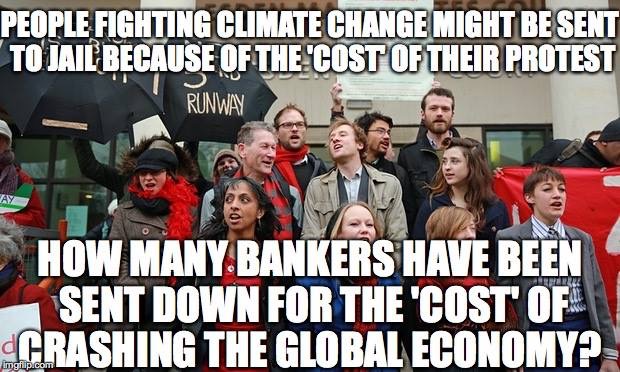
Six women and seven men have avoided jail for trespassing at Heathrow, following a protest against the possible expansion of the airport.
The activists, dubbed the Heathrow 13, were given sentences of six weeks suspended for 12 months, meaning they would not have to go to prison immediately.
They had been found guilty in January of aggravated trespass and entering a security-restricted area of an aerodrome. They had been warned by district judge Deborah Wright to expect a custodial sentence.
LONDON — Today I’ve been packing my bag for prison.
That sentence never gets less weird. It’s a task that most people will never have to do, or even think about doing, so it’s been a learning curve. Take this for example: you can’t take black clothes into prison. This is a serious problem for someone whose entire wardrobe is black.
If you’re wondering why I’m having to do this, here’s why: on Wednesday, myself and 12 others from direct action network Plane Stupid will be sentenced to “almost inevitable” (in the words of the judge) custodial sentences for our part in a direct action that happened last year.
In July, the #Heathrow13 occupied one of Heathrow’s runways for six hours: the longest airport occupation in the UK to date, and the most high profile. We managed to stop 25 planes and in so doing prevented the emission of hundreds, if not thousands, of tonnes of greenhouse gases into the atmosphere.
Aircraft are hugely polluting machines. They spew out air pollutants like particulate matter and nitrogen oxides that cause serious health effects for wildlife and for people living in the local area, as well as climate-damaging greenhouse gases. I’m sure I don’t need to explain that greenhouse gases cause climate change by trapping heat in the atmosphere, causing temperatures to rise and altering the way the climate functions. Carbon dioxide is the most obvious of these warming gases, but many others are also emitted by plane exhausts, such as oxides of nitrogen, which trigger the formation of ozone when emitted at altitude, and water vapour. All of these have a significant warming effect, especially when emitted at aircraft cruising altitude, several kilometres above the ground.
One of the major problems with aviation is that it cannot really be decarbonised. It takes a lot of energy to fly a heavy metal object full of people at hundreds of miles an hour across the world. Unfortunately, the technology is not yet there to allow planes to fly using hydrogen or electric fuel cells, which means that for now at least, jet fuel is very much fossil fuel based. Although efficiency improvements can reduce some of its impact, demand for aviation is enormous and any efficiency improvements are vastly outstripped by the rapid growth in passenger volumes. Many airlines, incl. United, are experimenting with biofuel blends as a possible transition fuel of sorts. But most biofuels are no better for the climate than oil. It’s not a serious solution.
What this means is that aviation is still a heavily polluting industry and will probably continue to be so for many years to come. However, action needs to be taken to combat climate change – something recognised in law by the UK’s 2008 Climate Change Act. This stipulates that UK emissions must be reduced by 80% from 2005 levels before 2050. That’s a big cut, but it might be possible if every sector in the UK economy makes aggressive and sustained reductions in their emissions.
However, aviation is being given something of a free ride – a proposed third runway at Heathrow, which would emit another 9 million tonnes or so of CO2 per year (emissions on a par with the whole of Kenya). We cannot build new runways if we are to prevent climate change –- and doing so undermines all of our other efforts to reduce emissions across the board.
Alnoor Ladha interviewed by Anna Bergren Miller - Shareable, February 18, 2016
The Rules is a worldwide network of activists working to transform the politico-economic structure undergirding global inequality. The network, which actively supports individual social movements while operating as a think tank, advocates radical reform focused on five strategic areas: money, power, secrecy, ideas, and the commons.
Last month, I spoke over Skype to The Rules founder Alnoor Ladha. Ladha filled me in on how The Rules operates on the ground, and on his own journey from reformer to revolutionary. We also spoke about the role of the city in neoliberalism, the part the sharing economy can play in rewriting "the rules," and why Donald Trump is emblematic of the challenges faced by anti-capitalist activists.
ABM: Tell me about The Rules. What is it?
AL: The Rules is a network of activists, writers, researchers, journalists, coders, hackers, and artists focused on addressing the root causes of inequality, poverty, and climate change. We don't focus on the traditional development model, which is based on aid, charity, and sympathy. We focus [instead] on the drivers of these injustices, which are things like the tax justice system, the global economic operating system—essentially the rules that ensure that the current state of pillage and destruction is the logical outcome.
We do that in two ways. We have a campaigning arm, that supports and works with social movements from around the world—peasant movements, farmer movements, women's rights groups, indigenous groups—as well as a think-tank arm, that tries to get more progressive and radical ideas into the mainstream media.
What are your objectives, both short- and long-term?
On the campaigning side, a lot of it is about helping groups articulate how all oppression is connected. So we're not fighting a lands-rights struggle in India, and a tax-justice struggle in Kenya, and a climate struggle in Venezuela. These are all linked to the same driver—the same nemesis, if you will. Which is the logic of the neoliberal capitalist system.
When we connect the dots like that, from a media perspective, a storytelling perspective, and a campaigning perspective, it helps expose the bigger picture at work. That's a lot of what the campaigning work is about. And also linking these civil-society groups with each other. We're trying to build that organizing infrastructure.
What brought you to this work? Did you have an epiphany moment, or was it more of an evolution in your thinking?
You know, it's funny. I think part of the journey for me has been like a removal of veils.
I was socialized by the Canadian education system. Things are pretty good in Canada for the average person. And no one looks at the historical reasons why that is the case. So I think when you start going on the journey of understanding privilege, you start having these veils systematically removed.
My dad was exiled from Uganda in the early 1970s by Idi Amin. So I was sensitive to power, and interested in understanding political power. But I was never an activist in that traditional sense from a young age. I wasn't some kind of child prodigy. I was just curious and interested.
As I became more curious, I started to question the structures behind the system. Once you start to understand, for example, that Canada's wealth is dependent on resource extraction and, historically, is a byproduct of the British colonial system, then you start understanding [why you were] taught this certain version of history.
Going to university in Canada, this idea [existed] that somehow we should be grateful for the jobs we're given. But [there was] no real explanation of the debt-based financial system that requires us to work these bullshit jobs.
I started as a reformist in many ways, because I believed the Western myth of progress, which is: everything's getting better, and if we could just make slight tweaks in this current system, things would be better.
I was really interested in the idea of social enterprise for a couple of years. Then when you start to ask, "Who are things getting better for, and in what way are they getting better?" you realize that that Western myth of progress is total bullshit.
Of every dollar of wealth created, 93 cents goes to the top one percent since 1998. You can see why we're told that the only model for any social change is more economic growth, more foreign direct investment, more GDP increase. Very few people benefit from that, but those are the same people who dictate what economic policy and theory is.
Understanding that every dollar of wealth creates inequality, and every dollar of wealth heats up our planet—because we have a fossil fuels extractive-based system—you realize that there's no way that reforming this current system is going to change the quality of life for the majority of humanity. Quite the opposite. The more we improve the system, the more we're keeping in a vampiric system whose logical outcome will be the destruction of the planet.
Cruel disregard of human life have been part of the capitalist package from the very beginning. To the ruling class our lives are important only to the degree that we produce profit they can exploit. In its latest neo-liberal incarnation, capitalism seems to have embraced its murderous impulses on a grand scale. The frustrations of extracting profits from an exhausted planet and its people have compelled the “job creators” to commit ever more shocking crimes. The poisoning of Flint stands as grim testimony to the complete contempt such people feel for the rest of us. To them, we are not quite human.
The tragedy initially received regional media attention 2014, shortly after the Republican-imposed Emergency Financial Manager switched Flint’s water supply from the Detroit supply system to a local system using the nearby Flint River. EPA and state reports indicating the poisonous content of the Flint River, a river thoroughly polluted by General Motors and others [i], were willfully ignored.
The excuse given at the time was that it was a money-saving measure in a city teetering on the edge of bankruptcy. Recent revelations have shown that even this poor excuse was an outright lie. [ii]. The question then is why did the Republican-appointed Emergency Manager make a decision that was so obviously sure to poison thousands of people?
One allegation is that it was a move to direct money away from Detroit, which at the time was in bankruptcy and being vigorously looted by every sort of shady speculator, including the selling of huge amounts of city real estate at what amounted to garage sale prices. The Detroit Water and Sewage Department made efforts to keep Flint from switching to the filthy water of the Flint River. They even offered their water at a reduced rate, one which negated any savings the City of Flint would make by switching. Flint would have actually SAVED money by staying with Detroit Water and Sewage. This was at a time when the Emergency Manager in Detroit was ordering that their own residents face water cut-offs if they couldn’t pay their bills.[iii]But the rightwing program of ethnic cleansing called for the complete destruction of Detroit, so the people of Flint were poisoned instead.
The cause of the mass-poisoning of the residents of Flint can also be laid at the feet of that innovation in capitalist extraction that has emerged in the last 25 years: Disaster Capitalism. It had nothing to do with saving 15 cents on the dollar, and it wasn’t mainly about diverting income from Detroit, it was about putting MILLIONS of dollars in public funds into the hands of private, rightwing capitalists. These are the people who financed the political campaigns that put the current gang of liars and murderers in power, and they were just looking for their payback – At least $12 million dollars worth of payback in fact. That’s what it was estimated it would cost to switch back to the Detroit water supply in October of 2015.[iv]
Who took that money? Contractors, the biggest an engineering firm from Texas ($4 million), with the help of the rightwing politicians who greased the way for them; many of whom can be seen in this photo of the all-white group surrounding the governor as he approves the aid package for Flint. [v]
Snyder has tried to blame the Flint City Council for the poisoning, but the facts tell a different story. In 2013 the Council voted to help build a new pipeline that would allow them to terminate their contract with the Detroit Water and Sewage Department, but the decision to stop taking Detroit water and start using the Flint River was made much later and by the Emergency Manager, at a time when the Council had no say in city decision-making.
“Snyder said that Detroit, after being informed of the Flint council vote, sent a “letter of termination” of water service. Detroit sent a letter giving Flint one year on its existing contract, but that didn’t mean Flint couldn’t get water from Detroit after that date. In fact, there was a flurry of negotiations between Detroit and Flint to sign a new contract that would carry Flint through until it could connect to the under-construction pipeline.”[vi]
The Flint water crisis is an illustration of the essential criminality of capitalism, with “disaster capitalism” taking the next step into open criminality. Those involved conspired to create a disaster, then reaped huge profits from its implementation, and are now reaping even greater profits from fixing the mess they made.
The greed-based, anti-human social and economic system we live in caused the poisoning of the people of Flint. This does not in any way absolve the individual politicians and capitalists who facilitated the disaster (they should all hang), but only places them in perspective. The system didn’t fail in Flint; it failed to protect the people of Flint, but that’s not what it was designed for. The system functioned exactly as it was supposed to: the ruling class was able to stuff it’s pockets with money, the politicians were able to pay-off their debts to them, and things are comfortably rolling on to the next election cycle.[vii]
The #Heathrow13 will ‘almost inevitably’ be sent to prison on 24 February for occupying the northern runway of Heathrow airport. They took this action, which led to 25 flights being cancelled, to protest against the building of a third runway at Heathrow airport, as recommended by the Davis Commission less than a fortnight previously. The fact is, we can't build any new runways in the face of climate change. It's that simple.
In going to jail, the #Heathrow13 will be the first climate activists in the UK to be given a custodial sentence. Given the seriousness that a prison sentence implies, it would be easy to let this scare us from taking the necessary action that our movements need. That would be a mistake, for now is the time for exactly the opposite. Now is the time to escalate things and given the amount of outrage towards this sentencing, as well as the love and support that is being shown to Plane Stupid, it seems like there is a real possibility of such an escalation.
By the Organizing Committee of March 11 Anti-NPP Fukushima Action in 2016 - January 1, 2016
Doro-Chiba Union calls for endorsement of and participation in Anti-Nuclear Power Plant Fukushima Action on March 11, 2016:
We have the power to change the history! This is the slogan of the Anti-Nuclear Power Plant Fukushima Action on March 11, 2016.
Against the legislation to exercise the right to collective self-defense more than 100 thousand of people filled the square in front of the Diet day after day. Since this mass uprising last autumn a rising tide of the struggle by millions workers, students and other people, has broadened deeply all over the country and around the world.
The struggle of the fifth anniversary of the Earthquake and nuclear reactor meltdowns on March 11th in Fukushima will be fought headed by the unions which have been waging strikes, with Fukushima people’s widespread anger, calling “down with Abe administration which promotes war bills and wages restarting of nuclear power plants”.
Please endorse and participate in this action from all over the country and around the world.
By an Anonymous Organiser - Novara, January 31, 2016
Britain is one of the wealthiest countries in the world. Still, a substantial minority of the workforce works for less than what it takes to get by. A much larger part of the workforce gets by in a haze of exhaustion, alienation and frustration, with little recourse. For the unemployed, disabled, ill or precariously employed, the sorrows of work are replaced or compounded by the malicious bureaucratic violence of the Department for Work and Pensions. For the retired, pensions are among the worst in the developed world and social care is a disgrace.
Chronic low expectations, low levels of worker solidarity and enfeebled official union structures – all the consequences of very deliberate legislative and executive action by successive governments – make it difficult to see a way out.
Still, a functional, scaleable, radical, rooted trade unionism capable of transcending bureaucratic hindrance and legal repression is a necessary starting point for a freer, more democratic, more equitable society.
With looming, sweeping automation threatening the movement’s last vestiges of strength in the industrial sectors – on the railways, and in some parts of distribution – the task of building this trade unionism is urgent.
Extensive automation achieved purely on the terms of capital will eradicate what’s left of the unionised working class, hastening the arrival of a purgatorial post-democracy. The absence of any industrial organisation with any means of obstructing the means of production and distribution in moments of conflict will lead to the total exclusion of the working class from civil society and political discourse. Protests and mobilisations are one thing – good unions secure and enforce the gains of the class in a permanent, scaleable way.
To unpack some of the obstacles to this work in the UK today, we need to approach this from the workplace and national level. We need to interrogate which demands, tactics and strategies could – just could – begin to rebuild the political and industrial power of workers and the economically excluded. And such interrogation is a matter of urgency: the Conservatives’ trade union bill – a bill that will make useful trade unionism close to impossible within the law – looks set to pass through parliament with little more than a whimper of labour movement opposition.
Last week thirteen members of UK direct action group Plane Stupid were found guilty of aggravated trespass and unlawfully entering a restricted area of an aerodrome for their part in an action last July. The #Heathrow13 occupied Heathrow airport’s northern runway for a record-breaking 6 hours, preventing hundreds, if not thousands, of tonnes of CO2 from being emitted. The action took place shortly after the release of the Davies Report, a government-commissioned report on airport expansion in the Southeast that recommended a third runway be built at Heathrow.
There are many issues here: for one thing, the Prime Minister David Cameron promised in a pre-election manifesto not to build a third runway, “no ifs, no buts”. The recommendation for a third runway therefore represents another massive U-turn on the part of the Conservative government, who also once claimed to be part of the ‘greenest government ever’. Meanwhile, the Tories have scrapped subsidies for wind energy, removed feed-in tariffs and support for small-scale community energy projects and given the go-ahead to grant fracking licenses. All of their actions are in direct opposition to the Climate Change Act 2008, a radical piece of legislation that requires the UK to reduce emissions by 80% relative to 1990 by 2050. If we are to meet these (legally binding) targets, aviation cannot be allowed to continue to emit as it does.
Yet Heathrow is just part of the problem. Building a runway anywhere in the UK will be massively damaging to the environment. Indeed, the Davies Commission investigated three options for expansion, none of which was not to expand at all. This is revealing of the government’s priorities: they would rather lock up peaceful activists and profit from human suffering than lose out on the £7bn a year that Heathrow apparently contributes to the UK economy.
Aviation cannot be readily decarbonised, and is one of the most polluting industries around. The emission of pollutants at cruising altitude makes their effects more pronounced and contributes considerably to climate change. On the ground, emissions of air pollutants like particulate matter and NOx cause severe respiratory illnesses and deaths in the local area. Within the 32km surrounding Heathrow, 31 deaths per year are directly attributable to emissions of NOx from aircraft.
Flying is also a preserve of the wealthy – in the UK, 70% of flights are taken by 15% of people, and only 5% of people globally have ever flown at all. This is a clear demonstration of global and national inequality. The whims of rich leisure flyers are prioritised over the lives and livelihoods of poor people who have to breathe toxic pollutants and lose their homes to rising seas. Aviation also enjoys a privileged status – aviation is not included in any climate negotiations or legislation and aircraft fuel and tickets are exempt from VAT. Imagine that – we live in a country where tampons are considered a luxury item and taxed as such, while a flight to a ski resort is not. The cost of meeting climate targets is never passed on, and airlines continue to get a free ride for exploiting us.
Exploitation is big business. Exploitation of the environment, of resources and of workers. Corporations like Heathrow Airport Ltd. are making billions from an industry that is contributing to premature deaths in the local area and around the world. And of course, it is the poorest people who get hit the hardest, and hit first.
In a capitalist society, a few people control the means of production, and they use this to exert their influence on the majority of people, profiting from their labour. This is a story of inequalities: Heathrow has the power and clout of the judicial system, financial backing, and a PR company behind them, whereas ordinary people have nothing but their bodies and their intellect at their disposal. Direct action is one way of redressing this vast imbalance and wresting back some control.
It scares those in power to think that people might begin to take things into their own hands and make change. That is why an example is being made here. The #Heathrow13 may soon be the first UK climate prisoners, but they certainly won’t be the last. To paraphrase Howard Zinn - action outside the law is essential to democracy. You’ll never change outdated laws without breaking them. We must challenge the capitalist status quo that abuses natural resources and people in equal and devastating measure with what means we have. It will take the sacrifices of thousands of normal people to break oppressive structures that exploit people and the environment, but the tide is turning.
Among thirteen defendants threatened with incarceration are two members of our One Big Union. Fellow Workers Ella Gilbert from Norwich and Bec Sanderson from Machynlleth. We express our solidarity and admiration for their courage. An injury to one is an injury to all!
Monday, January 20th, 2016, London – Today in Willesden Magistrates Court, the thirteen Plane Stupid activists who occupied Heathrow’s north runway for six hours on the 13th of July last year were all convicted of aggravated trespass and being airside without lawful authority. The Judge has asked them all to return in 3 weeks on the 24th February for sentencing and has advised all defendants to prepare for immediate custodial sentences.
The thirteen defendants released the following statement, in response to their convictions:
Today’s judgement demonstrates that the legal system does not yet recognise that climate defence is not an offence. We took action because we saw that it was sorely needed. When the democratic, legislative and processes have failed, it takes the actions of ordinary people to change them.
We are very grateful for all the messages of support and solidarity we have received from all over the world, and are immensely proud of the action we took to combat emissions from aviation. Climate change and air pollution from Heathrow are killing people now, and the government’s response is to spend millions making the problem bigger. As long as airport expansion is on the agenda, Plane Stupid will be here. We’re in it for the long haul.
Most of the defence’s witness evidence was not heard in court, and none of the witnesses were allowed to appear in court. John McDonnell was not heard in full due to the Judge having already accepted the points he was addressing, and therefore ruling the statement irrelevant.
Her ruling on John McDonnell’s evidence is available here
And John McDonnell’s full statement is available here
Statements from three local residents from the Heathrow area were read out, detailing the debilitating and life-threatening medical conditions they were suffering from as a consequence of living near to the airport.
Character references for the defendants were also read out in court, from a variety of public figures including High Court Judge Peter Jackson and a long list of barristers and solicitors.
Alice Bowes-Larkin, one of the UK’s leading climate scientists, and a specialist in the climate impacts of aviation, submitted a statement which was read to the court. It mentioned that Heathrow “is the airport with the highest CO2 contribution in the world in terms of combined international and domestic flights” and “this puts Heathrow expansion at odds with the UK Government’s commitment to avoiding a ‘well below’ 2’C target, unless a major programme of efficiency and biofuel development are delivered in tandem.”
Sian Berry, the Green Party’s candidate for the London mayoral elections, came to court to support the defendants, despite her evidence having been ruled as inadmissible by the judge. Her statement is available here
George Monbiot’s statement was also ruled inadmissible, and is available here
Writing on how the activists will be seen in the future, he said:
They will be regarded not as outlaws and subversives, but as democratic heroes. Succeeding generations, struggling with the impacts that our government’s failures to take action on climate change bequeathed them, are likely to be amazed that they could have been seen in any other light.
In all, of the ten defence witnesses, only four had their evidence allowed, and none were permitted to appear in court.
The runway occupation, under the banner of anti-aviation expansion group Plane Stupid and the first on a Heathrow runway, lasted six hours and delayed or cancelled dozens of flights. The activists, who are all pleading not guilty, are accused of aggravated trespass and trespassing airside without authority.
Image:Activists deliver the Our Power Plan to the EPA’s regional office in San Francisco on January 19, 2016 (Facebook/CEJA)
It has been a month since the UN climate summit in Paris, aka COP 21. One might expect the kind of ebb and flow we often see in popular movements. Interest in climate issues, the cause of the day during the summit, might be expected to wane and move to the back burner of public discourse until such time as another development pushes it forward again.
However, climate change is fundamentally different. It is going to get worse — we will be getting slapped in the face with this one for a long, long time, even under the best scenarios. Only a few weeks after COP 21, the world experienced a wave of floods and extreme weather exacerbated by global warming. In the US, there were record-setting floods along the Mississippi River. In South America, floods caused the evacuation of 180,000 persons. In Scotland, floods cut across class lines to threaten a historic castle neighboring the Queen's Balmoral residence, its foundation being eaten away by the swollen Dee river. Meanwhile, oil wars and drought continue to drive an immigration crisis in Syria and throughout the Middle East and Northern Africa. The issue of climate is not the “struggle du jour” - it is going to be the main course for quite a while.
Shamefully, the broad, “mainstream” climate movement in the so-called “developed” world is woefully inadequate to address this concern. It is not producing the kind of real life strategies, analysis and resistance that current conditions call for. Right now, the dominant character of this movement is actually holding us back, not pushing us forward. It is a movement that trumpets ambiguous desires for sustainability, but is all too silent when it comes to meaningful demands.
What we got from COP 21 was an accord that set inadequate and unenforceable carbon emissions limits; failed to guarantee reparations or support for the poorest, most exploited nations to develop alternative technologies; adopted market-based schemes that entrench international inequality; ignored the demands of indigenous peoples; and refused to address the huge and negative climate impact of US militarism and resource wars. Of course, no one expected such measures to be passed, so it might be justly claimed as a victory that any kind of agreement or protocol was passed at all. As has been noted, had the agreement been enforceable, the Republican-dominated US Congress would have quashed that government's participation. But what victory there has been is a Pyrrhic one.
The good news from Paris was those groups that defied the ban on public marches and protests instated following the November 13 terrorist attacks. There were some 200 protesters arrested on November 29, the opening day of the summit, when they broke ranks with officially-tolerated activities and took to the streets, despite authorities having “preventatively” detained a number of activists before the summit began. There was also the December 6 flotilla of indigenous peoples protesting the exclusion of indigenous rights from the accord minus a brief mention in the preamble. The flotilla exposed the machinations of the US, European Union, Australia and others to exempt indigenous rights from the body of the agreement. It was refreshing to hear of these and others who refused to cooperate with this gag rule.
Around the world people are getting radicalized and making bold efforts to save this biosphere we know and love. In the US, Flood the System called for and carried out multiple climate justice actions. The Global Climate Convergence is continuing its work to build a Peoples Climate Strike. Groups like the Indigenous Environmental Network and Climate Justice Alliance are confronting the legacy of colonialism and its damage to land and water. Fossil Fuel Student Divestment Network is organizing to divest universities from the oil and coal companies. Still, the reality is that the broad climate movement in the “developed”world has mostly been a failure and an obstacle to building an effective and truly relevant movement.
Disclaimer: The views expressed on this site are not the official position of the IWW (or even the IWW’s EUC) unless otherwise indicated and do not necessarily represent the views of anyone but the author’s, nor should it be assumed that any of these authors automatically support the IWW or endorse any of its positions.
Further: the inclusion of a link on our site (other than the link to the main IWW site) does not imply endorsement by or an alliance with the IWW. These sites have been chosen by our members due to their perceived relevance to the IWW EUC and are included here for informational purposes only. If you have any suggestions or comments on any of the links included (or not included) above, please contact us.
The Fine Print II:
Fair Use Notice: The material on this site is provided for educational and informational purposes. It may contain copyrighted material the use of which has not always been specifically authorized by the copyright owner. It is being made available in an effort to advance the understanding of scientific, environmental, economic, social justice and human rights issues etc.
It is believed that this constitutes a 'fair use' of any such copyrighted material as provided for in section 107 of the US Copyright Law. In accordance with Title 17 U.S.C. Section 107, the material on this site is distributed without profit to those who have an interest in using the included information for research and educational purposes. If you wish to use copyrighted material from this site for purposes of your own that go beyond 'fair use', you must obtain permission from the copyright owner. The information on this site does not constitute legal or technical advice.
Official IWW Notice:
This site is not the official webpage of the Industrial Workers of the World. If you are looking for the IWW's official site, please visit iww.org.






 ...You have defined your political philosophy as libertarian socialism/anarchism, but refuse to accept the view that anarchism as a vision of social order flows naturally from your views on language. Is the link then purely coincidental?
 Editors Note: Ella Gilbert MSc (as well as several other members of the #Heathrow13) are dues paying members of the IWW. for more details about the struggle, please visit
  The Rules
 Cruel disregard of human life have been part of the capitalist package from the very beginning. To the ruling class our lives are important only to the degree that we produce profit they can exploit. In its latest neo-liberal incarnation, capitalism seems to have embraced its murderous impulses on a grand scale. The frustrations of extracting profits from an exhausted planet and its people have compelled the “job creators” to commit ever more shocking crimes. The poisoning of Flint stands as grim testimony to the complete contempt such people feel for the rest of us. To them, we are not quite human.
 The #Heathrow13 will ‘almost inevitably’ be sent to prison on 24 February for occupying the northern runway of Heathrow airport. They took this action, which led to 25 flights being cancelled, to protest against the building of a third runway at Heathrow airport, as recommended by the Davis Commission less than a fortnight previously. The fact is, we can't build any new runways in the face of climate change. It's that simple.
 We have the power to change the history! This is the slogan of the Anti-Nuclear Power Plant Fukushima Action on March 11, 2016.
 Britain is one of the wealthiest countries in the world. Still, a substantial minority of the workforce works for less than what it takes to get by. A much larger part of the workforce gets by in a haze of exhaustion, alienation and frustration, with little recourse. For the unemployed, disabled, ill or precariously employed, the sorrows of work are replaced or compounded by the malicious bureaucratic violence of the Department for Work and Pensions. For the retired, pensions are among the worst in the developed world and social care is a disgrace.
 Last week thirteen members of UK direct action group Plane Stupid were found guilty of aggravated trespass and unlawfully entering a restricted area of an aerodrome for their part in an action last July. The #Heathrow13 occupied Heathrow airport’s northern runway for a record-breaking 6 hours, preventing hundreds, if not thousands, of tonnes of CO2 from being emitted. The action took place shortly after the release of the Davies Report, a government-commissioned report on airport expansion in the Southeast that recommended a third runway be built at Heathrow.
 Image: Activists deliver the Our Power Plan to the EPA’s regional office in San Francisco on January 19, 2016 (Facebook/CEJA)
 This site is not the official webpage of the Industrial Workers of the World.