You are here

green syndicalism

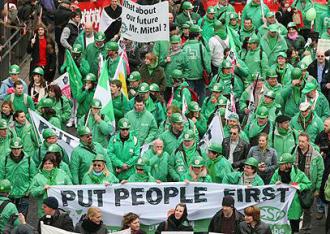
A new Lucas Plan for the future

By David King - Morning Star, November 26, 2016

The ideas pioneered by the Lucas workers are just as, or more, relevant now than in the 1970s, and there are strong political similarities in the situation.

As in the ’70s, we have an economic crisis caused by unjust economic policies and the failure of successive governments’ industrial strategy.

As usual, this has hit the working class hardest, and anger over this is being channelled into racism against immigrants. Now, the environmental effects of industrial capitalism are far more evident than 40 years ago, already creating wars, militarisation and widespread concern about insecurity.

Finally, introduction of new technologies threatens structural unemployment on a scale considerably greater than the ’70s.

The Tory government’s response to the economic and political crisis, despite continuing to publicly espouse neoliberal principles, looks a lot like a classic Keynesian economic stimulus package.

In the last few months it has made decisions to move ahead with a range of industrial infrastructure megaprojects — Hinkley C, fracking, HS2 and the Heathrow third runway, as well as pressing ahead with spending £200 billion on Trident renewal.

A key element in the case for all these projects is the jobs that they will generate or preserve, although the jobs estimates are bound to be inflated, while the price tag will be massively underestimated.

Compared to the ’70s, far fewer jobs will be created in this way because, due to automation and mechanisation, they are all highly capital rather than labour-intensive.

The Lucas Aerospace workers’ idea of socially useful production suggests a far better way forward.

Trump’s election showed widespread discontent: Our job is to help transform popular discontent into a political force

By Michael Eisenscher - Popular Resistance, November 19, 2016

Election night put most progressives into a state of shock and disbelief – a metaphysical body blow to all the values and ideals to which we are committed. Even though we knew intellectually that Trump might win, we didn’t really believe it would happen. The pollsters said it would not happen. Most of the corporate media said it would not happen. Most of the power structure was committed to preventing it. Who imagined that a crude narcissistic loud-mouthed bigot could win a national election for the highest office in the land! But that’s what happened.

The day after, the enormity of what had happened started to sink in. Trump’s promised Supreme Court appointments alone could reverse decades of hard fought victories, most especially in relation to human rights and civil liberties. Agencies like the NLRB, EPA, FDA and more could be gutted and regulatory protections they were established to enforce evaporate overnight. He’s already said he intends to move forward to deport two to three million immigrants. Racists, bigots and reactionaries of all sorts have been emboldened and attacks on Muslims, immigrants and people of color have escalated. Trump’s retrograde climate denial and commitment to his fossil fuel industry backers puts the population of the entire planet into peril as a consequence of unchecked global warming.

Trump, a man with a world-sized ego but virtually no experience in foreign relations or governing, will turn running the country over to a band of neocons and social reactionaries – like Vice President Mike Pence – who now see the opportunity to complete the revolution they started when George W. Bush held office. (Imagine a cabinet composed entirely of Dick Cheney clones.) It’s the stuff nightmares are made of.

With all three branches of government in the hands of the GOP, Trump will seek to dismantle the funding restrictions imposed by the Budget Control Act of 2011 that capped spending and requires that any increases in military spending be matched by equivalent increases in domestic funding. Once that is accomplished, the sluice gate between the Treasury and Pentagon will be lifted. Domestic programs that provide what’s left of a social safety net and social programs that serve working people and the poor will be drained into the swamp of the military-industrial complex.

As dire as the threats that Trump represents are, for me they have a ring of familiarity. Although the politics, social composition and economics of the U.S. are dramatically changed, I hear an echo of an earlier era – one of which an overwhelming majority of those who voted this month have no memory.

I am a child of the Cold War, born on the early side of the baby boom generation in 1944. I am just old enough to remember the McCarthy era of the 1950s. Living in Milwaukee, for my family the witch hunts of Senator Joseph McCarthy were very real. Because my father was a leader in the Wisconsin Communist Party, the FBI was a haunting presence in my family’s life. “Better dead than red” characterized the political climate in which the left strived to remain true to its progressive values. Being labeled a “red” meant being fired, blacklisted, threatened, harassed, and in some cases physically assaulted.

Then came Tricky Dick Nixon, an arch reactionary who made his reputation as one of the Cold War’s ugliest witch hunters. On the day that Nixon was elected, alarm bells sounded not unlike those that are ringing now. There was once again the sniff of fascism in the air.

They rang again when Ronald Reagan, former president of the Screen Actors Guild who led the purge of the left in his union, took office. Prior to switching from B-films to politics, he had appeared weekly on TV as the huckster for General Electric, one of the most prominent and powerful advocates for militarism and an aggressive foreign policy throughout the Cold War.

In the darkest days of the McCarthy era, it was hard to imagine that within a decade we would see the birth of new civil rights, women’s and antiwar movements that would transform the social order and the popular culture of the nation. On the morning after the Nixon and Reagan elections, the future looked grim and threatening. The prospect for progressive change appeared to be fading from the horizon.

I can recall how frightened people were at the prospect of what lay ahead for themselves, their family, community and the nation. Those were decades in which the arms race and threat of all out nuclear war stoked fears of global annihilation. With the atomic bombings of Hiroshima and Nagasaki still fresh in the collective memory of the country, the fear of a nuclear holocaust was very real.

But there is an important lesson embedded in that history. Most of the American people actually believe in democracy, freedom, justice and fairness. As dark and threatening as conditions might have appeared in the moment, the fundamental instinct for goodness of a majority of people ultimately surfaced.

Bite the Hand That Holds the Leash

By Patrick O’Donoghue - First of May Anarchist Alliance, November 18, 2016

“The thing to remember about people like Trump is that they offer false solutions and scapegoats to real problems- like the Klan did and still does, like the Commission on Public Safety did here in Minnesota during World War One, like the anti-refugee/anti-immigrant crowd does in stirring up hate against Somalis and Hispanic people in St Cloud and around the Twin Cities. The solutions Trump peddles don’t work. Deporting Mexicans can’t bring back jobs that got replaced by machines. Profiling Muslims can’t bring us security when the main domestic terror threat is white supremacists. You can’t reverse the stagnation of wages by busting unions. You can’t stop outsourcing by trying to stop other countries from developing.”

The night Trump got elected, I did a lot of soul searching, because the work I do as a revolutionary and an organizer involves, a lot of the time, trying to help and support people who… probably voted for Trump.

The place I work is mostly white, with coworkers that, like me, come from rural and blue collar backgrounds. It’s a place of contradictions, where rants about the boss getting rich off your labor comes as easily off of people’s lips as rants about ‘welfare queens’ coded in the tired language of black bashing, where nobody likes a cop until the issue of protesters and ‘thugs’ comes up. It’s a place where machismo is key and being “not PC” is part of being a man. A number of my coworkers are in that strange, almost fabled breed of voters who were excited about Sanders, then after he lost the primaries drifted towards Trump- more didn’t bother voting at all. It’s a racially divided workplace, and the black section, which has a union, is under attack from the company. Our section, mostly white, is non-union, and so far hasn’t gotten involved. Most aren’t even aware of the contract disputes; the two sections don’t talk much.

I was sitting on leave, thinking about my work, and wondering how the hell I could bring myself to go into work again and keep trying to talk to, and listen to, and support people who were fine with throwing my Muslim and queer family members and friends, and our immigrant and black coworkers, under the bus for a guy who made a lot of promises he can’t keep about making America great again. I knew, intellectually, why I had to- because after decades of neoliberal policies by a Democratic Party that abandoned the Great Society vision, of mechanization and outsourcing, of the Farm Crisis, and of the weakening of unions and the left, has left a lot of rural and working class white people searching for answers. I knew, intellectually, that if those answers don’t come in the form of standing with other exploited and marginalized people, they were going to come in the form of blaming even more exploited and marginalized people, of buying into the far right. I knew, from experience, that trying to approach anti-racism solely from a stance of guilt and blame is usually counterproductive and feeds the same processes that drive people to retreat into racism in the first place. I knew that I had to keep trying- but deep down in my gut, I felt like I was betraying my friends who are facing worse dangers under a Trump administration than I’m going to.

Then, the day after the election, a coworker of mine did something I hoped would happen for a long time. The man is a classic Rust Belt populist. A laid off union ironworker turned mariner, raised in a trailer park worrying about whether they’d have electricity that month. He harbors a lot of racial resentment over what he feels like are his problems not being acknowledged, being written off because of his relative white privilege. He resents being blamed or made to feel guilty for racism- and in a process familiar to anyone from my hometown, that defensiveness slowly turns into a defense of racism itself, a way to way to reject the blame by rejecting the idea that anything was wrong in the first place. This guy approached a queer coworker and an amazing organizer, and asked to meet with him, a Mexican, and a known Black Lives Matter arrestee to talk about forming a union. He insisted. He started talking organizing strategy. I got the news after work, in a pho shop near the waterfront. I almost broke down. It was the best news I could have hoped for. It gave me the strength to come into work ready to keep organizing.

DC IWW Resolution on Standing Rock

Official Statement by the DC IWW General Membership Branch - November 19, 2016

The DC General Membership Branch of the Industrial Workers of the World wish to express our solidarity with the water protectors at Standing Rock who are resisting the construction of the Dakota Access Pipeline on their tribal lands. The Standing Rock Sioux Tribe, and those fighting alongside them, are on the front lines of environmental struggle in North America, standing against corporate power and greed, against government collusion with private interests, and above all against the planet-killing depredations of the industrial capitalist system.

To the water protectors at Standing Rock, we say the following: Your struggle, to defend your own communities, health, dignity, and livelihoods, is a clear lesson to all who love freedom and justice: there is not, and must not be, any separation between fighting for Mother Earth and fighting for our lives. Protecting the Earth from destruction is an act of collective self-defense. The Sioux phrase, “Mitakuye Oyasin” -- “All Are Related” -- is similar to the old IWW slogan, “An injury to one is an injury to all,” reminding the working class of its common identity. By fighting the Dakota Access pipeline, the water protectors-our fellow workers- at Standing Rock protect not only themselves but millions of fellow workers who could potentially be impacted by the Dakota Access Pipeline.

By taking action to defend your water and land, you have struck powerful blows against the corporate action exploitation of the Earth. Your struggle is supported and appreciated. We encourage all groups and all peoples concerned with the exploitation of our Earth for profit to support the water protectors at Standing Rock.

In Harmony with the Earth! Mni Wiconi! Water Is Life!

The power of the movements facing Trump

By Michael Hardt and Sandro Mezzadra - ROARMag, November 16, 2016

It is much too early to say to what extent President Trump will enact his campaign promises as government policy and, indeed, how much he will actually be able to do in office. But every day since his election demonstrations have sprung up throughout the United States to express outrage, apprehension and dismay.
Moreover, there is no doubt that once in office Trump and his administration will continually do and say things that will inspire protest. For at least the next four years people in the US will rally and march against his government, regularly and in large numbers. Protesting against threats to the environment will undoubtedly be urgent, as will be the generalized atmosphere of violence against people of color, women, LGBTQ populations, migrants, Muslims, workers of various sorts, the poor — and the list goes on.

One of the potential pitfalls for social movements, however, is that activism goes no further than protest. Protest, of course, can bring a city to a halt, can block temporarily the action of the government, and can even play the crucial role of opening up spaces for political alternatives. But on its own, protest is never enough to create lasting social transformation.

The significance of the Trump presidency and, moreover, the keys to developing protest against it become clearer, we think, when posed in a global context. Before coming back to the questions for social movements, then, let us frame some of the basic aspects of the global context into which Trump’s government will enter.

To Escape Trump’s America, We Need to Bring the Militant Labor Tactics of 1946 Back to the Future

By Admin - Life Long Wobbly, November 12, 2016

Back to the Future, Part 1:

The last general strike in the US was in Oakland in 1946. That year there were 6 city-wide general strikes, plus nationwide strikes in steel, coal, and rail transport. More than 5 million workers struck in the biggest strike wave of US history. So what happened? Why haven’t we ever gone out like that again? Congress amended US labor law in 1947, adding massive penalties for the very tactics that had allowed strikes to spread and be successful – and the business unions accepted the new laws. In fact, they even went beyond them by voluntarily adding “no-strike clauses” to every union contract for the last 70 years, and agreeing that when they do strike in between contracts it will only be for their own wages and working conditions, not to support anybody else or to apply pressure about things happening in the broader society. When we allowed ourselves to lose our most important weapons 70 years ago, we took the first step towards Trump’s America. We’re stuck in the wrong timeline – if we want to get out, we have to bring the militant labor tactics of 1946 back to the future!

IWW Member Brenna Cain: Why I Am With Labor For Standing Rock

By Brenna Cain - IWW Environmental Unionism Caucus, November 3, 2016

Brenna Cain from IWW 610 talks about the importance of defending the human rights of Native Americans and supporting their efforts to protect the Missouri River.

IWW Member Liam Cain: Why I Am With Labor For Standing Rock

By Liam Cain - IWW Environmental Unionism Caucus, November 3, 2016

I Just got back from a brief but inspiring trip to North Dakota with Labor for Standing Rock. Here Liam Cain from LIUNA Local 1271 / IWW EUC talks about the importance of defending the human rights of Native Americans and supporting their efforts to protect the Missouri River. Mni Wiconi - Water is Life

Unions Prepare for UN Climate Talks in Marrakesh

(Original PDF) The times when climate action was raised as a job killer are behind us. Ambitious emissions reduction and adaptation policies are now recognised as vital to protect jobs, people and communities from the impacts of climate change, and investment is creating jobs in renewable energy, public transit, energy efficiency in buildings, sustainable agriculture, forestry, water and more.

We are living in a time of contradictions. A minority of corporate interests intends to benefit until the last minute from a socially unfair, environmentally-damaging and undemocratic system by obstructing change. Many governments bow to these interests while austerity policies, attacks on regulation and public services remain on the same governments’ tables, even when those policies have proven to be disastrous and their countries face climate aggravated crises.

For the past years, the international trade union movement has stood strong in calling for ambition from our political leaders on climate because we all know: “there are no jobs on a dead planet”.

In 2015 government leaders from all over the world signed the Paris Agreement, which will regulate international climate action from 2020 onwards. For unions, every step that contributes to global governance in favour of rights, justice and solidarity – every investment in climate action is a welcome one. However, we are conscious that the long-term objective governments have set for themselves and our societies of “staying well below 2°C in average temperature increase, and aiming at 1.5°C”, will only be reached if concrete measures are taken to dramatically change our production and consumption patterns and if national emissions reduction objectives, in particular in developed countries, are reviewed with greater ambition, before 2018.

Reaching the agreed goals will also require governments to deliver on their climate finance commitments and agree to provide more support so that everyone can contribute to the global effort. The Paris Agreement is one step in a long journey for protecting our climate.

This is not only a matter of principle – it is a matter of need: we need ambition to trigger sustainable investments and decent jobs at a time when we face historic levels of unemployment with half of the world’s workers either unemployed or in vulnerable employment, with two in five young people in this situation.

We know millions of workers and families still depend on a fossil-fuel-based economy for their jobs and livelihoods. They have generated the energy required for today’s prosperity. Governments and employers, with workers and their unions must sit together and commit to protect our future through a just transition strategy

– a plan which guarantees decent work for all. The inclusion of a just transition in the Paris Agreement is an important first step.

Corporations who refuse to diversify their energy base instead set out to frighten workers. But fear will not deliver for working families in communities dependent on fossil fuels. Fear will just increase the costs of action and make the prospects for organising the transition we need to build together more difficult. A difficult set of challenges confront us. The imperative to make our societies compatible with all forms of life and with the restrictions of limited planetary resources must be met with national and international plans that must deliver

on social justice and prosperity for all. The decisions by global leaders to meet the sustainable development goals by 2030 with the Paris agreement chart a course to a zero poverty, zero carbon world but this journey will only be realised when people act to make it happen.

Not Just Transition, But Transformation: the Paris Climate Agreement

By Sean Sweeney - The Murphy Institute, November 7, 2016

The Paris Climate Agreement came into effect November 4th, 2016. More than 90 countries have ratified the deal, which is enough to turn it into international law.

Unions all over the world are trying to anticipate the agreement’s likely impacts and navigate its provisions to advance the interests of working people. Towards that end, a cross section of international labor will be in Marrakech from November 7th-19th calling for a “just transition strategy,” and to press for more ambitious targets and adequate climate financing for the global South.

Pages

The Fine Print I:

Disclaimer: The views expressed on this site are not the official position of the IWW (or even the IWW’s EUC) unless otherwise indicated and do not necessarily represent the views of anyone but the author’s, nor should it be assumed that any of these authors automatically support the IWW or endorse any of its positions.

Further: the inclusion of a link on our site (other than the link to the main IWW site) does not imply endorsement by or an alliance with the IWW. These sites have been chosen by our members due to their perceived relevance to the IWW EUC and are included here for informational purposes only. If you have any suggestions or comments on any of the links included (or not included) above, please contact us.

The Fine Print II:

Fair Use Notice: The material on this site is provided for educational and informational purposes. It may contain copyrighted material the use of which has not always been specifically authorized by the copyright owner. It is being made available in an effort to advance the understanding of scientific, environmental, economic, social justice and human rights issues etc.

It is believed that this constitutes a 'fair use' of any such copyrighted material as provided for in section 107 of the US Copyright Law. In accordance with Title 17 U.S.C. Section 107, the material on this site is distributed without profit to those who have an interest in using the included information for research and educational purposes. If you wish to use copyrighted material from this site for purposes of your own that go beyond 'fair use', you must obtain permission from the copyright owner. The information on this site does not constitute legal or technical advice.