You are here

green syndicalism

Preparing to confront the politicians' hot air

By Michael Ware and Ragina Johnson - Socialist Worker, October 27, 2015

Disclaimer: The views expressed here are not the official position of the IWW (or even the IWW’s EUC) and do not necessarily represent the views of anyone but the author’s.

THE LATEST world summit conference on climate change, due to begin in Paris on November 30, will take place against the backdrop of continuing climate disasters--including a new report from the National Oceanic and Atmospheric Administration that the planet suffered its hottest summer ever recorded, and possibly the hottest in 4,000 years.

That ought to give some urgency to the two-week-long meeting--officially called the 21st Congress of the Parties for the United Nations Framework Convention on Climate Change, or COP 21--that is supposed to finally produce a binding international treaty to limit greenhouse gas emissions, with the goal of keeping the global temperature rise to less than 2 degrees Celsius.

But there's lots of reasons to doubt the resolve of world leaders--the recent failure of preparatory talks in Bonn, the lack of ambition or action by powerful governments in the past and, of course, the dismal record of previous COPs to accomplish anything meaningful. Whatever agreement is struck in Paris, it won't do nearly enough.

Climate justice activists worldwide will send a different message from the politicians' hot air--and show their determination to be heard with events and actions throughout the fall, culminating in large protests in Paris itself.

The Not-So Golden Age: a Radical and Eco-Socialist Take on Post-WW II America and “the Anthropocene”

By Paul Street - Counter Punch, October 16, 2015

Disclaimer: The views expressed here are not the official position of the IWW (or even the IWW’s EUC) and do not necessarily represent the views of anyone but the author’s.

Some Darkness Behind the “Sun-Washed Days”

There is a tendency among senior and middle-aged liberal and progressive United States intellectuals to sentimentalize the post-World War II “golden age” of American and Western capitalism between 1945 and the early to middle 1970s.   The inclination is understandable. During those “sun-washed days” (liberal author and former New York Times columnist Bob Herbert), economic inequality declined, significant Civil Rights victories were achieved, jobs were plentiful, the endlessly invoked middle class swelled, wages and consumption rose, the welfare state expanded, college was open and affordable for an unprecedented number of working class young adults, a new youth counterculture flourished, popular music reached new creative heights, the sexual revolution took off, and U.S. astronauts walked on the moon. American society was riding high, it seemed, underpinned by a relatively “high-functioning” and “reasonably egalitarian” (Herbert) capitalism operating at its regulated, “Fordist,” and Keynesian best, prior to the neoliberal “globalized capitalism” that has brought us over four decades to a savagely unequal and arch-plutocratic New Gilded Age – a time when the top 1% owns more wealth than the bottom 90% of the U.S. populace along with a wildly disproportionate share of the nation’s not-so “democratically elected” officials.

The nostalgia of many for post-WWII America is less than surprising. I share it to no small degree, thanks to my many fond grade-school memories of growing up on the streets of 1960s Chicago. Still, there’s a host of reasons to temper one’s progressive nostalgia for the “golden” post-WWII era. The downwardly redistributive trend of American and Western capitalism during the period was remarkably contingent, temporary, qualified, and – in retrospect – short lived The “reasonably egalitarian” direction of the “thirty glorious years” (the French phrase for “the golden age”) reflected an anomalous moment in the history of a rapacious profits system that was never removed from its position atop U.S. society and reverted to its default long-term inegalitarian and authoritarian tendencies once the moment passed. Between 1930s and the 1970s, it is true, a significant reduction in overall economic inequality (though not of racial inequality) and an increase in the living standards of millions of working-class Americans occurred in the U.S. This “Great Compression” occurred thanks to the rise and expansion of the industrial workers’ movement (sparked to no small extent by communists and other leftist militants); the spread of collective bargaining; the rise of a corporate-liberal New Deal (later “Fair Deal” and “Great Society”) welfare state; and the democratic domestic pressures imposed by World War II and subsequent U.S. social movements. Still, core capitalist prerogatives and assets were never dislodged, consistent with New Deal champion Franklin Roosevelt’s boast that he had “saved the profits system” from radical change. U.S. capital never lost its way or its dominant role in American society. U.S. politics remained “the shadow cast on society by big business,” as Dewey prophesized it would so long as power rested with “business for private profit through private control of banking, land, industry, reinforced by command of the press, press agents, and other means of publicity and propaganda” (Dewey, “The Need for a New Party,” New Republic, March 18, 1931).

The gains enjoyed by ordinary working Americans were made possible to no small extent by the uniquely favored and powerful position of the U.S. economy (and empire) and the historically extraordinary profit rates enjoyed by U.S. corporations after the war, when the U.S. was briefly home to more than half the world’s industrial production. When that remarkable position and those profits were inevitably challenged and rolled back by resurgent Western European and Japanese economic competition in the 1970s and 1980s, egalitarian “golden” time trends were naturally reversed by capitalist elites who had never lost their critical command of the nation’s core economic and political institutions. They undertook a Great U-Turn (Bennett Harrison and Barry Bluestone) from the top down – a change of direction that was really U.S. capitalism returning to its historical wealth- and power-concentrating norm. Middle and working class Americans have paid the price ever since and Democratic presidential candidates now try to outdo each other in claiming to feel, and present progressive solutions to, their pain (though overwhelmingly preferring the phrase “middle class” to “working class”).

Tony Mazzocchi Lives: Blue-Green Organizer Takes Up ‘Just Transition’ Mantle

By Mark Hand - CounterPunch, October 20, 2015

Disclaimer: The views expressed here are not the official position of the IWW (or even the IWW’s EUC) and do not necessarily represent the views of anyone but the author’s.

Union and environmental activist Alex Lotorto believes environmentalists should be working more closely with organized labor and following the advice of some of labor’s more enlightened leaders.

When Lotorto speaks with his friends and neighbors who work in the shale gas fields of northeast Pennsylvania, they generally do not have favorable things to say about environmental groups. And when he meets with his fellow environmental activists, solidarity with workers is often missing.

“Hardly anywhere in the conversation do you hear the question, ‘How do we bring the workforce into the picture and how do we make sure that the communities that are losing these well-paying, family-sustaining jobs have something in the end?'” Lotorto, who lives in Scranton, Pa., said in an interview.

There have been attempts in recent years to bridge the gap. For example, the 1999 WTO protests in Seattle featured “Turtles and Teamsters” coming together to oppose corporate-managed globalization. The BlueGreen Alliance was created in 2006 to unite large labor unions and Big Green groups in a more lasting manner, with the goal of addressing environmental challenges while maintaining quality jobs.

And yet, the ties forged between labor unions and environmental groups remain fragile. Lotorto sympathizes with extractive industry employees, including coal miners in the bituminous coal fields of southern West Virginia, many of whom blame federal regulators for their worsening job prospects. “There is a war on coal. And it’s been led by Beltway, nongovernmental organizations,” Lotorto emphasized, referring to the Big Green groups who have made shutting down coal-fired power plants a top priority. “We’ve missed the fact that removing coal from the picture in Appalachia is devastating.”

The federal government is offering some help to the hardest-hit communities in coal country. The Obama administration on Oct. 15 announced the federal government will be giving $14.5 million to 36 programs designed to help coal country communities cope with the economic hardships from the coal industry’s decline. The grants will be used to spur economic development and workforce training to move coal communities away from coal reliance.

Lotorto views these efforts as an attempt by he Obama administration to throw a “bone to labor and a bone to Appalachia.”

Numsa Press Statement on the Numsa 14th of October 2015 Anti-Corruption March

By Irvin Jim - NUMSA, October 7, 2015

Disclaimer: The views expressed here are not the official position of the IWW (or even the IWW’s EUC) and do not necessarily represent the views of anyone but the author’s. The following event is unfolding as this goes to press:

A. The origins and foundations of South Africa’s unique corruption

There is concrete evidence, and also an admission by a key individual with a conscience, Ronnie Kasrils, about the extent of the sell-out deals the ANC made with capital during the 1990s, namely that the ANC would only get political power, without economic power, and that no radical measures would be embarked upon to restructure and to transform the South African economy.

We now know for certain that those deals sold the struggle for liberation in South African down the drain, and instead they ensured that post apartheid South Africa would be an extremely corrupt neoliberal capitalist state and society. South Africa is now in that space – an Olympic gold medal winning corrupt neoliberal capitalist system and society.

In place of the radical and full implementation of the Freedom Charter, the ANC abandoned both the philosophy and ideology of the liberation struggle – which were based on moving South Africa out of apartheid capitalism and all its evils including corruption and environmental destruction, into a society free of racism, colonialism, patriarchy and one of shared human values, social and economic justice and a transition to socialism.

Such a society was not capable of being created on the foundation of our inherited racist and patriarchal colonial capitalism.

Secretly and publicly, the ANC sold the dream for a racism free, equal and just society for a neoliberal capitalist society, complete with the corruption that comes with that package.

Apart from accepting International Monetary Fund (IMF) and World Bank neoliberal capitalist dogma, and guaranteeing that land justice would never take place outside the capitalist markets, here are some of the deals the ANC struck with the devil, literally and figuratively, between 1990 and 1994:

  • The ANC accepted to repay $25 billion of inherited apartheid-era foreign debt (October 1993).
  • They gave the central bank formal independence in the interim and final constitutions (November 1993 and July 1996).
  • They borrowed $850 million from the IMF with tough conditions (December 1993)
  • They reappoint apartheid finance minister Derek Keys and SA Reserve Bank governor Chris Stals (May 1994).
  • They agreed that South Africa would join the General Agreement on Tariffs and Trade (later renamed World Trade Organisation) on disadvantageous terms (August 1994).
  • They agreed to lower the main corporate tax rate from 48% to 29% and maintain countless privileges enjoyed by wealthy white people and corporations (1994-99)
  • They agreed to privatise peripheral parts of the state (January 1995).
  • They agreed to relax exchange controls (the ‘finrand’) and raise interest rates (March 1995).
  • They granted permission to South Africa’s biggest companies to move their financial headquarters to London (1999).
  • Finally, of course, they adopt a neoliberal Growth, Employment and Redistribution (GEAR) policy (June 1996).

The adoption of the GEAR policy (June 1996) effectively buried any hope of sustaining any liberation ethos and cultures, as South Africa was now fully confirmed as a neoliberal capitalist state and society replete with all the cutthroat competition, capitalist greed and pathological craving for accumulation of wealth by all means necessary including all and extreme forms of corruption.

All that we have said above is in the public domain. Why are our own state regulators, academics and journalists not blowing the whistle? Why must it take the FBI to tell us the details of the $10 million bribe that Thabo Mbeki and Danny Jordaan made to Sepp Blatter’s cronies, and the $6 million (R80 million) that Chancellor House made from the corrupt Hitachi deal to build Medupi’s boilers?

In effect an elite has agreed to use its control of the state to allow the white racist colonial capitalist foundation of South Africa to remain intact, in the process, allowing white dominated and foreign corporations to continue with their economic activities unchanged. It has done this in exchange for a share of the spoils. We know some of them are direct beneficiaries. They are businessmen and women during the night and politicians during the day. And of course their families are crony capitalists night and day. Today, the ANC itself acknowledges this fact – just read their 2015 NGC documents.

There is no difference between the ANC and the network of public officials and private individuals who agree to corruptly allocate tenders in exchange for a share of the spoils. This behaviour is a logical and necessary corrupt character structure of the society that neoliberal capitalism thrives on.

Confronted by the ecological emergency: project of society, programme, strategy

By Daniel Tanuro - International Viewpoint, October 12, 2015

Disclaimer: The views expressed here are not the official position of the IWW (or even the IWW’s EUC) and do not necessarily represent the views of anyone but the author’s.

In April 2014, two different teams of American glaciologists, specialists in the Antarctic, reached - by different methods, based on observation - the same conclusion: because of global warming, a portion of the ice sheet has begun to dislocate, and this dislocation is irreversible.

Although scientists are reluctant to say that their projections are 100 per cent certain, these ones were categorical: "We have gone beyond the point of no return," they said at a joint press conference. According to them, nothing can prevent a rise in sea level of 1.2 metres in the coming 300-400 years. It is their opinion that the phenomenon will lead to accelerated destabilization of the adjacent area, which could subsequently lead to a further rise in sea level of more than three metres. [1]

Unions and the Climate Justice Movement

By That Green Union Guy - IWW Environmental Unionism Caucus, October 7, 2015

Disclaimer: The views expressed here are not the official position of the IWW (or even the IWW’s EUC) and do not necessarily represent the views of anyone but the author’s.

Where does the union movement stand on the issue of climate justice? The answer to that question is not entirely simple. First of all, it's important to understand the differences between revolutionary unions (most of which are syndicalist--such as the CNT, FAI, SAC--or Marxist--such as NUMSA--in their orientation, or some hybrid inclusive of both and more--such as the IWW) and mainstream reformist unions, such as the AFL-CIO.  For most revolutionary unions, climate justice is an inherent part of the struggle to overthrow capitalism, abolish wage slavery, and create a new society within the shell of the old. For example, the IWW has organized an environmental unionism caucus that dedicates itself to climate justice and other ecological issues. The South African union, NUMSA, is a supporter of Trade Unions for Energy Democracy (TUED)1 and has issued a statement calling for the end to the "Mineral Industrial Complex" (even though they represent mine workers) in favor of renewable energy.

Where the reformist unions (sometimes called "business unions" or "class collaborationist" unions by their detractors) stand varies widely, and to be accurate, some of these "reformist" unions have more (or less) "revolutionary" orientation within the spectrum of the mainstream labor movement. While many still believe that capitalism can be reformed, the evolving realities of capitalism--which is becoming extremely repressive as it imposes increasingly crushing austerity upon the working class--the ever heightening urgency of addressing capitalist induced global warming, and the increasingly impossible-to-ignore realities of police violence, movements like Black Lives Matter, and other social issues are driving many unions to question their adherence to it, beyond the mere rank and file militants within each of them.

One would expect the Building Trades and most heavy industry based unions in the United States, many of which are still largely dominated by white male workers, to be least supportive of climate justice (or even likely to swallow the rhetoric of climate denialism) and conversely expect the service unions, many of which are predominantly composed of women and People of Color to be most supportive of it, and in some cases that's true, but not always! The actual "geography" of where unions stand on climate justice is actually quite complex2, inconsistent, and in some instances contradictory.  Sorting it out completely is well beyond the scope of this article, but it is illustrative to cover some general ground and cite a few interesting examples.

Socialist Internationals in History

By Richard Greeman - Institute for Social Ecology, October 4, 2015

Disclaimer: The views expressed here are not the official position of the IWW (or even the IWW’s EUC) and do not necessarily represent the views of anyone but the author’s.

This study is based on the premise that any profound social transformation in our era of globalized capitalism would have to take place on a planetary scale. History has shown that revolutionary movements, when geographically isolated, are inevitably either crushed or assimilated into the capitalist world system. This internationalist conclusion first became apparent to working people during the 19th century as capitalism and the Industrial Revolution spread across Europe, and it was first elaborated theoretically by Karl Marx and Friedrich Engels in their 1848 Manifesto of the Communist League with its ringing conclusion: “Workers of the world, unite!”
SIDEBAR

In point of fact, the French socialist and feminist Flora Tristan (1803-1844), ahead of her time, was the first to call for a “universal union” of workers. Moreover, Tristan’s “union” was truly “universal” because she proclaimed the necessity of uniting “workers of both sexes” – in Working Class Unity (L’Union Ouvrière). It took two years before the International Workingmen’s Association, of which Marx was a founder, began to admit women as members and it was three years before a woman, the feminist Harriet Law, was added to the General Council.

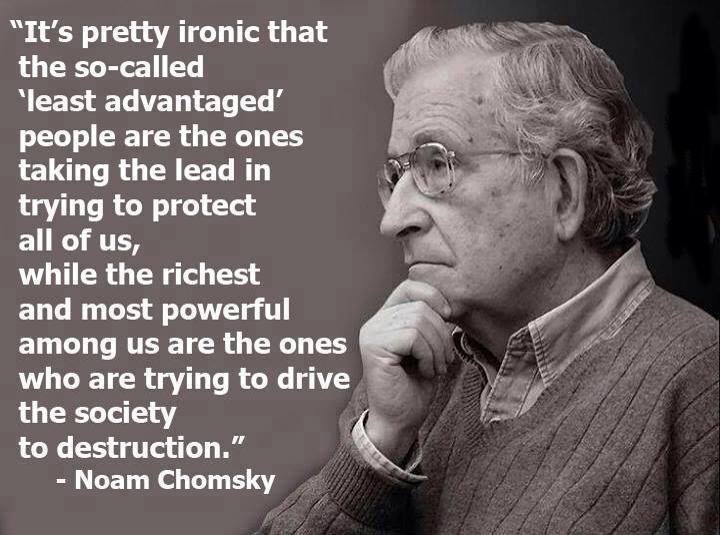
Chomsky: History Doesn’t Go In a Straight Line

Noam Chomsky interviewed by Tommaso Segantini - Jacobin, September 22, 2015

Disclaimer: The views expressed here are not the official position of the IWW (or even the IWW’s EUC) and do not necessarily represent the views of anyone but the author’s.

Throughout his illustrious career, one of Noam Chomsky’s chief preoccupations has been questioning — and urging us to question — the assumptions and norms that govern our society.

Following a talk on power, ideology, and US foreign policy last weekend at the New School in New York City, freelance Italian journalist Tommaso Segantini sat down with the eighty-six-year-old to discuss some of the same themes, including how they relate to processes of social change.

For radicals, progress requires puncturing the bubble of inevitability: austerity, for instance, “is a policy decision undertaken by the designers for their own purposes.” It is not implemented, Chomsky says, “because of any economic laws.” American capitalism also benefits from ideological obfuscation: despite its association with free markets, capitalism is shot through with subsidies for some of the most powerful private actors. This bubble needs popping too.

In addition to discussing the prospects for radical change, Chomsky comments on the eurozone crisis, whether Syriza could’ve avoided submitting to Greece’s creditors, and the significance of Jeremy Corbyn and Bernie Sanders.

And he remains soberly optimistic. “Over time there’s a kind of a general trajectory towards a more just society, with regressions and reversals of course.”

Reversing Climate Change: What Will It Take?

By Jeremy Brecher - Labor Network for Sustainability, September 26, 2015

Disclaimer: The views expressed here are not the official position of the IWW (or even the IWW’s EUC) and do not necessarily represent the views of anyone but the author’s.

On the weekend of September 21, 2014, people in 162 countries joined 2,646 events to demand global reductions in the greenhouse gas (GHG) emissions that are generating climate catastrophe. An estimated forty thousand marched in London; thirty thousand in Melbourne; and twenty-five thousand in Paris. Some four hundred thousand joined the People's Climate March through the center of New York City. The climate protection movement had come a long way since 2006, when a march of one thousand through Burlington, Vermont proved to be the largest climate protest in American history. Yet, despite its exponential growth, whether and how the climate protection movement could realize its goals remained an open question.

The Failures of Climate Protection

Climate change poses an existential threat to our species, to every individual, and to all that any of us hold dear. Protecting the earth's climate is in the long-term interest of all humanity. Yet, efforts to cut carbon and other GHGs to a climate-safe level have been defeated for a quarter-century in arenas ranging from the United Nations to the US Congress.

Those failures are not what most climate protection advocates expected. From the scientific confirmation of global warming in the 1980s, they had laboriously built institutions like the United Nations Framework Convention on Climate Change and the Intergovernmental Panel on Climate Change and had painstakingly constructed a consensus among scientists,government leaders, and UN officials around the policies defined as necessary by the IPCC. The UN "framework agreement" was followed by the Kyoto Protocol and the Bali Road Map for the 2009 Copenhagen climate summit. The world seemed to be proceeding on a rational, if tardy, course to address climate change.

With the collapse of the Copenhagen climate summit in 2009, it became evident that the entire process had been little more than a charade in which world leaders, governments, and businesses pretended to address climate change while pursuing policies that pour ever more GHGs into the atmosphere. Copenhagen revealed a collection of greedy, advantage- seeking institutions whose leaders were unable to cooperate even for their own survival. The charade goes on: last November's extravagantly hailed US–China climate agreement, in the unlikely event that it is actually adhered to, will result in an estimated temperature rise of 3.8 degrees Celsius—nearly twice the 2-degree increase scientists say is the maximum compatible with human civilization as we know it. It is a suicide pact by the world's two leading polluters with the rest of the world as collateral damage.

In response to the failures of the official climate protection process, an independent climate protection movement has emerged. It is not controlled by any national or special interest. Instead, it has been organized globally and has demonstrated the capacity to act globally, exemplified by the actions in 162 countries for last year's People's Climate March. This movement has broken out of the constraints of lobbying and demonstrating within a legal framework set by governments by instead adopting civil disobedience as an important and legitimate part of its strategy. It has challenged the governments that permit climate destruction, the fossil fuel producing and using industries that conduct it, and the corporations and other institutions around the world that collude with it. In spite of its growth and commitment, the movement's ability to sharply reduce GHG emissions and establish climate-safe levels of carbon in the atmosphere has so far proven minuscule.

California climate activists set sights on COP21

By Nicholas Isaac - Socialist Action, September 21, 2015

Disclaimer: The views expressed here are not the official position of the IWW (or even the IWW’s EUC) and do not necessarily represent the views of anyone but the author’s.

As governments and some 40,000 corporate negotiators, scientists of different persuasions, and other mostly corporate-friendly parties prepare to attend the Nov. 30-Dec. 12 United Nations Conference of Parties (COP21) in Paris, environmental and climate-crisis organizations are preparing massive and perhaps unprecedented mobilizations around the world.

Fear is widespread that this 21st UN-sponsored climate meeting will propose nothing to stop the earth’s temperature from rising beyond the point of no return—the point where catastrophic and irreversible changes threaten all life on earth. Few, if any, environmental and related movement organizations believe that the world’s greatest polluters have any intention of subordinating their highly profitable fossil-fuel extraction to the interests of humanity. Indeed, the greatest of the polluters, the U.S. and China, have every intention of increasing their production and use of fossil fuels!

Activists from 350.org and a broad range of other concerned organizations on the East Coast are making preparations for a massive mobilization in Boston on Dec. 12, the last day of COP21. They chose the last day of COP21 to indicate their lack of confidence in any of the “solutions” proposed to date and to state unequivocally that only a massive international movement, a “movements of movements,” is capable of saving the earth and its inhabitants from the destructive forces of today’s profit-driven polluters.

In Northern California, a broad coalition of environmental groups, labor unions, social justice, antiwar, and human rights groups, and a number of socialist parties, has been meeting in Oakland union halls for the past two months to plan a mass march and rally through downtown Oakland on Nov. 21. Leading organizations include 350.org chapters in all Bay Area counties, the Sunflower Alliance—which focuses on defending frontline communities—System Change Not Climate Change, and a host of groups aimed at fighting California fracking, coal transport, explosive bomb trains, and environmental racism. Socialist Action, Solidarity, DSA, ISO, and CoC have also been actively building this effort.

Pages

The Fine Print I:

Disclaimer: The views expressed on this site are not the official position of the IWW (or even the IWW’s EUC) unless otherwise indicated and do not necessarily represent the views of anyone but the author’s, nor should it be assumed that any of these authors automatically support the IWW or endorse any of its positions.

Further: the inclusion of a link on our site (other than the link to the main IWW site) does not imply endorsement by or an alliance with the IWW. These sites have been chosen by our members due to their perceived relevance to the IWW EUC and are included here for informational purposes only. If you have any suggestions or comments on any of the links included (or not included) above, please contact us.

The Fine Print II:

Fair Use Notice: The material on this site is provided for educational and informational purposes. It may contain copyrighted material the use of which has not always been specifically authorized by the copyright owner. It is being made available in an effort to advance the understanding of scientific, environmental, economic, social justice and human rights issues etc.

It is believed that this constitutes a 'fair use' of any such copyrighted material as provided for in section 107 of the US Copyright Law. In accordance with Title 17 U.S.C. Section 107, the material on this site is distributed without profit to those who have an interest in using the included information for research and educational purposes. If you wish to use copyrighted material from this site for purposes of your own that go beyond 'fair use', you must obtain permission from the copyright owner. The information on this site does not constitute legal or technical advice.

