

You are here

capitalism

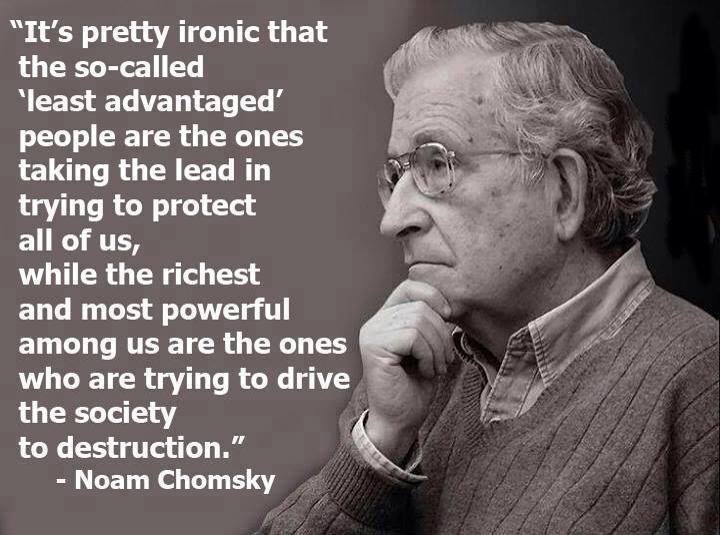
Imagining a New Social Order: Noam Chomsky and Robert Pollin in Conversation

Interview by C.J. Polychroniou - Truthout, November 19, 2017

We live in an age of illegitimate neoliberal hegemony and soaring political uncertainty. The evidence is all around: citizen disillusionment over mainstream political parties and the traditional conservative-liberal divide, massive inequality, the rise of the "alt-right," and growing resistance to Trumpism and financial capitalism. 

Yes, the present age is full of contradictions of every type and variety, and this is something that makes the goals and aims of the left for the reordering of society along the lines of a true democratic polity and in accordance with the vision of a socialist reorganization of the economy more challenging than ever before.

In this context, the interview below, with Noam Chomsky and Robert Pollin, which appeared originally in Truthout in three separate parts, seeks to provide theoretical and practical guidance to the most pressing social, economic and political issues facing the United States today. It is part of an effort to help the left reimagine an alternative but realistic social order in an age when the old order is dying but the new has yet to be born.

Noam Chomsky is professor emeritus of linguistics at MIT and laureate professor in the department of linguistics at the University of Arizona. Robert Pollin is distinguished professor of economics and co-director of the Political Economy Research Institute at the University of Massachusetts at Amherst. These two thinkers are pathbreakers in the quest to envision a humane and equitable society, and their words can provide a helpful framework as we strive -- within an oppressive system and under a repressive government -- to fathom new ways of living together in the world.

C.J. Polychroniou: Noam, the rise of Donald Trump has unleashed a rather unprecedented wave of social resistance in the US. Do you think the conditions are ripe for a mass progressive/socialist movement in this country that can begin to reframe the major policy issues affecting the majority of people, and perhaps even challenge and potentially change the fundamental structures of the US political economy?

Noam Chomsky: There is indeed a wave of social resistance, more significant than in the recent past -- though I'd hesitate about calling it "unprecedented." Nevertheless, we cannot overlook the fact that in the domain of policy formation and implementation, the right is ascendant, in fact some of its harshest and most destructive elements [are rising].

Let's Just Admit It: Capitalism Doesn't Work

By John Atcheson - Common Dreams, November 13, 2017

In almost every way you examine it, capitalism – at least the relatively unconstrained, free- market variety practiced here in the US and supported by both parties -- has been an abysmal failure. Let’s take a close look some of its worst failings.  But first, it must be admitted that when it comes to exploiting people and the planet for the purpose of generating apparent wealth for the few, it has been a smashing success.  More about that notion of “apparent wealth” in a moment, but now, the specifics.

The logical end-point of a competitive system is an oligarchic monopoly

A recent report  by UBS reveals that the global march of economic inequality is accelerating.  The report found that the billionaire’s share of wealth grew by nearly 20 percent last year, reaching a level of disparity not seen since 1905, the gilded age.  Interestingly, the first gilded age followed decades of uber-free market laissez-faire policies, just as today’s gilded age has.

Not surprising, really. Empirical evidence shows that without constraint, markets will proceed toward a winner-take-all status. In short, monopolies and oligopolies. For example, the United States has had three periods of prolonged laissez-faire economic policies, and each was followed by extreme wealth inequality and the three biggest economic crises in US history, such inequality causes.

Oh, but the magic of competition makes companies compete for our dollar, so they can’t afford to exploit us, right? Not so much.

The magic elixir of competition doesn’t work—for the simple reason that there isn’t much competition anymore. Having convinced folks that regulation is bad, the Oligarchy is in the midst of a frenzy of mergers that is giving a few large conglomerates control of many of the major market sectors.

Derrick Thompson, in a recent article in the Atlantic, lays out some of the grim statistics that illustrate the trend. As Thompson writes,

To comprehend the scope of corporate consolidation, imagine a day in the life of a typical American and ask: How long does it take for her to interact with a market that isn’t nearly monopolized? She wakes up to browse the Internet, access to which is sold through a local monopoly. She stocks up on food at a superstore such as Walmart, which owns a quarter of the grocery market. If she gets indigestion, she might go to a         pharmacy, likely owned by one of three companies controlling 99 percent of that market. If she’s stressed and wants to relax outside the shadow of an oligopoly, she’ll have to stay away from ebooks, music, and beer; two companies control more than half     of all sales in each of these markets. There is no escape—literally. She can try boarding an airplane, but four corporations control 80 percent of the seats on domestic flights.

The consolidation of the media is yet another example; just six corporations now control 90 percent of the market. And of course, there’s the inconvenient fact that the “too-big-to-fail” banks that were a major cause of the 2008 Great Recession are now bigger and fewer.

This concentration of market power translates into lower wages, fewer jobs, and higher prices – exactly the opposite of what the neoclassical economic theory embraced by capitalists tells us will happen when we remove regulatory constraints – and exactly the opposite of what the Republicans’ trickle-down myth says will happen. Or what the neoliberal Democrats tell us, for that matter.

But it also gives the wealthy control over our political system, and the people have gotten wise to it.  That’s why a little over a quarter of the eligible voters were able to put Trump in power – most of the rest of us are completely turned off by a political system that’s clearly for sale and so, increasingly, many do not show up to vote.

That control has expressed itself in policies that result in extreme income disparities between the increasingly few haves and the expanding have-nots. Today, just five people have as much wealth as the 3.8 billion people comprising the least wealthy half of the world’s population, and nowhere in the developed world is the problem as acute as it is in America.  The system is rigged, and our belief in capitalism and the power of the magic markets is what allowed that.

Part of the 1st Ecosocialist International

By various - Ecosocialist Horizons, November 2017

It has been one year since “The Calling of the Spirits” in Monte Carmelo, Lara, when, with spirited minds and seeds in our hearts, we initiated a convocation titled “The Cry of Mother Earth.” Those who responded to this cry are now here: around 100 people from 19 countries and five continents, 12 original peoples from Our America, and ecosocialist activists from 14 states of Venezuela. We are here in the Cumbe* of Veroes, cradled in the enchanted mountains of Yaracuy, where the guardian goddess of nature lives. From the 31st of October until today, the 3rd of November, 2017, we have done the work demanded of us: the articulation of a combined strategy and plan of action for the salvation of Mother Earth.

We have made the decision and the collective commitment to constitute the First Ecosocialist International: To reverse the destructive process of capitalism; to return to our origins and recuperate the ancestral spirituality of humanity; to live in peace, and end war.

We recognize that we are only a small part of a spiral of spirals, which has the profound intention to expand and include others until all of us are rewoven with Mother Earth; to restore harmony within us, between us, and among all the other sister beings of nature.

The First Ecosocialist International is not just another meeting, nor another conference of intellectuals to define ecosocialism. We believe that ecosocialism will define itself to the extent that it is reflected and conceptualized in praxis; based on what we do and what we are. Nor is the First Ecosocialist International a single organization or a rubber stamp in constant danger of becoming a bureaucracy. It is a common program of struggle, with moments of encounter and exchange, which anyone may join, by committing themselves to fulfilling one or more of the various actions agreed upon here in order to relieve our Mother Earth. No person or process can be owner or protagonist of that which is done and achieved collectively.

We invite all peoples, movements, organizations, collectives and beings in the world to join the First Ecosocialist International, and to undertake the collective construction of a program for the salvation of Mother Earth. By restoring a lost spirituality we may arrive at a new one; a new and sometimes ancient ecosocialist ethic, sacred and irreverent, fed by the sun of conscience. We are recreating our spirituality with a new imagination and a new heartbeat, which may carry us to unity and diversity. The understanding and practice of this new spirituality will have the power to repel empire and capitalism which are powered by greed, and it will be able to strengthen our peoples and cultures which are conditioned by necessities. Because right now we are not living – we are merely surviving. We confront a contradiction: restore life, or lead it to extinction. We must choose.

We don’t have any doubts. We are radicals; we shall return to our roots and our original ways; we shall see the past not only as a point of departure but also as a point of arrival.

A collective birth towards a loving upbringing; we are an immortal embryo… Let’s dream, and act, without sleeping!

Read the report (PDF).

What Whales Have to Teach Humans About Capitalism

By Laura Bridgeman - Common Dreams, October 22, 2017

The International Whaling Commission meets every four years to decide the future of the whales. That is, it decides which nation will kill how many, and for what reasons (commercial, subsistence, “research”). Stakeholders from around the world are engaged, from whaling and non-whaling nations alike.

Notably absent in these discussions on the future of whales, are the whales themselves. But this is not just because they would have a hard time fitting into the conference room. It’s an intentional omission, since whales are a part of the commons: that great, amorphous void which we draw individuals out of, pour refuse in to, and in which lives the nameless, faceless “biomass” that we refuse any real legal or political consideration on a categorical basis. According to our current paradigm, the whales, and everyone else in the oceans, are resources to be protected, conserved or exploited: divided up (albeit unequally) amongst ourselves, and consumed.

This might sound like an article about whales, but it isn’t. It’s really about us, and what we chose to believe about ourselves, our societies, and what our future can look like. For perhaps the first time in history, we human cultures of the world are largely united in a struggle for what comes next – an active discussion, a exercise in collective imagination that’s becoming all the more urgent as we watch our current world, and worldviews, fall apart – or more aptly, being ripped apart by late-stage capitalism.

Our current system is incapable of addressing the problems within our own species because inequality is embedded within its very foundation. Strategies to dismantle plutocracy and eradicate poverty often involve new ways of managing the commons. However, as long as we try to preserve or manage “habitats” and “ecosystems” for human benefit alone, the resulting devastation of the lives of other species will reverberate into our own in increasingly disastrous and unpredictable ways.

Within capitalist models, individuals of other species are not only neglected - their very existence is denied. They are instead relegated to the realm of property, only to be considered or “conserved” when their bodies are seen as necessary for the health of an ecosystem of value; and then, they are lumped into “populations” or “stocks” rather than recognizing them as individuals with interests, deserving of their fair share of resources like any human being.

When we begin to consider this legion of individuals of other species, the commons can transform into a system for “mutualizing responsibilities” wherein other species are considered active stakeholders as they participate and benefit from those responsibilities. This can maximize the health and generative capacities of a given area, be it in the ocean or upon the grasslands or within a forest.

Let’s go back into that conference room again, with its notable absence of the whales who are being discussed. The changes I’m proposing might sound extreme, but not if we begin with species that we can all agree are intelligent and sophisticated enough to have interests of their own. We can begin by considering whale’s needs, desires, and perspectives as stakeholders. Rather than having conservationists advocating for whales’ protection, we ought to be giving whales a seat at the table – via a representative such as a guardian ad litem - to express what’s in the best interest for these individuals in matters concerning them, such as establishing Marine Protected Areas designed to protect their culturally relevant spaces in the ocean. Whales should also be considered stakeholders where industrial projects, such as salmon farms, may have adverse impacts on their lives. And, one day, whales should be considered stakeholders at the very meetings where their kin are being scheduled for slaughter.

This is no quaint idea rooted in sentimentality towards charismatic megafauna. It’s an idea that can save us - all of us – because when other species thrive, we all thrive.

Any accounting of the commons without acknowledging the presence and interests of others within these spaces will lead to their continued destruction, to our human detriment as well. But when we consider the perspectives of the other species, whom we rely upon for our survival and vice versa, can we begin to work towards nurturing an environment that is actually sustainable. Doing otherwise will only doom us to repeat history. And it’s already a bit late for that.

Why Libertarian Socialists Reject Free Market Liberalism

By Geoff R - Ideas and Action, October 4, 2017

Libertarian socialists’ political goals are both radical and ambitious: we seek to replace capitalism in its entirety with libertarian socialism. As a result, libertarian socialists do not just stand against capitalism as it exists today but also against positions in favor of increasing liberalism of markets; positions to reduce regulation of markets by external actors, including the government. This is largely because there is more evidence that increased market liberalism worsens problems of markets rather than improving or resolving them.

A fundamental promise of free market liberalism is that market share becomes more equitable among competing firms due to increased competition. This means firms are both created and go out of business at a higher rate than that which currently exists. Assuming this is true, it would mean that both employers and workers would face extreme economic uncertainty and therefore have trouble planning economically for the future. It’d be harder for workers to plan personal economic decisions and harder for employers to make business decisions regarding their firms. Meeting the demand economic actors have for stability is one of the many areas where markets particularly fail.

But this argument – that market share would be more equitable among competing firms due to increased competition – lacks evidence. All firms seek to increase their market share to compete and often firms end up dominating and even monopolizing markets simply by buying up their competition. Early industrialists in the U.S. were known for doing this and that was a time where there was far less regulation in markets by the government than there is today.

Early American industrialism is also known for company towns where one company owned nearly everything; from stores to housing to the local government. As a result, all law and public policy in these towns was solely for the benefit of the employer and kept the rest of the town under complete subjugation. Such was famously the case in West Virginia, the site of the mine wars including the Battle of Blair Mountain which was the largest insurrection in the United States since the American Civil War.

Greed Has Poisoned Their Souls

By Demand Climate Justice - The World at 1°C, September 9, 2017

Unless you are an environmental geographer or a regular reader of The World at 1°C, chances are you apply the term “natural disaster” to events such as Hurricane Harvey, the landslides in Sierra Leone which claimed 1000 lives, or any of the other countless climatic shocks felt over the last month.

The fact is that nothing could be more unnatural:

In every phase and aspect of a disaster […] the contours of disaster and the difference between who lives and who dies is to a greater or lesser extent a social calculus.”

This is true enough of events which occur irrespective of human activity, such as volcanic eruptions, but when it comes to the droughts, storms, floods, and famines (and, actually, even some earthquakes) caused by climate change or extractive industries, the term natural disaster hides not only a truth about differentiated impacts — it also masks a truth about where responsibility lies.

ExxonMobil, for example, has known that its continued existence causes climate change for decades. And ExxonMobil lied about having this knowledge with such abandon that now even their ex-employees are suing them (in addition to Californian communities affected by climate change). A journal article published this month was the first to analyse all of Exxon’s communications about climate change. It concluded that the corporation knew the facts thanks to its own scientists, yet continued to peddle doubt and foster confusion (including through paid editorials in liberal papers like the New York Times).

The very same ExxonMobil, which now has a major ‘in’ at the White House via Secretary of State Rex Tillerson, has been repeatedly let off the hook by authorities. One emblematic story recently published in The Intercept explains how the company has been poisoning a black community in Beaumont, Texas, for decades, by pumping millions of tonnes of toxic chemicals into the air while refining “sour crude.” The community, where people suffer from high rates of hair loss, birth defects, asthma, and cancer, tried to get the EPA to do something (the Exxon refinery regularly broke the law), but were ignored for 17 years. Those who could afford to moved away. Those who could not still live in the shadow of Exxon’s stacks, which stand as monuments to greed and indifference to human suffering.

The market-based “logic” of greenwashed capitalism is that if corporations must pay for doing things like ruining people’s lives or even ruining the planet, then they won’t do it, or at least not as much. But that is demonstrably untrue. Last year, Exxon’s Beaumont refinery illegally released 2,125 pounds of carbon monoxide, sulfur oxide, nitrogen dioxide, and hydrogen sulfide. They were fined $7001. Even when companies are fined much more — as Exxon was when one of its decrepit pipelines burst in 2013, flooding an Arkansas community with 200,000 gallons of Tar Sands oil — they are often able to appeal, as Exxon did.

If a conviction somehow sticks, corporations are sometimes able to ignore the ruling altogether, as these 3 companies appear to be doing in Indonesia. Following successful convictions with penalties in billions of dollars, the Indonesian government has been unable to collect. While the corporations make billions exploiting Indonesia’s vast mineral reserves and precious forests, the communities in the way are left destitute and savaged by both corporate mercenaries and state military forces.

Cognizant of (negative) publicity, corporations are careful to cover themselves with the fig leaf of “corporate social responsibility” and other such meaningless phrases which sound good but don’t mean much in practice. In a case that has echoes of ExxonMobil’s climate change cover-up, Monsanto was recently exposed in The Poison Papers as having made and sold a toxic industrial chemical known as PCB almost a decade after being told by their scientists that:

The evidence proving the persistence of these compounds and their universal presence in the environment is beyond questioning.”

In addition to covering up the horrendous health impacts of its PCB products, newly revealed documents show that Monsanto also conspired with a consultancy firm to “ghost write” a supposedly independent review of the health impacts of its flagship herbicide Roundup. Monsanto has since attempted to force the documents offline, out of sight.

What these examples make clear is that the ways in which people are made to suffer under the dominant social, political, and economic systems are not natural or innate. People suffer by design. And the designers have names like Exxon and Monsanto.

The root of the climate crisis is capitalism, not demographics

By Michael Friedman - Monthly Review, August 15, 2017

Growing concerns about climate change and other environmental trends have set off the next round of old Malthusian diagnoses and solutions.

As a case in point, ecological economist William E. Rees recently wrote in the Canadian alternative magazine The Tyee (“Staving Off the Coming Global Collapse” July 17, 2017):

The “competitive displacement” of other species is an inevitable byproduct of continuous growth on a finite planet. The expansion of humans and their artifacts necessarily means the contraction of everything else. (Politicians’ protests notwithstanding, there is a fundamental contradiction between population/economic growth and protecting the “environment.”)

As a first sweep, one might assert that “common sense” would dictate that as a population increases, so does pressure on resources, all else being equal. This is the logic behind the ecological concept of the “carrying capacity” of an ecosystem. It is the basis for the old Club of Rome report, “Limits to Growth.” And it is also associated with some versions of the “planetary boundaries” concept.

All else is not equal.

Is Capitalism in Crisis? Latest Trends of a System Run Amok

By C.J. Polychroniou - Truthout, August 4, 2017

Having survived the financial meltdown of 2008, corporate capitalism and the financial masters of the universe have made a triumphant return to their "business as usual" approach: They are now savoring a new era of wealth, even as the rest of the population continues to struggle with income stagnation, job insecurity and unemployment.

This travesty was made possible in large part by the massive US government bailout plan that essentially rescued major banks and financial institutions from bankruptcy with taxpayer money (the total commitment on the part of the government to the bank bailout plan was over $16 trillion). In the meantime, corporate capitalism has continued running recklessly to the precipice with regard to the environment, as profits take precedence not only over people but over the sustainability of the planet itself.

Capitalism has always been a highly irrational socioeconomic system, but the constant drive for accumulation has especially run amok in the age of high finance, privatization and globalization.

Today, the question that should haunt progressive-minded and radical scholars and activists alike is whether capitalism itself is in crisis, given that the latest trends in the system are working perfectly well for global corporations and the rich, producing new levels of wealth and increasing inequality. For insights into the above questions, I interviewed David M. Kotz, professor of economics at the University of Massachusetts at Amherst and author of The Rise and Fall of Neoliberal Capitalism (Harvard University Press, 2015).

The Epic Failure of Labor Leadership in the United States, 1980-2017 and Continuing

By Kim Scipes - CounterPunch, August 4, 2017

The US labor movement is in terrible shape; in 2016, union membership was only 6.4 percent of workers in the private sector, and 34.4 percent of the public sector, giving an overall percentage of 10.7 percent.[1]  (It had been 33.4 percent in 1954.)  But, worse than the actual numbers and percentages is the all-but-total lack of vision as to what to do about this.  The labor movement has been under direct attack since at least the PATCO strike in 1981, and the leaders of the labor movement—and focus here is on the AFL-CIO, although there are others labor organizations outside of its ambit—have had no vision and, arguably, no clue about what to do about this.  And other than perhaps a nine-year window under John Sweeney (1996-2005)—I’m being generous—it has been blind and vision-less.  And this continues today under Richard Trumka.[2]

This problem is a major reason for the election of Donald Trump to the presidency, aided strongly by working class voters, and I’m speaking of those who are not generally racist, sexist, homophobic and/or xenophobic.

The fact is that, no matter how good any one of our national/international union leaders might be as an individual trade union leader, that does not necessarily make them a good labor leader.  By “labor leader,” I’m referring to those who look out for the well-being of working people in general in this country; i.e., those who go beyond members of their own union to think about working people overall.  I would give the AFL-CIO leaders, individually and collectively, an “F” for their efforts since the early 1980s—with Sweeney possibly getting a D for the nine years referred to above.

This failure is even worse in light of myriad efforts by rank-and-file activists, lower level leaders and staffers, and labor researchers/academics who have spent years of their lives struggling to get the labor movement to address its’ weaknesses and change its ways.  Whether through organizing new members, educating and mobilizing current members, analyzing what we can learn from workers’ struggles in the past as well as from studying contemporary efforts at home and overseas, and thinking about how we can revitalize the labor movement so as to seriously address the problems facing working people in this country, there has been extensive efforts by those “below” to overcome the lack of vision and ineptitude of national labor leaders; but the institutional power granted these “leaders” has overcome all efforts to date to initiate progressive, life-enhancing change.[3]

I’m going to argue that this organizational failure is more than individual failures, which could perhaps be overcome by the election of new leaders, although obviously individual leaders can have a significant impact once put into office.  However, I’m going to argue that the primary problem is in our very model of trade unionism in this country:  I argue that the model of trade unionism that has dominated US unionism—business unionism—offers no viable way forward and must be replaced by another model, that of social justice unionism.  I’m going to argue that unless this change from business unionism to social justice unionism is made, and made soon, the US labor movement is going to fade into irrelevancy, with its power and importance diminishing even further as years go by.

Several steps must be made to develop this argument.  First, the theoretical delineations of business and trade unionism are presented, which are crucial to understand the argument being made.  Then, a historical overview is presented, with a primary focus on the CIO years, 1933-1955, and special attention is paid to the removal of “the left” from the CIO in the late 1940s.  This is followed by a discussion of “global competition, the US economy and the attacks on working people,” and then a question:  “where is the AFL-CIO leadership?”

Following, there is an effort to make sense of why the AFL-CIO leadership has been “missing in action.”  Key to understanding this, it is argued, is to connect the lack of AFL-CIO initiative in domestic situations to the initiative it shows in international affairs—and that requires discussion of the US Empire, and the AFL-CIO leadership’s support of it.  And why they support the US Empire.

And then, there is the beginning of a discussion of how progressive workers can reclaim our labor movement.

Oscar-Nominated Actor James Cromwell Speaks Out Before Jail Time for Peaceful Anti-Fracking Protest

James Cromwell interviewed by Amy Goodman and Nermeen Shaikh, Democracy Now! - July 14, 2017

AMY GOODMAN: Oscar-nominated actor James Cromwell is reporting to jail at 4:00 p.m. Eastern time today in upstate New York, after he was sentenced to a week behind bars for taking part in a nonviolent protest against a natural gas-fired power plant. Cromwell says he’ll also launch a hunger strike. He’s one of six activists arrested for blocking traffic at the sit-in outside the construction site of the 650-megawatt plant in Wawayanda, New York, upstate, December 2015. The activists say the plant would promote natural gas fracking in neighboring states and contribute to climate change.

James Cromwell is well known for his roles in some 50 Hollywood films, nominated for an Oscar in Babe, as well as a number of TV series, including Six Feet Under. I spoke to him Thursday along with one of his co-defendants who’s going to jail today, as well, Pramilla Malick, founder of Protect Orange County, a community group leading the opposition to the fracked gas power plant. She ran in 2016 for New York state Senate. I began by asking James Cromwell about why he’s going to jail today.

Pages

The Fine Print I:

Disclaimer: The views expressed on this site are not the official position of the IWW (or even the IWW’s EUC) unless otherwise indicated and do not necessarily represent the views of anyone but the author’s, nor should it be assumed that any of these authors automatically support the IWW or endorse any of its positions.

Further: the inclusion of a link on our site (other than the link to the main IWW site) does not imply endorsement by or an alliance with the IWW. These sites have been chosen by our members due to their perceived relevance to the IWW EUC and are included here for informational purposes only. If you have any suggestions or comments on any of the links included (or not included) above, please contact us.

The Fine Print II:

Fair Use Notice: The material on this site is provided for educational and informational purposes. It may contain copyrighted material the use of which has not always been specifically authorized by the copyright owner. It is being made available in an effort to advance the understanding of scientific, environmental, economic, social justice and human rights issues etc.

It is believed that this constitutes a 'fair use' of any such copyrighted material as provided for in section 107 of the US Copyright Law. In accordance with Title 17 U.S.C. Section 107, the material on this site is distributed without profit to those who have an interest in using the included information for research and educational purposes. If you wish to use copyrighted material from this site for purposes of your own that go beyond 'fair use', you must obtain permission from the copyright owner. The information on this site does not constitute legal or technical advice.