You are here

capitalism

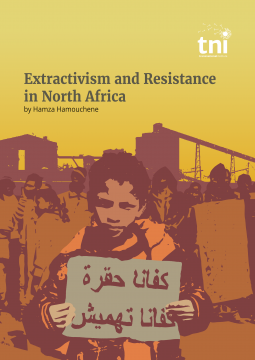
Extractivism and Resistance in North Africa

By Hamza Hamouchene - Transnational Institute, October 2019

Extractivism as a mode of accumulation and appropriation in North Africa was structured through colonialism in the 19th century to respond to the demands of the metropolitan centres. This accumulation and appropriation pattern is based on commodification of nature and privatisation of natural resources, which resulted in serious environmental depredation. Accumulation by dispossession has reaffirmed the role of Northern African countries as exporters of nature and suppliers of natural resources – such as oil and gas- and primary commodities heavily dependent on water and land, such as agricultural commodities. This role entrenches North Africa’s subordinate insertion into the global capitalist economy, maintaining relations of imperialist domination and neo-colonial hierarchies.

The neo-colonial character of North African extractivism reflects the international division of labour and the international division of nature. It is revealed in largescale oil and gas extraction in Algeria and Tunisia; phosphate mining in Tunisia and Morocco; precious ore mining - silver, gold, and manganese - in Morocco; and water-intensive agribusiness farming paired with tourism in Morocco and Tunisia. This plays an important role in the ecological crisis in North Africa, which finds its clear expression in acute environmental degradation, land exhaustion and loss of soil fertility, water poverty, overexploitation of natural resources, pollution and disease, as well as effects of global warming such as desertification, recurrent heat waves, droughts and rising sea levels.

Concurrent with this dynamic of dispossession of land and resources, new forms of dependency and domination are created. The (re)-primarisation of the economy (the deepened reliance on the export of primary commodities) is often accompanied by a loss of food sovereignty as a rentier system reinforces food dependency by relying on food imports, as in the case of Algeria; and/or as land, water and other resources are increasingly mobilised in the service of export-led cash crop agribusiness, as in Tunisia and Morocco. Extractivism finds itself mired in serious tensions, which generates protests and resistance. This paper documents some of these tensions and struggles by analysing activist grassroots work, including the participation in alternative regional conferences and ‘International Solidarity Caravans’ where representative of grassroots organisations, social movements and peasant communities met and travelled together to sites of socio-environmental injustices, providing a space to strategise together and offer effective solidarity to their respective struggles.

The rural working poor and the unemployed in Northern Africa are the most impacted by the multidimensional crisis. Comprising small-scale farmers, near-landless rural workers, fisherfolks and the unemployed, the movements emerging in the five case studies presented here are resisting the looting of their subsoil resources, the despoliation of their lands, pervasive environmental destruction and the loss of livelihoods. The paper asks the following questions: should we see these protests, uprisings and movements as mainly environmental, or are these fundamentally anti-systemic – anti-capitalist, antiimperialist, decolonial and counter-hegemonic protests? Are these circumstantial episodes of resistance, or do they rather represent the latest development in the historical trajectory of class struggle against the latest capitalist offensive in North Africa? The paper presents an assessment of the nature of these movements which grapple with tensions and contradictions that face them.

Read the report (PDF).

A Real Extinction Rebellion Means the End of Colonialism, Imperialism, and Capitalism

By Jessica Garraway - Common Dreams, September 22, 2019

Land and Water Defender Beginnings

In 2011, as a 20 year old activist new to the environmental movement I joined up with other like-minded people for a retreat in rural Wisconsin to plan and strategize our next steps. As a Black woman, it was painfully obvious that amongst the scores of people in attendance that there were very few people of color present. However, what was even more jarring than the racial disproportionality of the retreat was the attitudes of the white activists.

We were hanging out late at night in the living room of a retreat after a long day of workshops and trainings.

The overwhelming number of white activists and their views on race and the environment came to a head for me when I was asked,

“Damn, how do we get black people to care about the environment?”

This is what a white environmentalist (with dreads no less) asked me years ago. Being new to environmental spaces, I was dumbfounded by this comment. I took a long deep sigh, and thought, aren't I Black? Didn't I spend countless hours turning people out for direct actions? It was at this moment I began to realize that I was scoring points for the organization with frontline folks while within the organization I was in a sea of white people who saw me as a token.

Yet I knew that Black people care about the environment - about lead paint in housing, parks in the neighborhood, clean water and clean air. We have to care because we are disproportionately affected by the processes of capitalist environmental degradation.

Historically “environmentalism” was not the modality through which Black people explicitly addressed these issues. It was only later that I realized the lack of orientation that white-dominated environmental groups had toward people of color, and Black people in particular, helped to reinforce the alienation of marginalized communities from the wider environmental movement.

It is no wonder that so many of our people see environmental issues as largely the concern of privileged white people. Far too often we hear more about the protection of wild places we have little access to and not about the incinerators, refineries and mines that pollute our air and water. Anti police brutality movements such as Black Lives Matter struggles have focused attention on deaths of Black people through police terror, however, it is only recently that cases like Flint, Michigan and Newark, New Jersey, majority Black cities with no access to clean water, have gotten notice.

Because of racist housing practices like redlining, Black people have been forced to live near refineries and incinerators at higher rates compared to white people. According to a recent study from the Proceedings of the National Academy of Sciences, white people bear the burden of 17 percent less air pollution than is generated by their own consumption. Meanwhile, Blacks and Latinos experience 56 percent and 63 percent more exposure, respectively, than is caused by their consumption. Even still, it is not the consumption habits of workers that is causing this crisis. It is a political and economic system based on the accumulation of profits and ever expanding markets that is pushing the earth over the edge. Individual actions such as taking shorter showers or passing on plastic straws is not going to change that.

Extinction Rebellion Must Evolve to Tackle Our Systemic Climate Crisis

By Steve Rushton - Occupy.Com, May 9, 2019

The movement known as Extinction Rebellion (XR) has pushed climate change firmly into the British consciousness, clearing the political hangover left by the never-ending Brexit fog. But there are constructive critiques to this monumental, London-centred climate activism that bear mentioning. Namely, what does this movement need to do to gather enough popular support and halt the ongoing climate meltdown.

XR takes over London

For 10 days in April, Extinction Rebellion created headline disruption, taking over prominent sites across London, including Parliament Square. They demanded that the UK government "tell the truth" about the scale of the climate crisis; enact legally binding policies to reduce carbon emissions to net zero by 2025; and do both through a Citizens Assembly (more on citizens assemblies here).

People last month participated in the tens of thousands, and many of then were new to activism. Holding these sites created space for public assemblies and direct action. When police arrested activists – more than 1,000 in total – more came forward until jail cells were full. Actions went far beyond London, from road blocks in Brussels to stopping a coal train in Australia, and die-ins as well as other actions from India to South Africa to Seattle.

Pressure from XR made Labour table a motion in Parliament to declare a climate emergency. The Welsh assembly did the same just days before. Now, as XR expands its effective activism globally, it is worth asking: what does this movement need to do to stop the climate catastrophe?

Does the transition to the Circular Economy on a global scale enhance mechanisms of intragenerational inequality?

By Sara Huier - International Development Studies and Global Studies, Roskilde University, April 2019

The study argues that the Circular Economy (CE) model often privileges the Global North economies’ standpoint, revealing a significant inadequacy. Therefore, the present research investigates the extent of the disparities in closed-loop strategies between developed and developing countries. The objective of the analysis is to understand whether these contingencies are relevant and whether they are the display of global economy dynamics that reinforce mechanisms of inequality, conflicting with the Sustainable Development rationale.

It is found that the analysis corroborates the existence of imbalanced drivers, opportunities, barriers and drawbacks between the Global North and the Global South, although potential benefits for the South are entailed. However, it also emerges the existence of critical transnational dynamics which may prevent the achievement of CE objectives globally. The existence of these overlooked and unaddressed global forces is identified as the actual problem of the CE model. Indeed, the narrow focus of the CE on production processes and local, national and regional dynamics diverts the attention from the Global Value Chains. Thus, it is recommended to analyse the global CE structure by applying the Global Value Chain framework, in order to investigate if it is possible to overcome the exposed CE’s limits.

Read the Report (PDF).

Bayer’s takeover of Monsanto: Indian farmers send their objections to Competition Commission

By - La Via Campesina, January 30, 2018

On 25 January, the Indian Coordination Committee of Farmers Movements (ICCFM), placed on record their objection with the proposed acquisition of Monsanto by the German firm Bayer.

Here is the full text of the letter.


All Indian Coordination Committee of Farmers Movements

Road No. 2, A – 87, Mahipalpur Extension, New Delhi – 110 037, IndiaTel:+91-9899435968 ; Email: yudhvir55@yahoo.com

The Secretary, 25.01.2018

Competition Commission of India,

New Delhi – 110001

Dear Madam/Sir,

Subject: Our objection to the Proposed Combination between Bayer AG and Monsanto and request for extension of 15 days notice for public participation.

We the farmers in India as Individual Farmers, Farmers Groups, Women Farmers, Small farmers, Young Farmers, Farm Workers, Landless Labourers have come together to place on record our objections pertaining to the Notification issued by the Competition Commission of India under Section 29(2) of the Competition Commission Act, 2002, inviting objections/ comments/ suggest with regard to the combination of Two Corporate Giants across the Globe viz, between Bayer AG, Kaiser-Wilhelm-Allee, 51368, Leverkusen, Germany (hereinafter ‘Bayer’ or ‘Acquirer’) and Monsanto Company, 2711 Centerville Road, Suite 400, Wilmington, Delaware 19808, County of New Castle (hereinafter ‘Monsanto’ or ‘Target’, and collectively with Bayer as ‘Parties’).

The signatories hereunder are members of All India Coordination Committee for Farmers’ Movements (ICCFM) and South Indian Coordination Committee for Farmers’ Movements (SICCFM) and we represent 12 farmers’ organizations across India representing millions of peasants, small and medium size farmers, landless people, rural women and youth, indigenous people, migrants and agricultural workers. We defend peasant agriculture for food sovereignty as a way to promote social justice and dignity and strongly oppose corporate driven agriculture that destroys social relations and nature.

We consider that the acquisition of Monsanto by Bayer not only causes but also likely to cause an appreciable adverse effect on competition within India. We request the Commission to call for the records from these two companies regarding their market concentration and study the overall reach of these two companies put together in the market and assess the percentage of their shares objectively and independent of the projections given by the Parties in Form IV, before arriving at any conclusions. The Commission should carry out this investigation to determine the questions whether the acquisition or the combination of these two giant Corporates would cause adverse effect on competition within India.

It is important to place on record the study conducted by the Friends of Earth, Europe led by Ioannis Lianos, Professor of Global Competition Law and Public Policy and Director of the Centre for Law, Economics and Society (CLES) at University College London (UCL),1 concludes that even on a narrow reading of EU competition law, the merger between US-based agro-chemical and biotech company Monsanto and German ‘life science’ company Bayer should not be permitted. The legal study sets out five main reasons why EU competition law requires that the merger be blocked. The copy of the said document is enclosed herewith.

In addition to the issues raised in the said study mentioned supra and the objections submitted by many other individual farmers, farmers organization and farmers collective, we also like to highlight the certain discrepancies in the combination of Bayer and Monsanto as published in the Notification dated 5th January 2018.

In India, Bayer and Monsanto, as per the assertions given by the Parties in Form IV, prior to the closing of the Proposed Combination operate in the 5 Segments in terms of Products, viz, 1. Crop Production, 2. Agricultural Seeds, 3. Vegetable Seeds, 4. Environmental Science and 5. Traits and Technology. The Crop Productions again has 6 Sub Segments, Agricultural Seeds has 5 Sub Segments, Vegetable Seeds has 22 Sub Segments , Environment Science has 5 Sub Segments and Traits and Technology has 1 Sub Segment.

In the Crop Production Segment, both the parties have one Sub Segment overlapping i.e., Non –selective herbicides.

In Agricultural Seeds Segment, both the parties have one Sub Segment overlapping i.e. Cotton Seeds.

In Vegetable Seeds Segments, both the parties have 13 Sub segments overlapping, i.e., Cabbage, Cauliflower, Cucumber, Eggplant, Bitter Gourd, Bottle Gourd, Melon, Okra, Onion, Hot Pepper, Sweet Pepper, Tomato and Watermelon.

The Shutdown as Shock Doctrine

By Basav Sen - Truthout, February 15, 2019

As the dust settles from the last long government shutdown, it’s time to reflect on some fundamental truths about our political system.

First, during the last shutdown, the government forced 420,000 of its own employees to work without pay indefinitely, while another 380,000 were furloughed. A government that cares so little about the economic security of its own employees obviously cares even less about people experiencing poverty in the wider public.

Second, all this happened as a result of the president’s demonstrably false claims of a “crisis” of migration — and his demands to further militarize an already militarized border with a neighboring country that, the last time I checked, we aren’t at war with.

But there’s a third set of reasons we should be outraged and worried about the shutdown. The stories that form the nucleus of this narrative have all been in the news, but the common thread that ties these stories together is not widely understood or discussed, and it should be.

Consider this juxtaposition. During the last shutdown, the National Park Service, an agency of the Interior Department, couldn’t do its job looking after our national parks because its employees weren’t considered “essential” and were furloughed. This had some serious consequences, including permanent damage to the namesake trees in Joshua Tree National Park.

But while parks closed, other agencies of the Department of the Interior were busy leasing oil and gas drilling rights on public lands, including in the ecologically sensitive Arctic National Wildlife Refuge (ANWR). The department even recalled furloughed employees to process drilling permits, which is potentially illegal.

Meanwhile, at the Environmental Protection Agency (EPA), work on the US-Canada Great Lakes Water Quality Agreement, which deals with issues, such as toxic algae blooms on Lake Erie that affect water quality for hundreds of thousands of people, was stalled. (These blooms are a direct consequence of fertilizer runoff from our polluting food production system, exacerbated by climate change impacts, such as warmer water and heavier rains that increase runoff.)

And in North Carolina, communities devastated by Hurricane Florence — an event whose damaging impacts were amplified because of climate change — couldn’t access reconstruction funds from the Department of Housing and Urban Development because of the shutdown. Remember that the people hurt most by Hurricane Florence were disproportionately Black or Native, and low-income.

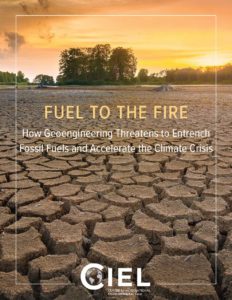
Fuel to the Fire: How Geoengineering Threatens to Enrich Fossil Fuels and Accelerate the Climate Crisis

By Carroll Muffett and Steven Felt - Center for International Environmental Law, February 2019

The present report investigates the early, ongoing, and often surprising role of the fossil fuel industry in developing, patenting, and promoting key geoengineering technologies. It examines how the most heavily promoted strategies for carbon dioxide removal and solar radiation modification depend on the continued production and combustion of carbon-intensive fuels for their viability.

It analyzes how the hypothetical promise of future geoengineering is already being used by major fossil fuel producers to justify the continued production and use of oil, gas, and coal for decades to come. It exposes the stark contrast between the emerging narrative that geoengineering is a morally necessary adjunct to dramatic climate action, and the commercial arguments of key proponents that geoengineering is simply a way of avoiding or reducing the need for true systemic change, even as converging science and technologies demonstrate that shift is both urgently needed and increasingly feasible. Finally, it highlights the growing incoherence of advocating for reliance on speculative and risky geoengineering technologies in the face of mounting evidence that addressing the climate crisis is less about technology than about political will.

Read the report (Link).

Beyond the Nation State: A Critical Look at Venezuela’s Current Crisis

By Brooke Anderson and Mateo Nube - Movement Generation, February 2019

Venezuela has made headlines in the last few weeks, as Venezuelan opposition leader and National Assembly head Juan Guaidó has declared himself interim President, throwing the country into turmoil. Current President, Nicolás Maduro has called the effort a coup. Meanwhile, thousands of people have taken to the streets on both sides, with a death toll of 26 and rising. The Trump administration, many Western European countries, and the right-leaning bloc of Latin American governments have recognized Guaidó as the legitimate president of Venezuela.  Meanwhile Russia, China and others are backing Maduro. A third bloc, most notably Mexico and Uruguay, are calling for a peaceful transition through new elections.

I recently sat down with my co-worker Mateo Nube, collective member of the Movement Generation Justice & Ecology Project, for more political and economic context to the current crisis. In the interview, Nube unpacks the history and promise of the Bolivarian Revolution in Venezuela and beyond; the roots and early warning signs of the authoritarianism we’re now seeing play out in Venezuela; the lost opportunity for Venezuela to leverage its oil money wealth toward a just transition away from extractivism and toward a regenerative economy; and the dangers of U.S. interventionism in the conflict.

Brooke Anderson: Your family came up under dictatorships in both Venezuela and Bolivia, so this is personal for you. Give us some context to how you come to the question of Venezuela.

Mateo Nube: My family has roots in Venezuela. We originally  fled the Holocaust in the 30’s and 40’s and settled in Caracas [Venezuela] from Berlin. My mom grew up under Marcos Pérez Jiménez, the military dictatorship that really marked and traumatized Venezuelans. In turn, I was born in Bolivia in 1971 and spent the first 10 years of my life under military dictatorship there. So I’m politically steeped in resisting military authoritarianism and building social movements to not only overthrow the military but to redistribute wealth and power. So the Venezuelan context really marked my family and informed my political orientation.

So the Venezuelan context really marked my family and informed my political orientation.

Brooke Anderson: What’s actually happening on the ground in Venezuela right now?

Mateo Nube: The situation in Venezuela right now is dire and painful to witness. It is a mixture of a political, economic, and humanitarian crisis. The man who is controlling the state of Venezuela is Nicolás Maduro. He is the successor of Hugo Chávez, who led the Bolivarian Revolution for the last two decades, prior to his death in 2013. Maduro is currently facing a challenge from Juan Guaidó, the current head of the National Assembly. Guaidó is arguing that Maduro is not a legitimate President and that the constitution dictates that he, Guaidó, is the next in line. This contestation coming from the opposition is largely the right wing.

Neither of these leaders has tremendous legitimacy. There are two men (representing two political factions) who are calling themselves President of Venezuela. They are both claiming power in a way that disrespects the constitutional process of Venezuela. We can definitely call Guaidó’s move an attempted coup and unconstitutional. If we do, we also have to recognize that Maduro won the 2018 elections after banning the main opposition leader, Henrique Capriles, and multiple opposition parties from running and dissolved the opposition-controlled National Assembly in March 2017 through a stacked Supreme Court. If a right-wing political party had made these moves, we would have loudly denounced them.

Productivism, endless growth and accumulation for accumulation’s sake must be reversed

By various - Counterview, November 23, 2018

Final statement of  the international civil society meet Thematic Social Forum on Mining and Extractivist Economy, held at Johannesburg, November 12-15, 2018, in which representatives* from Indian voluntary organizations also participated:

We, the participants of the Thematic Social Forum on Mining and Extractivist Economy, are gathered in Johannesburg, South Africa to consolidate a broad movement of resistance, to build common struggles for solidarity, to guarantee the integrity of nature and to ensure a better world for present and future generations.

We come from mining-affected communities, trade unions, people’s organizations, the women’s movement, LGBTI people, faith-based groups, indigenous peoples, workers, small scale farmers, fisherfolk, youth, support groups and academics from 60 countries, including from 28 African countries, as well as from the Americas, Asia Pacific and Europe.

We celebrate our diversity, recognising our different perspectives and the alternatives that we offer, but understanding that we are bound together by our desire for a future free from the destructive effects of extractivism.

Extractivism is a destructive model based on the exploitation of so-called “natural resources” and people of which mining is a prime case.

Confronting the Carbon Capitalists

By Seattle IWW - It's Going Down, November 14, 2018

Last summer brought another record wildfire season to the Pacific Northwest. Smoky air from fires in the region caused hellish air quality around the entire Northern Hemisphere. The causes of the forest fires and the destruction of our forest ecosystem generally are incontrovertible. Over one hundred years of fossil-fueled capitalist development and hundreds of years of violent colonial oppression–of people and the biological world–have driven the Earth to the brink.

Northwest forests, once some of the most biodiverse regions on Earth, have been clear-cut and laden with biocides. Complex interrelationships have been smashed with saws and machinery to make way for monoculture “working forests” devoid of biodiversity. Decades of fire suppression by the Forest Service on behalf of timber companies have left trees to grow on each other like matchsticks waiting to be lit.

In the face of all of this, liberals, true to form, have resorted to self-flagellation and hand-wringing. The New York Times Magazine’s recent piece, “Losing Earth: The Decade We Almost Stopped Climate Change” by Nathaniel Rich, places the blame of climate change and ecocide squarely at the foot of an undefined human nature. The author mostly chronicles failed climate negotiations between nation-states at the United Nations.

In his telling, we were so close to breakthroughs, but then greedy human nature stopped everything. Our collective desire for more stuff led to the failure of negotiations being made in good faith between nations. There is no other possible direction for history to have unfolded. Or so the story goes.

International diplomacy’s climate failures are a failure of all humans in the eyes of the liberal elite like Rich. That a nation-state would act counter to the will of its subjects is unthinkable to the privileged classes.

The victims of colonialism and capitalism have always known otherwise. At the same time “human nature” was failing to protect the earth in UN meeting halls, working-class people were mobilizing against extractive industry in Northern California and being targeted for assassination. Indigenous peoples around the world were suffering from state violence for fighting against the very oil drilling that state officials said they were trying to curb. Everywhere the triplet monsters–capitalism, colonialism, and patriarchy–tread, organized resistance by the oppressed fought back. Contrary to the pearl-clutching lament that “human nature led to this,” water protectors, land defenders, and workers have laid their bodies in front of the machinery of extractive capitalism countless times. And this is nothing new.

Pages

The Fine Print I:

Disclaimer: The views expressed on this site are not the official position of the IWW (or even the IWW’s EUC) unless otherwise indicated and do not necessarily represent the views of anyone but the author’s, nor should it be assumed that any of these authors automatically support the IWW or endorse any of its positions.

Further: the inclusion of a link on our site (other than the link to the main IWW site) does not imply endorsement by or an alliance with the IWW. These sites have been chosen by our members due to their perceived relevance to the IWW EUC and are included here for informational purposes only. If you have any suggestions or comments on any of the links included (or not included) above, please contact us.

The Fine Print II:

Fair Use Notice: The material on this site is provided for educational and informational purposes. It may contain copyrighted material the use of which has not always been specifically authorized by the copyright owner. It is being made available in an effort to advance the understanding of scientific, environmental, economic, social justice and human rights issues etc.

It is believed that this constitutes a 'fair use' of any such copyrighted material as provided for in section 107 of the US Copyright Law. In accordance with Title 17 U.S.C. Section 107, the material on this site is distributed without profit to those who have an interest in using the included information for research and educational purposes. If you wish to use copyrighted material from this site for purposes of your own that go beyond 'fair use', you must obtain permission from the copyright owner. The information on this site does not constitute legal or technical advice.