

You are here

capitalism

Climate Change Is the Inevitable Consequence of Capitalist Privatization

By Nathaniel Matthews-Trigg - Common Dreams, August 12, 2018

The notion of the commons refers to shared land, publicly available for all people to access for leisure and when times get tough, for survival. Publicly shared lands have existed since humans first walked the earth but have progressively been enclosed for individual sustenance or for profit. The most profound period of enclosures came with the introduction of European capitalism, and mass displacement of agricultural people to toil in industrial factories.

Throughout European and U.S. colonialism, the genocide, enslavement, and displacement of indigenous people from their lands was “justified” via the pseudo-science concept of Social Darwinism—the notion that humans inherently compete for resources and the most violent and coercive are rightfully in charge. Similarly, the pseudo-science tragedy of the commons was created to justify the privatization of public lands. This “tragedy” was based on the premise that shared resources will inherently be exploited and destroyed by the unruly public. That if left to their own volition people are inherently greedy, they don’t think in the long-term, they don’t communicate, and just like Social Darwinism, they must compete. Economist Elinor Ostrom debunked the tragedy of the commons and in doing so became the first woman to win a Nobel Peace Prize for Economics. 

Our atmosphere, a publicly needed space containing many vital resources such as nitrogen, oxygen, and carbon dioxide—may seem to the untrained eye to be the tragedy of the commons playing out above our heads. But this is hardly the case, and one must only take their head out of the clouds and refocus on the social developments on-the-ground to see that climate change is really the tragedy of the enclosures, the inevitable consequence of capitalist privatization.

"Capitalism's grow-or-die imperative stands radically at odds with ecology's imperative of interdependence and limit. The two imperatives can no longer coexist with each other; nor can any society founded on the myth that they can be reconciled hope to survive. Either we will establish an ecological society or society will go under for everyone, irrespective of his or her status." —Murray Bookchin

Capitalism is an economic system based on competition, and competition is a state of constant warfare. The competing corporation must always be in the process of growing, strengthening, improving in combat, and always ready to strike—or risk losing everything to someone or something that’s biggest, stronger, or more strategic. For corporations, success is based on profit, and profits are used to continue the cycle of growth, exploitation, and political influence. 

The long-term consequences of a corporation’s actions are ignored by the corporation because short-term threats and successes are paramount. The moral implications of a corporation’s actions are ignored by the corporation because short-term threats and successes are everything. It’s a toxic environment of immediacy, anxiety, and violence—that leaves an epoch of garbage, pollutants, and suffering in its wake. 

Building post-capitalist futures

By various - Transnational Institute - June 2018

Over several sunny days in June 2018, a diverse group of 60 activists and researchers from 30 countries convened for a multi-day meeting to discuss the collective building of post-capitalist futures. The meeting provided the opportunity for a rich exchange of perspectives and experiences, as well as deep discussion and debate. The goal of the meeting was not to achieve consensus both an impossible and unnecessary endeavour but rather to stimulate mutual learning, challenge one another and advance analyses.

One session of the meeting – Transformative Cities – was held not as a closed discussion but as a public event attended by 300 people at which prominent activists and academics engaged with municipal leaders and politicians on the role cities can play in building post-capitalist futures.

In line with the meeting, this report does not intend to advance one line of analysis, but rather summarise some of the key ideas and issues discussed and debated (not necessarily in the order they were articulated). To summarise necessarily means to leave things out. It would be impossible to fully capture the incredible richness of the discussion that took place, but hopefully this report provides a valuable sketch.

Read the report (PDF).

Envisioning a Leap Forward: How We Can Replace Neoliberalism With a Caring Economy

By Cliff Durand - Truthout, May 26, 2018

In her timely book No Is Not Enough: Resisting Trump’s Shock Politics and Winning the World We Need, Naomi Klein calls on us to resist President Trump and the turn to reactionary-right politics in the US. She also reminds us that, even if we succeed, we will still be left with the conditions that gave rise to Trumpism in the first place. We’ve got to do more than resist Trump. She calls us to change the neoliberal paradigm that has guided (or rather, misguided) public and private life for the last four decades in the United States and much of the rest of the world. This is no small challenge, but without a new way forward, life will become increasingly unlivable. 

As I have discussed previously, neoliberalism is a renewal of the 19th century liberalism of laissez faire, free market, unbridled capitalism of the robber baron era. The 20th century social liberalism we are more familiar with is the opposite of that. Born of the crisis of the Great Depression of the 1930s, it accepts the need for an active state to protect ordinary people from the depredations of the market while also regulating and guiding the economy to make capitalism work. That social liberalism, or “social democracy” as it is also called, was the dominant public ideology in the US up through the 1970s.

But then, with the presidency of Ronald Reagan in the US and Margaret Thatcher’s leadership in the United Kingdom, a new ideology began to eclipse “social democracy.” Rather than seeing the state as the instrument for democratic self-government, this ideology saw government as the source of our problems. In this view, government should just “get out of the way” and let the market direct society.

The dirty little secret that advocates of neoliberalism try to hide from us is that government is still needed to structure markets so they will work for capitalism. For example, unions must be curtailed since organized workers bargaining collectively distort a free market in labor. Individual workers are to be free to sell their labor as they choose. Powerless as individuals, the “right to work” in reality amounts to a right to work for less. At the same time, investors can organize collectively into corporations and operate freely in the market. In neoliberalism, grossly unequal power relation between individuals and corporations is ignored or even perpetuated. This means that neoliberalism favors the interests of corporate capitalism over working people, and that neoliberalism is a project for unbridled capitalism. It is the default position of capital when unrestrained by popular forces.

Capitalism Is Killing the Earth: An Anarchist Guide to Ecology

By John Warwick, et. al. - Anarchist Federation, 2018

We are in a period of crisis that we in MEDCs cannot yet see. The signs are there if you look hard enough but at the moment the water is still flowing, the crops are still reliable the ski lifts are still running. The first wave of climate refugees are trying to make their way into Europe but they are being dismissed as "economic migrants" or those displaced by war. In all likelihood, MEDCs will not feel the effects of climate change for some time; our relative wealth will push the impacts onto those who haven't the means to adapt or whose local climates were less temperate to begin with. The longer we wait to act, however, the bigger the coming crunch will be.

Collectively, MEDCs are responsible for the overwhelming majority of cumulative carbon emissions and will have to radically change their energy and transport systems if an ecological disaster is to be avoided. Who will bear the brunt of the costs and who will get rich from this process is sadly predictable. The working class in MEDCs and most people in LEDCs will pay for the fossil fuel addiction and growth-at-all-costs model of the capitalist system. We have already begun to see this happen in the black, working-class communities devastated by natural disasters in the USA and flooding killing thousands in Bangladesh.

Capitalism relies on constantly increasing accumulation of profits. This has been achieved historically by appropriations (a polite term for thefts) both internal and external to the nation state. Internally, in Europe from the fifteenth century onwards, this has followed the model of stealing common land from the people to create a proletarian class dependent on wage labour to support itself. Externally, this expansion was tied to a move outside Europe's borders to exploit natural resources and labour in other locations. Thus colonialism and capitalism were, from the beginning, linked to processes of resource extraction and accumulation.

Capitalism is now in crisis; with so few areas beyond its reach, there are no easy sources of growth to appropriate, and the ability of the earth's ecosystems to accommodate further growth is being seriously questioned. How then to continue growth and profit? In MEDCs, we are seeing a fresh attack on workers? rights, with more precarious jobs, lower pay and poorer social care. In LEDCs, the neoliberal development model is pushed with privatisation and financial deregulation extracting the most profit for the capitalists.

We write this pamphlet to discuss the environmental problems that capitalism has created, with a focus on climate change and the false solutions offered up to us. There has been wider understanding of environmental issues since mainstream publications such as Silent Spring, Gaia and An Inconvenient Truth; however, an anti-capitalist critique has been lacking.

Read the report (PDF).

Focus on China: The East is green?

By Martin Empson - Socialist Review, February 2018

China’s rapid economic expansion is based on massive state investment, low pay and manufacturing for export to the Western economies at the same time as the promotion of domestic consumerism. Global competition for resources and markets means China must continue this economic model. But this brings with it the risk of war, economic crisis and the threat of workers fighting for an increased share of the enormous wealth being generated. But it is also driving environmental disaster on a local and international scale.
Last October Chinese President Xi Jinping outlined a five-year economic strategy. He focused on putting China at the centre of the world economy, offering “a new option for other countries and nations who want to speed up their development while preserving their independence”. But commentators noted how Xi also emphasised the environment, using the word 89 times in the 3-hour, 23-minute speech and pledging to lead globally on the environment.

In a dig at Donald Trump’s withdrawal of the United States from the Paris climate agreement, Xi argued that, “No country alone can address the many challenges facing mankind. No country can afford to retreat into self-isolation.” By contrast he claimed that China had “taken a driving seat in international cooperation to respond to climate change”, and echoing Friedrich Engels, concluded that, “Only by observing the laws of nature can mankind avoid costly blunders in its exploitation. Any harm we inflict on nature will eventually return to haunt us. This is a reality we have to face.”

China faces an unprecedented environmental crisis. Mao Zedong’s decision to make China’s economy match and then overtake the West triggered numerous environmental problems. But the sheer scale of today’s economic expansion means that China’s environmental crises today are colossal.

China is the world’s leading polluter in absolute terms. The country is responsible for around 30 percent of global carbon emissions, twice that of the next biggest polluter, the US. In per capita terms, China’s emissions (7.9 tons per person) fall below those of many other industrialised countries such as the US (16.4) or Germany (9.2). But this merely highlights the size of China’s population (1.4 billion). Meanwhile, current economic trends will only drive emissions upwards. In 2000 China’s per capita emissions were just 2.7 tons per person.

Women and Climate Change Impacts and Action in Canada: Feminist, Indigenous, and Intersectional Perspectives

Written and researched by Lewis Williams with Amber Fletcher, Cindy Hanson, Jackie Neapole and Marion Pollack - Work and Climate Change Report - February 2018

Climate change is unequivocally occurring across the globe, impacting the conditions, experiences, and livelihoods of communities in multiple ways.2 Between 1948 and 2007 temperatures in Canada increased at a rate approximately twice the global average.3 Accelerated rates of global warming and dramatically increased temperatures are expected to occur in parts of Canada well into the future.4 Yet, Canada remains one of the world’s biggest per capita carbon polluters5 and is falling far short of meeting climate mitigation goals under the Paris Agreement, an international agreement for meeting climate change mitigation and adaptation targets.

Emerging research on the gendered impacts of climate change in Canada demonstrates how climate change is exacerbating inequalities between women and men. Women’s lower incomes relative to men, their gendered roles and social statuses, and the ways in which these interact with changing environments and related policies and programs affect women’s experiences of climate change. Despite these inequities, gender considerations are remarkably absent in climate plans and policies across the country.

Climate change is largely the result of the tightly interwoven forces of colonialism, patriarchy, and neoliberal forms of development.9 These conditions are constraining women’s knowledge, expertise, and unique agencies in addressing what is probably the most defining issue of our age. Yet women, including Indigenous women, have significant roles to play in the articulation of feminist and Indigenous worldviews, and aligned climate action strategies.

Read the Report (PDF).

The Invention of Capitalism: How a Self-Sufficient Peasantry Was Whipped into Industrial Wage Slaves

By Yasha Levine - Transcend, January 22, 2018

Our popular economic wisdom says that capitalism equals freedom and free societies, right? Well, if you ever suspected that the logic is full of shit, then I’d recommend checking a book called The Invention of Capitalism, written by an economic historian named Michael Perelmen, who’s been exiled to Chico State, a redneck college in rural California, for his lack of freemarket friendliness. And Perelman has been putting his time in exile to damn good use, digging deep into the works and correspondence of Adam Smith and his contemporaries to write a history of the creation of capitalism that goes beyond superficial The Wealth of Nations fairy tale and straight to the source, allowing you to read the early capitalists, economists, philosophers, clergymen and statesmen in their own words. And it ain’t pretty.

One thing that the historical record makes obviously clear is that Adam Smith and his laissez-faire buddies were a bunch of closet-case statists, who needed brutal government policies to whip the English peasantry into a good capitalistic workforce willing to accept wage slavery.

Francis Hutcheson, from whom Adam Smith learned all about the virtue of natural liberty, wrote: ”it is the one great design of civil laws to strengthen by political sanctions the several laws of nature. … The populace needs to be taught, and engaged by laws, into the best methods of managing their own affairs and exercising mechanic art.”

Yep, despite what you might have learned, the transition to a capitalistic society did not happen naturally or smoothly. See, English peasants didn’t want to give up their rural communal lifestyle, leave their land and go work for below-subsistence wages in shitty, dangerous factories being set up by a new, rich class of landowning capitalists. And for good reason, too. Using Adam Smith’s own estimates of factory wages being paid at the time in Scotland, a factory-peasant would have to toil for more than three days to buy a pair of commercially produced shoes. Or they could make their own traditional brogues using their own leather in a matter of hours, and spend the rest of the time getting wasted on ale. It’s really not much of a choice, is it?

But in order for capitalism to work, capitalists needed a pool of cheap, surplus labor. So what to do? Call in the National Guard!

Faced with a peasantry that didn’t feel like playing the role of slave, philosophers, economists, politicians, moralists and leading business figures began advocating for government action. Over time, they enacted a series of laws and measures designed to push peasants out of the old and into the new by destroying their traditional means of self-support.

Materialism and the Critique of Energy

Edited by Brent Ryan Bellamy and Jeff Diamanti - MCM' Publishing, 2018

The critique of energy sits between two fields that condition the present — environmental catastrophe and capitalist crisis. Marx wrote that the past “weighs like a nightmare” on the living.1 With global warming and the interminable crisis of capital, it is not just the past but the future, too, which strikes fear into the human mind. During the ongoing industrialization of the planet under capitalism, fossil fuels have been the dominant source of energy to power economic expansion and political domination.2 The very fabric of today’s climate crisis is knit from the exhaust of intensive and extensive waves of capital accumulation. Typically framed as a consequence of bad consumer habits, the environmental problem of energy is and always has been deeply bound to the material origins of the commodity form — what it takes to make a thing and what it takes to move it.
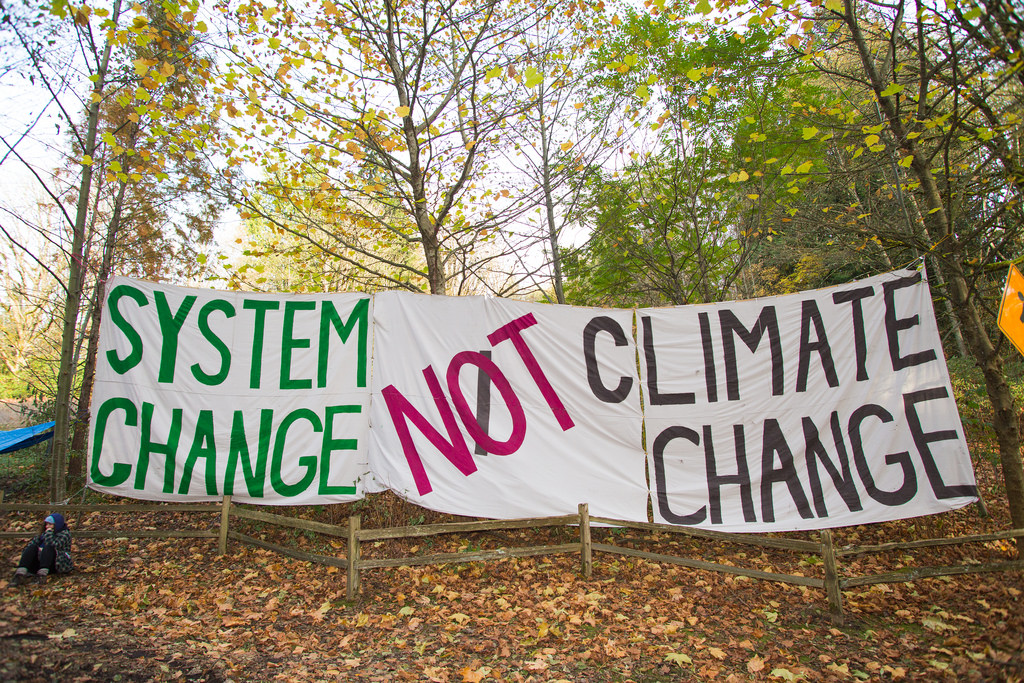
Today, the lion’s share of emissions come from transportation and production sectors of the industrial economy. By almost every projection, the simple reproduction of existing systems of production and distribution, to say nothing of their growth, will doom the planet to a host of ecocidal developments — from rising sea levels and ocean acidification to desertification in some places and more intensely concentrated rainfall in others. Against the weaving of such catastrophic tapestries, pundits of the coming energy transition spread solace with the techno-future vision of a world that could be different than the one currently soaked in hydrocarbons. Yet these proponents of technologically smoothed energy transition miss the forest for the trees: the question is not simply one of engineering, but instead how to overcome the deep roots of capitalism’s ever-growing energy dependence.

Read the text (PDF).

Market Economy: Deep Roots Of Dysfunction

By Jane Roelofs - Global Justice Center, December 2, 2017

There is nothing new in the disaster anticipated from NAFTA. The market  economy hasn’t “broken down,” or suddenly reached environmental limits. Its inherent faults are simply more clearly manifest in an age of mass communication and heightened consciousness. Here I will focus on the conflict between the market—the backbone of capitalism—and Green values.

Many people, even some socialists, believe that both trade and  commodification are beneficial. These processes, essential to the creation of a market economy, are considered progressive because they offer both more choice and a larger amount of stuff. While these effects cannot be disputed,  their hidden costs in human and environmental terms must be taken into account. In contrast to conventional economics, Green economics does not measure progress in terms of expanded production and consumption. A further supposed benefit of markets, saving of labor and increased leisure, is highly questionable. Even consumption becomes “work”: e.g., driving to a shopping mall to purchase an exercise bicycle to compensate for a sedentary lifestyle.

International markets intensify the dysfunctions, although these effects may occur whenever there is trade. We are less aware of the conditions abroad, and we feel little responsibility for the labor and environmental policies (or lack of them) of other countries. However, the practices of the developed countries, and UN agencies controlled by them (e.g., the World Bank) are often directly responsible for production conditions in other countries. An obvious example is the foreign-trained “death squad” which  targets labor organizers in Third World countries. Even without outside prodding, countries anxious for export growth will intensify exploitation of workers and destruction of the environment. The Quayle-headed “Council on Competitiveness” was an instance of this operating in a “developed” nation.

International trade, and the consequent competition for markets and raw materials, has historically been the occasion for militarism and war. This remains true today, and now includes covert actions and counter-insurgency warfare.

Climate Summit’s Solution to Global Warming: More Talking

By Pete Dolack - CounterPunch, November 24, 2017

The world’s governments got together in Germany over the past two weeks to discuss global warming, and as a result, they, well, talked. And issued some nice press releases.

Discussing an existential threat to the environment, and all who are dependent on it, certainly is better than not discussing it. Agreeing to do something about it is also good, as is reiterating that something will be done.

None of the above, however, should be confused with implementing, and mandating, measures that would reverse global warming and begin to deal concretely with the wrenching changes necessary to avoid flooded cities, a climate going out of control, mass species die-offs and the other rather serious problems that have only begun to manifest themselves in an already warming world.

The 23rd Conference of the Parties to the United Nations Framework Convention on Climate Change (UNFCCC), or COP23, wrapped up on November 17 in Bonn. Fiji was actually the presiding country, but the conference was held in Bonn because Fiji was not seen as able to accommodate the 25,000 people expected to attend. The formal hosting by Fiji, as a small Pacific island country, was symbolic of a wish to highlight the problems of low-lying countries, but that this was merely symbolic was perhaps most fitting of all.

These conferences have been held yearly since the UNFCCC was adopted in 1992 at the Rio Earth Summit. Two years ago, at COP21 in Paris, the world’s governments negotiated the Paris Accord, committing to specific targets for reducing greenhouse-gas emissions. Although capping global warming at 2 degrees Celsius (as measured from the 19th century as the Industrial Revolution took off around the world) has been considered the outer limit of “safe” warming, a goal of halting global warming at 1.5 degrees was adopted at Paris. The catch here is that the goals adopted are far from the strength necessary to achieve the 2-degree goals, much less 1.5 degrees.

Before we explore that contradiction, let’s take a brief look at the self-congratulatory statements issued at the Bonn conference’s conclusion.

Pages

The Fine Print I:

Disclaimer: The views expressed on this site are not the official position of the IWW (or even the IWW’s EUC) unless otherwise indicated and do not necessarily represent the views of anyone but the author’s, nor should it be assumed that any of these authors automatically support the IWW or endorse any of its positions.

Further: the inclusion of a link on our site (other than the link to the main IWW site) does not imply endorsement by or an alliance with the IWW. These sites have been chosen by our members due to their perceived relevance to the IWW EUC and are included here for informational purposes only. If you have any suggestions or comments on any of the links included (or not included) above, please contact us.

The Fine Print II:

Fair Use Notice: The material on this site is provided for educational and informational purposes. It may contain copyrighted material the use of which has not always been specifically authorized by the copyright owner. It is being made available in an effort to advance the understanding of scientific, environmental, economic, social justice and human rights issues etc.

It is believed that this constitutes a 'fair use' of any such copyrighted material as provided for in section 107 of the US Copyright Law. In accordance with Title 17 U.S.C. Section 107, the material on this site is distributed without profit to those who have an interest in using the included information for research and educational purposes. If you wish to use copyrighted material from this site for purposes of your own that go beyond 'fair use', you must obtain permission from the copyright owner. The information on this site does not constitute legal or technical advice.
