You are here

green capitalism

Time for Tesla to Listen

By Jose Moran - Medium, February 9, 2017

I’m proud to be part of a team that is bringing green cars to the masses. As a production worker at Tesla’s plant in Fremont for the past four years, I believe Tesla is one of the most innovative companies in the world. We are working hard to build the world’s #1 car — not just electric, but overall. Unfortunately, however, I often feel like I am working for a company of the future under working conditions of the past.

Most of my 5,000-plus coworkers work well over 40 hours a week, including excessive mandatory overtime. The hard, manual labor we put in to make Tesla successful is done at great risk to our bodies.

Preventable injuries happen often. In addition to long working hours, machinery is often not ergonomically compatible with our bodies. There is too much twisting and turning and extra physical movement to do jobs that could be simplified if workers’ input were welcomed. Add a shortage of manpower and a constant push to work faster to meet production goals, and injuries are bound to happen.

A few months ago, six out of eight people in my work team were out on medical leave at the same time due to various work-related injuries. I hear that ergonomics concerns in other departments are even more severe. Worst of all, I hear coworkers quietly say that they are hurting but they are too afraid to report it for fear of being labeled as a complainer or bad worker by management.

Ironically, many of my coworkers who have been saying they are fed up with the long hours at the plant also rely on the overtime to survive financially. Although the cost of living in the Bay Area is among the highest in the nation, pay at Tesla is near the lowest in the automotive industry.

Most Tesla production workers earn between $17 and $21 hourly. The average auto worker in the nation earns $25.58 an hour, and lives in a much less expensive region. The living wage in Alameda county, where we work, is more than $28 an hour for an adult and one child (I have two). Many of my coworkers are commuting one or two hours before and after those long shifts because they can’t afford to live closer to the plant.

While working 60–70 hours per week for 4 years for a company will make you tired, it will also make you loyal. I’ve invested a great deal of time and sacrificed important moments with my family to help Tesla succeed. I believe in the vision of our company. I want to make it better.

I think our management team would agree that our plant doesn’t function as well as it could, but until now they’ve underestimated the value of listening to employees. In a company of our size, an “open-door policy” simply isn’t a solution. We need better organization in the plant, and I, along with many of my coworkers, believe we can achieve that by coming together and forming a union.

Many of us have been talking about unionizing, and have reached out to the United Auto Workers for support. The company has begun to respond. In November, they offered a raise to employees’ base pay — the first we’ve seen in a very long time.

But at the same time, management actions are feeding workers’ fears about speaking out. Recently, every worker was required to sign a confidentiality policy that threatens consequences if we exercise our right to speak out about wages and working conditions. Thankfully, five members of the California State Assembly have written a letter to Tesla questioning the policy and calling for a retraction.

I’m glad that someone is standing up for Tesla workers, and we need to stand up for ourselves too. The issues go much deeper than just fair pay. Injuries, poor morale, unfair promotions, high turnover, and other issues aren’t just bad for workers — they also impact the quality and speed of production. They can’t be resolved without workers having a voice and being included in the process.

Tesla isn’t a startup anymore. It’s here to stay. Workers are ready to help make the company more successful and a better place to work. Just as CEO Elon Musk is a respected champion for green energy and innovation, I hope he can also become a champion for his employees. As more of my coworkers speak out, I hope that we can start a productive conversation about building a fair future for all who work at Tesla.

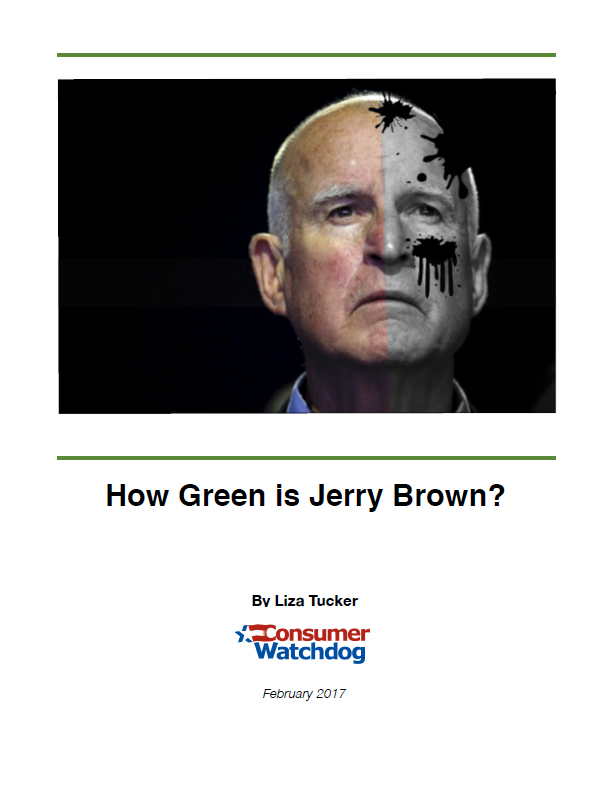
How Green is Jerry Brown?

By Liza Tucker - Consumer Watchdog, February 2017

This review fact-checks the perception of Jerry Brown as an environmentalist against his actions since taking office as Governor in 2011 to answer the question: “How Green Is Brown?” On a continuum of “Green” to “Murky” to “Dirty,” the review concludes that Brown’s environmental record is not green. The following advocates and public interest groups concur with the report’s analysis, conclusions, and recommendations: Food & Water Watch, Physicians for Social Responsibility-Los Angeles, Rootskeeper, Powers Engineering, Basin & Range Watch, Aguirre & Severson LLP, Public Watchdogs, the Southern California Watershed Alliance, The Desal Response Group, Restore The Delta, and Committee to Bridge the Gap.

Brown has staked his environmental legacy on fighting climate change, calling it the “singular challenge of our time.” He claims that he is enacting “a 1 thorough, integrated plan to reduce fossil fuel consumption.” He plans to have 1.5 million electric cars on the road by 2025 and has granted major investor-owned utilities a windfall of billions of dollars to build the charging infrastructure to make it happen. Yet, he has thrown his support to the fossil fuels industry whose products emit the most carbon on the planet when burned for transportation, electricity, and heat.

Far from the environmentalist that Brown claims to be, Brown has expanded the burning of heat-trapping natural gas and nurtured oil drilling and hydraulic fracturing while stifling efforts to protect the public from harm. The Public Utilities Commission has approved a slew of unnecessary new fossil-fuel power plants when the state’s three major investorowned utilities have overbuilt their generating capacity by nearly triple the minimum extra capacity that the state requires. Under Brown, the number of active onshore state oil and gas wells jumped by 23 percent since the year before he was elected Governor in a bid to produce more oil.

Hydraulic fracturing is producing 20 percent of the state’s oil, while companies continue to use other common, dirty methods of oil extraction exempted from fracking legislation under Brown. Companies are extracting oil from a few hundred newly permitted offshore wells in existing state leases since Brown came to office, though Brown asked then- President Obama to ban any new drilling in California’s federal waters. Brown’s regulators have ignored a petition signed by 350,000 people to ban the use of toxic oil wastewater for crop irrigation until proven safe.

Read the report (PDF).

(Working Paper #9) Are We Moving Away From Fossil Fuels? Separating Facts from Fantasies

By Sean Sweeney - Trade Unions for Energy Democracy, January 31, 2017

Is the World Really Moving Away from Fossil Fuels? Examining the Evidence.

PDF available for download now.

During 2015 and 2016, a number of significant public and political figures have made statements suggesting that the world is “moving away from fossil fuels,” and that the battle against greenhouse gas emissions (GHGs) and climate change is therefore being won. Such statements are frequently accompanied by assurances that the transition to renewable energy and a low-carbon economy is both “inevitable” and already well underway, and that economic growth will soon be “decoupled” from dangerously high annual emissions levels. This optimism has also been accepted by a section of the environmental movement, and even by some unions.

Renewables and Reality 

If the “green growth” optimists are correct, the political implications for trade unions and social movements are profound. For unions, it would mean focusing aggressively on the need to protect the livelihoods of the tens of millions of workers around the world who currently work in fossil fuels and rallying around the principle of “just transition” encoded in the preface to the Paris Agreement. But it would also mean that the need to wage a determined and protracted political struggle against fossil fuel expansion and “extractivism” would immediately become less urgent. In this scenario, trade union efforts would rightly focus on working to shape the next energy system as it rises from the ashes of the old.

But what if proclamations of fossil fuels’ demise are wrong? What if the “momentum” has not shifted, and the transition to renewables-based power is neither inevitable nor well underway? In that case, the struggle against the current model of ownership that drives the growth of fossil fuels and extractivism—that is, the struggle for democratic control and social ownership of energy—remains vital. This would demand redoubled effort and commitment across all sections of our movement. It would mean the level of urgency in the struggle for energy democracy must be increased, activism stepped up, and fresh approaches embraced, encouraged, and endorsed.

Their Optimism, and Ours

In this ninth TUED working paper, authors Sean Sweeney and John Treat document the recent claims of the optimistic, “green growth” narrative; examine the evidence frequently used to legitimize and sustain it; and then consider this evidence in context of the broader trends in the global energy system, drawing on a range of major recent data sources.

What the paper’s analysis shows is that, unfortunately, the world is not “moving away from fossil fuels”; far from it. The recent “we are winning” optimism is misplaced, misleading, and disarming. It must therefore be rejected, and replaced with a more sober perspective that draws hope and confidence not from a selective and self-deceiving interpretation of the data, but from the rising global movement for climate justice and energy democracy, armed with clear programmatic goals and a firm commitment to achieve them.

Unions are urged to circulate the paper and use its contents to stimulate debates on energy policy and political action. Please send comments, additional data, and requests for more information to Irene Shen (ireneTUED@gmail.com).

Download the full paper here.

Survival Is the Question

By Michael Löwy - Against The Current, January 2017

Facing the Anthropocene:
Fossil Capitalism and the Crisis of the Earth System
By Ian Angus
Monthly Review Press, 280 pages, $19 paper.

Green Capitalism:
The god that failed
By Richard Smith
World Economics Association, http://www.worldeconomicsassociation.org/, 115 pages, $21.50 paper.

CRITICAL ECOLOGY PUBLI­CA­TIONS are finding a growing audience in the United States, as is evident in the success of Naomi Klein’s  book This Changes Everything. Within this field there is also an increasing interest in ecosocialist thought, of Marxist inspiration, of which the two authors reviewed here are a part.

One of the active promoters of this trend is Monthly Review and its publishing house. It is this group that has published the compelling book, Facing the Anthropocene by Ian Angus, the Canadian ecosocialist and editor of the online review Climate and Capitalism.

His book has been lauded by the general public as well as by many within the scientific community, such as Jan Zalasiewicz and Will Steffen. Among the principal proponents of this outstanding work on the Anthropocene are Marxist researchers like Mike Davis and John Bellamy Foster, and ecologists on the left like Derek Wall of the Green Party of England.

From the work of such thinkers as chemist Paul Crutzen, who won the Nobel Prize for his research on the destruction of the ozone layer, geophysicist Will Steffen and many others, the conclusion that we have entered into a new geological era that is distinct from the Holocene (the era of the past 12,000 years) is beginning to be accepted.

The term “Anthropocene” is most often used to identify this new epoch, which is characterized by the profound impact of human activity on the earth-system. Most experts agree that the Anthropocene began in the mid-20th century, when a “Great Acceleration” of destructive changes were triggered. In fact, three-quarters of all CO2 emissions have been produced since the 1950s.

The term “Anthropos” does not mean that all humans are equally responsible for these drastic and disturbing changes — researchers have clearly shown the overwhelming responsibility of the world’s richest countries, the OECD countries, in shaping these events.

We also know the consequences of these transformations, notably climate change: most temperature rise, increasing extreme climate events, elevating ocean levels, the drowning of large coastal cities, etc. These changes are not gradual or linear and can be both abrupt and disastrous.

It seems to me, however, that this part of Facing the Anthropocene is less developed. Although Angus mentions these dangers, he does not discuss in a more detailed and concrete way the threats that weigh on the survival of life on the planet.

What are the established powers doing — especially the governments of the rich countries principally responsible for the crisis? Angus cites the fierce response of James Hansen, the North American NASA climatologist, to the 2015 United Nations Climate Change Conference in Paris, saying, “a fraud really, a fake…. It’s just bullshit.”

Indeed, even if all the countries present at the conference keep their promises, which is very unlikely considering that not a single sanction is expected to be fully met by the Paris agreements, we still will not be able to avoid an increase in the planet’s temperature past two degrees Celsius over pre-industrial levels.

COP22’s Imperialist Environmentalism

By Joe Hayns - Jacobin, November 11, 2016

Each year, the world’s heads of state meet at the Conference of Parties (COP) to discuss how to “stabiliz[e] greenhouse gas concentrations in the atmosphere at a level that would prevent dangerous anthropogenic interference with the climate system,” as the guiding United Nations Framework on Climate Change demands.

Last year’s COP garnered international attention and praise. Le Monde’s verdict included a quote from the event’s president and Parti Socialiste foreign minister, Laurent Fabius (“a compromise guided by ‘climate justice’”). The Guardian called the meeting “a rare and heartening case of disparate peoples being led to a common conclusion by evidence and reason.” The New York Times declared that the negotiations ended with “a historic breakthrough.”

But many climate justice activists and scientists disagree. Against the “People’s Test” — “a set of criteria that the Paris deal would need to meet in order to be effective and fair” created by social movements, unions, and environmental groups — the Paris agreements failed on every count.

On Monday, COP22 began in Marrakech, Morocco. International attention will again focus on the political class’s negotiations. But if we’re serious about fighting climate change globally, we might be better off listening to the Moroccan activists currently fighting environmental ruination.

This resistance comes out of the country’s imperialist environmental policy, which, to paraphrase William Faulkner, isn’t past: it isn’t even history.

DIRTY CLEAN ENERGY: Is Morocco’s renewable energy from Western Sahara really ‘Green’?

By Fabian Wagner - Green European Journal, November 28, 2016

Young Green Fabian Wagner attended the COP 22 negotiations in Marrakesh and found that despite the host’s eagerness to project itself as a constructive force in the fight against climate change, its policies in other areas raise serious concerns – not least the levels of repression around the question of Western Sahara.

Morocco certainly did not hold back in terms of advertising its efforts to become a country powered by renewable energy during the COP22. Only the most oblivious of visitors could have missed the banners at the airport, posters in the city, ads on horse carriages, and stickers on cars. Wind power, solar power — Morocco is transitioning towards clean energy at a very quick pace.

Africa’s forgotten conflict

Sounds great? Here’s the downside: Africa has a largely forgotten and ignored conflict right on the doorsteps of Europe. After colonial Spain retreated from Western Sahara in the ‘70s, Morocco quickly imposed itself following a bit of a struggle with Mauritania which ended in its favour, and subsequently annexed the entire territory as its “Southern Provinces”. The UN installed a peacekeeping mission there (without a mandate to observe human rights in the region) and spent the next almost half a century repeatedly, and without success, calling for a referendum on the independence of resource rich territory, and its identity as the Sahrawi Arab Democratic Republic. It was interesting to see how much effort Morocco invested into presenting this as the “African COP”, despite Morocco being the only country in Africa that is not a member of the African Union (AU) — Morocco left after the AU acknowledged the independence of Western Sahara. In the run-up to the COP in Marrakech the topic naturally attracted slightly more attention than usually, but very little criticism was raised openly for obvious reasons. Morocco’s reaction to any kind of criticism of its Western Sahara politics is brusque. When the UN Secretary General called the situation out for what it is — an illegal occupation — Morocco expelled the entire peacekeeping mission. A subsequent apology from the Secretary General was still not enough to re-admit the entire mission. Moreover, our own Green activists from several of the Federation of Young European Greens’ (FYEG) member organisations have been evicted from or denied entry to both Western Sahara and Morocco, when trying to report from the ground. Plain-clothes and uniformed police are everywhere, as FYEG’s activists witnessed first-hand, when trying to work on unrelated, but still undesirable for the Moroccan government, media projects. Under these circumstances FYEG, the Western Sahara Support Committees from around the world, the Sahrawis themselves, and other civil society organisations and movements like the teachers group we met in Marrakech found it very difficult to raise concerns about the topic of Western Sahara while being present for COP22 in Morocco.

The Carbon Tax Is Doomed

By Matt Huber - Jacobin, October 9, 2016

Climate change is often chalked up to “market failure.” We’re told that, despite prevailing assumptions that prices accurately transmit “signals” about the costs of goods and services, emitters like power plants, refineries, automobiles, and households simply do not pay the full ecological costs of their emissions. Hence, the market has failed.
To fix the problem, the argument goes, we must internalize the costs of emissions into the price mechanism so that emitters pay the full costs of their actions. If we could craft a policy that accurately monetized the ecological costs of emissions — a carbon tax, or fee and dividend scheme — fossil fuels would become costlier and renewables would be more competitive and cost effective. The failure could be corrected, and the market would succeed in guiding us to a clean energy future.

Accounting for ecological costs has become the primary way of crafting environmental policy for public officials and legal experts. But the rhetoric of cost internalization is a political dead end for a left climate politics.

Focusing on getting the price right, and thereby assuming the market can be corrected, allows right-wing and fossil-fuel interests to effectively argue that any and all climate policy will be a cost to working people. Recently, the CEO of Chevron put it bluntly “I’ve never had a customer come to me and ask to pay a higher price for oil, gas, or other products.” Indeed, while many on the climate left attribute slow movement on climate to a problem of education and denial of climate science, popular opposition to climate policy is more often framed in economic terms, focusing on costs to the economy and to everyday people’s lives.

In an ideological landscape dominated by an obsession with accounting for and trimming costs, environmental policy proposals often advocate raising costs—costs that are likely to end up being passed down to working people. Opponents of climate justice easily argue that any tax or cost will end up percolating throughout the economy and hitting ordinary people: wealth doesn’t trickle down, but costs do.

A left climate politics must move beyond a language of cost-internalization, and emphasize the real material benefits for a society beyond fossil fuel: not only in terms of a cleaner environment, but also cheaper energy and green jobs. This requires a language of public goods and collective action, not a language of markets and costs. If the Left must speak of costs at all, it needs to be framed in class terms — costs that the wealthy and corporations must pay to fund a better energy economy.

An A-Z of Green Capitalism

By staff - Corporate Watch, September 2016

Capitalism thrives on crisis, and the multiple global environmental crises, including climate change and habitat and biodiversity loss, are creating new markets from which to generate profit. Those promoting green capitalism argue that if nature was valued correctly it will not only be protected, but even enhanced, along with the health of the economy and well-being in society.

However, it is a contradiction in terms. Capitalism is fundamentally exploitative of people and the natural world, it is not and cannot be ‘green’. Green capitalism involves various institutions, including governments, corporations, think tanks, charities and NGOs, implementing policies, practices and processes to incorporate nature into capitalist market systems. It takes the same capitalist ideas and values that create environmental crises – i.e. continual economic growth, private property, profit and ‘free’ markets – and applies them to the natural world as a way to solve those crises. It serves to maintain capitalism’s dominance, both through finding new ways to generate profit, and as a way of protecting it from criticism of being environmentally destructive.

This guide is intended as an introduction to the ideas surrounding green capitalism as well as the alternatives to it. We hope it will support attempts to resist the threat of green capitalism and create space for real ecological alternatives.

Download the complete report (PDF) here.

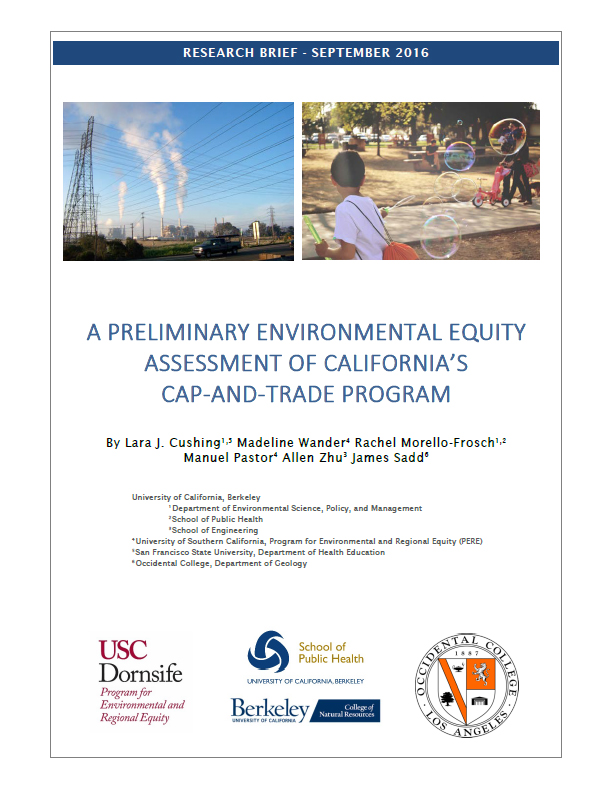
“A Preliminary Environmental Equity Assessment of California’s Cap-And-Trade Program

By Rachel Morello-Frosch, Manuel Pastor, James Sadd, Lara Cushing, Madeline Wander, and Allen Zhu - California Environmental Justice Alliance, September 2016

California’s cap-and-trade program is a key strategy for achieving reductions in greenhouse gas (GHG) emissions under AB32, the California Global Warming Solutions Act. For residents living near large industrial facilities, AB32 offered the possibility that along with reductions in GHGs, emissions of other harmful pollutants would also be decreased in their neighborhoods. Carbon dioxide (CO2), the primary GHG, indirectly impacts health by causing climate change but is not directly harmful to health in the communities where it is emitted. However, GHG emissions are usually accompanied by releases of other pollutants such as particulate matter (PM10) and air toxics that can directly harm the health of nearby residents.

In this brief, we assess inequalities in the location of GHG-emitting facilities and in the amount of GHGs and PM10 emitted by facilities regulated under cap-and-trade. We also provide a preliminary evaluation of changes in localized GHG emissions from large point sources since the advent of the program in 2013. To do this, we combined pollutant emissions data from California’s mandatory GHG and criteria pollutant reporting systems, data on neighborhood demographics from the American Community Survey, cumulative environmental health impacts from the California Environmental Protection Agency’s CalEnviroScreen tool, and information from the California Air Resources Board (CARB) about how regulated companies fulfilled their obligations under the first compliance period (2013-14) of the cap-and-trade program. Our methodology is described in greater detail in the appendix to this report.

In this analysis, we focus primarily on what are called “emitter covered emissions,” which correspond to localized, in-state emissions (derived mostly from fossil fuels) from industries that are subject to regulation under cap-and-trade. The cap-and-trade program also regulates out-of-state emissions associated with electricity imported into the state and, beginning in 2015, began regulating distributed emissions that result from the burning of fuels such as gasoline and natural gas in off-site locations (e.g., in the engines of vehicles and in homes).

We found that regulated GHG-emitting facilities are located in neighborhoods with higher proportions of residents of color and residents living in poverty. In addition, facilities that emit the highest levels of both GHGs and PM10 are also more likely to be located in communities with higher proportions of residents of color and residents living in poverty. This suggests that the public health and environmental equity co-benefits of California’s cap-and-trade program could be enhanced if there were more emissions reductions among the larger emitting facilities that are located in disadvantaged communities. In terms of GHG emission trends, in-state emissions have increased on average for several industry sectors since the advent of the cap-and-trade program, with many high emitting companies using offset projects located outside of California to meet their compliance obligations. Enhanced data collection and availability can strengthen efforts to track future changes in GHG and co-pollutant emissions and inform decision making in ways that incentivize deeper in-state reductions in GHGs and better maximize public health benefits and environmental equity goals.

Read the report (PDF).

The Dark Side of Local

By Margaret Gray - Jacobin, August 21, 2016

We live in the shadows,” explained Javier, a Hudson Valley farmworker, while describing his life to me. “We are treated like unknown people . . . We are not paid well and cannot ask for more.” A worker on another farm said, “They treat us like nothing; they only want the work . . . Whether we like it or not, we have to like it.”

Some of today’s liveliest political conversations concern agricultural production and distribution. But these discussions are also among the most confused.

Exploitative conditions on factory farms have rightly drawn the attention of academics, activists, and journalists. Indeed, the vast majority of research on farmworkers focuses on the largest farming sites. Consumers are offered countless reasons to avoid produce from them — but few alternatives other than to “buy local.”

Much contemporary food writing argues that when we buy locally grown food directly from farms, we not only secure fresher, more seasonal produce, but we also create an intimate, trusting relationship with the farmer. This supposed bond reinforces the common understanding that the local food production process is more wholesome than the industrial agricultural system.

Food writers and scholars have highlighted the many positive aspects of local food systems: economic and social justice, the sense of community facilitated by face-to-face interactions with food producers, and the civic engagement and democracy promoted by alternative agri-systems.

For example, as Barbara Kingsolver argues in Animal, Vegetable, Miracle, “‘locally grown’ is a denomination whose meaning in incorruptible.” Later in the book she addresses the poor pay and conditions of workers on factory farms, citing their average annual income of $7,500. Clearly, she intends readers to feel grateful that local farms offer a more just and well-paid alternative.

Or take another prominent example: in The Omnivore’s Dilemma, a landmark in the new food literature, Michael Pollan describes two types of farming — industrial and pastoral — and offers no in-between.

In promoting local diets as healthy and righteous alternatives to the capitalist-industrial monoculture food system, such writers have sold us an idea premised on a false dichotomy.

On one hand, they demonize factory farms for poisoning the land and local waterways, for confining and mistreating animals, and for exploiting their workers in the name of earning profits. On the other hand, they promote local agriculture as the antidote to the factory farms’ corporate ills.

By shopping at the farmers market or joining a Community Supported Agriculture (CSA) program, consumers support smaller (though not necessarily small) farmers, keep food dollars local, encourage limited pesticide use, and ensure animals are treated humanely.

Pages

The Fine Print I:

Disclaimer: The views expressed on this site are not the official position of the IWW (or even the IWW’s EUC) unless otherwise indicated and do not necessarily represent the views of anyone but the author’s, nor should it be assumed that any of these authors automatically support the IWW or endorse any of its positions.

Further: the inclusion of a link on our site (other than the link to the main IWW site) does not imply endorsement by or an alliance with the IWW. These sites have been chosen by our members due to their perceived relevance to the IWW EUC and are included here for informational purposes only. If you have any suggestions or comments on any of the links included (or not included) above, please contact us.

The Fine Print II:

Fair Use Notice: The material on this site is provided for educational and informational purposes. It may contain copyrighted material the use of which has not always been specifically authorized by the copyright owner. It is being made available in an effort to advance the understanding of scientific, environmental, economic, social justice and human rights issues etc.

It is believed that this constitutes a 'fair use' of any such copyrighted material as provided for in section 107 of the US Copyright Law. In accordance with Title 17 U.S.C. Section 107, the material on this site is distributed without profit to those who have an interest in using the included information for research and educational purposes. If you wish to use copyrighted material from this site for purposes of your own that go beyond 'fair use', you must obtain permission from the copyright owner. The information on this site does not constitute legal or technical advice.