You are here

green capitalism

VW Chose Profit Over the Planet

By Tyler Zimmer - Socialist Worker, October 1, 2015

Disclaimer: The views expressed here are not the official position of the IWW (or even the IWW’s EUC) and do not necessarily represent the views of anyone but the author’s.

IT'S ONLY been a week, but it's already being dubbed one of the biggest-ever corporate scandals.

Volkswagen, the world's largest auto manufacturer, was recently caught rigging millions of its cars to cheat on emissions tests. Software known as "defeat devices" was installed in more than 11 million cars that enabled the vehicles to pass emissions tests they would otherwise have failed. The illicit devices detect when a car is being tested and direct the engine to pump out far less pollutants--98 percent less--into the air than they ordinarily do when on the road.

The fallout has been swift and profoundly damaging for the company. In a single week, more than a quarter of the company's total value of shares has been completely wiped out. Governments in Germany and the U.S. are already promising to impose heavy fines--some sources say the total amount could add up to as much as $10 billion to $20 billion. Executives have resigned, sales have been suspended, and a massive recall of rigged cars looms large.

Of course, if you were to take the VW brand's self-image at face value, these revelations would come as something of a severe shock. Volkswagen has spent the last several years cultivating a public image that evokes precision, efficiency and ecological sensitivity--VW's are "clean, quiet and powerful" as a recent advertisement put it.

The company has courted millennials with talk of "clean diesel technology." Indeed, before the scandal broke, VW was held up by the Dow Jones Sustainability Index as the "greenest," most environmentally conscious carmaker in the world. This is only one of many awards that the company has racked up over the years for its supposed commitment to ecological sustainability.

No doubt much of the public outrage directed at VW owes to the contradiction between the company's "green" reputation, on the one hand, and its systematic engagement in fraudulent polluting, on the other. As more and more information about the company's decision-making comes to light, the easier it becomes to see the matter in purely ethical terms, as a case where greed blinded those at the top.

The public will be encouraged to conclude that this scandal is the result of cynical, deceptive actions on the part of a few corporate executives--"a few bad apples"--at the top of Volkswagen. But thinking about the issue in this way would be a mistake, since it would lead us to overlook the larger, systemic problems with capitalism that this scandal reveals.

UN plan to save Earth is “fig leaf” for Big Business insiders; Why the new Sustainable Development agenda is “fundamentally compromised” by corporate interests

By Nafeez Ahmed - Medium.Com, September 4, 2015

Disclaimer: The views expressed here are not the official position of the IWW (or even the IWW’s EUC) and do not necessarily represent the views of anyone but the author’s.

At the end of this month, the UN will launch its new 2030 Sustainable Development agenda for “people, planet and prosperity” in New York, where it will be formally adopted by over 150 world leaders.

The culmination of years of consultations between governments, communities and businesses all over the world, there is no doubt that the agenda’s 17 Sustainable Development Goals (SDGs) offer an unprecedented vision of the interdependence of global social, economic and environmental issues.

But records from the SDG process reveal that insiders at the heart of the UN’s intergovernment engagement negotiations have criticised the international body for pandering to the interests of big business and ignoring recommendations from grassroots stakeholders representing the world’s poor.

Formal statements issued earlier this year as part of the UN’s Post-2015 Intergovernmental Negotiations on the SDGs, and published by the UN Sustainable Development Division, show that UN ‘Major Groups’ representing indigenous people, civil society, workers, young people and women remain deeply concerned by the general direction of the SDG process — whereas corporate interests from the rich, industrialised world have viewed the process favourably.

Klein vs. Klein

By Out of the Woods - The New Inquiry, January 7, 2015

Disclaimer: The views expressed here are not the official position of the IWW (or even the IWW’s EUC) and do not necessarily represent the views of anyone but the author’s.

This Changes Everything is a book capacious enough to allow Naomi Klein two positions at once. But a real climate-justice movement will at some point have to make choices.

Naomi Klein’s success pulls her in two directions. To some, her decades-long failure to produce “proper” theory as well as writing scintillating and successful books has been an affront. On her Reddit AMA she’s said her writing “will never be enough for hyper-sectarian Marxists, and I’m cool with that.” Perhaps it was her bad luck that Slavoj Žižek had begun to use the phrase “shock therapy, in the Naomi Klein sense.” Both No Logo, published just after Seattle’s WTO conflagration in 1999, and 2007’s The Shock Doctrine, which named “a fifty-year campaign for total corporate liberation,” were seminal, highly readable accounts of consumerism and neoliberalism, and (primarily) vindications of mostly unvictorious struggles against their encroachment across the globe, in which she participated. The anglophone world is now just beginning to digest her latest, an ecological magnum opus, and its eagerly anticipated castigation of the mainstream environmental movement.

Klein’s Twitter bio now claims “they say I’m polarizing.” In fact, the responses to This Changes Everything: Capitalism Vs. The Climate, have been unequivocally enthusiastic. The New York Times published one such, which asked only: “what’s with the subtitle? (…) Klein is smart and pragmatic enough to shun the never-never land of capitalism’s global overthrow.” Even the right-wing Telegraph was content to praise someone it clearly saw as “no advocate of socialism.” Opening This Changes Everything, Klein says that “this is the hardest book I’ve ever written, precisely because the research has led me to search out such radical responses.” Yet these radical responses have been warmly embraced by the center. The establishment, if it is trembling, is hiding it well.

Indeed, her difficulty writing it seems to have led to apparent contradictions. Klein supports proposals to create millions of green jobs and liberate people from work. She advocates rapid fossil fuel abolition and a welfare state funded by taxes on fossil fuel profits. She takes aim at the profit motive and endorses small local businesses as the fabric of the community. Rather than make accusations of confusion or hypocrisy, let’s take seriously her claim to have been pushed into radical positions by the urgency and severity of the climate crisis, and propose that, instead, two divergent Naomi Kleins have been formed who together make up the author of This Changes Everything.

EcoUnionist News #58

Compiled by x344543 - IWW Environmental Unionism Caucus, July 27, 2015

Disclaimer: The views expressed here are not the official position of the IWW (or even the IWW’s EUC) and do not necessarily represent the views of anyone but the author’s.

The following news items feature issues, discussions, campaigns, or information potentially relevant to green unionists:

Lead Stories:

Bread and Roses:

An Injury to One is an Injury to All:

Carbon Bubble:

Just Transition:

Other News:

For more green news, please visit our news feeds section on ecology.iww.org; Twitter #IWWEUC; Hashtags: #greenunionism #greensyndicalism #IWW

Greens support pension cuts but keep benefits for the rich

By Andrea Bunting - Green Left Weekly, June 20, 2015

Disclaimer: The views expressed here are not the official position of the IWW (or even the IWW’s EUC) and do not necessarily represent the views of anyone but the author’s.

The federal government is keen to cut the age pension. Its latest proposal to double the taper rate on the assets test has been supported by the Greens on the basis that this measure will reduce government support to those with significant wealth.

The Greens also hoped that by supporting these pension cuts, the government would rein in tax concessions on superannuation. However, the government has since publicly ruled out any superannuation changes.

So the deal does not reduce benefits given to the rich. It reduces benefits to those in the middle, while providing a small benefit — about $15 per week — to pensioners with modest assets. The poorest pensioners receive nothing extra.

National Seniors Australia has expressed concern that these changes will reduce pensions, while not addressing superannuation tax concessions.

The government provides support for people’s retirement through the age pension and through tax concessions on superannuation. The Australian Institute of Superannuation Trustees (AIST) and Mercer have modelled the total lifetime government support for retirement incomes received by those on different levels of income.

Their modelling found that the bottom 10% of earners average about $400,000 in government retirement support over their lifetime. Meanwhile, the top 10% of earners average about $489,000. This group doesn’t even get the age pension.

But the greatest government largesse is reserved for those in the top 1% income range. The modelling showed that the richest 1% receive on average around $630,000 of lifetime government support. Under the new law, lifetime support for some middle income earners has now been slashed to $214,000.

EcoUnionist News #53

Compiled by x344543 - IWW Environmental Unionism Caucus, June 23, 2015

Disclaimer: The views expressed here are not the official position of the IWW (or even the IWW’s EUC) and do not necessarily represent the views of anyone but the author’s.

The following news items feature issues, discussions, campaigns, or information potentially relevant to green unionists:

Lead Story:

Bread and Roses:

An Injury to One is an Injury to All:

Carbon Bubble:

Just Transition:

Other News:

For more green news, please visit our news feeds section on ecology.iww.org; Twitter #IWWEUC; Hashtags: #greenunionism #greensyndicalism

Avaaz’s Climate Vanity

By Patrick Bond - Triple Crisis, June 17, 2015

Disclaimer: The views expressed here are not the official position of the IWW (or even the IWW’s EUC) and do not necessarily represent the views of anyone but the author’s.

Who’s not heard the great African revolutionary Amilcar Cabral’s injunction, fifty years ago, “Tell no lies and claim no easy victories”? If, like me, you’re a petit bourgeois who is hopeful for social progress, then let’s be frank: this advice hits at our greatest weakness, the temptation of back-slapping vanity.

The leading framers for the 41-million strong clicktivist team from Avaaz need to remember Cabral. They over-reached ridiculously last week in praising the G7:

Many told us it was a pipe dream, but the G7 Summit of leading world powers just committed to getting the global economy off fossil fuels forever!!! Even the normally cynical media is raving that this is a huge deal. And it’s one giant step closer to a huge win at the Paris summit in December – where the entire world could unite behind the same goal of a world without fossil fuels – the only way to save us all from catastrophic climate change… Our work is far from done, but it’s a day to celebrate – click here to read more and say congratulations to everyone else in this incredibly wonderful community!!

Actually, according to The Economist: no fossil-fuel-burning power station will be closed down in the immediate future as a result of this declaration. The goal will not make any difference to the countries’ environmental policies, since they are mostly consistent with this long-range goal anyway. Where they are not (some countries are increasing coal use, for example) they will not be reined in because of the new promises… the G7’s climate effort raises as many questions as it answers. The group seems to have rejected proposals for more demanding targets, such as decarbonisation by 2050.”

Or Time: “The results were disappointing to say the least… The G7 announced an ‘ambitious’ plan to phase out all fossil fuels worldwide by 2100. Unfortunately, they didn’t make any concrete plans to scale back their own conventional fuel consumption. That’s a big deal when 59 percent of historic global carbon dioxide emissions—meaning the greenhouse gases already warming the atmosphere—comes from these seven nations. Taken as a group, G7 coal plants produce twice the amount of CO2 as the entire African continent, and at least 10 times the carbon emissions produced by the 48 least developed countries as a whole. If the G7 is serious about tackling climate change, they should start at home.”

So what was going on, really? Here’s a talking head from the Council on Foreign Relations (an imperialist braintrust): “The United States has long pressed for a shift away from binding emissions reduction commitments and toward a mix of nationally grounded emission-cutting efforts and binding international commitments to transparency and verification. European countries have often taken the other side, emphasizing the importance of binding targets (or at least policies) for cutting emissions. Now it looks like the big developed countries are on the same page as the United States. The language above is all about binding countries to transparency – and there isn’t anything elsewhere in the communiqué about binding them to actual emissions goals.”

There is an even tougher critique from the left, e.g. from Oscar Reyes of the Institute for Policy Studies, who annotated the G7 climate communique here. He lands many powerful blows, not least of which is that you simply cannot trust these politicians. This is well known in Africa. Exactly a decade ago, Tony Blair led the (then-G8) Gleneagles Summit that made all manner of ambitious redistributive promises for the continent that weren’t fulfilled.

Green Capitalism Won’t Work

By Sean Sweeney - New Labor Forum, June 1, 2015

For the last twenty years, unions in the United States and internationally have generally accepted the dominant discourse on climate policy, one that is grounded in assumptions that private markets will lead the “green transition,” reduce emissions, and stabilize the climate over the longer term. Indeed, unions began attending the climate negotiations convened by the United Nations in the early 1990s, a time when the “triumph of the market” went unchallenged and the climate debate was awash with neoliberal ideas. Unions, therefore, focused on articulating the need for “Just Transition” policies to deal with the negative impacts on employment brought about by climate policies and to highlight the need for income protection, re-employment opportunities, education and re-training, and job creation.1
In keeping with the policy discourse of the time, unions talked and acted as if the transition to a low carbon economy was inevitable—the science was, after all, definitive and a broad consensus was emerging among business, governments, and civil society that emissions reductions were urgently needed and made good economic sense. Few unions openly expressed the view that capitalism might be incapable of addressing climate change and that radical restructuring of political economy is necessary in order to stay within planetary boundaries.

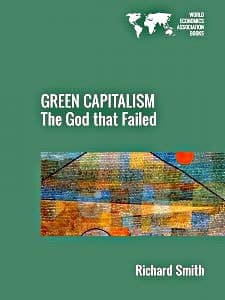
Green Capitalism: the God That Failed

By Richard Smith - World Economics Association - 2015

This book is a collection of five essays that deal with the prime threat to human life on Earth: the tendency of global capitalist economic development to develop us to death, to drive us off the cliff to ecological collapse. It begins with a review of the origins of this economic dynamic in the transition to capitalism in England and Europe and with an analysis of the ecological implications of capitalist economics as revealed in the work of its founding theorist – Adam Smith. I argue that, once installed, the requirements of reproduction under capitalism – the pressure of competition, the imperative need to innovate and develop the forces of production to beat the competition, the need to constantly grow production and expand the market and so on, induced an expansive logic that has driven economic development and overdevelopment, down to the present day.

In successive essays I explicate and criticize the two leading mainstream approaches to dealing with the ecological consequences of this over-developmental dynamic – décroisance or “degrowth”, and “green capitalism”. I show that the theorists and proponents of no-growth or de-growth – like Herman Daly or Tim Jackson – are correct in arguing that infinite economic growth is not possible on a finite planet, but that they’re wrong to imagine that capitalism can be refashioned as a kind of “steady state” economy, let alone actually “degrow” without precipitating economic collapse. There are further problems with this model, which I also investigate. I show that the theorists and proponents of “green capitalism” such as Paul Hawkin, Lester Brown and Frances Cairncross are wrong to think that tech miracles, “dematerialization”, new efficiencies, recycling and the like, will permit us to grow the global economy – more or less forever – without consuming and polluting ourselves to death. I show that while we’re all better off with organic groceries, energy-efficient light bulbs and so on, such developments do not fundamentally reverse the eco-suicidal tendencies of capitalist development, because in any capitalist economy the environment has to be subordinated to maximizing growth and sales, or companies can’t survive in the marketplace. Yet infinite growth, even green growth, is impossible on a finite planet.

In the final essays I argue that since capitalism can only drive us to ecological collapse, we have no choice but to try to cashier this system and replace it with an entirely different economy and mode of life based on: minimizing not maximizing resource consumption; public ownership of most, though not necessarily all, of the economy; large-scale economic planning and international coordination; and a global “contraction and convergence” between the North and the South around a lower but hopefully satisfactory level of material consumption for all the world’s peoples. Whether we can pull off such a transition is another question. We may very well fail to overthrow capitalism and replace it with a viable alternative. That may be our fate. But around the world, in thousands of locations, people are organizing and fighting against corporate power, against land grabs, against extreme extraction, against the incessant commodification of our lives. Here and there, as in Greece and China, ruling classes are on the defensive. All these fights have a common demand: bottom-up democracy, popular power. In this lies our best hope. This little book is intended as more ammunition for that fight.

Read the report (Link).

Organizing Against Climate Catastrophe

By Paul Messersmith-Glavin - Institute for Anarchist Studies, April 15, 2015

Disclaimer: The views expressed here are not the official position of the IWW (or even the IWW’s EUC) and do not necessarily represent the views of anyone but the author’s.

The forces responsible for changing the climate and endangering the future of humanity have names. Names such as: Chevron and Exxon Mobil, Saudi Aramco and Petroleos de Venezuela. They are the predominant groups responsible for playing havoc with our collective future. In fact, two-thirds of historic carbon dioxide and methane emissions can be attributed to exactly ninety entities. They are based in forty-three countries and extract resources from every oil, natural gas, and coal rich region in the world. They process the fuels into products that are sold to consumers in every nation on the planet. Of the top 85 emitters, 54 are in industrialized countries and 31 are in developing nations.[2] Knowing who and where they are demonstrates that an end to the problem is within our reach. In order to stop global climate change all we need to do is put pressure on these isolated entities, right?

Wrong. While these are the primary economic forces responsible for climate change, it would be a mistake to think if we stop these particular companies from conducting business as usual, we can solve the problem. They are only the most public faces of a system that goes much deeper.

Naming the responsible parties should not lead to a reformist strategy of regulating or even abolishing these companies. That would not be ultimately effective because they operate within a system that rewards their behavior. Very similar groups would emerge to fulfill these roles. What must be addressed and confronted is the social and economic system of capitalism that makes their work possible. This is the true enemy. The driving force of climate change is the capitalist profit motive and confronting this effectively will require massive grassroots local organizing with an international perspective. It will require developing an extra-legal movement, one that does not play by the rules of established power. It necessitates a revolutionary focus, and attention to how the systems and structures of racism, patriarchy and the nation state intersect with and reinforce capitalist social relations. It will require working with a broad cross-section of the population, learning from folks outside established radical circles, educating ourselves and others, while moving with hundreds, thousands, and ultimately millions of people to fundamentally transform society. The civilization that gets us out of the climate crisis will be different than the one that has gotten us into it.

Many questions arise: what is required to create such a mobilization? How does social change happen, and can it happen quickly enough to prevent further catastrophic change? Simply having access to the science is not enough; activists battle conflicting and politically driven media messages alongside feelings of despair and apathy born of disempowerment. A new, ecologically minded paradigm will require not just information but an expanded and critical economic analysis, as well as shared assumptions about collective power and the experience of working together from the ground up.

In the Pacific Northwest of the US, several organizations have been working on responding to the crisis. Three groups working closely together in Portland, Oregon have been experimenting with new models. These groups offer ideas for organizers through their experimentation with different approaches to outreach, education, and mobilization.

Pages

The Fine Print I:

Disclaimer: The views expressed on this site are not the official position of the IWW (or even the IWW’s EUC) unless otherwise indicated and do not necessarily represent the views of anyone but the author’s, nor should it be assumed that any of these authors automatically support the IWW or endorse any of its positions.

Further: the inclusion of a link on our site (other than the link to the main IWW site) does not imply endorsement by or an alliance with the IWW. These sites have been chosen by our members due to their perceived relevance to the IWW EUC and are included here for informational purposes only. If you have any suggestions or comments on any of the links included (or not included) above, please contact us.

The Fine Print II:

Fair Use Notice: The material on this site is provided for educational and informational purposes. It may contain copyrighted material the use of which has not always been specifically authorized by the copyright owner. It is being made available in an effort to advance the understanding of scientific, environmental, economic, social justice and human rights issues etc.

It is believed that this constitutes a 'fair use' of any such copyrighted material as provided for in section 107 of the US Copyright Law. In accordance with Title 17 U.S.C. Section 107, the material on this site is distributed without profit to those who have an interest in using the included information for research and educational purposes. If you wish to use copyrighted material from this site for purposes of your own that go beyond 'fair use', you must obtain permission from the copyright owner. The information on this site does not constitute legal or technical advice.