You are here

health and safety

At Paris Trade Union Forum: A call to ban fracking worldwide

By Blake Deppe - People's World, December 4, 2015

PARIS -- In the Climate Generations event area here at COP 21, the Trade Union Forum on Climate and Jobs presented on Dec. 3 an event called Resisting Extreme Extraction. Labor organizations including the New York State Nurses Association (NYSNA), the Argentine Workers' Central Union (CTA), and the Public and Commercial Services Union (PCS) addressed the audience with a clear declaration: that fracking, in every country and every part of the world, has got to go.

These organizations are part of the Trade Unions for Energy Democracy, an initiative coordinated by the International Program for Labor, Climate and Environment (IPLCE). Their call for a global moratorium on the harmful natural gas extraction process is bolstered by the findings of Robert Howarth, the David R. Atkinson Professor of Ecology and Environmental Biology at Cornell University. He published his findings about the disastrous effects of fracking in an article titled A bridge to nowhere: methane emissions and the greenhouse gas footprint of natural gas, and shared them at COP 21.

"Natural gas is widely promoted as a 'bridge fuel,' " Howarth said, referencing the publication. "It is said that it allows continued use of fossil fuels while reducing greenhouse gas emissions compared to oil or coal. And since 2009, over 40 percent of natural gas has come from shale gas, which is such a driver for climate change, because of methane. Most climate scientists, in their studies, are focusing on carbon, but methane is 120 times more powerful while both gases are in the atmosphere."

He explained that carbon, of course, is the larger instigator behind climate change, as there is more of it in the atmosphere, but in terms of actually slowing global warming, there is a key difference between the two. "Because of its long residence time," he said, "reductions in carbon emissions can only slowly change the atmospheric concentration." On the other hand, "methane emissions reductions lead to almost immediate reductions in atmospheric concentration. If we cut methane emissions today, we could really slow warming and prevent the [planet] from exceeding that two degree mark."

What Howarth is referring to is the very goal of COP 21: to avert a planetary warming of two degrees Celsius. This is a slightly more realistic ambition - in comparison with last year's climate conference in Copenhagen, which sought to avoid 1.5 degrees of warming - and one based on assessments made on global warming by the Intergovernmental Panel on Climate Change.

But curbing that methane output can best be done by putting an end to fracking, and increased transparency, based on recent studies not funded by the fossil fuel industry, is shifting public opinion on this false 'energy alternative.' "There have been about 32 new research papers published on fracking recently," said Hogarth. This, he conveyed, provides an excellent counterbalance to the problematic studies carried out by the Environmental Protection Agency and the Environmental Defense Fund, with the latter in particular notorious for its biased and industry-collaborative approach. He said that both the agency and the EDF "misuse their instruments during their studies, and thus draw unrealistic conclusions about fracking. The truth is, it is globally warming the planet today."

Former inspectors allege safety issues with Spectra pipeline project

By Steve Ahlquist - RI Future, November 30, 2015

Two safety inspectors who worked on Spectra Energy’s proposed methane gas pipeline that will cut through Burrillville, RI, say the company cut corners when it came to project, worker and environmental safety.

“Right now, what they’re hoping to do, is they’re hoping to slam all this through, and then at the end ask for forgiveness,” said one of the former inspectors. “Oops, sorry about that, I didn’t know, let me write you a check. Because once this thing’s turning meter, they’re going to be making millions of dollars a day. It doesn’t matter what your problems are…”

The other added, “We were told to shut the fuck up or quit.”

Both men, who spoke on the condition of anonymity, were subcontracted by Spectra and both were terminated from the project this summer. I was introduced to them through FANG (Fighting Against Natural Gas), an environmental group that opposes the project, and have spent time talking with both men by phone as well as reviewing audio interviews and emails provided by FANG.

“Like every other company, Spectra gives a tremendous presentation about their commitment to safety, but their actions lack any kind of resolve. No one ever says, ‘Safety’s #2 here,’” said the first inspector. “At every turn when I made a safety suggestion, I was met with monumental resistance from the company on every level.”

Perhaps suspecting their days are numbered, fossil fuel companies are rushing to build the infrastructure required to keep us dependent on methane or “natural” gas for the next 50 years or more, even as evidence mounts that methane is a major contributor to climate change. This gives lie to the claim that methane will serve as a bridge fuel, something to ease the transition from fossil fuels to green energy sources, as the infrastructure investments being made are long term and permanent. Companies are investing billions laying pipelines, building compressor stations, and constructing energy plants and other infrastructure ahead of industry-wide extinction.

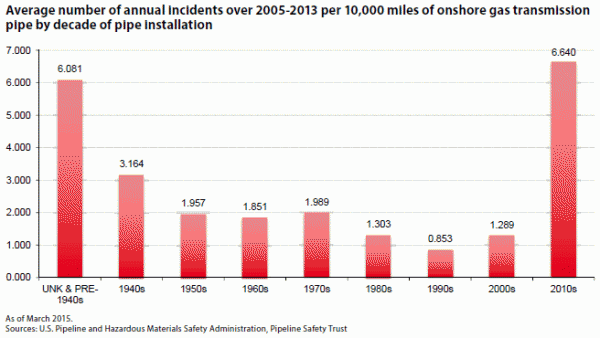
In their rush to build, safety and environmental concerns are being brushed aside, suspect many experts. A recent “Pipeline Safety Trust analysis of federal data,” shows that, “new pipelines are failing at a rate on par with gas transmission lines installed before the 1940s.”  Sarah Smith writes that Carl Weimer, director of the Pipeline Safety Trust, told attendees at a National Association of Pipeline Safety Representatives annual meeting in Tempe, AZ that, “The new pipelines are failing even worse than the oldest pipelines.”

Pipeline Incidents

Though some of the problems may be related to workers learning how to implement the latest technologies, Weimar says, “there’s also some suggestions that we’re trying to put so many new miles of pipeline in the ground so fast that people aren’t doing construction … the way they ought to.”

In the same piece Smith quotes Robert Hall, of the National Transportation Safety Board Office of Railroad, Pipeline and Hazardous Materials Investigations, who agreed that, “the rapid construction of pipelines in the U.S. is likely a contributing factor to ‘people … out there possibly taking shortcuts or not being as diligent’ as they would be if the pace of construction were less fervent.”

Coming forward to confirm these observations are two former Spectra contractors I’m calling Inspector One and Inspector Two. Both wish to remain anonymous for this piece for personal and professional reasons, though they know that their former bosses may be able to identify them.

Using Violation Tracker to Analyze Workplace Safety and Labor Relations

By Phil Mattera - Dirt Digger's Digest, November 5, 2015

It’s widely known that BP has a terrible workplace safety record, especially at its Texas City refinery, where 15 workers were killed in a 2005 explosion blamed in large part on management. In 2010 BP had to pay a record $50 million to settle OSHA allegations relating to the incident and the serious deficiencies in its subsequent remediation efforts.

Figuring out which other companies have created the greatest hazards for their workers has been more difficult — until now, that is. Violation Tracker, a new database on corporate misconduct, brings together information on some 100,000 environmental, health and safety cases filed by OSHA and a dozen other federal regulatory agencies since 2010. The database links the companies involved in the individual cases to their corporate parents, and the penalties are aggregated. Here I look at the largest OSHA violators identified by Violation Tracker and discuss a key characteristic they tend to have in common.

Companies with the most OSHA penalties, 2010-August 2015

  • BP: $63,860,860
  • Louis Dreyfus (parent of Imperial Sugar): $6,063,600
  • Republic Steel: $2,635,000
  • Tesoro: $2,532,355
  • Olivet Management: $2,359,000
  • Dollar Tree: $2,153,585
  • Ashley Furniture: $1,869,745
  • Kehrer Brothers Construction: $1,822,800
  • Renco: $1,535,475
  • Black Mag LLC: $1,218,500

(Source: Violation Tracker. Amounts are totals of “current penalties” for serious, willful or repeated violations of $5,000 or more after any negotiated reductions in OSHA’s initial proposed fines.)

Last February, members of the United Steelworkers union walked off the job at BP refineries in Ohio and Indiana as part of a strike focusing on safety problems in the industry. USW president Leo Girard stated at the time: “Management cannot continue to resist allowing workers a stronger voice on issues that could very well make the difference between life and death for too many of them.” BP’s $63 million in OSHA fines and settlements since 2010, far more than any other company, have put it at the forefront of that deadly resistance.

Tesoro, another unionized oil refiner criticized by the USW for its safety shortcomings, has the fourth highest OSHA penalty total ($2.5 million) among the companies in Violation Tracker. In 2014 the union called on the company to develop a “comprehensive, cohesive safety program” after an accident at a California refinery in which two workers were seriously injured. The USW also took the company to task for disputing a report by the U.S. Chemical Safety Board citing “safety culture deficiencies” among the causes of a 2010 explosion at a Tesoro refinery in Anacortes, Washington that killed seven workers.

Kehrer Brothers Construction, on the top-ten list of OSHA violators with $1.8 million in penalties, is nominally a union contractor, but it was the subject of a 2010 lawsuit by the Roofers union complaining about wage theft. Earlier this year, OSHA accused the company of bringing in non-English speaking workers under H-2B visas and knowingly exposing them to asbestos on the job.

Not all of the largest OSHA violators are rogue unionized employers. Some are firms that have managed to keep unions out. Chief among those is Imperial Sugar, which in 2010 had to pay $6 million to settle more than 120 violations linked to a 2008 explosion at its non-union plant in Port Wentworth, Georgia that killed 14 people and seriously injured dozens of others. (Imperial, acquired by Louis Dreyfus in 2012, had unions at some of its other facilities.)

Dollar Tree, which has racked up more than $2 million in OSHA fines since 2010, is one of the large deep-discount retailers that target the portion of the population that cannot afford to shop at Walmart. The non-union chain has been cited repeatedly for piling boxes in storage areas of its stores to dangerous heights and blocking emergency exits.

Ashley Furniture was fined $1.8 million by OSHA earlier this year at its non-union plant in Arcadia, Wisconsin for 38 willful, serious or repeated violations stemming from the company’s failure to protect workers from moving equipment parts. One worker lost three fingers while operating a woodworking machine lacking required safety protections. OSHA recently proposed another $431,000 in fines for similar problems at another Ashley facility in Wisconsin.

A more obscure company in the OSHA top ten is Olivet Management, a real estate developer fined more than $2.3 million for exposing its own workers and contractor employees to asbestos and lead during clean-up activities at the site of the former Hudson Valley Psychiatric Center in Dover Plains, New York. The company was created by Olivet University, which calls itself “a private Christian institution of biblical higher education.”

There’s a smaller third category of top OSHA violators, represented by Republic Steel: a company with decent union relations that appears to have gotten sloppy in its safety practices. In 2014 Republic agreed to pay $2.4 million as part of a settlement with OSHA resolving violations at its facilities in Ohio and New York. The settlement, which also involved the creation of a comprehensive illness and injury prevention program, was praised by the USW. Yet this year Republic was fined another $162,400 for repeated and serious violations at its plant in Lorain, Ohio.

The lesson of all this seems to be that workers face the greatest hazards in non-union companies and rogue unionized firms, but they also need to be vigilant in workplaces with decent labor-management relations.

Labor Beat: Railroad Safety--Workers, Community & the Environment

By Milo Wolf - Labor Beat, October 26, 2015

Disclaimer: The views expressed here are not the official position of the IWW (or even the IWW’s EUC) and do not necessarily represent the views of anyone but the author’s.

Motivated by the need to prevent dangerous and toxic railroad accidents, railroad workers, environmental and community activists met on Sept. 19, 2015 in Chicago for a conference organized by Railroad Workers United. A recurring topic was the 2013 railroad disaster in Lac-Megantic, Canada involving what is known as a "bomb train" of oil tanker cars that wiped out a significant part of that community. That doomed train in fact went through Chicago on its way to Lac-Megantic.​

This video demonstrates how squeezing increased productivity from rail workers produces negative effects that extend into the community and environment, in addition to the problem of exploiting workers.

After years of debating with management, retired locomotive engineer Fritz Edler concluded: "We demanded that they produce the evidence that you could do these [work] schedules and have it not be unsafe. And what they would do is stand up in the room and say 'fatigue is not a safety factor'. This is why we can't have this discussion just inside the railroad. We can't do that because they would never say that out in public."

Interviews and speakers featured: Ron Kaminkow, General Secretary of RWU; Dr. Lora Chamberlain, Chicago Oil by Rail; Jeff Kurtz, former BLET Iowa State Legislative Chair; Rozalinda Borcila, Artist, Compass; Ed Michael, RWU; Fritz Edler, BLET Div. 482 Local Chair (ret.); Vince Hardt, Chicagoland Oil by Rail.

RWU Resolution of Support for Charged Railroad Workers

Resolution passed by Railroad Workers United - October 7, 2015

Disclaimer: The views expressed here are not the official position of the IWW (or even the IWW’s EUC) and do not necessarily represent the views of anyone but the author’s.

Whereas the Montreal, Maine & Atlantic Railway (MM&A) had a record of compromising the safety and security of employees and the communities through which the railroad operated, scoring very low on the indicators of what makes for a safe railroad; and

Whereas the MM&A Railway did not keep its equipment in a state of good repair; operated with single employee crews; did not effectively manage crew fatigue; and had a poor “safety culture”; and

Whereas the MM&A Railway is primarily responsible for the disaster by placing Tom Harding and the residents of Lac-Mégantic in a hazardous situation, placing profit over safety; and

Whereas, MM&A former CEO Ed Burkhart has had a history of buying and selling railroads around the world, attacking the existent unions, and degrading safety and working conditions of the employees; and

Whereas Transport Canada did not effectively enforce its own railroad safety rules through proper oversight, inspections, or relevant operations testing: and

Whereas the relevant laws, operating rules and policies in place at the time of the Lac Megantic, Quebec disaster allowed for that a very heavy train carrying a highly dangerous substance could legally and operationally be left on the main line with an unlocked cab on a steep grade, unattended, with only one faulty locomotive running in order to keep the braking system charged; and

Whereas the failure of an employee to perfectly perform all job functions at all times might be grounds for discipline and/or dismissal by the company, but should not never be grounds for a civil trial and a murder charge; and

Whereas RWU has continually advocated for railroad safety programs that eliminate hazards rather than blaming victims of railroad accidents; and

Therefore, Be it Resolved that RWU once again calls on all North American railroaders and our unions to take an active role in making our nations’ rail networks and communities safer by insisting upon rail safety programs which focus on hazard elimination rather than simply worker behavior; and

Be it Further Resolved that RWU believes that in the aftermath of this tragedy, railroaders and our unions must focus on how to prevent future tragedies such as Lac-Mégantic through such efforts as: eliminating hazards; strengthening rules governing movements of trains carrying hazardous materials; restricting the length and tonnage of trains; reducing crew fatigue; and supporting measures to ensure two person operations of freight trains; and

Be it Further Resolved that while RWU does not take a position on their possible role in the train’s runaway, RWU considers the civil charges against Tom Harding and Richard Labrie to be outrageous and absurd, an attack on all railroad workers that could set a dangerous precedent for all workers involved in future accidents and as such, these charges should be dropped; and

Be it Finally Resolved, that RWU demands an immediate end to the injustice of this witch hunt and this attempt to scapegoat these fellow workers, and insists that any criminal charges should start with Transport Canada and MM&A CEO Ed Burkhardt.

Railroad Workers Fight Proposed Job Consolidation

By Jon Flanders - CounterPunch, October 13, 2015

Disclaimer: The views expressed here are not the official position of the IWW (or even the IWW’s EUC) and do not necessarily represent the views of anyone but the author’s.

With the unprecedented scrutiny freight railroads are now under due to oil train wrecks, and with record profits on the books, you would think that the major carriers would be unusually solicitous of their mechanical maintenance workforce, the people that are the doctors in the shop “hospitals” that treat the defects of locomotives. But you would be wrong.

One leading class 1 carrier, CSX, is demanding unprecedented changes in the working agreement of its
machinists and pipefitters, changes that could potentially turn the lives of these workers upside down. A “Master Mechanic” tentative agreement (TA) is currently being discussed in its locomotive shops.

In a promotional press release a CSX spokesman said: “This agreement is part of CSX’s focus on promoting a flexible workforce to meet changing business demands, and developing opportunities to retain and support our highly skilled workforce,” said Cressie Brown, vice president-labor relations, CSX.

The CSX press release quoted the head of the International Association of Machinists (IAM) District 19 in support of the agreement. “This tentative agreement provides new options for CSX employees, giving them more control of their careers, by expanding on the efficiencies gained from our previous partnership at Huntington, West Virginia while providing CSX with the tools they need to have the most efficient locomotive maintenance team in the industry,” said Jeff Doerr, IAM President and Directing General Chairman.

The Huntington “partnership” saw machinists and pipefitters foregoing former job descriptions in return for keeping locomotive rebuilding from outsourcing. There was no merging of union representation however, a “ratio” of machinists to pipefitters assured the two unions of their dues. The same ratio deal goes along with the proposed tentative agreement. So for example perhaps 85 percent of the jobs going forward would be machinists, 15 percent pipefitters.

Threatening major layoffs if the machinists and pipefitters, members of the International Association of Machinists(IAM) and the the Sheet Metal Workers’ International Association (SMART) fail to ratify it, CSX is pulling out all the stops to see the TA passed.

Gaswork, the Fight for CJ's Law

By Josh Fox; Introduction by Alex Lotorto - Vimeo, October 6, 2015

Disclaimer: The views expressed here are not the official position of the IWW (or even the IWW’s EUC) and do not necessarily represent the views of anyone but the author’s.

This is a tremendous film by Josh Fox about worker safety issues in the oil and gas industry and CJ's Law, part of a concept of worker organizing that I've been talking about for years.

There was a retired steelworker who once told me in 2010 that the only way he foresaw worker organizing in the shalefields would be to run an issue-campaign for a Workers' Bill of Rights that enrolls workers and environmentalists into the same general membership union. In addition to safety, it would strengthen pay theft penalties, provide outplacement or re-training for workers who are laid off during downturns, paid time off, sick leave, personal days, etc.

That union, if it grew to scale, could then leverage themselves against various drilling and supply contractors, and eventually against industry associations like the union trades have done with the pipeline industry association project labor agreements (PLAs). It would take a chunk of change to hire the staff to support a campaign like that and open offices in the shalefields, which is the most difficult piece of the puzzle.

Railroad Work Is Getting More and More Dangerous. These Workers Want To Change That

By Kari Lydersen - In These Times, October 10, 2015; image by Jon Flanders

Disclaimer: The views expressed here are not the official position of the IWW (or even the IWW’s EUC) and do not necessarily represent the views of anyone but the author’s.

CHICAGO—Railroad workers from around the country and Chicago residents stood on an overpass on a recent bright September Sunday, watching a seemingly endless line of black tanker cars pass on the railroad tracks below. The train was likely carrying crude oil from the Bakken shale in North Dakota, judging by the red hazard placards on the cars and widely documented trends in crude oil shipment.

Chicagoans have become increasingly worried about oil trains carrying the highly explosive Bakken crude through the city, a major transport hub on the way to East Coast refineries. A conference hosted by the progressive labor group Railroad Workers United in Chicago Sept. 19 brought together railroad workers and local residents and train buffs to discuss how railroad workers’ safety and labor rights issues dovetail with safety and environmental concerns for the larger public.

Oil trains are a perfect example, speakers and participants at the conference noted. Just look at the July 6, 2013 disaster in Lac-Mégantic, Quebec, when a parked oil train dislodged and plowed into the town, killing 47 and causing massive destruction and ecological devastation.

The train was operated by a single crew member, engineer Thomas Harding, who now faces the possibility of life in prison, with trial starting in November.

While prosecutors and the now-defunct Montreal Maine & Atlantic Railway have blamed Harding and several other railroad employees for the disaster, labor unions and other advocates say such tragedies are bound to happen more often if railroads are allowed to operate trains with single-man-crews and otherwise make staffing and management decisions driven by the bottom line rather than the needs and rights of railroad employees plus public safety.

This weekend, October 11-12, there will be rallies in Lac-Mégantic and Chicago, demanding freedom for Harding and railroad traffic conductor Richard Labrie, accountability from railroads and government regulators including bans on one-man-crews and a continued ban on shipping crude oil through Lac-Mégantic. A flier for the Chicago rally, held at noon on October 12 outside the Canadian consulate at 180 N. Stetson Drive, calls on “environmentalists, neighborhood organizations, railroad workers, steel workers, firemen, all unions and all justice-loving people” to support Harding and Labrie and demand strict safety regulations from the federal government.

Oil “Bomb” Train, Lac-Megantic Solidarity Protest

The following protest took place on October 12, 2015 at the Consulate General of Canada in Chicago, at Randolph and Stetson, 1 block east of the NE corner of the Randolph and Michigan and was endorsed by Railroad Workers United following #RailCon15

Disclaimer: The views expressed here are not the official position of the IWW (or even the IWW’s EUC) and do not necessarily represent the views of anyone but the author’s.

No Oil Bomb Trains in Lac-Mégantic, Chicagoland or Anytown. Keep the explosive oil in the soil and out of our towns!

The coalition of groups endorsing this action are determined to send the message that we stand with the railroad workers in their efforts to keep our communities safe from the inherent dangers of these volatile oil trains, and that the railroad and oil corporations involved in the tragedy of July 6th, 2013, in Lac-Mégantic are the principal offenders. Specifically, we demand:

  • 1. More than one man crews for all freight trains, especially the High Hazard Flammable Trains, such as the Bakken oil trains. In light of fatigue and emergency situations, a single man crew is insufficient for handling all possible dangerous scenarios.
  • 2. No oil should be transported through Lac-Mégantic by rail until all the tracks in the town have been repaired and passed inspections. The people of Lac-Mégantic have been adamant about this and their demands should not be ignored.
  • 3. We agree with the victims and residents of Lac-Mégantic when they call for the Canadian government to stop scapegoating Mr. Harding, the engineer of the train involved in the Lac-Megantic disaster. The residents are asking for further investigations, and that the blame for the accident climb up the chain of command and throughout the entire unsafe infrastructure of the railroad and oil corporations.
  • More information can be found at: https://www.facebook.com/events/920554121361635/
  • Endorsed by: Chicagoland Oil By Rail, Pilsen Alliance, McKinley Park Progressive Alliance, Chicago Greens, Frack Free Illinois, Near West Citizens for Peace and Justice, 350Kishwaukee, Forest City 350, Northern Illinois Jobs with Justice, Railroad Workers United, Fox Valley Citizen's For Peace And Justice

Emergency motion on health and safety at work

By the ETUC Congress - European Trade Union Congress, October 2, 2015

Disclaimer: The views expressed here are not the official position of the IWW (or even the IWW’s EUC) and do not necessarily represent the views of anyone but the author’s.

To work in a healthy and safe environment is a fundamental human right. Work should not put the lives or health of workers at risk.

The ETUC Congress condemns the attempts to put into question the existing framework of health and safety protection and to classify much needed health and safety standards as needless red tape or "the most burdensome if EU legislative acts".

The Congress is gravely concerned that this tactic has prevented any progress. Improvements recommended by social partners have stalled. Several legislative proposals, including those supported by both employers and workers (e.g. proposals on carcinogens and mutagenic substances, the hairdressers’ agreement) have been blocked.  

The Congress therefore welcomes the Opinion of the tripartite Advisory Committee on Safety and Health at Work delivered on 24th September 2015 and adopted unanimously by representatives of governments, employers and workers organisations in 28 member states.

We endorse the Committee finding that "there is no need for a full recast of the occupational health and safety directives system. The current structure with a framework directive and individual directives should be maintained”.

The Congress calls on the EU Commission to respect the Opinion of the Advisory Committee and 

  • stop the endless reviews, revisions and discussions on reducing health and safety legislation under the guise of “better regulation”;
  • define an ambitious EU strategy and actions to improve the deteriorating working conditions in Europe by tackling the rise in psychosocial risks, the large number of musculoskeletal disorders and recognise invisible occupational diseases. Specific attention should be given to precarious work for both men and women and to the reinforcement of the role of safety reps.
  • ensure that health and safety legislation is applied to all workers regardless of the size of the company
  • take proper regulatory measures to eliminate work-related cancers in Europe and should collaborate with international Institutions to eradicate them globally. Priority should be given to tightening European binding limit values for fifty of the most carcinogenic and mutagenic substances used in the workplace, and to harmonizing of all other existing national standards at the highest European level. 

Pages

The Fine Print I:

Disclaimer: The views expressed on this site are not the official position of the IWW (or even the IWW’s EUC) unless otherwise indicated and do not necessarily represent the views of anyone but the author’s, nor should it be assumed that any of these authors automatically support the IWW or endorse any of its positions.

Further: the inclusion of a link on our site (other than the link to the main IWW site) does not imply endorsement by or an alliance with the IWW. These sites have been chosen by our members due to their perceived relevance to the IWW EUC and are included here for informational purposes only. If you have any suggestions or comments on any of the links included (or not included) above, please contact us.

The Fine Print II:

Fair Use Notice: The material on this site is provided for educational and informational purposes. It may contain copyrighted material the use of which has not always been specifically authorized by the copyright owner. It is being made available in an effort to advance the understanding of scientific, environmental, economic, social justice and human rights issues etc.

It is believed that this constitutes a 'fair use' of any such copyrighted material as provided for in section 107 of the US Copyright Law. In accordance with Title 17 U.S.C. Section 107, the material on this site is distributed without profit to those who have an interest in using the included information for research and educational purposes. If you wish to use copyrighted material from this site for purposes of your own that go beyond 'fair use', you must obtain permission from the copyright owner. The information on this site does not constitute legal or technical advice.