By GAIA - Partnership for Working Families, MassCOSH, and the National Council for Occupational Safety and Health, June 23, 2015
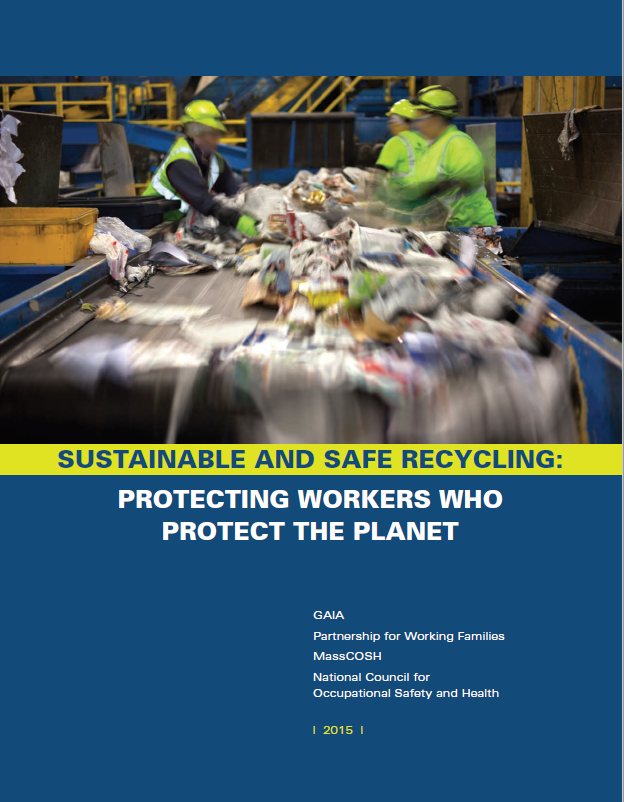 Zero waste is the future. Growth in the recycling economy has the potential to not only conserve the environment, but also create 1.5 million new jobs. But research indicates that recycling work can be dangerous, with injury rates more than double the national average. By addressing this problem, local governments have an opportunity to secure the sustainability and health of their cities while ensuring that recycling jobs are good jobs. Recyclers deserve safe working conditions, as they protect public health and the planet from waste, pollution, and resource depletion.
The environmental necessity of recycling is well-established: achieving a 75% recycling rate would yield greenhouse gas emission reductions equivalent to shutting down one-fifth of all U.S. coal power plants (Tellus 2011). A growing number of cities recognize recycling as a key component of their local climate action plans (West Coast Climate and Materials Management Forum 2012). In short, recycling provides proven benefits for clean air and waste reduction, and along with other zero waste strategies it can offer a critical pathway for municipalities to achieve sustainable growth.
Recycling can also play a key role in urban job creation strategies. At our current national recycling rate of 34.5%, the U.S. recycling industry employs nearly 1 million people and generates billions of dollars of economic activity annually (Tellus 2011, USEPA 2012).
Studies have shown that recycling creates at least 10 times as many jobs per ton of waste as disposal in either incinerators or landfills, and that investments in recycling, composting, and recycling reliant manufacturing could produce 1.5 million more jobs across the country.
But recycling workers face serious hazards on the job. In too many cities across the country, sorters work in loud and dusty facilities where they are often exposed to extreme temperatures. Working long hours, they lean over conveyor belts sorting materials – pulling out things that don’t belong, ensuring the best quality materials are bundled together for the highest value. They work with heavy equipment in dangerous situations – climbing onto and into massive conveyor belts and balers to clean them. They maneuver past huge front-end loaders and forklifts, and walk by heavy bales of material that, when unsafely managed, can fall on workers who are in the wrong place at the wrong time. Moreover, they deal with an array of inherently unsafe materials that should not be on the recycling line – used needles, chemicals, dead animals and broken glass. As a result of these unsafe conditions, recycling workers face above-average injury rates and are sometimes even killed on the job.
Many recycling sorters are employed by temp agencies, further increasing the likelihood that they won’t have the training or experience needed to do their job safely. But it doesn’t have to be this way. Occupational hazards can be mitigated, and in some cases eliminated, with a combination of engineering controls, improved safety systems, work practices, and extensive training.
There are important actions and best management practices that cities can and should take to improve recycling jobs. Cities that offer curbside recycling service generally contract with private companies to process recyclable materials collected from households. To ensure safe and dignified recycling jobs, municipal governments must require rigorous health and safety standards in recycling contracts.
This report offers a unique inside look at the working conditions faced by recycling workers across the United States, as well as a series of specific policy recommendations that municipal decision makers should follow to improve industry accountability and health and safety outcomes. It also includes practical recommendations for public education programs that can prevent dangerous materials from entering the recycling stream. Our analysis is based on occupational health studies, OSHA reports about health and safety violations, articles from news media and industry trade publications, interviews with recycling workers, and first-hand observation of recycling work.
Our findings underscore the need for urgent action to improve health and safety conditions for recycling workers. Improving the recycling sector overall is not only possible – it’s imperative for averting today’s ecological crises, and protecting the health and well-being of this important group of climate workers who protect us all.
Read the report (PDF).






 The following news items feature issues, discussions, campaigns, or information potentially relevant to green unionists:
 As a registered nurse, a member of the California Nurses Association, as well as a San Luis Obispo County resident and homeowner, I have been following Phillips 66’s attempt to win approval from the San Luis Obispo County Board of Supervisors and Planning Commission, to build an expansive new rail spur at its refinery in Nipomo. The plans include a route through San Bernardino and Los Angeles counties and up the coast through the heart of Santa Barbara County.
 The following news items feature issues, discussions, campaigns, or information potentially relevant to green unionists:
 The following news items feature issues, discussions, campaigns, or information potentially relevant to green unionists:
 The following news items feature issues, discussions, campaigns, or information potentially relevant to green unionists:
 The following news items feature issues, discussions, campaigns, or information potentially relevant to green unionists:
 Washington, DC — Strife within the U.S. Chemical Safety and Hazard Investigation Board (CSB) has burst into the open again with one board member seizing control and ordering immediate suspension of the agency’s entire executive staff, according to documents posted today by Public Employees for Environmental Responsibility (PEER). In less than a week, the CSB will be left with only two board members who cannot agree on governance of the small agency.
 The news media have been full of speculation about what caused an Amtrak train to derail east of Philadelphia on May 12, killing at least eight people and injuring hundreds.
 This site is not the official webpage of the Industrial Workers of the World.