You are here

health and safety

The Revolution Will Be On Rail, Part I

By Matt Stannard - Occupy.Com, June 14, 2016 (image by Jon Flanders)

Trains have the ability to move America into a post-carbon economy with fewer cars, cleaner air and stronger communities. But railroad bosses are telling their workers they have to support more oil and coal extraction, and faster, more dangerous train routes in order to keep their jobs.

John Paul Wright is concerned about this contradiction. The husband and father is a locomotive engineer, union and labor organizer, and a singer of protest songs. As the national lead organizer for [Railroad Workers United] and a member of the organization’s steering committee, part of his job is bringing together railroad unions who’ve been told by the bosses that they have incompatible views and interests. “This is the very nature of big business craft unionism,” he tells me. “The workers are caught in the middle.”

Wright says that “the railroad could be the most efficient way to move anything we move today. But we’ve been sold on an economy that doesn’t represent our best interests.”

Part of our job as storytellers and advocates for a new economy is to articulate how the interests of working people converge with those of a healthy and just planet. Trains are a crucial part of that picture. “The railroads built the small towns, passenger service was the transportation policy before cars,” Wright says, “and small farming communities had access to larger markets.”

But now, the trains and often the land on which they travel are owned by big corporations. “So us workers are forced to move whatever America wants. We move coal, oil, products from sweatshops overseas, fertilizer, plastics, etc,” he says. All because corporate capitalism “sees no profit in a transportation policy built on service and access.”

This isn’t just the market following around people’s preferences like a faithful dog. The story of the decline of public transportation and railways is one of criminal manipulation by capitalists, not honest brokering. In the first half of the 20th century, a group of executives colluded to buy and literally dismantle the electric train systems in many of America’s major cities in order to artificially create a market for oil, cars, trucks and eventually an interstate system.

America’s public transit was like a Library of Alexandria for the United States: if it had survived and been regularly upgraded, we’d have quite a system today, one that would likely be transitioning to completely renewable power, as smaller nations are in the process of doing.

The potential ecological and socioeconomic benefits of rail are overwhelming. For transport of goods, trains are four times more fuel efficient than trucks. They also reduce highway gridlock, lower greenhouse gas emissions, and reduce pollution. For personal travel, trains emit on average between 80 and 90 percent less carbon output than airplanes per passenger.

Although some trains still run on diesel and oil, and a growing number of cars are hybrid or totally electric, trains could make the jump forward by going totally renewable, as they have in other countries. And a well-planned and executed mass transit system could make travel virtually free, replacing vehicles that are expensive to buy and maintain.

As usual it comes down to who makes the decisions: citizens and railway workers, or corporate shareholders and bosses. The corporations are in control now, and the results are unsafe trains that are about to become even less safe due to labor-saving proposals to decrease crew members; trains speeding through ecologically sensitive areas carrying lethal crude oil and frequently causing spills and explosions; and a passenger transit system that doesn’t come close to living up to its efficiency potential. Contrary to what the railway bosses are telling workers and the public, these issues are interrelated and must be part of an agenda for economic and ecological justice.

EcoUnionist News #108

Compiled by x344543 - IWW Environmental Unionism Caucus, June 14, 2016

The following news items feature issues, discussions, campaigns, or information potentially relevant to green unionists:

Lead Stories:

Ongoing Mobilizations:

The Thin Green Line:

Just Transition:

Bread and Roses:

An Injury to One is an Injury to All:

Whistleblowers:

Railroad Workers United Former Co-Chair and Organizer Mark Burrows Speaks at Chicago Break Free Rally

On Sunday, May 15th in Whiting, Indiana, former RWU Co-Chair Mark Burrows was invited to speak to a group of community members and environmental activists about rail safety. Mark touched on the Lac Megantic tragedy and frame-up of railroad workers in Canada, crew fatigue and single employee train crews.

EcoUnionist News #107

Compiled by x344543 - IWW Environmental Unionism Caucus, June 7, 2016

The following news items feature issues, discussions, campaigns, or information potentially relevant to green unionists:
Lead Stories:

Ongoing Mobilizations:

The Thin Green Line:

Just Transition:

Bread and Roses:

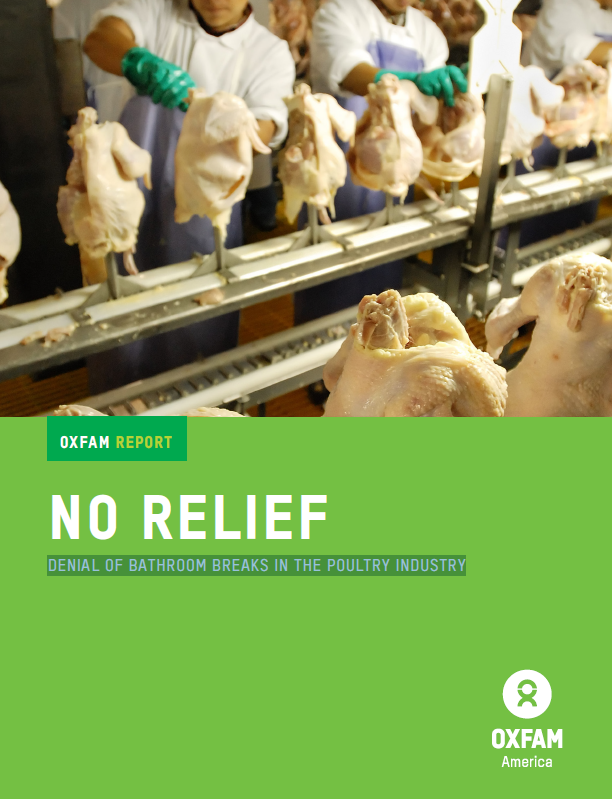
No relief: Denial of bathroom breaks in the poultry industry

By staff - OxFam, 2016

As poultry workers are routinely denied adequate bathroom breaks, they face dangers to their health and blows to their dignity.

While the poultry industry today enjoys record profits and pumps out billions of chickens, the reality of life inside the processing plant remains grim and dangerous. Workers earn low wages, suffer elevated rates of injury and illness, toil in difficult conditions, and have little voice in the workplace.

Despite all that, though, workers say the thing that offends their dignity most is simple: lack of adequate bathroom breaks, and the suffering that entails, especially for women.

Routinely, poultry workers say, they are denied breaks to use the bathroom. Supervisors mock their needs and ignore their requests; they threaten punishment or firing. Workers wait inordinately long times (an hour or more), then race to accomplish the task within a certain timeframe (e.g., ten minutes) or risk discipline.

Workers struggle to cope with this denial of a basic human need. They urinate and defecate while standing on the line; they wear diapers to work; they restrict intake of liquids and fluids to dangerous degrees; they endure pain and discomfort while they worry about their health and job security. And it’s not just their dignity that suffers: they are in danger of serious health problems.

The situation strikes women particularly hard. They face biological realities such as menstruation, pregnancy, and higher vulnerability to infections; and they struggle to maintain their dignity and privacy when requesting breaks.

Supervisors deny requests to use the bathroom because they are under pressure to maintain the speed of the processing line, and to keep up production. Once a poultry plant roars to a start at the beginning of the day, it doesn’t stop until all the chickens are processed. Workers are reduced to pieces of the machine, little more than the body parts that hang, cut, trim, and load—rapidly and relentlessly.By its nature, it is demanding and exhausting work.

But it does not have to be dehumanizing, and it does not have to rob people of their dignity and health.

Read the report (Link).

EcoUnionist News #106

Compiled by x344543 - IWW Environmental Unionism Caucus, May 31, 2016

The following news items feature issues, discussions, campaigns, or information potentially relevant to green unionists:

Lead Stories:

Ongoing Mobilizations:

The Thin Green Line:

Just Transition:

Bread and Roses:

Appeal from Railroad Workers United: No Single Employee Crews!

Public Comment Period Extended to June 15th at 11:59 PM EDT 

Tell the FRA:

"No Single Employee Train Crews!"

Email Your Message today!

Dear RWU Members & Supporters:

On March 15th, the Federal Railroad Administration (FRA) offricially announced a Proposed Rule on the whole question of crew staffing for trains in the United States. After careful consideration, RWU has come to the only conclusion possible: the Proposed Rule provides a road map for any and all rail carriers to obtain the FRA's blessing to run trains with a single employee. Therefore, RWU cannot support this Proposed Rule, period.

We continue to agree with the joint statement from nearly 7 years ago that the BLET and the UTU made in a joint Petition filed in June 2009 with the FRA on the question of traincrew  staffing which reads: “No conditions exist where one-person operations are safe.”  And since the Proposed Rule is predicated on the "safe" operation of trains with a single crew member, we must urge the FRA to promulgate a Rule that outlaws the practice. We urge all RWU members and all railroad workers to contact the FRA and tell them in plain language: "No single employee train crews!"

  • To write/FAX the FRA, click HERE.
  • To email the FRA, click HERE.
  • To view the RWU Letter to the FRA on the Proposed Rule, click HERE.
  • To view the FRA Proposed Rule, Click HERE.
  • To view the RWU Editorial on the Proposed Rule Click HERE.
  • To view a comprehensive article entitled "What's Wrong with Single Employee Train Operations?" with 21 reasons why they are unsafe and unworkable, click HERE.
  • To view the most recent RWU Resolution to Oppose Single Employe Operating Crews from March 2nd, 2015, see below or click HERE.
  • To view the original RWU Resolution on Single Employee Train crews from January 5th, 2010, click HERE
  •  

EcoUnionist News #105

Compiled by x344543 - IWW Environmental Unionism Caucus, May 25, 2016

The following news items feature issues, discussions, campaigns, or information potentially relevant to green unionists:

Lead Stories:

Ongoing Mobilizations:

The Thin Green Line:

Just Transition:

Bread and Roses:

The problem is not glyphosate, or DDT, or BPA; we must challenge the entire system!

By Jonathan Latham, PhD - The Ecologist, May 20, 2016

Piecemeal, and at long last, chemical manufacturers have begun removing the endocrine-disrupting plastic bisphenol-A (BPA) from products they sell.

Sunoco no longer sells BPA for products that might be used by children under three. France has a national ban on BPA food packaging. The EU has banned BPA from baby bottles.

These bans and associated product withdrawals are the result of epic scientific research and some intensive environmental campaigning. But in truth these restrictions are not victories for human health. Nor are they even losses for the chemical industry.

For one thing, the chemical industry now profits from selling premium-priced BPA-free products. These are usually made with the chemical substitute BPS, which current research suggests is even more of a health hazard than BPA. But since BPS is far less studied, it will likely take many years to build a sufficient case for a new ban.

But the true scandal of BPA is that such sagas have been repeated many times. Time and again, synthetic chemicals have been banned or withdrawn only to be replaced by others that are equally harmful, and sometimes are worse.

Neonicotinoids, which the International Union for the Conservation of Nature (IUCN) credits with creating a global ecological catastrophe, are modern replacements for long-targeted organophosphate pesticides. Organophosphates had previously supplanted DDT and the other organochlorine pesticides from whose effects many bird species are only now recovering.

The same is likely to happen with glyphosate - whose authorisation the EU notably failed to renew yesterday. If the EU does ban the herbicide in the next few months, the most likely outcome by far is that farmers will reach for another bottle. They will only spray 2,4-D, dicamba and glufosinate (phosphinothricin) instead.

EcoUnionist News #104 - Special #BreakingFree 2016 Edition

Compiled by x344543 - IWW Environmental Unionism Caucus, May 17, 2016

The following news items feature issues, discussions, campaigns, or information potentially relevant to green unionists:

Lead Stories:

Ongoing Mobilizations:

The Thin Green Line:

Just Transition:

Bread and Roses:

An Injury to One is an Injury to All:

Whistleblowers:

Pages

The Fine Print I:

Disclaimer: The views expressed on this site are not the official position of the IWW (or even the IWW’s EUC) unless otherwise indicated and do not necessarily represent the views of anyone but the author’s, nor should it be assumed that any of these authors automatically support the IWW or endorse any of its positions.

Further: the inclusion of a link on our site (other than the link to the main IWW site) does not imply endorsement by or an alliance with the IWW. These sites have been chosen by our members due to their perceived relevance to the IWW EUC and are included here for informational purposes only. If you have any suggestions or comments on any of the links included (or not included) above, please contact us.

The Fine Print II:

Fair Use Notice: The material on this site is provided for educational and informational purposes. It may contain copyrighted material the use of which has not always been specifically authorized by the copyright owner. It is being made available in an effort to advance the understanding of scientific, environmental, economic, social justice and human rights issues etc.

It is believed that this constitutes a 'fair use' of any such copyrighted material as provided for in section 107 of the US Copyright Law. In accordance with Title 17 U.S.C. Section 107, the material on this site is distributed without profit to those who have an interest in using the included information for research and educational purposes. If you wish to use copyrighted material from this site for purposes of your own that go beyond 'fair use', you must obtain permission from the copyright owner. The information on this site does not constitute legal or technical advice.

