You are here

health and safety

CSX Train Carrying 8,000 Tons of Coal Derails in Company’s Second Wreck in 24 Hours

By Brandon Baker - EcoNews, May 1, 2014

Disclaimer: The views expressed here are not the official position of the IWW (or even the IWW’s EUC) and do not necessarily represent the views of anyone but the author’s.

A train derailed early Thursday morning in Bowie, MD marking the second derailment for CSX Corp. in 24 hours.

CSX spokeswoman Kristin Seay told the Associated Press that about 10 cars of the train traveling from Cumberland, MD to Bowie derailed Thursday. The train had three locomotives and 63 railcars, all of which were carrying coal. The train originated from a coal mine in Pennsylvania. 

The train was carrying about 8,000 tons of coal.

One of the train cars overturned, spilling its load of coal, but there were no injuries reported in the incident. CSX spokesman Gary Sease said the company would investigate the derailment. He said increased rain may have played a role, but it’s too early to say.

Official Tipped Off Hess Rail Yard About Oil-Carrier Inspection

By Cole Stangler - In These Times, April 29, 2014

Disclaimer: The views expressed here are not the official position of the IWW (or even the IWW’s EUC) and do not necessarily represent the views of anyone but the author’s.

Emails obtained by In These Times show a cozy relationship between North Dakota’s oil industry and a chief federal inspector charged with monitoring the safety of shipping crude oil by rail. The emails cast serious doubts on the integrity of the federal government’s supposed crackdown on the industry’s shoddy shipping practices—a subject of growing concern in the midst of a largely unregulated, and in some cases, deadly, transport boom.

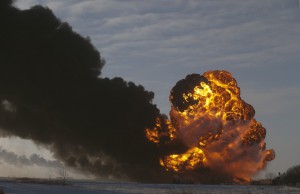
Last August, the Pipeline and Hazardous Materials Safety Agency (PHMSA) and Federal Railroad Administration announced they were rolling out the “Bakken Blitz”—a crackdown on shippers and carriers that mislabel their cargo. Federal hazmat regulations require trains carrying oil to properly classify and identify their shipments with placards. These practices are supposed to ensure that oil is safely packaged before being shipped. They’re also aimed at informing railroad personnel and, in the event of a mishap, any emergency responders. Regulators introduced the Blitz just one month after the Lac Mégantic disaster, when a runaway freight train carrying oil exploded in the small Quebec town, killing 47 people. In that case, Canadian safety investigators found American shippers in North Dakota’s Bakken region had understated the volatility of the oil that ignited and destroyed much of Lac Mégantic’s downtown area. Improper classification caused the shipment to be transported in an improper package. Emergency responders, too, were caught by surprise at how quickly the fire spread and how long it burned.

As part of the Department of Transportation’s new enforcement effort, PHMSA officials show up unannounced at rail facilities to conduct classification inspections—at least that’s what an agency spokesperson told In These Times at first. An email obtained through a Freedom of Information Act request strongly suggests that Kipton Wills, Central Region Director of PHMSA's Office of Hazardous Materials Enforcement, pre-arranged at least one of his agency’s visits to a Hess Corp. rail yard in Tioga, North Dakota, last October.

“We will accommodate your request to inspect trucks at the Tioga Rail Terminal,” Jody Schroeder, the rail terminal supervisor, wrote in an email to Wills dated October 3, 2013—five days before the inspection took place. “At your convenience please let me know your schedule for this event.”

Schroeder later confirmed that Wills reached out to him about the visit.

Earlier this month, PHMSA spokesperson Gordon Delcambre told In These Times that such inspections are impromptu. “They’re unannounced,” he said. “[Inspectors] figure out who they’re going to visit ahead of time, make plans, go to the area and then start knocking on doors.”

Indeed, this is normal procedure. The agency’s handbook notes “the policy of the PHMSA hazardous materials enforcement program is to conduct unannounced inspections.” Exceptions can include cases of “apparent imminent danger to enable the company to correct the danger,” instances where special preparations, records and equipment are necessary, and cases where “giving advance notice would enhance the probability of an effective and thorough inspection.”

Read the entire article here.

This Company’s Gas Plants Just Keep on Exploding

By John Upton - Originally published at Grist, April 25, 2014

Disclaimer: The views expressed here are not the official position of the IWW (or even the IWW’s EUC) and do not necessarily represent the views of anyone but the author’s.

Perhaps executives at the Williams energy company have fiery personalities. Or maybe they just don’t care about safety, or about their workers or neighbors.

A huge explosion at one of the company’s gas processing plants in southern Wyoming on Wednesday afternoon triggered the evacuation of all residents of the small nearby town of Opal. The plant, which is connected to six pipelines that help feed fracked natural gas to customers throughout the American West, burned throughout Wednesday night and into Thursday, when its neighbors were allowed to return to their homes.

As extraordinary as the (fortunately injury-free) accident sounds, something similar happened just four weeks ago at a Williams gas processing plant near the Washington-Oregon border. That explosion injured five workers and led to the evacuation of 400 residents.

Less than a year ago, workers were injured when one of the company’s natural gas facilities blew up in Branchburg, N.J. The company’s pipelines have also blown up.

Also last year, a leak of 241 barrels of fluid from a Williams natural gas processing plant in Colorado contaminated a creek with carcinogenic benzene. At least nothing blew up that time.

“Williams is committed to maintaining the highest standards of safety,” the company claims on its website. We’d hate to see what lower standards looked like.

Runaway Train: The Reckless Expansion of Crude-by-Rail in North America

By Lorne Stockman, et. al. - Oil Change International, May 2014

This report tracks the rise of crude-by-rail in North America, detailing where crude trains are being loaded and unloaded, how many trains carrying crude oil are crossing the North American continent, and who is involved in this burgeoning trade.

This reportis the first in a series covering North America’s booming crude-by-rail industry and is being published in conjunction with a unique interactive on line map of crude-by-rail terminals and potential routes.

Future reports in this series will look at the economics of crude-by-rail, safety, and climate change issues. Please see this site for the map and links to reports and data.

Read the report (English PDF).

Green Unionism Strategy and Tactics - Railroad Workers and Crude by Rail Trains

By x344543, x356039, and x363464 - April 29, 2014

Disclaimer: The views expressed here are not the official position of the IWW (or even the IWW’s EUC) and do not necessarily represent the views of anyone but the author’s. This is not an official statement of either Forest Ethics or Railroad Workers United, and neither organization has vetted this article.

As many of you may be aware, there has been a growing uproar against crude-by-rail, which is one of the major components of the current fossil fuel capitalist driven extreme energy boom. This is due in large part to the fact that there were more derailments involving crude-by-rail trains in 2013 alone than the previous four decades combined. In some cases, like Lac Megantic, whole towns have been nearly wiped off of the map.

This is particularly true in the San Francisco Bay Area where residents in five different communities dominated by oil refineries are organizing to prevent increased transportation of crude-by-rail into their homes. The organizers have built coalitions with local environmental and social justice groups as well as called upon the support of environmental NGOs. Their efforts have included speaking out at public forums, attending public hearings, watch-dogging the regulatory process (such as it is), participation in in electoral campaigns, producing alternative media, rallies, marches, and even nonviolent civil disobedience.

These community activists have even cultivated relationships with rank and file workers employed by the refineries--at least those not buying the company line. Still, there's another group of workers that these coalitions could approach, and that is the railroad workers themselves, but how to do it?

Many of our fellow workers who are union railroad workers are quick to point out that in spite of all of the recent derailments, rail is nevertheless the safest mode of transportation of crude, even the heavy and dirty crude resulting from the extreme energy extraction of tar sands and shale, relative to all of the others. This, of course, is a matter of degrees.

Transportation of heavy crude by any means is a risky business. In addition to derailments, there have been oil spills by ship and pipeline breakages. As the folks at Forest Ethics have pointed out, there is really no completely safe way to transport this stuff.

And the railroad workers to which we have spoken have hinted that they're entirely supportive of the efforts to transition away from fossil fuels to greener, non-polluting alternatives. It's just that of all of the cargoes they transport, crude-by-rail is but one of many dangerous examples.

So, can there be any common ground between the community organizers and railroad workers? The answer is, "yes" (according to those very same railroad workers).

The Fight For Railway Safety & The Case Of IBT BLET BNSF Railroad Worker Jen Wallis

Jen Wallis, a railroad worker and member of IBT BLET Division 238, who works at the BNSF railroad in the state of Washington talks about her struggle for health and safety and the retaliation against her for reporting a personal injury. Wallis won a lawsuit against the railroad which is owned by Warren Buffet. This video was done on 4/5/2014 when conference of the Railroad Workers United RWU convention was taking place in conjunction with Labor Notes in Chicago.

Production Of Labor Video Project www.laborvideo.org

Tesoro: A Track Record of Pollution, Hostility to Workers, and Meddling in Politics

By Eric de Place - Sightline Daily, March 21, 2014

Disclaimer: The views expressed here are not the official position of the IWW (or even the IWW’s EUC) and do not necessarily represent the views of anyone but the author’s.

Right about now, oil executives in Texas are boarding a plane bound for the Northwest. Their goal? To steam roll opposition to the monster oil train terminal that Tesoro wants to construct on the downtown waterfront of Vancouver, Washington.

Hot on the heels of learning that the local city council is narrowly opposed to the project, the oil refining giant is going on a full court press lobbying mission in Vancouver, Washington. The companies leadership, including senior VPs and CEO Greg Goff, will be meeting behind closed doors with members of the city council and the Port of Vancouver. Then on Tuesday, March 25 from 1:00 to 2:00, they are holding a private meeting with 40 business leaders at the Heathman Lodge.

As a public service to the community of Vancouver, it’s worth explaining what Tesoro is—and why their oil train terminal has no place on the Columbia River.

‘Blame-the-Worker’ Allegations Reveal Deep Divide Between Labor, Management

By Stephen Lee - Tony Mazzochi Center for Health, Safety, and Environmental Education, March 10, 2014

Disclaimer: The views expressed here are not the official position of the IWW (or even the IWW’s EUC) and do not necessarily represent the views of anyone but the author’s.

Feb. 27 — Worker advocates and some labor scholars contend that employers routinely blame and punish employees for sustaining on-the-job injuries, reflecting a fundamental dysfunction in labor relations.

Employer representatives dispute those claims, saying the allegations are purely anecdotal and require knowledge of employers’ motives that workers don’t have.

“Blame-the-worker” policies take many forms, James Frederick, the United Steelworkers’ assistant director for health, safety and environment, told Bloomberg BNA Feb. 27: discipline for workers who suffer injuries, incentives for those who avoid them, signs promoting the number of consecutive days without lost-time incidents or programs in which workers are assigned to monitor each other for safety violations.

“All of these programs, what unites them is [that] they say, ‘If you get injured, it’s your fault, so we’re going to give you a prize because you’ve worked safely, or we’re going to punish you because you worked unsafely,’ ” said Nancy Lessin, a United Steelworkers employee representative.

RWU Resolution in Support of Limits to Long & Heavy Trains

Adopted by the RWU Steering Committee February 4th, 2014

Disclaimer: The views expressed here are not the official position of the IWW (or even the IWW’s EUC) and do not necessarily represent the views of anyone but the author’s.

Whereas, the North American rail carriers continue to run longer and heavier trains each year, and have expressed their desire to run even longer trains in the future; and
 
Whereas, the  last year has witnessed a number of long and heavy train wrecks, resulting in a loss of life and property, wholesale evacuations, injured train crews and environmental devastation; and
 
Whereas, the rail carriers have a professed interest in operating such long and heavy trains as a way to perceived savings on fuel costs, motive power and labor costs; and
 
Whereas, rather than face the reality of the situation, the rail carriers and law makers choose to focus on irrelevant issues like inward facing cameras; and
 
Whereas, such overly long and heavy trains create a dangerous and unsafe situation for a number of reasons:
 

  • 1 -- the longer and heavier the train, the more difficult it is and the more time it takes to slow or to stop such a train;
  • 2 -- the longer and heavier the train, the more slack action is in the train, increasing run-ins and run-outs, increasing the potential for break-in-twos, emergency brake applications and derailments;
  • 3 -- the longer and heavier the train, the more severe the train wreck if and when such a train does derail;
  • 4 -- the longer and heavier the train, the more difficult it is for the train crew to safely run, inspect, work, test, and otherwise get such a train over the road.
  • 5 -- such trains tend to make for longer tours-of-duty for train crews, resulting in fatigue, more time at the away-from-home terminal, and a lower quality of work and home life;
  • 6 – such trains are more likely to have air brake problems, especially in cold weather;
  • 7 -- the longer and heavier the train, the greater likelihood of blocked road and pedestrian crossings, creating a best an inconvenience to the public and at worst an inability to provide emergency services when needed;
  • 8 -- these blocked crossing in effect “train” motorists and the public to “run the gates” to avoid being blocked for long periods, resulting in grade crossing accidents and fatalities.

 
Therefore, Be it Resolved that Railroad Workers United opposes any expansion of the current length and tonnage of existing trains; and
 
Be it Further Resolved that RWU supports a reduction in length and tonnage of already existing trains, especially those hauling hazardous materials, traversing steep grades and /or cold temperatures; and
 
Be it Finally Resolved that RWU urge the unions in the U.S., Canada and Mexico to further these ends legislatively and/or contractually.

Oil Boom Kills More Workers, But Government Takes No Action

By Andrew Breiner - Think Progress, February 26, 2014 (used by permission)

Disclaimer: The views expressed here are not the official position of the IWW (or even the IWW’s EUC) and do not necessarily represent the views of anyone but the author’s.

Just last Friday [February 21, 2014], oil drilling claimed the life of another worker. Nathan James Scott, 26, was struck by a welding truck and died at a drilling site in Converse County, Texas, owned by Houston-based EOG Resources. An investigation into his death is in progress. But federal regulations and investigations haven’t been enough to stem the climbing death and injury rates in the oil and gas industry. In fact, the federal government has declined to issue even basic safety rules for onshore drilling, and is in the midst of cutting funding for workplace safety inspections.

The fatality rate for workers in onshore oil and gas drilling is startlingly high compared with other industries, seven times higher than the average, and injuries are far more common. In Texas, the oil industry kills more of its workers than any other. And as an investigation by the Houston Chronicle found, the federal government isn’t taking action to make it safer.

Pages

The Fine Print I:

Disclaimer: The views expressed on this site are not the official position of the IWW (or even the IWW’s EUC) unless otherwise indicated and do not necessarily represent the views of anyone but the author’s, nor should it be assumed that any of these authors automatically support the IWW or endorse any of its positions.

Further: the inclusion of a link on our site (other than the link to the main IWW site) does not imply endorsement by or an alliance with the IWW. These sites have been chosen by our members due to their perceived relevance to the IWW EUC and are included here for informational purposes only. If you have any suggestions or comments on any of the links included (or not included) above, please contact us.

The Fine Print II:

Fair Use Notice: The material on this site is provided for educational and informational purposes. It may contain copyrighted material the use of which has not always been specifically authorized by the copyright owner. It is being made available in an effort to advance the understanding of scientific, environmental, economic, social justice and human rights issues etc.

It is believed that this constitutes a 'fair use' of any such copyrighted material as provided for in section 107 of the US Copyright Law. In accordance with Title 17 U.S.C. Section 107, the material on this site is distributed without profit to those who have an interest in using the included information for research and educational purposes. If you wish to use copyrighted material from this site for purposes of your own that go beyond 'fair use', you must obtain permission from the copyright owner. The information on this site does not constitute legal or technical advice.