You are here

health and safety

Soma Mine was Death Trap, Report Shows

IndustriALL Global Union - Mining.Com, October 2, 2014

Disclaimer: The views expressed here are not the official position of the IWW (or even the IWW’s EUC) and do not necessarily represent the views of anyone but the author’s.

A scathing official report into the Soma mining disaster in Turkey has revealed a catalogue of negligent practices and a complete disregard for worker safety. The comprehensive analysis shows warning sensors were ignored, safety reports fabricated and ventilation systems faulty. Three hundred and one miners were killed in the tragedy in May.

The much-anticipated 126-page expert report, commissioned by the Turkish public prosecutor, clearly states the catastrophe was preventable. While eight high-level managers of the mine’s operating company have already been arrested in connection with the tragedy, the report points the finger of blame at almost everyone involved in the mine, including ministry bureaucrats, with the exception of the miners themselves. “The only innocent group is the workers,” says the report.

The Soma mine is owned by a state-owned company Turkish Coal Enterprises (TKI) and operated by a private company, Soma Kömür İşletmeleri A.Ş.

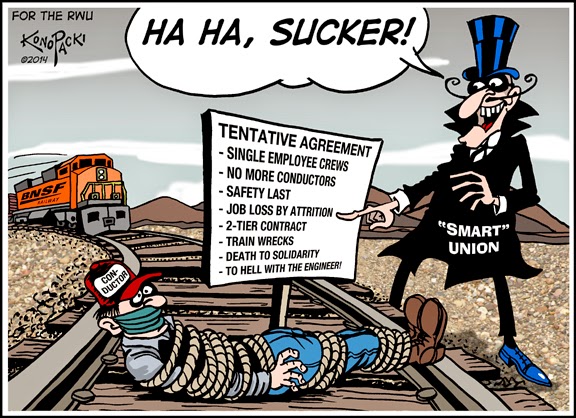
Blood on the Tracks: Saying No to Warren Buffett

By Guy Miller; image by Mike Konopacki - CounterPunch, September 26, 2014

Disclaimer: The views expressed here are not the official position of the IWW (or even the IWW’s EUC) and do not necessarily represent the views of anyone but the author’s.

The City of New Orleans by Steve Goodman is a loving tribute to an era gone-by. Steve mourned what he perceived to be ”the disappearing railroad blues.” He takes a nostalgic look back at an America that looks better through the sepia tones of memory than it actually was. Steve Goodman was unquestionably a great song writer, but for all that, he was a lousy economist. America’s railroads are anything but disappearing. Rather than a relic from another time, they are at the forefront of American capital’s plan for the 21st century. If you don’t live along the major corridors of rail traffic, it is easy to miss this vital aspect of the US economy.

For people that live in, or near, one of the cities that stretch from Boston to Washington, when they think about railroads at all, they generally think first about Amtrak. Everyone who uses Amtrak has a horror story to tell. Even the premium Acela train is seen as not measuring up to the trains of Europe or China. The primary reason high speed passenger trains aren’t a priority in the US is simple: freight traffic makes too damn much money. Wherever in the world there are fast and efficient passenger trains, freight traffic is secondary, or non existent. There was a time in the United States when freight traffic was shunted to the side to make room for passenger trains. To the major railroads that was a waste of time and money.

If high speed passenger service were to be successful two essential things would be needed: 1. Government subsidies (or better yet total nationalization) and 2. A huge upgrade in infrastructure. File the first requirement under the category of “come the revolution,” and the second under unlikely. The infrastructure is just fine for what the major carriers want to accomplish. They do not want, or need tracks, or roadbeds, that can safely move 15,000 tons of freight at 100 miles per hour, sixty MPH will do nicely, thank you. Building and maintaining the right-of-way is an expensive and labor intensive proposition. Even with cost-cutting machinery it is viewed by railroads as something to be kept to a minimum.

In the decade before the crash of 2008 railroad freight traffic exploded. From 1996 to 2006 railroad and truck traffic both grew, but railroad traffic grew faster. Using the metric of ton miles, the industry’s standard measurement, that decade saw rail traffic grow 25.1% and truck traffic grow 21.8%. This boom is still being fueled by the growth of “unit trains.” Unit trains, as opposed to manifest trains, are a one trick pony. For example a train consisting solely of crude oil, or grain or coal are of unit trains. Such trains go from point A to point B with no stops in between. No setting out a cut of cars in Podunk, Iowa or picking up cars of lumber in Rochester, Minnesota. Much of America has become not only flyover country, but also roll-by country as well. This contrasts with the once more common manifest train. Such trains required switching at various points along the route. This change brought with it the loss of thousands of switching jobs, those jobs did indeed go the way of Steve Goodman’s disappearing railroad.

After years of consolidation American railroad evolved into five large carriers. With the aid of this monopoly the railroads were on track for bigger and bigger payoffs. My old boss, the Union Pacific has over 32,000 miles of tracks resulting from mergers and takeovers. In the second quarter of 2014 the Union Pacific saw its profits jump 17%.  This in the midst of an economy that is, at best, sputtering along.

Chevron Richmond Refinery August 6, 2014 Pipe Rupture and Fire [REPORT NO. 2012-03-I-CA OCTOBER 2014]

By staff - U.S. Chemical Safety and Hazard Investigation Board, October 2014

An August 6, 2012, release of flammable vapor led to a fire at the Chevron Refinery in Richmond, California. The CSB released three investigation reports into this incident.

This report is particularly sigificant in that it reveals that the refinery workers repeatedly tried to warn the managers and employers of the deteriorating conditions of the refinery's infrastructure (which led to the fire), but were ignored. Knowing this, climate justice activists and organizers can develope relationships with workers in capitalist extractive industries and do the painstaking, tedious work of cultivating relationships and building trust to build a united front against the capitalist class.

Read the report (English PDF).

A Gas Plant Fire Just Killed One Wyoming Worker; Here’s Why That Could Start Happening More

By Emily Atkin - Think Progress, September 24, 2014

Disclaimer: The views expressed here are not the official position of the IWW (or even the IWW’s EUC) and do not necessarily represent the views of anyone but the author’s.

Four workers were caught in a storage tank “flash fire” at a natural gas production facility in Lincoln County, Wyoming on Tuesday. The incident, a spokeswoman for Salt Lake City’s University Hospital told ThinkProgress, left one worker dead, and two critically injured. The workers, who have not yet been named, were cleaning gas tanks when the fire broke out. The exact cause is still unknown.

The fire happened at a natural gas plant owned by Houston-based EOG Resources. Of the four workers who were caught in the fire, two were direct employees of EOG while others were contractors. It’s not yet clear if the worker who died was a direct employee or a contractor.

The incident is the latest fossil fuel-related workplace fatality in Wyoming, which has historically had one of the highest rates of oil worker injuries and deaths in the country. Worker death rates there have fallen — Wyoming oil workers are dying at half the rate they were five years ago — but so have the number of oil and gas rigs in the state. The correlation suggests that Wyoming may still be plagued with a problem it’s been facing for years: a high rate of occupational fatalities due to a lacking “culture of safety.”

The idea that Wyoming may have an endemic workplace safety problem comes from a 2012 report from state-hired epidemiologist Timothy Ryan, who analyzed occupational fatalities in Wyoming and found numerous problems with the overall business attitude toward safety. “Safety [in Wyoming] occurs as an afterthought,” he wrote. He found that from 2001-2008, 20 percent of all Wyoming’s worker fatalities came from the oil and gas industry, and that a whopping 96 percent of those deaths occurred when safety procedures were not followed.

Since then, progress appears to be happening, with the current state epidemiologist telling Wyoming’s local NPR affiliate last week that he’s optimistic — there’s been an increase in worker safety training programs and safety meetings, he said. But NPR’s report also pointed out that some aren’t convinced that the culture is really changing at all. And that’s a problem, because once-declining drilling activity is again starting to expand in the state.

If Wyoming hasn’t in fact changed its “culture of safety,” it will be even more susceptible to the dangers of what is widely known as an industry that the U.S. Bureau of Labor Statistics says is unprecedentedly dangerous to workers. Indeed, the fatality rate for onshore oil and gas workers is seven times higher than the national average, and injuries are even more common. Between 2007 and 2012, a total of 663 workers were killed in oil-related accidents nationwide.

Working with flammable substances and heavy machinery is one reason for this increased rate, but another reasons the oil and gas industry remains so dangerous could be the fact that oil worker deaths aren’t very widely publicized. An in-depth report on worker fatalities released by Wyoming Public Media last week pointed out that oil worker deaths rarely merit more than a few sentences in local newspapers, an unfortunate phenomenon driven by the nature of the deaths. Compared to a dramatic coal mine collapse — where dozens of workers are trapped or killed underground — oil worker deaths generally happen one-by-one, in small fires or explosions.

“They don’t get the same kind of attention as a disaster in a coal mine, where you have multiple miners that may be killed,” Peg Seminario, director of safety and health for the AFL-CIO, told Wyoming Public Media. “Nonetheless, the worker who’s working in oil and gas is more likely to be killed on the job than a coal miner. That’s a fact.”

DISTRICT ATTORNEY CALLED ON NEW PCB FINDINGS IN MALIBU SCHOOLS - School District Threatens Fearful Children with Truancy, Teachers with Termination

By Kirsten Stade - Public Employees for Environmental Responsibility, September 23, 2014

Disclaimer: The views expressed here are not the official position of the IWW (or even the IWW’s EUC) and do not necessarily represent the views of anyone but the author’s.

New independent lab testing shows even more classrooms in Malibu public schools with toxic contamination thousands of times greater than permitted under federal law, according to test results released today by Malibu Unites and Public Employees for Environmental Responsibility (PEER). These EPA-certified laboratory results have been turned over to the Los Angeles District Attorney’s Office for review under state laws outlawing child endangerment and failure to disclose dangerous conditions.

“We are frustrated that politics and fear of liability have prevented both our school district and EPA from protecting our children and teachers from exposure to cancer-causing PCBs,” said Jennifer deNicola, President of Malibu Unites, a 501(c)(3) made up of parents, scientists and citizens for safe schools. “We have turned to the Los Angeles District Attorney to seek enforcement of the law.”

For months, the Malibu Middle and High Schools and Juan Cabrillo Elementary School have been roiled by discovery of illegal levels of contaminants, including extremely high concentrations of polychlorinated biphenyls (PCBs) found in window and door caulk, ventilator dust and soil. The Santa Monica-Malibu Unified School District claims that all buildings are safe to occupy and yet some rooms have been closed off; meanwhile tests continue to come in showing that classrooms currently occupied by students and teachers have PCBs that exceed safe limits set by federal law. The district continues to refuse to do additional source testing despite requests by parents, teachers and most recently by the Malibu Mayor and City Council. It has also rejected an offer by Malibu parent and supermodel Cindy Crawford and Rande Gerber to personally pay for source testing.

In July, samples taken from several Malibu school facilities showed illegal PCB levels dramatically higher than previously reported – as much as 7400 times higher than legal limits and the highest known results for a classroom in the U.S. In September, new samples from five classrooms and a caulk sample from an unannounced removal operation showed four classrooms testing above the federal Toxic Substance Control Act limit of 50 parts per million (ppm). One classroom sample tested at 231,000 ppm (more than a quarter of the caulk consisted of PCBs) while another contained 146,000 ppm.

“These EPA lab-certified tests results are alarming and require immediate action as children are sitting in classrooms every day that vastly exceed the legal health standard,” added Kurt Fehling, a health scientist working with Malibu Unites. “Concentrations that high in the caulk leave no doubt that significant exposure may be occurring.” The Mayor of Malibu, Skylar Peak, also warned the Santa Monica-Malibu School Board “Your school board’s data as well as other independent data, done at credible testing facilities indicates that at least nine buildings [at Malibu High School] exceed the legal allowable standard for PCBs. It’s unsafe.”

Cindy Crawford and numerous other parents have decided to remove their children from Malibu High and home school their children. At the same time, the District is threatening truancy proceedings against children whose parents have requested that their child not attend classes in contaminated classrooms which have high levels of PCBs. Teachers resisting assignment to classrooms with PCBs above federal law have also been threatened with termination.

“For the District and EPA to say certain rooms are unsafe but others constructed at the same time from the same materials are just fine makes absolutely no sense,” stated PEER Senior Council Paula Dinerstein who last month filed a notice of intent to sue both the District and EPA for violations of the Toxic Substances Control Act on behalf of both Malibu teachers and parents. “Air and dust testing have no legal basis and offer no assurance that students and teachers will not be directly exposed to hazardous material. The law requires that these contaminants be removed.”

The Environmental Crimes Section of the District Attorney’s Office is reviewing the latest test results for violations of several California state statutes, including Maintaining a Public Nuisance, in violation of California Penal Code Section 372; Child Endangerment in violation of Penal Code Section 273a; and Failing to Disclose a Serious Concealed Danger in violation of Penal Code Section 387.

Railroad Worker Jen Wallis: "The Fence is Capitalism...It's Time to Take it Down!"

By Jen Wallis - exclusive, September 21, 2014

Disclaimer: The views expressed here are not the official position of the IWW (or even the IWW’s EUC) and do not necessarily represent the views of anyone but the author’s.

Editor's note: Jen Wallis meant to give the following speech at the People's Climate March in Seattle on Sunday, September 21, 2014, but had to abbreviate it due to time constraints. Here is the entire speech she would have given:

Hi my name is Jen Wallis, and I’m a founding member of Railroad Workers United. We are a rank-and-file caucus of the various national and international railroad unions. A few of us started this organization to respond to the decades of infighting created by the carriers to keep us divided.

I've been a conductor with BNSF Railway for over ten years. In 2008, I was injured on the job through no fault of my own. I was one of the first workers to file a whistleblower suit against a major railroad for retaliation for reporting a work-related injury. After 6 years of litigation, I won my case in Federal Court this past March, so I know a little bit about what it takes to fight corporations and what they will do to you and your family. I lost much of my support system, and I lost my house to foreclosure. And just as a side note, I first met Kshama Sawant when she showed up and got arrested for those of us fighting foreclosure. She is amazing!!! Over 1,000 railroaders who filed similar complaints have lost. I’m one of a handful to have won. The railroads have a lot of money to fight you, and they usually win.

I’ve taken it upon myself to use my victory to speak out for safety on the railroad because I’m one of the few people who can and not get fired for it, and I was actually in San Francisco speaking at a labor conference this past July when I got word that a group of unelected union officials from the conductor’s union had been meeting in secret with BNSF for 18 months, and unleashed a proposal that would have ended the job of the conductor on freight trains right here in my territory. My job. One person running trains at least a mile long through our communities where there have always been at least two, and engineer and a conductor. 140 years of railroading tradition gone with one contract. All the railroads would follow that precedent.

So we at Railroad Workers United went into what I can only call DEFCON 1 organizing. We had less than a month to mount a campaign to vote no before ballots were to be sent out. There were plenty of carrots in the agreement being dangled for the huge numbers of new hires we have, with things like “worker retention board” which claimed if you can’t hold a job, we’ll pay you to sit at home and not work, ending pay scale for new hires, and huge buy-outs for those getting close to retirement anyway. It was the standard concessionary agreement. Now those of us who have been in the game long enough knew these were only empty promises. We’ve seen enough of these broken in our careers, but the massive numbers of new hires did not, and we saw what scare tactics do at places like Boeing. Unions usually don’t defeat concessionary contracts, even when those companies are swimming in profits.

We knew we had to be bold, as bold as they were. I immediately started a FB group to protest the meeting in Sea-Tac where the officers would be to give us the hard-sell pitch. Now railroaders aren’t allowed to strike, and we haven’t done much in terms of organizing anything since 1894. You won’t find many of us who have ever so much as held a sign on a picket line. So I invited people who are more comfortable with holding signs - I invited my environmentalist friends I’d been trying to build alliances with these last couple of years - people from Backbone, from 350.org, Rising Tide, and members of the more radical unions like the Teamsters and Teachers and ILWU, and they showed up for us. Jess Spear showed up for us. The media we got in Seattle from that little picket inspired towns all across the country to follow suit. In places like Greybull, Wyoming and Creston Iowa, we got the spouses and families out there holding signs, (probably for the first times in their life), because they know our jobs and how terrifying it would be to have their loved ones out on these dangerous trains by themselves working under extreme fatigue in every kind of weather. We added over 2,000 new members to our facebook group in a month, distributed thousands of stickers and flyers and talking points. Many of us put our lives on hold and spent every waking moment organizing around this.

Finally, on September 10th, less than two months after we first got wind of it, the results were in. From the Gulf Coast to the Great Lakes to right here in the Pacific Northwest, our members voted that proposal down. It was one of the proudest moments of my life. But as sweet as that victory was, none of that means anything compared to this fight against climate change. I have a 9 year-old son. I read recently that by the time he is my age, at the rate we’re going, this planet will experience a mass extinction. Extinction! And I can’t help but wonder If I’ve really done enough to protect him from that future.

Now our recent victory was a huge inspiration to all of us. We now know what we have to do, and we know what it takes to do it. We understand completely now that we are fighting an industry that cares as much about us as they do the environment, which is not at all...It might seem a little scary for environmentalists to approach labor, and sometimes the feeling is mutual, but when my co-workers saw that tripod up in Everett with the sign that said “Cut Oil Trains, Not Conductors”, they were blown away. Nobody has stood up for us in a very long time. America has what I call an epidemic of fence-straddling. Most people like to be perched up there, listening to information from both sides and occasionally hopping down from one to the other based on the news we get or the friends we know or which side has the most money or slickest campaign. But my friends, the fence is an illusion. If we could all just step back for a minute and notice that big field we’ve been in together this entire time. The fence is capitalism and corporate plutocracy, and it’s time to take it down!!!

Workers at Fracked Wells Exposed to Benzene, CDC Warns Amid Mounting Evidence of Shale Jobs' Dangers

By Sharon Kelly - DeSmog Blog, September 18, 2014

Disclaimer: The views expressed here are not the official position of the IWW (or even the IWW’s EUC) and do not necessarily represent the views of anyone but the author’s.

For years, the oil and gas industry has worked to convince Americans that the rush to drill shale wells across the country will not only provide large corporations with lavish profits, but will also create enormous numbers of attractive and high-paid jobs, transforming the economies of small towns and cities that greenlight drilling.

The industry's numbers are often picked up by policy-makers and politicians who back drilling, in part because talk of job growth is an especially alluring idea in the wake of the 2008 financial collapse.

But numerous independent studies have conclude that the industry vastly overstated the number of jobs that fracking has created, and that the economic benefits have been overblown.

A growing body of research suggests that not only does the industry create fewer jobs than promised, the jobs that are created come with serious dangers for the workers who take them.

Research made public late last month suggests that some of those jobs may be even more hazardous to workers than previously believed, calling into question the true benefits of the boom.

Rank-and-File Rail Workers Rebel Against Single-Person Crews

By Kari Lyderson - In These Times, September 15, 2014

Disclaimer: The views expressed here are not the official position of the IWW (or even the IWW’s EUC) and do not necessarily represent the views of anyone but the author’s.

Railroad workers scored a victory last week in a years-long battle over the introduction of single-person crews on freight trains, a move that railroad workers say is a recipe for disaster. On September 10, a unit of the International Association of Sheet Metal, Air and Rail Transportation Workers (SMART) union announced that members had voted down a proposed contract which would have allowed the railroad company BNSF to run more than half its trains with just one worker on board.

BNSF and other railroad companies assert that automation and modern controls on tracks mean freight trains can be safely and efficiently operated by only one engineer, a change that would essentially eliminate the position of the conductor.

Railroad workers, however, say that having only one person on trains that are often more than a mile long is a safety risk for workers and communities alike, especially as more and more trains are involved in carrying explosive crude oil cross-country. The introduction of single-person crews would further a longstanding push by industry to reduce the number of workers needed to operate trains; currently most freight trains have a conductor and an engineer, but in decades past crews of three to five people were common. An industry shift to single-person crews would likely mean significant job losses, and significant savings for railroads on labor costs.

Currently the major railroads like BNSF are not using single-person crews, but smaller railroads are. The July 2013 Lac-Megantic disaster in Quebec, in which a train derailed and caused a deadly explosion, brought increased scrutiny of single-person crews. 

The contract between the union and BNSF had been negotiated by a union leadership body known as the district committee, SMART GO-001, representing about 3,000 conductors, brakemen and switchmen in multiple states. Leaders of Railroad Workers United (RWU), a national organization that includes members from the country’s 13 different railroad labor unions, said that SMART GO-001 leadership had pushed for approval of the single-person crew provision, apparently as a way to gain other concessions from BNSF.

SMART’s national leadership opposes single-person crews, and supports proposed federal legislation on the issue. The Rail Safety Improvement Act (S. 2784) just introduced in the Senate on September 10, and the Safe Freight Act (HR 3040), introduced in August 2013 in the House, would require two workers on any freight train.

In a statement on SMART’s website, SMART Transportation Division President John Previsich says: “No one would permit an airliner to fly with just one pilot, even though they can fly themselves. Trains, which cannot operate themselves, should be no different.”

In an email notifying union members that the proposed contract had been voted down, SMART GO-001 committee general chairperson Randall Knutson said, “Moving forward, this office will notify BNSF Labor Relations that we remain open to informal conversation regarding these matters, but will oppose any formal attempt by BNSF to serve notice to change our existing crew consist agreements prior to the attrition of all protected employees.”

In other words, the leadership indicated that it would not cooperate with the company in pushing single-person crews any longer. Knutson’s email also said the leadership would be in touch with more details about the contract fight in coming weeks.

SMART GO-001 district committee leaders did not return a phone message or emails for this story.

Black Lung Among Coal Miners At Highest Level In 40 Years

By Kate Valentine - TruthOut, September 16, 2014

Disclaimer: The views expressed here are not the official position of the IWW (or even the IWW’s EUC) and do not necessarily represent the views of anyone but the author’s.

Rates of a deadly form of black lung are the highest they’ve been in 40 years among Appalachian coal miners, according to federal experts.

Scientists from the National Institute for Occupational Safety and Health published a letter Monday in the American Journal of Respiratory and Critical Care Medicine that stated that levels of progressive massive fibrosis (PMF) have risen to levels not seen since the early 1970s among coal miners in Kentucky, West Virginia and Virginia. The high numbers come just 15 years after the “debilitating and entirely preventable respiratory disease” was “virtually eradicated,” the scientists note.

PMF is caused only by breathing in too much coal mine dust, the letter said, so the increase in rates “can only be the result of overexposures and/or increased toxicity stemming from changes in dust composition.” The letter also notes that 2014 marks the 45th anniversary of the Federal Coal Mine Health and Safety Act, which aimed to curb incidence of black lung among coal workers by implementing dust standards. Current rates of PMF prove that exposure to coal dust continues to be a major health hazard for coal miners, however.

“Each of these cases is a tragedy and represents a failure among all those responsible for preventing this severe disease,” the letter reads.

David Blackley, one of the letter’s authors who works at the NIOSH office in Morgantown, West Virginia, told the Charleston Daily Mail that he was “shocked” when he looked at the black lung data.

The Battle has Just Begun!

By J.P Wright - Railroad Workers United Blog, September 13, 2014

Disclaimer: The views expressed here are not the official position of the IWW (or even the IWW’s EUC) and do not necessarily represent the views of anyone but the author’s.

I have been numb for a couple of days about "our" and "their" victory on the BNSF against a contract that would have allowed for one person trains. I feel like David has hit Goliath squarely on the face and yes... he is hit, and.... Railroad Workers United played a very serious roll in this campaign, but I am reluctant for our organization to take credit for the "action." While I do know that many of our activist, some who put their jobs on the line, were seriously helping to fan a flame that has long been smoldering, analysis and strategy is needed.

Who is Goliath?

Is it Warren Buffet, the Berkshire-Hathaway hedge fund owner of the BNSF railroad? Is it the "Business" union structure that created the environment that allowed this contract to come about? Is it a membership that has become very apathetic and reluctant to "get involved." Is it a Federal Railroad Administration that has historically been very reluctant to make strong regulations. Is it a "robber barron" industry that has long controlled Washington?

All of the above and more, is Goliath. Who is David? that is the question!

The motive of the railroad industry for decades has been a reduction of crew size. You can bet that the strategy sessions are going on at the labor relations level. There is a union political environment that is also at work here. This is a "war on workers" and there will be a "last man standing." The wheel of history is turning and there will be massive changes to work rules. There will be more battles to wage. There is a fire burning and we must keep it lit.

I am inspired, and i can feel it in my blood. There is a power that comes from a victory, but the forces we are up against are very,very powerful. The BNSF conceded, and said they will respect the workers mandate. But fellow railroaders don't be fooled. Remember from where this attack came. The union and the company, think about that.

It would be SMART to remember that the Brotherhood is at an impasse on the W&LE out in Ohio. Goliath has been on a rampage against 100 Teamster represented fellow railroad workers there for may years now. Now that the front has quieted in the west, shouldn't we turn our slingshots in that direction? If an arbi "traitor" settles that fight.. We are in serious trouble. The W&LE has not conceded.

Brothers and Sisters, Fellow Railroaders.. the fight ain't over.. it has just begun. In our hands is placed a power and there is no greater power than the union. Are you ready David? Goliath will be back.

Solidarity!

Pages

The Fine Print I:

Disclaimer: The views expressed on this site are not the official position of the IWW (or even the IWW’s EUC) unless otherwise indicated and do not necessarily represent the views of anyone but the author’s, nor should it be assumed that any of these authors automatically support the IWW or endorse any of its positions.

Further: the inclusion of a link on our site (other than the link to the main IWW site) does not imply endorsement by or an alliance with the IWW. These sites have been chosen by our members due to their perceived relevance to the IWW EUC and are included here for informational purposes only. If you have any suggestions or comments on any of the links included (or not included) above, please contact us.

The Fine Print II:

Fair Use Notice: The material on this site is provided for educational and informational purposes. It may contain copyrighted material the use of which has not always been specifically authorized by the copyright owner. It is being made available in an effort to advance the understanding of scientific, environmental, economic, social justice and human rights issues etc.

It is believed that this constitutes a 'fair use' of any such copyrighted material as provided for in section 107 of the US Copyright Law. In accordance with Title 17 U.S.C. Section 107, the material on this site is distributed without profit to those who have an interest in using the included information for research and educational purposes. If you wish to use copyrighted material from this site for purposes of your own that go beyond 'fair use', you must obtain permission from the copyright owner. The information on this site does not constitute legal or technical advice.