Article and Photo by Steve Early - In These Times, September 8, 2014
Disclaimer: The views expressed here are not the official position of the IWW (or even the IWW’s EUC) and do not necessarily represent the views of anyone but the author’s.
 For three years in the early 1970s, journalist Studs Terkel gathered stories from a variety of American workers. He then compiled them into Working, an oral-history collection that went on to become a classic. Four decades after its publication, Working is more relevant than ever. Terkel, who regularly contributed to In These Times, once wrote, “I know the good fight—the fight for democracy, for civil rights, for the rights of workers has a future, for these values will live on in the pages of In These Times.” In honor of that sentiment and of Working’s 40th anniversary, ITT writers have invited a broad range of American workers to describe what they do, in their own words. More "Working at 40" stories can be found here.
In Working, Terkel interviewed Bill Norworth, a railroad worker for fifty-three years who had recently retired as a locomotive engineer on the Chicago Northwestern Railroad. In 1970, he was still serving as president of his local of the Brotherhood of Railroad Engineers (which is now part of the Teamsters) in Working, Norworth described some of the changes in technology—including the transition from steam to diesel power—that affected working conditions, job skills and staffing levels during his career working on passenger and freight trains. Reflecting on the higher status of railroaders in the heyday of the industry, Norworth told Terkel: “They were the aristocrats at one time, but that time’s gone now…. The engineer was respected then, and now there’s no respect for him. He’s just a dummy….” As for deterioration of U.S. passenger train service, already evident four decades ago, he observed that, “If they had good trains again, people would ride. But they discourage you…”
Forty-two years later, Brian Lewis talked to In These Times about his job as a Union Pacific Railroad conductor, which he has just retired from after 36 years in the industry. He was long active in the United Transportation Union and also belongs to a cross-union reform group called Railroad Workers United (RWU). RWU has been fighting industry attempts to introduce single-employee train crews, which it believes are unsafe. RWU has also tried to warn regulators and the public about the dangers of longer and heavier trains, particularly those hauling hazardous materials like Bakken crude oil from North Dakota. Lewis talked to In These Times about how rail carriers have changed in the decades since Norworth’s long tour of duty and the challenges facing railroad workers today.
It was a childhood dream to become a railroad worker. Ever since I was a kid, I always loved trains. After graduating from UC-Berkeley and trying my hand at journalism for a few years in the early 1970s, I ended up at the Environmental Protection Agency (EPA) in San Francisco. I felt stuck in the office, doing intake on air quality complaints and setting up investigative interviews. Then, one day I saw a job advertisement—the Western Pacific Railroad was hiring “switchmen/brakemen” for its freight hauling operations between Salt Lake City and the Bay Area. I got my training and orientation in Portola, CA., a small railroad town north of Lake Tahoe, in the Sierras. The union was very involved in the whole process—job training, testing and helping to decide who made the grade and was ready to go. Half of my training class consisted of sons or daughters of existing railroaders.
Railroading has changed so much since then. In this day and age, they want you to have a college degree. But I didn’t dare tell them I had finished college because they would have figured I wouldn’t stick around and not hired me. I really thought I’d be coming back to the EPA so I took a 6-month leave of absence, just in case. After two months on the railroad, I called and said I was never coming back. In my first six months, I made double and triple the money I was earning at the EPA. Of course, I was working a lot of hours. You used to be able to work 16-hours continuously before 12-hours on duty became the maximum. It was a lot of very physical work, jumping on and off of moving equipment, throwing switches, with cars rolling in several different directions. They don’t let you climb on and off moving cars like that anymore. It was dangerous—and that’s why thousands of railroaders have been maimed or injured over the years.






 Over the past two years the volume of bakken crude oil, extracted from the tar sand fields of Alberta, Wyoming, Utah, North and South Dakota, has skyrocketed by an
  On Tuesday, September 10, 2014, the rank and file union members of the International Association of Sheet Metal, Air, Rail & Transportation Workers (SMART) General Committee GO—001 overwhelmingly voted down a concessionary proposal to reduce train crew size from 2 to 1 by a margin of 2 to 1 against the proposal.
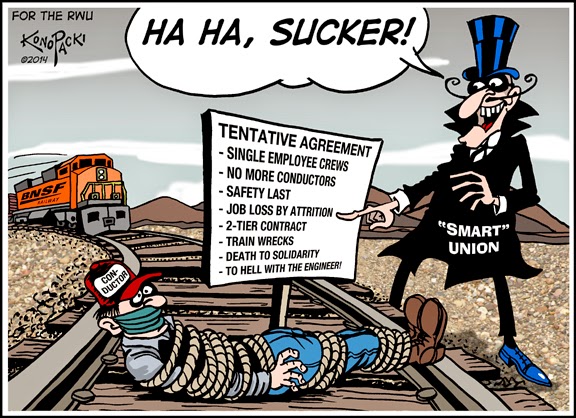 The members of the International Association of Sheet Metal, Air, Rail & Transportation Workers (SMART) General Committee GO—001 have spoken. In a loud and clear mandate, they have told the BNSF railway, their union leaders, and the world, that they do not support single employee train crews. By 2-to-1, the rank and file voted down a tentative agreement, that – had it been ratified – would have resulted in conductorless train operations over more than half of the Burlington Northern Santa Fe Railway (BNSF), the second largest rail carrier in the U.S.
 Dear fellow rails:
 An Illinois scrap metal recycling company has been fined nearly half a million dollars for various safety violations
  Rescuers at Zenica coal mine in central Bosnia freed Friday 29 of the 34 miners trapped underground after a gas explosion that followed a 3.5 magnitude earthquake, which cause the walls to collapse.
 Employees of an Ohio landfill used primarily for disposing of toxic coal waste byproducts like coal ash were told that the waste was “safe enough to eat” and weren’t required to wear protective gear, resulting in numerous illnesses and some deaths, according to a
 This site is not the official webpage of the Industrial Workers of the World.