You are here

health and safety

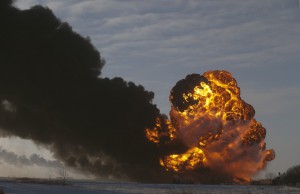
Another Oil Train Derailment – Rail Crews Call Them “Bomb Trains”

From the blog Railroaded - January 6, 2014 (used by permission)

Disclaimer: The views expressed here are not the official position of the IWW (or even the IWW’s EUC) and do not necessarily represent the views of anyone but the author’s.

Twenty-one cars and 2 locomotives of a mile-long Burlington Northern Santa Fe (BNSF) Railway train derailed December 30, 2013, near Casselton, North Dakota, overturning oil tanker cars that exploded and burned for more than 24 hours (Star TelegramAsbury Park PressAssociated PressDuluth News TribuneValleynewslive.comAssociated Press 2McClatchy Interactive).

Another BNSF mile-long train carrying grain derailed first (13 cars) and some of the grain cars fell onto an adjacent track carrying the BNSF oil train. About a minute after the grain train derailed, the oil train struck one of the derailed cars filled with soybeans, causing the oil train to fall off the tracks. 20 crude oil tank cars derailed, of which 18 were punctured. Subsequent explosions and fires lasted for hours. One observer noted at least 6 separate explosions in the 2 hours following the derailments, which sent huge fireballs and clouds of hazardous toxic black smoke into the air. The fire burned so hot emergency crews didn’t even attempt to put out the blaze.

475,000 gallons of oil were spilled in the derailment, some of it burning off and some of it leaking into the soil. Investigators estimate that at least 7,300 tons of dirt contaminated with oil must be removed from the site.

Most of Casselton’s 2,400 residents followed a call from the Cass County Sheriff’s Office to evacuate the town due to health concerns about exposure to the toxic burning crude which can cause shortness of breath, coughing and itching, watery eyes. North Dakota Governor Jack Dalrymple visited Casselton and called it a “major catastrophe” that would prompt concern no matter where it happened.

A preliminary investigation by the U.S. National Transportation Safety Board (NTSB) suggests the derailment occurred at a mechanical switching point between 2 tracks. The oil tanker cars that derailed and exploded and burned were the older-model DOT-111 cars which have been known for years to rupture easily in derailments and other accidents. The NTSB, Transportation Safety Board (TSB) of Canada and most rail safety experts have been recommending for many years that the DOT-111 model cars be replaced or upgraded. Unfortunately, railway companies and shippers have been inordinately slow, and in some cases unwilling, to replace this antiquated model with sturdier built and safer models.

Going Green at the Cost of Workers’ Safety

Going Green at the Cost of Workers’ Safety by Emmett J. Nolan

Animation of Fire at Chevron's Richmond Refinery, August 6, 2012

Tony Mazzocchi Talks About Chemicals and the Workers: 1978 National Film Board of Canada

Coal’s Assault on Human Health

By Alan H Lockwood, Kristen Welker-Hood, Molly Rauch, and Barbara Gottlieb - Physicians for Social Responsibility, November 2009

Coal pollutants affect all major body organ systems and contribute to four of the five leading causes of mortality in the U.S.: heart disease, cancer, stroke, and chronic lower respiratory diseases. This conclusion emerges from our reassessment of the widely recognized health threats from coal. Each step of the coal lifecycle—mining, transportation, washing, combustion, and disposing of postcombustion wastes—impacts human health. Coal combustion in particular contributes to diseases affecting large portions of the U.S. population, including asthma, lung cancer, heart disease, and stroke, compounding the major public health challenges of our time. It interferes with lung development, increases the risk of heart attacks, and compromises intellectual capacity.

Oxidative stress and inflammation are indicated as possible mechanisms in the exacerbation and development of many of the diseases under review. In addition, the report addresses another, less widely recognized health threat from coal: the contribution of coal combustion to global warming, and the current and predicted health effects of global warming.

Read the report (PDF).

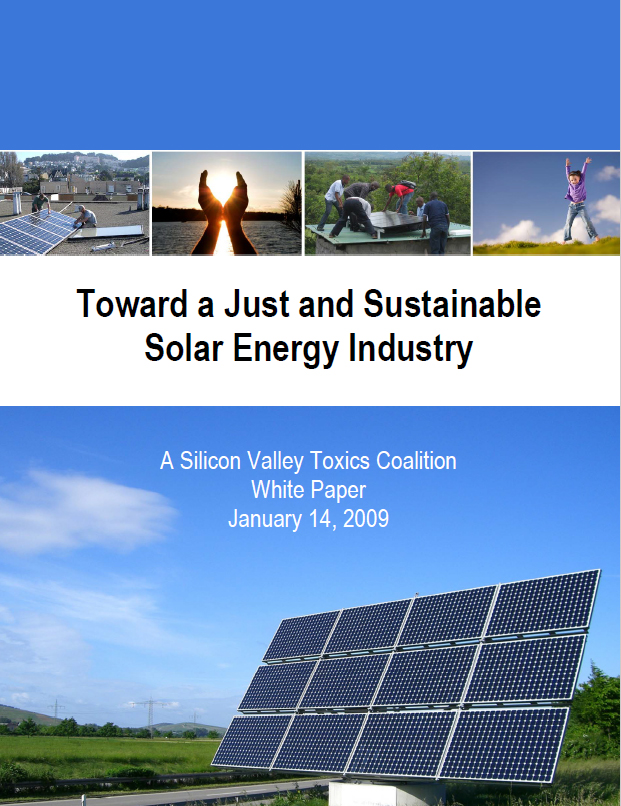
Towards a Just and Sustainable Solar Energy Industry

Towards a Just and Sustainable Solar Energy Industry - A Silicon Valley Toxics Coalition White Paper, January 14, 2009.

Every hour, enough solar energy reaches the Earth to meet human energy needs for an entire year. Solar photovoltaic (PV) technology is widely seen as a “win-win” solution that can harness this “free energy” to address global warming, reduce U.S. dependence on energy imports, create “green jobs,” and help revitalize the U.S. economy.

Solar energy will play an essential role in meeting these challenges, but as the solar PV sector expands, little attention is being paid to the potential environmental and health costs of that rapid expansion. The most widely used solar PV panels are based on materials and processes from the microelectronics industry and have the potential to create a huge new wave of electronic waste (e-waste) at the end of their useful lives, which is estimated to be 20 to 25 years. New solar PV technologies are increasing cell efficiency and lowering costs, but many of these use extremely toxic materials or materials with unknown health and environmental risks (including new nanomaterials and processes).

With the solar PV sector still emerging, we have a limited window of opportunity to ensure that this extremely important industry is truly “clean and green,” from its supply chains through product manufacturing, use, and end-of-life disposal. The solar industry has taken a leadership role in addressing the world’s pressing energy and environmental challenges and will serve as a model for how other innovative “green” industries address the lifecycle impacts of their products.

In this white paper, the Silicon Valley Toxics Coalition (SVTC) provides an overview of the health and safety issues faced by the solar PV industry, including the toxic materials used in manufacturing and the potential end-of-life disposal hazards of solar PV products. The report also lays out recommendations to immediately address these problems to build a safe, sustainable, and just solar energy industry. These recommendations include:

  • Reduce and eventually eliminate the use of toxic materials and develop environmentally sustainable practices.
  • Ensure that solar PV manufacturers are responsible for the lifecycle impacts of their products through Extended
    Producer Responsibility (EPR).
  • Ensure proper testing of new and emerging materials and processes based on a precautionary approach.
  • Expand recycling technology and design products for easy recycling.
  • Promote high-quality “green jobs” that protect worker health and safety and provide a living wage throughout the
    global PV industry, including supply chains and end-of-life recycling.
  • Protect community health and safety throughout the global PV industry, including supply chains and recycling.

Read the report (PDF)

Your Nuclear Workplace: Know Your Risks, Know Your Rights

By staff - Nuclear Information and Resource Service, April 2006

A handy guide for workers in nuclear power plants, including information about PPE, and the (high) risks of employment in such facilities.

Read the report (PDF).

Environmental Impacts of Polyvinyl Chloride (PVC) Building Materials

Joe Thornton, Ph.D. - Healthy Building Network, 2002

In the last 40 years, polyvinyl chloride plastic (PVC) has become a majorbuilding material. Global vinyl production now totals over 30 milliontons per year, the majority of which is directed to building applications,furnishings, and electronics. The manufacture, use, and disposal of PVC poses substantial and uniqueenvironmental and human health hazards. Across the world, govern-ments, companies, and scientific organizations have recognized the haz-ards of PVC.

In virtually all European nations, certain uses of PVC havebeen eliminated for environmental reasons, and several countries haveambitious programs to reduce PVC use overall. Scores of communitieshave PVC avoidance policies, and dozens of green buildings have beenbuilt with little or no PVC. Firms in a variety of industries haveannounced measures to reduce PVC consumption and are using or pro-ducing alternative materials in a variety of product sectors, includingbuilding materials. This paper discusses the hazards of the PVC lifecyclethat have led to this large scale movement away from PVC products.

Read the report (English PDF). (Link Only)

The Secret History of Tree Spiking - Part 2

By Judi Bari - Anderson Valley Advertiser, March 8, 1993; reprinted in Timber Wars, © 1994 Common Courage Press.

Tree-spiking is a failed tactic by any standard. It has been practiced by Earth First! for 10 years now, and I think it's fair to say that the results are in. Here's [an excerpt of] Dave Foreman's description of tree-spiking from Eco-Defense

Tree-spiking is an extremely effective method of deterring timber sales, which seems to be becoming more and more popular. If enough trees are spiked to roadless areas, eventually the corporate thugs in the timber company boardrooms, along with their corporate lackeys who wear the uniform of the Forest Service, will realize that timber sales in wild areas are going to be prohibitively expensive.

Believing this to be so seems to be an article of faith for some Earth First!ers. But a look at the actual history of Earth First! tree-spiking will show that it hasn't really worked out that way.

The most intensive spiking campaigns occurred in Oregon and Washington, although there have also been tree-spikings in California, Colorado, Montana, Idaho, New Mexico, Arizona, British Columbia, southern Illinois, Kentucky, Maine, and New Jersey, to name a few. And I'm not going to say that none of them saved any trees, because in a few cases they did, especially early on, or in areas without a timber based economy. But the successes have been few and far between. Even unabashed Earth First! apologist Chris Manes, writing in his well researched book Green Rage, could only come up with two timber sales that were canceled because they were spiked, one in George Washington National Forest in Virginia, and one in the Wanatchee Forest's Icicle River drainage in Washington state. I don't know about the trees in Virginia, but the Icicle River sale has since been cut. Earth First! activists from Shawnee in Southern Illinois also report that when the hard-fought Fairview sale was finally clear-cut, the only trees that were left were a few oaks that had been spiked.

But there have been scores and scores of tree-spikings, and in the vast majority of cases, the Forest Service or timber company just sent people in with metal detectors and, often with great public fanfare, removed the spikes and cut the trees. Sometimes spikes were missed and sometimes they hit the blades in sawmills. But the timber industry has made it quite clear that this is a price they are willing to pay.

The first known tree-spiking in Earth First! history occurred in the Siskiyou Mountains of Oregon in 1983, on the Woodrat timber sale on Bureau of Land Management (BLM) land. Notice was given of the spiking, and some of the trees were marked with yellow ribbons to make them easy to find and verify. The BLM reacted by having the loggers cut the trees and leave them on the ground for firewood cutters to saw at their own risk.

In 1984, a group calling itself the Hardesty Avengers mailed a letter to the Oregon Register-Guard announcing that a 132-acre sale on Hardesty Mountain in the Willamette National Forest had been spiked. The area was scheduled for helicopter logging by Columbia Helicopter. The Forest Service responded with a plan it called "Operation Nail." sending 20 Forest Service employees into the woods to remove the nails before they went ahead and cut the trees.

The Secret History of Tree Spiking - Part 1

By Judi Bari - Anderson Valley Advertiser, February 17, 1993, and the Earth First! Journal, December 21, 1994; reprinted in Timber Wars, © 1994 Common Courage Press.

In May, 1987, sawmill worker George Alexander was nearly decapitated when a tree-spike shattered his sawblade at the Cloverdale Louisiana-Pacific mill in northern California.

This grisly accident sent shock waves through our community, and eventually led Northern California Earth First! to renounce tree spiking. Southern Oregon and Southern Willamette Earth First! joined us, as well as a few Earth First!ers from Stumptown, but that's all.

The rest of Earth First! still endorses spiking, and many of them even today react to our no-spiking policy by denouncing us as traitors and dismissing us as wimps, without ever considering the reasons for our actions. Because of this, because there are so many new Earth First!ers who don't know this history, I think it is time to re-examine the issue of tree-spiking. A few years ago, George Alexander and his wife Laurie agreed to talk to me about the 1987 incident. The following account is based on my conversation with them.

"I was the perfect victim," began George Alexander, "I was nobody." George, a lifetime Mendocino County resident and son of an old-time Willits logger, was 23 years old and just married, with his wife Laurie three months pregnant at the time of the accident. George's job at the mill was called off-bearer. The off-bearer operates a huge band saw that makes the first rough cut on logs as they come into the mill, sectioning off slices of wood that will later be cut to standard lengths and planed for finished lumber.

Off-bearer is one of the most dangerous jobs in the mill. The saw that George Alexander worked on was sized for old-growth logs-52 feet around, with a ten-inch blade of high tensile steel. "That saw was so powerful that when you turned it off you could make three more cuts through a 20-foot log before it stopped," George told me. One of the dangers of working as off-bearer is that if the blade hits a hard knot or metal debris (from old fences, choker chains, nails, etc., embedded in the wood), the sawteeth can break. To protect against this, workers have to wear a heavy face mask and stay on the alert, checking each log as it goes through.

George knew the job was dangerous, but he also was confident of his skill. "I always figured that if the blade ever hit me, it would hit me on the urn." he said. He knew every sound the saw made, and could tell by listening when something was going wrong. He also knew to look for the tell-tale black stains that usually show up on the smooth surface of the de-barked logs if metal is present in the wood.

Although George Alexander was an LP employee, he was no company man. Louisiana-Pacific had earned his disrespect long ago through the callous way they treat their employees. "We're not even people to them," he said. "All they care about is production." The perfect example of this L-P management attitude was Dick Edwards, the day shift foreman. Edwards was always after everyone, but he seemed to go out of his way to harass George. In the months before the tree spiking, Edwards would often stand on the catwalk overlooking George's work station with LP Western Division head Joe Wheeler, just watching George work.

L-P has never been known to spend too much time maintaining equipment or worrying about worker safety. But in the weeks preceding the tree spiking incident, conditions had gotten worse than usual. The bandsaw blade was wobbling when it ran, and cracks had begun to appear in it. But when George and other workers complained, Edwards shined them on, saying the new blades were not in yet, and they would have to ma1ke do. "That blade was getting so bad," said George, "That I almost didn't go to work that day."

Normally when a big tree is sawed, they start from the outside and square off the edges first. But the tree that George was sawing on May 8, 1987 was a 12-inch pecker-pole, and because it was so small he took the first cut down the middle. Halfway through the 20-foot log, the saw hit a 60-penny nail. "That nail must have been recently placed and countersunk," George told me. He had checked the log when he started cutting it and had seen no sign of the metal. And because he hit the nail square-on, there was no warning sound. "Usually there's a high-pitched metal sound and you have time to get out of the way," explained George. "This time I didn't hear nothing but 'BOOM!'"

The next thing he knew, George was lying on the floor covered with his own blood. "I knew I was dying. And all I could think about was Dick Edwards, and all the shit he gave me when I complained about the saw. I tried to get up, but they pushed me back down. I tried to beckon to Edwards so he would come close enough for me to get my hands around his throat in a death grip. If I had to die, I wanted to take that bastard with me."

Pages

The Fine Print I:

Disclaimer: The views expressed on this site are not the official position of the IWW (or even the IWW’s EUC) unless otherwise indicated and do not necessarily represent the views of anyone but the author’s, nor should it be assumed that any of these authors automatically support the IWW or endorse any of its positions.

Further: the inclusion of a link on our site (other than the link to the main IWW site) does not imply endorsement by or an alliance with the IWW. These sites have been chosen by our members due to their perceived relevance to the IWW EUC and are included here for informational purposes only. If you have any suggestions or comments on any of the links included (or not included) above, please contact us.

The Fine Print II:

Fair Use Notice: The material on this site is provided for educational and informational purposes. It may contain copyrighted material the use of which has not always been specifically authorized by the copyright owner. It is being made available in an effort to advance the understanding of scientific, environmental, economic, social justice and human rights issues etc.

It is believed that this constitutes a 'fair use' of any such copyrighted material as provided for in section 107 of the US Copyright Law. In accordance with Title 17 U.S.C. Section 107, the material on this site is distributed without profit to those who have an interest in using the included information for research and educational purposes. If you wish to use copyrighted material from this site for purposes of your own that go beyond 'fair use', you must obtain permission from the copyright owner. The information on this site does not constitute legal or technical advice.