You are here

Industrial Workers of the World (IWW)

Workers and the fight for climate justice

By David Camfield - New Socialist, June 10, 2019

The push for a Green New Deal (GND) that’s become a big topic of political discussion in the US has come north. At the beginning of May 2019, the Pact for a GND was launched publicly in Canada. It was endorsed by a range of organizations and prominent individuals. Behind the scenes, staff from a number of major NGOs including Greenpeace and Leadnow are playing key roles in the initiative.

The Pact calls the GND “a vision of rapid, inclusive and far-reaching transition, to slash emissions, protect critical biodiversity, meet the demands of the multiple crises we face, and create over a million jobs in the process. It would involve the full implementation of the United Nations Declaration on the Rights of Indigenous Peoples (UNDRIP) including the right to Free, Prior and Informed Consent (FPIC), dozens of other pieces of legislation, new programs and institutions, and a huge mobilization calling on the creativity and participation of all of us.”

The Pact sets out “two fundamental principles” for a GND: “1. It must meet the demands of Indigenous Knowledge and science and cut Canada’s emissions in half in 11 years while protecting cultural and biological diversity”, and “2. It must leave no one behind and build a better present and future for all of us.”

Over 100 town hall meetings have been held in cities, towns and smaller communities to discuss what should be in a GND, and more are planned. The results of the discussions are supposed to be reported back and used to develop a package of GND policies. It seems that the contents of the package will eventually be decided by some of the people, mostly NGO staff, doing the work of the Pact for a GND Coalition. The Coalition, however, will not be campaigning publicly between June 30th and the federal election due to election advertising regulations. The GND policy package will be launched after the federal election, with the Coalition talking internally about doing some kind of mass mobilization around it.

The Strategic Importance of a Green New Deal Campaign

It does matter what the specific GND policies will be – but not only or mainly for the reason that some anti-capitalists think. Some radicals in the US have dismissively criticized the GND championed by Alexandria Ocasio-Cortez and other Democratic politicians for not targeting the capitalist system itself. In a much more constructive reflection, British socialist Richard Seymour has asked if the GND depends “on magical thinking about technology and capitalism? Are the legislative tools it looks to adequate? Is it internationalist, or can it be? Does it risk further commodifying the natural world?” Seymour suggests “we need the GND plus something else.”

We definitely need accurate assessments of the enormous scale of change needed to carry out a just transition away from a way of organizing society that spews out vast quantities of greenhouse gases. As Samuel Miller McDonald argues, “we first have to be clear-eyed about the challenges involved.”

Defend Our Sperrins Not Toxic Gold Mining

By staff - IWW Ireland, May 11. 2019

The Industrial Workers of the World (IWW) have issued a call for support and solidarity with communities in the heart of the Sperrin Mountains who continue object to the poisoning of our environment by Canadian based multinationals, Dalradian Gold Ltd.

A spokesperson for the IWW General Members Branch in Ireland said in a statement: “At a time when communities in lockdown are dealing with the Covid 19 crisis, some will intend to use such a period of uncertainty to deflect attention away from events happening elsewhere to shamelessly promote themselves and their own agenda.

"To date we have witnessed the behaviour of multinationals such as Dalradian Gold Limited attempting to use such a climate to befriend local community organisations with financial incentives and windfalls as advertised in the press. This is yet another under hand attempt by a tarnished company to embellish themselves as a type of 'saviours of the community' at a time of increasing hardship.

"Again for anyone approached by or offered to be garnished by financial rewards from multinational companies with an atrocious environmental legacy, we would urge them to firstly question their own conscious and of course their own ethical policies of the organisations to which they belong. Recent moves should be viewed as nothing shy of a community grooming exercise.

"Let's be clear, this is an attempt to sow seeds of division within and around the north west which will ultimately fail, like their ongoing plans to mine and destroy our environment in the pursuit of profit will fail.

"As an international union we would urge community and environmental groups both locally and internationally, as well as the wider trade union movement to acknowledge the many groups challenging the destructive consequences of gold mining within a location such as the Sperrins. An area of outstanding natural beauty.

"Any attempt to view Dalradian Gold Limited as a some type of 'financial saviour' much be challenged. A multinational gold company who plan to create a toxic gold mining plant, an act that will impact upon all our lives throughout the entire North West for future generations to come.

“It is vital at this time we remain vigilant and vocal about what is actually happening. We believe that it is up to all of us to protect and defend our environment and our rights as workers. The right to live in an environment free from toxic pollution and environmental destruction. Free from the greed of scrupulous multinational corporations who try to divide communities.

"Our message today as all ways remains, an injury to one is an injury to all!"

Statement by IWW Secretary, Russ Spring - Union calls for an end to the growing economy and the transformation of industry

Statement by IWW DEC Secretary, Russ Spring - Bristol IWW EUC, April 22, 2019

Statement delivered to Bristol IWW EUC, to be announced in solidarity with the Earth Strike climate protest on April 27th, 2019: https://www.facebook.com/events/777567979287005/

Regarding the passing of the IWW’s new environmental policy, calling for an end to the growing economy and the transformation of harmful industry.

“The threat of extinction is a very loud wake up call. Not just a wake up call to the needs of the planet but also a wake up call to the need for system change. Urgent and seismic action is needed for the immediate future and the long term survival of our planet.

The changes that are required are so substantial that capitalism cannot deliver them. System change not climate change is one of the placards and chants of the schools strikes.

That is largely due to the fact that it is a world driven by greed, self interest in the pursuit of private wealth, profit and privilege, that has brought us to the brink of extinction.

The best that a green capitalism can offer is a temporary truce in its war on the planet, before its insatiable appetite for more will push us again to the edge of catastrophe.

The terms of struggle have changed from the desire for a fairer world to the necessity of a fairer world and one that puts ecology before economy.

We are living at the most important time in human history. It is the time when the reality and consequences of human activity is laid bear like never before.

And whilst we are staring oblivion full in the face it is also a great time of possibility. A time for us to have the most radical shake up of our economics our culture and our relationships with each other and of course our planet.

BUT it is our last chance... screw this up and ...well it doesn't bear thinking about.

The climate change emergency is creating a vacuum throwing old politics to the sides and it is important that progressive ideas and actions fill that vacuum.

The small minded bigots of the right wing are already talking about the need to curb populations in Africa and Asia and pointing to other world economies such as China as the problem. We can expect to see climate change being used more and more to fuel racism, xenophobia and nationalism and the ideas of green fascism.

The school strikes, the XR occupations in London and events like this are a start but we must dramatically increase our efforts.

We must start to frame a clear vision of the future that we and the planet demand.

Sadly many on the left have dismissed ecological concerns in the past. Seeing environmental degradation as an inevitable consequence of the sacred cow of progress and the creation of jobs...at any cost.

All political parties, both mainstream and those on the fringes, are locked into the growing economy, standards of living and the right to consumption. The trade union movement following suit.

Quality of life, community and ecology have long been shoved off the agenda.

The question is does the left have the ability to heed the wake up call and adapt or are they due for extinction.

So the IWW, has since the 80s had in its constitution, sadly somewhat neglected, a line that says that we aim to build a world in which we can live in harmony with the planet.

We have now given new life to that desire by passing a long overdue environmental policy that calls for; an end to the growing economy and the transformation of harmful industries.

I think we will be the first trade union to do so. But we also commit that the IWW should seek to be a radical influence in politics and environmental debate and in particular the trade union movement which can be very protective of the most damaging industries.

So we aim to try and influence the trade unions that still have over 6million members.

We also acknowledge that this is not a time for political dogma. It is a time of political pragmatism.

So whilst we will keep our revolutionary aims we will work to bring about reforms to slow down climate change ….. by any means necessary.

The battle is on, and time is short. We need to be bold and draw on all our creative energies to bring about change in our individual lives but most importantly system change.

The time for squabbling among ourselves is over.

Lets get angry lets get passionate and direct it at those that are responsible.

The Autonomous Earth Federation

By anonymous - May 2019

We are standing at a crucial crossroads. Not only does the age-old “social question” concerning the exploitation of human labor remain unresolved, but the plundering of natural resources has reached a point where humanity is also forced to politically deal with an “ecological question.” Today, we have to make conscious choices about what direction society should take, to properly meet these challenges. - Eirik Eiglad

In the wake of recent events, many anarchists and social ecologists have found their early concerns about Extinction Rebellion and Earth Strike confirmed: the movements appear destined for failure.

Activists under the green, black, and red are agreed that now, perhaps more than ever, an organised autonomous movement is needed to build towards insurrection and general strikes, as well as provide a clearly outlined ecological alternative to the capitalist industrial order based on one of communal ownership and democracy. What follows is the proposal for a rough set of guidelines towards the formation of a decentralised network of activists, united by a shared belief in this set of core principles:

  • Climate collapse is class war
  • Capitalism and centralisation have devastated our planet
  • Direct Action and Autonomy - not looking to elected representatives for reform
  • Climate issues are social issues
  • Consensus is key - All Power to the People!
  • Anti-Fascism
  • Rejection of the state and police
  • The climate struggle is an internationalist struggle
  • The climate struggle is an anti-racist, anti-ableist, anti-imperialist struggle

The Autonomous Earth Federation aims to establish an organised autonomous undercurrent within the wider climate and labour movements. There are no membership fees, no registration - anyone who agrees with our core principles can consider themselves a part of the AEF. We offer no support or affiliation to any political party, and have no officials or internal hierarchy - we are all leaders.

The Green New Deal Isn’t Just Affordable, It’s Necessary Now

By Ryan Smith - Broke Ass Stuart, February 27, 2019

Editor's Note: the IWW has not taken a position on the Green New Deal; the author is a cofounder of the IWW EUC; the image is from the Intercept.
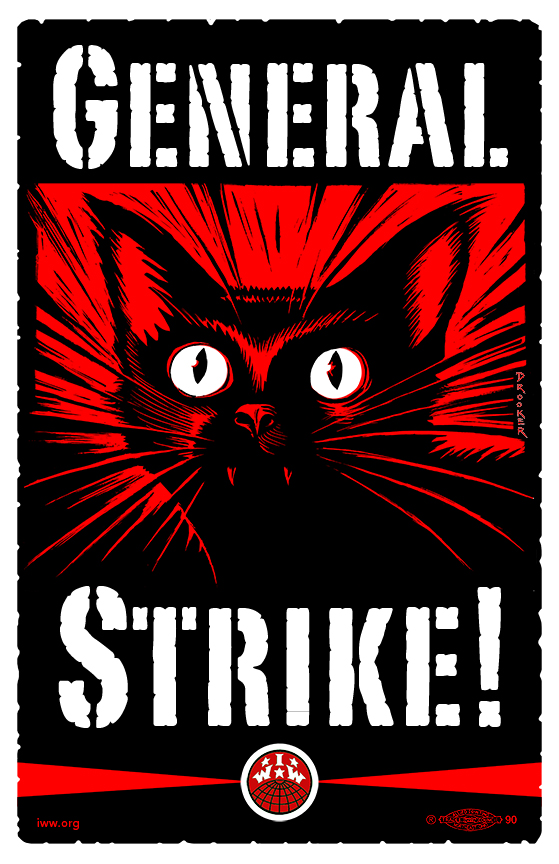
The Green New Deal resolution Rep. Alexandra Ocasio-Cortez (D-NY) and Senator Ed Markey (D-MA) have proposed has captured the attention of the American public like nothing else. The deal presents a sweeping vision for meeting the challenge of climate change by creating a more just, equitable and equal society — in the weeks since its introduction, the Green New Deal has stirred up enormous controversy. It’s been co-sponsored by five Democratic presidential candidates and panned by others like Senator Diane Feinstein (D-CA) and former Rep. John Delaney (D-MD) as unrealistic with Delaney going so far as to say:

The Green New Deal as it has been proposed is about as realistic as Trump saying that Mexico is going to pay for the wall. Let’s focus on what’s possible, not what’s impossible.

Donald Trump easily takes the cake when he said, “I really don’t like their policy of taking away your car, of taking away your airplane rights, of ‘let’s hop a train to California,’ of you’re not allowed to own cows anymore!”  In fairness, you have to be impressed by Trump topping former President George HW Bush’s ranting that environmental regulations would leave everyone jobless, “and up to our necks in owls!”

Regardless of the criticism, some of which is couched in more reasonable language than others, there’s strong evidence that the Green New Deal is not only desirable but actually very feasible.

“If You Want a General Strike, Organize Your Co-Workers” Interview with Joe Burns

By staff - Black Rose Anarchist Network, February 21, 2019

BRRN Introduction: The following interview with Joe Burns, author of the important labor text Reviving The Strike, takes up the evergreen questions of the role of strikes and building a base within our workplaces. With the recent wave of teacher strikes these questions are back on the radar of the U.S. left but this interview from 2012 spoke to then-current discussions of how to move the left from fleeting activist mobilizations to building long term roots within the working class.
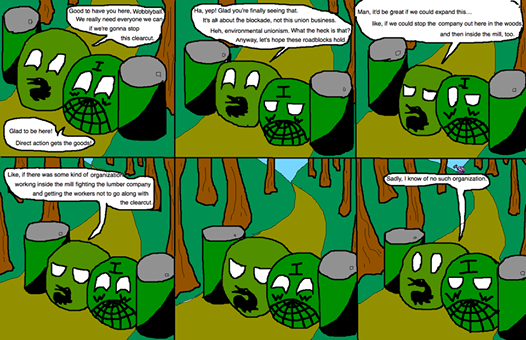
The “Build Power, Show Power” campaign, also referred to as “Occupy May 1st,” was an effort initiated by groups within the anarchist milieu, some later coalescing into what became Black Rose/Rosa Negra Anarchist Federation, which sought to channel the numbers and energy of those radicalized by the Occupy movement towards a May 1st, 2012, General Strike. Ultimately the political temperature and activity in the wake of the Occupy movement cooled and contracted into a “post-Occupy lull” rather than heating and the campaign culminated in anti-capitalist themed rallies in a number of cities instead of hoped for strikes. But the effort wasn’t without basis in 2012 given the widespread popularity of the general strike in the prior year – calls for a general strike electrified the wider left during the April 2011 Wisconsin uprising called for by members of the IWW and endorsed by local labor unions and the one-day general strike carried out in November 2011 by Occupy Oakland which resulted in shutting down the Port of Oakland and activists taking over the downtown core of the city.

With renewed discussions around the use of general strikes during the January 2019 federal government shutdown by the leader of the flight attendants union, Joe Burn’s advice that we need to be organizing at our workplaces and building rank-and-file organizations are just as relevant then as they are now.

-Adam Weaver

Ghostbusting: Exorcising the Separation Between Workplace and Community Struggles

By anonymous - It's Going Down, January 28, 2019

The following essay, written by Wobblies for a Revolutionary Union Movement, continues the back and forth dialog and discussion on the back and forth dialog about unions, syndicalism, and the IWW.

For the last several weeks, an exchange of articles has appeared on It’s Going Down, on the value of workplace organizing, including “Nothing to Syndicate”, “Aiming at Ghosts”, “Crafty Ghosts”, and several other pieces. Most of these have taken aim at “syndicalism”, and opponents of workplace struggle have insisted on using a restricted, shop-floor-only definition of “syndicalism”, accusing workers who support unions of having a narrow focus on their own workplace, of wanting to run the existing exploitative economy under their own democratic management, and of ignoring oppressions beyond class.

Supporters of workplace struggle, meanwhile, have answered with a broader definition of our organizing based in the real work that we do. Our revolutionary unionism is based in interconnected community and workplace organizing, imagines the radical transformation of the economy and liberation of people from our exploitation as workers, and sees the oppressions that we face on and off the shop floor as our shared concern. We are here as revolutionary unionists speaking about the work we actually do – not as “syndicalists” defending a workplace-only stance that we don’t take.

Several of the pieces, starting with “Crafty Ghosts”, take aim at the General Defense Committee and Incarcerated Workers Organizing Committee, claiming that these are “entryist” projects, competing with other radical projects. “Crafty Ghosts” specifically names Wobblies for a Revolutionary Union Movement (WRUM), a caucus of the IWW that supports prisoner organizing, the community self defense mission of the GDC, and further democratization of the union. The author of “Crafty Ghosts” specifically mentions “the author of Aiming at Ghosts—and the Wobblies for a Revolutionary Unionist Movement (WRUM) in general”. We’re glad that someone wrote Aiming at Ghosts, but it wasn’t anyone in WRUM.

We are members of WRUM, writing specifically to respond to the charges of “entryism”. However, given the short length of “Crafty Ghosts”, we hope to use it as a jumping off point for clarifying some misconceptions about the IWW’s role in community self defense and prison abolition.

Some Notes On Mass Refusal: Kim Kelly Interview with IGD

By staff - It's Going Down, January 25, 2019

Recently, It’s Going Down was asked by Kim Kelly (who we have interviewed on our podcast) to talk about the history and impact of general strikes within the United States, as well as the possibilities of its current applications for an op-ed in the pages of Teen Vogue. You can read the finished article here. What follows is our complete responses.

KK: Historically speaking, how successful of a tactic is the general strike?

In the American context general strikes have historically been very important, leading to not only the winning of key demands or beating back this or that attack, but also in fundamentally changing society, and at times, creating a potentially revolutionary situation, as workers have used them as a staging point for the taking over of cities and regions, and large sections of industries, and running them themselves.

One of the most successful general strikes, as noted by Black liberation and socialist author W.E.B. Du Bois, was when millions of enslaved Africans during the Civil War in the American south left plantations en masse and headed for the North, crippling the economy and the war machine. This, coupled with mass desertion of poor white Confederate soldiers, led to a crippling of the Confederacy, as many poor whites refused to die for the rich, white planter class, who was excused from fighting if they owned enough slaves. This combined desertion and mass general strike, played a key role in the collapse of the Confederate State, and also highlights the power of mass refusal under a neo-colonial power structure that thrives on a regimented caste system.

In the contemporary period, in 2006, a wave of wildcat strikes and school walkouts began in response to HR-4437, a bill that attempted to criminalize both undocumented people but also anyone that willingly offered them aid; for instance teachers at school could be charged if they did not turn in undocumented students. Starting from schools and growing to include strikes at workplaces, this mass movement that was largely self-organized and not led by political parties and unions, culminated in a massive May 1st demonstrations that saw a general strike of immigrant workers under the banner, “A Day Without An Immigrant.” The legislation was defeated soon after.

The immigrant general strike of 2006 also revived in the US popular lexicon the importance of May Day, which began as a celebration of the anarchist Haymarket Martyrs, who were executed by the State for their role in strikes in support of the 8-hour work day and against violent attacks on strikers. In this struggle, a variety of tactics were used, including mass strikes, which finally secured the right to the 8 hour work day.

But beyond simply attacking unjust legislation or as a means to win a reform, general strikes have also been the kicking off point for workers in the US to go about seizing the means of existence; in some cases, entire cities and regions.

A Response to “Crafty Ghosts”

By anonymous contributor - It's Going Down, January 10, 2019

Another response and continuation of the discussion around syndicalism, work, civilization, and the anarchist movement.

I’ve been reading some of the debates that have been going on lately around the topic of workplace-organizing, economics, ecology and the future. I think its not bad that this is being discussed at all, but the matter is leaving me more and more puzzled due to the way things are being brought up.

There is some kind of contradiction being brought to the forefront that at least in my opinion is not really there. This especially visible in the latest response of the 28th of December called “Crafty Ghosts: A Critique of Entryist Trajectory.” It’s a little related to the actual article “Nothing to Syndicate” and I do recon that by responding to this very article in a way I am adding to the drifting from the original subject. But with such an article actually being published I find it necessary to add a short response. First and foremost the anonymous author of “Crafty Ghosts” is having a different opinion on the value of open organization with membership and organizing that has a nation-wide (or beyond) reach – like for instance the IWW. There can be flaws made with this way of organizing for sure. For instance when the main goal is getting as many people to sign up. But that would be a caricature of the IWW. If there would be a problem around this there is hardly anything being put forward what could be helping to overcome this issue. The concept of membership seems to be just dismissed as a whole.

Instead there author claims that “Anarchist projects like antifa crews, Books to Prisoners, Anarchist Black Cross (ABC), and more [are] […] objectively superior to the GDC and IWOC’s approach.” This is quiet a subjective statement as it is put here and I’d like to see that substantiated. I’ve been an active anarchists for years and I’ve seen many autonomous initiatives over the years by very good comrades. But as far as I know these collectives are subject to very similar problems. I do not see how these initiatives function so much better in terms of E.G. being more productive or easier accessibility. I would suggest they are above all complementary and adding another modus operandus that fits better to certain people. The overcoming of the problems attributed to formal organizing and membership-organizing that the author of “Crafty Ghosts” puts forward, has little to do with membership itself, but more with the question of how a certain organization (formal or informal) is being filled.

Build the Revolution: Anarcho-Syndicalism in the 21st Century

By Radical Education Department - It's Going Down, January 10, 2019

The Radical Education Department (RED) weighs in on the ongoing debate around syndicalism and organizing strategies, arguing that modern variations of syndicalism still offer powerful weapons for autonomous anti-capitalist struggles and movements.

Read and Print PDF HERE

Introduction

Anarchists are debating anarcho-syndicalism once again. If anarcho-syndicalism is a “ghost”—like some critics are claiming—it has proven extremely hard to exorcise. But it is something very different entirely.

The current debate was sparked by “Nothing to Syndicate,” which largely repeats standard criticisms of AS, some of the more recent of which can be seen here and here; see also the summaries here. Then came a critique of “Nothing” (“Aiming at Ghosts”), and then two replies defending the original piece (here and here). The debate has been fairly limited so far. The important first reply to “Nothing,” as well as the defenses that followed, have been wrestling over the details of the original piece. But what’s been missing is a comprehensive response to the original question. What does anarcho-syndicalism offer radicals in the 21st century US?

Some have given this kind of response to critics before, though often in more limited ways (like here). My goal is to go further and deeper. First, I give a systematic historical-materialist analysis of 21st century capitalism in the United States today: its basic drives, structures, and developments. Then I examine the profound limits facing anarchists and their revolutionary allies facing such conditions. (This section tacitly rejects the superficial analysis of the original article.)

And then I offer a vision of what anarcho-syndicalism has to offer. It is far from a ghost. It is a set of inherited, audacious, and sometimes conflicting experiments. Those experiments are still developing. (The ongoing evolution is obvious in more recent syndicalist praxis like green syndicalism and community syndicalism.)

I locate in AS explosive resources for our present—for moving past the fundamental limits of radical organizing today and building revolutionary power to strike at 21st century capital. Defending AS, I explore how its inner resources could be developed to meet the revolutionary needs of the moment.

Anarcho-syndicalism offers badly needed tools for building mass, durable, working-class autonomy inside and outside the workplace for the sake of the revolutionary overthrow of every institution of capitalist control. It is an idea whose time has come again.

Pages

The Fine Print I:

Disclaimer: The views expressed on this site are not the official position of the IWW (or even the IWW’s EUC) unless otherwise indicated and do not necessarily represent the views of anyone but the author’s, nor should it be assumed that any of these authors automatically support the IWW or endorse any of its positions.

Further: the inclusion of a link on our site (other than the link to the main IWW site) does not imply endorsement by or an alliance with the IWW. These sites have been chosen by our members due to their perceived relevance to the IWW EUC and are included here for informational purposes only. If you have any suggestions or comments on any of the links included (or not included) above, please contact us.

The Fine Print II:

Fair Use Notice: The material on this site is provided for educational and informational purposes. It may contain copyrighted material the use of which has not always been specifically authorized by the copyright owner. It is being made available in an effort to advance the understanding of scientific, environmental, economic, social justice and human rights issues etc.

It is believed that this constitutes a 'fair use' of any such copyrighted material as provided for in section 107 of the US Copyright Law. In accordance with Title 17 U.S.C. Section 107, the material on this site is distributed without profit to those who have an interest in using the included information for research and educational purposes. If you wish to use copyrighted material from this site for purposes of your own that go beyond 'fair use', you must obtain permission from the copyright owner. The information on this site does not constitute legal or technical advice.

