You are here

Industrial Workers of the World (IWW)

On The Front Lines: Climate Change Threatens the Health of America's Workers

Future Beyond Fossil Fuels: California’s Just Transition

By staff - Sunrise Movement, May 1, 2020

You may have heard the term ‘Just transition’ floating around, but what does it mean? This webinar will focus on what a just transition means for workers in California, and how the vision of a Green New Deal can guide the much-needed economic recovery from the COVID crisis.

This video features IWW Environmental Unionism Caucus cofounder, Steve Ongerth, speaking on workers, unions, and just transition in Northern California.

Redwood Uprising: From One Big Union to Earth First! and the Bombing of Judi Bari (Steve Ongerth)

Introduction
Chapter 1 : An Injury to One is an Injury to All!
Chapter 2 : Pollution, Love it or Leave it!
Chapter 3 : He Could Clearcut Forests Like No Other
Chapter 4 : Maxxam’s on the Horizon
Chapter 5 : No Compromise in Defense of Mother Earth!
Chapter 6 : If Somebody Kills Themselves, Just Blame it on Earth First!
Chapter 7 : Way Up High in The Redwood Giants
Chapter 8 : Running for Our Lives
Chapter 9 : And they Spewed Out their Hatred
Chapter 10 : Fellow Workers, Meet Earth First!
Chapter 11 : I Knew Nothin’ Till I Met Judi
Chapter 12 : The Day of the Living Dead Hurwitzes
Chapter 13 : They’re Closing Down the Mill in Potter Valley
Chapter 14 : Mother Jones at the Georgia Pacific Mill
Chapter 15 : Hang Down Your Head John Campbell
Chapter 16 : I Like Spotted Owls…Fried
Chapter 17 : Logging to Infinity
Chapter 18 : The Arizona Power Lines
Chapter 19 : Aristocracy Forever
Chapter 20 : Timberlyin’
Chapter 21 : You Fucking Commie Hippies!
Chapter 22 : I am the Lorax; I speak for the Trees
Chapter 23 : Forests Forever
Chapter 24 : El Pio
Chapter 25 : Sabo Tabby vs. Killa Godzilla
Chapter 26 : They Weren’t Gonna Have No Wobbly Runnin’ Their Logging Show
Chapter 27 : Murdered by Capitalism
Chapter 28 : Letting the Cat Out of the Bag
Chapter 29 : Swimmin’ Cross the Rio Grande
Chapter 30 : She Called for Redwood Summer
Chapter 31 : Spike a Tree for Jesus
Chapter 32 : Now They Have These Public Hearings…
Chapter 33 : The Ghosts of Mississippi Will be Watchin’
Chapter 34 : We’ll Have an Earth Night Action
Chapter 35 : “You Brought it On Yourself, Judi”
Chapter 36 : A Pipe Bomb Went Rippin’ Through Her Womb
Chapter 37 : Who Bombed Judi Bari?
Chapter 38 : Conclusion

This entire book and all of its chapters are also available for viewing at judibari.info.

Know the Union: Steve Ongerth

By Editorial Collective - Industrial Worker, Fall 2019; IWW leaflet hand drawn by Judi Bari, October 1989.

How would you like your name printed? (Options include first and last, first and last initial, first, X-number, etc. It’s completely up to you)

Steve Ongerth

What are your pronouns?

He/Him

What branch or local are you affiliated with?

Bay Area IWW GMB

Do you hold a local or national office? If so, what is it?

No

Why did you join the IWW?

I was inspired to join by reading the work of Judi Bari (“Timber Wars”) and greatly appreciating her green syndicalism (she was also an IWW member) in 1995.

Why have you stayed?

I believe in what the IWW stands for and its potential (in spite of its imperfections and limitations).

Is there a wobbly (current or historical) you most admire? 

Judi Bari (of course! And I actually was friends & comrades with her from the time I met her and joined the IWW in May 1995 until she passed away in 1997).

The revolution is over, the wage system is abolished, we installed whatever post-capitalist system you prefer. What are you doing Saturday?

Hiking in the woods or along the Bay (which hopefully isn’t drowning the SF Bay Area due to climate change and sea level rise)

What are you working on right now (union-wise)?

I am one of the cofounders of and active organizers of the IWW Environmental Unionism Caucus (I also maintain its webpage https://ecology.iww.org) I am also the Bay Area IWW Tabling Coordinator.

Union Members Support Coal Phase Out at Levin Terminal in Richmond

By Steve Morse, Martha Hawthorne, Jonathan Kocher, Jud Peake, and Steve Ongerth - Open Letter, January 2020

We are rank-and-file union members who support Richmond’s proposed ordinance to phase out coal and pet coke export from the city.

Others supportive of the ordinance who were present at the December 3rd meeting of the Richmond City Council, include members of unions representing nurses, educators,  and city and county workers. 

The Richmond City Council has been debating an ordinance to phase out coal and pet coke transport from the Levin Terminal over three years. It will finally come to a vote on Tuesday, January 14. We support this ordinance, and Richmond residents’ demands, because we support healthy, vibrant communities with clean air that are free from coal dust.

We also support good, well-paying jobs – union jobs – and the right to bargain collectively and organize for ourselves and our communities.  And we support full employment and a just transition for all workers displaced by the rapid transition away from fossil fuels toward clean and renewable energy that can protect us from climate disaster.

As union members, we call on other union members to oppose the fossil fuel corporations’ agenda -- which callously divides workers, community members and environmentalists -- so that we can’t effectively fight for our common interests and protect the health and safety of our families.

We ask all people to be fully part of the fight for protecting and expanding green union jobs. We all must work for a commitment to a just transition that goes beyond vague support.

We can have good jobs, healthy communities and environmental justice. With real unity, we can halt the power of the oil and coal industries to pollute our neighborhoods, and to pollute our planet.

The Green New Deal offers us a way forward. At the local, state and national level, it is our best strategy for jobs, community health and climate justice. A poll by Data for Progress shows that 62% of working union members favor a Green New Deal, while only 22% are in opposition. We want the collective voice of union workers to reflect this sentiment.

While just transition is a strategy to fully compensate and retrain workers displaced from the fossil fuel economy, the task at Levin Terminal is simpler. The workers can retain their jobs, their wages and benefits. They can retain their representation by the Operating Engineers and the other unions. By shifting terminal operations to handling materials that are compatible with community health and a sustainable world, their jobs can be sustained as well.

We commit ourselves to joining with community health and climate justice activists to create one or more viable fleshed-out plans to change the materials that are stored and shipped at the terminal.  At UC Berkeley alone, there are many resources, including the Labor Center, that could help hone this plan.

We ask Levin and the unions to commit to ongoing meetings with the Richmond community and to work in good faith to make this transition happen.  We also ask Levin to withdraw the threat that they made at the Dec. 3 City Council meeting that they would litigate if the ordinance passed. After all, this ordinance doesn't call for an immediate ban, and it includes an option to return to the council if replacement commodities genuinely cannot be found.

The Richmond City Council voted to push the vote on the ordinance to this Tuesday.  The clock is ticking, and the health and safety of the people here in our community is at stake. How much longer will workers and Richmond residents have to endure the worst air quality in the Bay Area?

The Industrial Workers’ Climate Plan: A Great Green Charter

By various - Bristol IWW, 2019

An ecology movement that once seemed jaded is budding and blossoming beautifully. The fantastic efforts of the school strikes’ movement and groups like Extinction Rebellion, Earth Strike and the Green Anti-Capitalist Front have forced green issues back into mainstream public debate. This achievement has been marked by declarations that there is a ‘climate emergency’, first by the Welsh and Scottish governments and then, fittingly on 1st May, by the UK Parliament. A fortnight earlier, the University of Bristol had become the first UK university to declare a climate emergency. So successful have these campaigns been that there is now a broad consensus that something must be done. It is essential to build on this achievement and keep up the momentum. We urgently need to continue the conversation about what do to now.

Alongside the general strikes for climate action in September 2019, Earth Strike is therefore proposing that a Great Green Charter would be a powerful rallying document for the environmental crisis of the Twenty-First Century. The nineteenth-century movement called Chartism inspired the idea of a Great Green Charter. The Chartists drew up clear and agreed points which they pursued with a mix of political, economic and cultural approaches. Chartism became the largest reform movement of its time, taken up by thousands of ordinary people across the United Kingdom. The Chartists were successful, in as much as most of the points listed on ‘The People’s Charter’ were eventually attained, and even exceeded. While this was not within the years of Chartism, and achieved only after great struggle, the Chartists defined the terms of political reform for the decades to come.

Read the report (PDF).

Tough Times Organizing Street Canvassers

By Gavin McAllister - Organizing Work, December 5, 2019

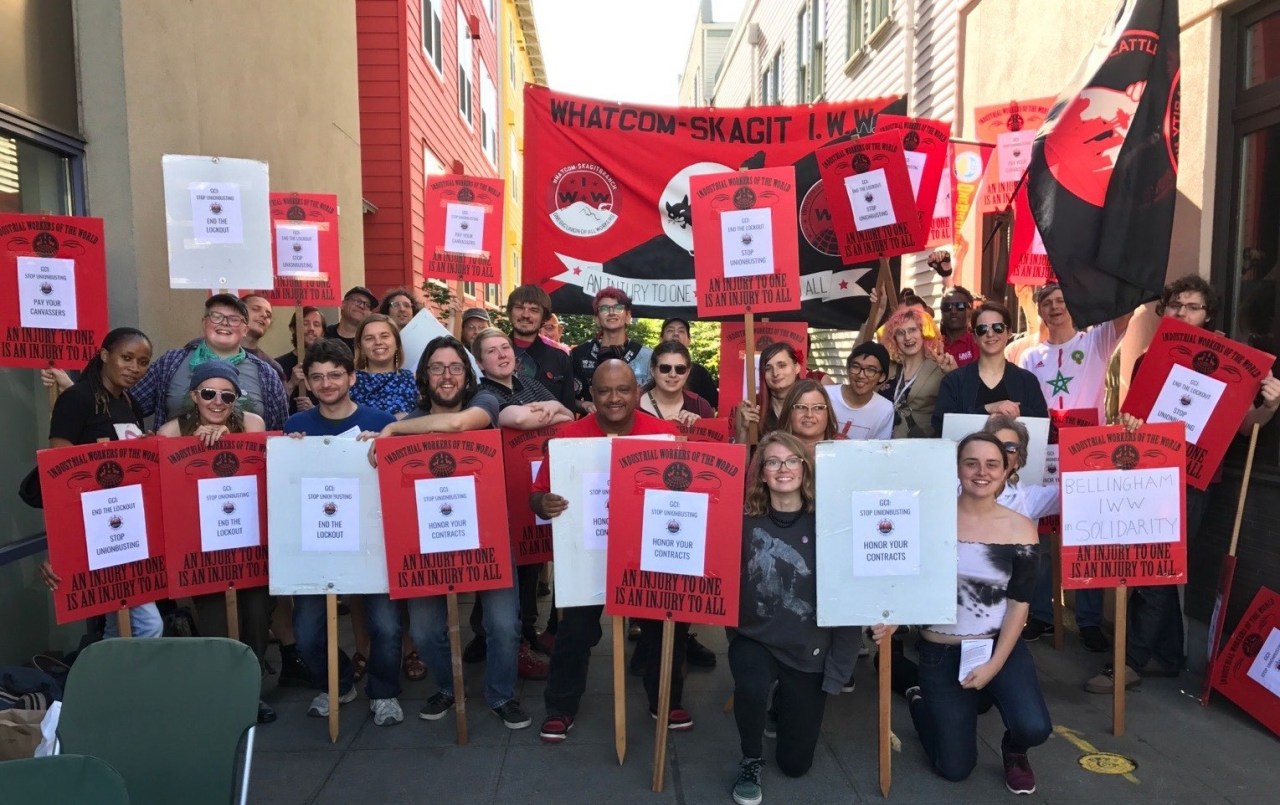
The Industrial Workers of the World (IWW) organized the Seattle office of Grassroots Campaigns, Inc. (GCI) from July 2017 to August 2018. GCI is a company neck-deep in the “nonprofit industrial complex”: it is a fundraising company that contracts with nonprofit organizations to provide high-volume small donor funds. Their business model consists of selling canvassing shifts to organizations such as the American Civil Liberties Union, the Southern Poverty Law Center, Planned Parenthood, and Doctors Without Borders. The worker’s job is to stand on a public street wearing the nonprofit’s uniform, flag down passersby, and try to convince them to donate to the nonprofit. GCI would then also collect the donor’s contact information and sell it to third party organizations, primarily the Democratic Party.

The union drive began when disgruntled workers approached the Seattle IWW General Membership Branch (GMB) in 2017. Through the course of the campaign, the union grew from a small committee to a wall-to-wall solidarity union. The drive ended on a difficult note when the employer closed the shop and fled the state in August 2018 to avoid having the union in the workplace. All 15 workers, including me, were laid off.

The campaign ultimately taught the Seattle IWW a few important lessons about the nuts and bolts of organizing in this type of workplace. We learned that it is absolutely possible to organize a fighting union at a small, high-turnover workplace. However, we underestimated how far the bosses would be willing to go to keep a union out, and we overestimated what the Labor Relations Board could do for us.

Progressives in the Streets, Union-busters in the Sheets

By Marianne Garneau - Organizing Work, November 22, 2019

In the past few weeks, we’ve seen multiple headlines about social justice advocacy groups and other progressive nonprofits resisting their workers’ attempts to organize. The tactics range from hiring anti-union law firms and holding “captive audience” staff meetings challenging the need for a union, to ruthless responses like mass layoffs.

Basically, we’re witnessing the same anti-union playbook that we’re used to in the corporate or for-profit sector, applied within organizations that claim to have a mandate to actively fight for good. These organizations will even tout their support for unions and partnerships with them, and yet having one in-house, representing their own workers, is apparently intolerable.

We’ve said before on this site that a boss is a boss is a boss. Managers want to control wages and workflow, and any pushback against that will unleash a power struggle. But it’s worth digging into the particular form this takes at nonprofits: why workers at these ostensibly progressive institutions feel the need to organize, and why they face so much resistance.

This isn’t just about calling out the hypocrisy of so-called progressives. It’s about preparing nonprofit sector workers, who are often young and idealistic and inexperienced at asserting their rights, for what they might face from these employers, and inoculating them against the bosses’ attempts to convince them they don’t need or deserve a union.

Workers go to work for these organizations thinking they can do good, and assuming they will be treated well by employers committed to social justice. But it turns out that good treatment for workers is not a matter of philosophical commitment to progressive political values, but a matter of how power is distributed in the workplace.

On Climate Action by Jacob Morrison

By Jacob Morrison - Industrial Worker, October 2019.

A speech by the secretary of the Huntsville, AL branch on the nature of individual vs. class-based climate action.

My desire tonight is to connect action on climate change to a working class politics, to directly connect the material interests of the working class to action on this looming issue.

As an exposition, I want to point out some of the way that environmentalist campaigns are framed, and the history of this framing.

I am sure we have all seen the famous picture of the crying Native American in the Keep America Beautiful PSAs. And I’m sure that mostly the feelings that we have regarding that PSA are positive. Don’t literally throw full bags of uneaten McDonald’s food at the feet of a Native American as you drive by — pretty uncontroversial stuff.

But did you know who funded these PSAs? The American Can Company, the Owens-Illinois Glass Co., Coca-Cola, and the Dixie Cup Company.

And here is another question – do you know why they funded this PSA campaign? I am sure that many of us would like to believe, in the classic American sense, that the corporations were simply operating benevolently in the best interest of the country, because they care about the environment and they care about us.

Well, my dear, sweet, naive fellow workers, I regret that I am the one who must inform you of this, but you would be wrong.

You see, originally the conversation around litter and disposable single use products was around production and not consumption. Meaning that there was a strong movement to nip this problem in the bud, rather than stem the tide after the dam broke. In the 1950s, single-use items were fairly new and not nearly as integral to our lives as we see them today. So many people said we should just ban them. Vermont did just that and, following the leadership of Vermont, state legislatures the country round had anti-single-use production bills lined up.

The corporations smelled a threat to their profits. With this ad, and many like it, they were able to change the entire focus of the debate from the producer, the multi-million dollar, international oligopolies with immense political power, to the average, atomized, individual consumer.

So now we have myriad anti-litter laws, but no laws targeting companies, laws like the refillable bottle law in Finland with decreased their garbage output by almost 400,000 tons. We’ve got these anti-litter laws, but no laws remaining like the deposit law that Oregon passed in 1972 targeting corporations that decreased the number of beverage containers used in the state by 385 million.

The rightful ire of the public was  successfully shifted on this issue from the source of power to largely powerless individuals. This phenomenon, turning workers on each other other, convincing them to look to their left or their right but never up, follows a pattern. This happens all the time on any number of issues, whether it be immigration, union versus non union workers, the worker versus the homeless person, and even regarding the subject at hand today, climate change. Capital interests invest huge sums of money to shift the blame from them, from the source of the issue, down to us, so that we are too busy fighting to address the issue, and all the while the capital interests rake in the profits and the working class suffers.

With this frame in place, let’s turn to the topic at hand today — climate change.

The conversation on this topic has been, until very recently, almost exclusively looking at the atomized, individual consumer as the problem. We’ve got websites that will tell us our carbon footprint, but what we don’t have is websites that will tell you how corporations and the monied elite set the structure up such that you must pay them, thus creating the carbon footprint that you do in order to move through the world. We’ve got articles telling us that if we set our thermostats down or up two degrees we would decrease our carbon footprint by so much but next to no effort is spent on why our utility company is still using fossil fuels when we’ve got so many other options.

The through line of much of the environmental talk, the climate change mitigation talk, is that as individual, atomized consumers, we must simply consume less. This talk, as Matt Huber points out in a paper called Ecological Politics for the Working Class, is a recommendation that is hardly likely to appeal to a working class whose wages and living standards have stagnated for almost two generations.

Earth Strike Ireland Rising

By IWW Ireland - IWW Ireland, September 22, 2019.

Millions of people took part in one of the largest international mobilisations seen in a number of decades as Earth Strike generated street protests across the globe from the biggest cities to the smallest of villages and Ireland was no exception.

As an internationalist working class movement, members of the Industrial Workers of the World have played a full role in helping to mobilise the grassroots in the build up to Earth Strike.

In Ireland activists took part in student rallies, street mobilisations and die-ins throughout the country from Cork to Derry at which thousands of people took part to help highlight this emergency call. Thousands including many schoolchildren along with teachers, parents, older supporters, community and trade union organisations came to out on to the streets in a unified global demonstration as part of a world-wide Climate Strike. Villages, towns and cities such as Ennis, Cloughjordan, Letterkenny, Belfast, Dublin, Waterford, Galway, Cork, Sligo, Derry and Athlone added their names to the vast growing list of mass protests and rallies across the country whilst similar demonstrations took part in London, Cardiff, Glasgow and beyond.

During the Earth Strike a spokesperson for the Industrial Workers of the World said that, “for wobblies, today’s actions around the world is one of people power and grassroots activism. Our union in particular has a long history of not just fighting against capital but the protection of our earth. Over the past decades our members have been targeted, arrested and imprisoned for their part played in the fight to save the earth from its destruction by the hand of capitalism. Make no mistake this is a class war in that the business class will stop and nothing in their pursuit of profit, that is the nature of capitalism.

“As a revolutionary grassroots union, it is our fundamental belief, that the only way in which we can stop the destruction of our planet before its too late is to make capitalism extinct. That can only be done by the workers themselves, the working class. Without doubt there is an urgency in that class war but it’s never too late to unionise that fight. What we can’t have now is for all that anger and energy witnessed today to be allowed to slowly evaporate. Widespread and continuing pressure must be increased on those who are killing our planet. On a day such as this, we should take note of the words of one our great troubadours, Utah Philips ‘the earth is not dying, it’s being killed, and those who are killing it have names and addresses.’

Pages

The Fine Print I:

Disclaimer: The views expressed on this site are not the official position of the IWW (or even the IWW’s EUC) unless otherwise indicated and do not necessarily represent the views of anyone but the author’s, nor should it be assumed that any of these authors automatically support the IWW or endorse any of its positions.

Further: the inclusion of a link on our site (other than the link to the main IWW site) does not imply endorsement by or an alliance with the IWW. These sites have been chosen by our members due to their perceived relevance to the IWW EUC and are included here for informational purposes only. If you have any suggestions or comments on any of the links included (or not included) above, please contact us.

The Fine Print II:

Fair Use Notice: The material on this site is provided for educational and informational purposes. It may contain copyrighted material the use of which has not always been specifically authorized by the copyright owner. It is being made available in an effort to advance the understanding of scientific, environmental, economic, social justice and human rights issues etc.

It is believed that this constitutes a 'fair use' of any such copyrighted material as provided for in section 107 of the US Copyright Law. In accordance with Title 17 U.S.C. Section 107, the material on this site is distributed without profit to those who have an interest in using the included information for research and educational purposes. If you wish to use copyrighted material from this site for purposes of your own that go beyond 'fair use', you must obtain permission from the copyright owner. The information on this site does not constitute legal or technical advice.