You are here

Industrial Workers of the World (IWW)

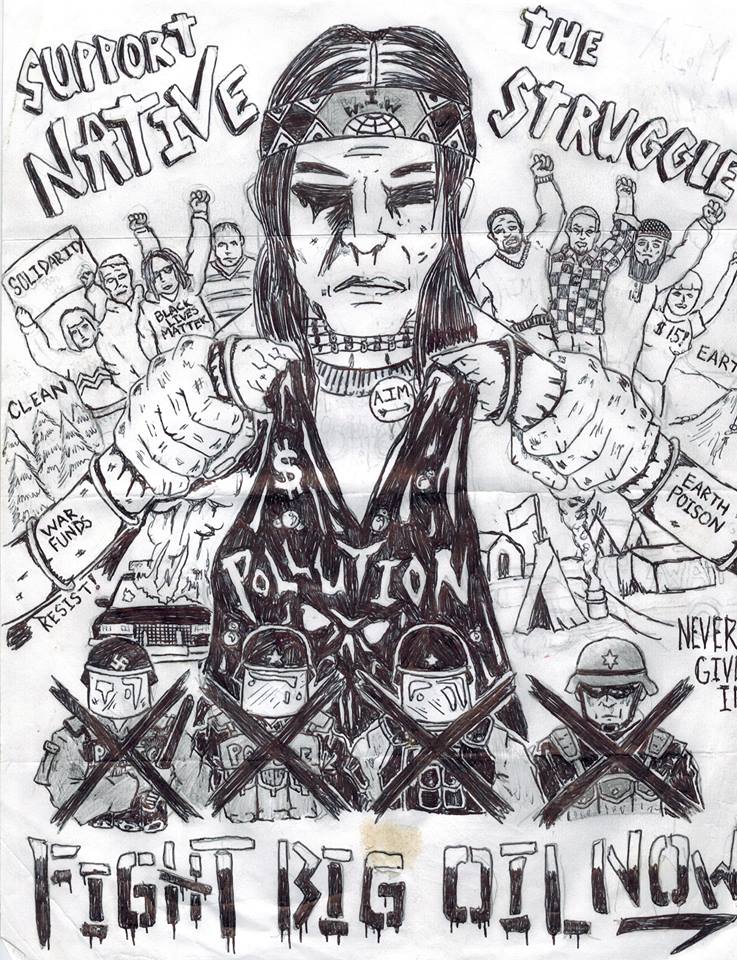
Twin Cities IWW Resolution in Solidarity with Camp Makwa and the movement for environmental justice

Adopted Unanimously by the Twin Cities IWW General Membership Branch - December 5, 2017
Whereas: On March 3rd 1991 the Line 3 pipeline caused the largest inland oil spill in US history, rupturing in Grand Rapids, Minnesota spilling 1.7 million gallons of oil into the Prairie River; and

Whereas: In July 2010, Enbridge also spilled about a million gallons of Dilbit Oil in the Kalamazoo River when the Line 6B pipeline burst and flowed into the Talmadge Creek and then the Kalamazoo before the the spill was contained. On 29 July 2010, the Calhoun County Health Department asked 30 to 50 thousand households to evacuate, and twice as many were advised not to drink their water. Union workers cleaning up the Kalamazoo Spill have spoken against Enbridge for insufficiently cleaning up the spill which has resulted in birth defects, illness, cancer and death of both humans and animals in the area of the disaster; and

Whereas: In 2007, 2 Enbridge workers were killed in Clearbrook, Minnesota when a pinhole leak explosion sparked a huge fire and spilled 15,000 gallons of oil. Enbridge let the spill burn for three days poisoning the air of the surrounding community; and

Whereas: The Oil Industry and many other unsustainable industries sacrifice the health and safety of the working class and poor communities, especially many indigenous and communities of color. These communities are subject to environmental racism and classism and often ignored and violated during the permitting process of such projects; and

Whereas: These communities often are forced to defend themselves with direct action which puts them at greater risk of violence and incarceration from the state and private security; and

Whereas: The construction of these pipelines will contribute to the acceleration of already dangerous levels of currently existing greenhouse gas emissions which are contributing to the already dangerous effects of climate change, which could lead to a dead planet with no jobs; and

Whereas: Camp Makwa was established in August of 2017 to resist the pipeline using direct action to protect the water and natural resources such as the wild rice lakes, fishing and hunting, and farming that the Anishinaabe Tribe and working class in the area depend on. They have taken several direct actions to shut down construction of the Line 3 pipeline in Superior, Wisconsin and will resist the possible expansion in the spring. They are currently still camping during the harsh Minnesota winter.

Whereas: Neither the Line 3 Pipeline Dakota Access Pipeline, or the Keystone XL Pipeline will provide anywhere near the number of permanent union jobs the promoters of these projects promise they will, and

Whereas: More permanent union jobs can be created at union wages by decommissioning oil pipelines and upgrading water pipeline infrastructure, such as in Flint, Michigan. LIUNA and many labor unions currently have jobs working in the renewable energy sector such as solar, wind, and hydroelectric and could organize for a rapid transition of energy production and manufacturing to be safe for the workers, the surrounding communities and the environment. Though these renewable energy jobs are currently, typically non-union, trade unions if so determined, could easily develop a successful green energy organizing program, using solidarity unionism, that would revitalize the currently struggling labor movement. Far more jobs currently exist in the growing renewable energy sector than in the declining fossil fuel sector. Also these pipeline projects will not deliver the promised "energy security" or "energy independence" promised by their promoters, including the Building Trades and AFL-CIO Union officials among them and;

Whereas: Many unions, including the IWW, ILWU, ATU, APWU, LIUNA-City Employees Local 236, CWA, UE, SEIU, NNU, Pride at Work, A. Phillip Randolph Institute, the Asian Pacific American Labor Alliance, the Coalition of Black Trade Unionists, the Coalition of Labor Union Women, the Labor Council for Latin American Advancement, Labor for Standing Rock, and many members of other Labor organizations have already publicly stated opposition to the Dakota Access Pipeline and or the Keystone XL Pipeline; and

Whereas: President Donald Trump's executive orders that dismantle environmental regulation and ostensibly "clear a path" for the completion of the aforementioned pipelines are contradictory in nature and are designed primarily to divide workers and environmentalists over the false dichotomy of "jobs versus the environment"; and

Be Resolved that: The Twin Cities IWW reaffirms the IWW’s opposition to the construction of the Dakota Access Pipeline and the Keystone XL Pipeline as well as officially declares its opposition to the construction of the Line 3 Pipeline; and

Be it Also Resolved that: The Twin Cities IWW donates $100 each to both Camp Makwa’s legal and supply fund (Legal | CAMP SUPPLIES FUND) and urges our Union’s members, the Labor Movement, and working class to pass resolutions like this one, donate, join, and organize in solidarity with Camp Makwa, the resistance to Line 3, and the movement for environmental justice, locally and abroad.

Be it also Resolved that: The Twin Cities IWW endorses Black Snake Killaz Circuit, a collection of benefit shows created by organizers, artists, and eco-activists who are standing in solidarity with indigenous water protectors and their accomplices fighting Line 3 to defend Anishinaabe land and water from the extractive industry; and

Be it Further Resolved that: The Twin Cities IWW calls on rank and file members of the Building Trades, Teamsters, and other unions who have declared support for these pipelines and other unsustainable projects to implement Green Bans and take direct action by striking and or slowing down in solidarity with the communities resisting Line 3, additional pipelines, and other projects that are exploitive of the working class and the plant we inhabit.

Be it Additionally Resolved that: The Twin Cities IWW calls on the working class, unions, and the unsustainable companies that employee them, such as Enbridge, as well as their financial supporters to develop and rapidly implement a "Just Transition" plan for workers in unsustainable industries, such as pipeline and oil industry workers, to be trained in and given union jobs in the green energy sector. ; and

Be it Finally Resolved that: The Twin Cities IWW reaffirms our belief and commitment to revolutionary industrial unionism, environmental justice, and community self-defense with our goal to “organize as a class, take possession of the means of production, abolish the wage system, and live in harmony with the Earth.”

Why Redneck Revolt Says Deal With Racism First, Then Economics

By Zenobia Jeffries - Yes! Magazine, November 29, 2017

Moved by the need for control, for an unchallenged top tier, the power elite in American history has thrived by placating the vulnerable and creating for them a false sense of identification—denying real class differences where possible.
—Nancy Isenberg, White Trash: The 400-Year Untold History of Class in America

There is no shortage of media commentary discrediting “identity politics,” particularly the focus on Black, Latinx, LGBTQ, and immigrant communities calling for justice and equity. Economics is our real problem, a counter argument goes, not race, sex, gender, citizenship. But as author Nancy Isenberg points out in White Trash, “identity has always been a part of politics.”

Laws have been written to oppress and exploit particular identities—Native Americans, Black Americans, Asians, homosexuals, transgender, and women—in a successful effort to maintain a system of White supremacy. Yet, members of these communities have worked for the rights and equality of everyone. In turn, White allies have joined in these anti-racism fights.

The Redneck Revolt is one such organization. The self-described anti-capitalist, anti-racist, anti-fascist group challenges working-class White people to stand against White supremacy.

I recently talked to Brett, one of the members who heads up the network’s Southeast Michigan Chapter. (Because of hostilities toward the organization, Redneck Revolt members use only their first names publicly.) There are about 40 chapters nationwide. He explained why the group focuses on anti-racism rather than economics even though it seeks out white working-class and poor people in economically struggling rural areas.

¿Quién le puso una bomba a Judi Bari? / Who Bombed Judi Bari? (Spanish Subtitles)

By Darryl Cherney - YouTube, November 27, 2017

Premiering on youtube and winner of 6 awards, this feature documentary filled with music, humor, and inspiration is a blueprint for activism in these more than urgent times. The Martin Luther King of the Redwoods, Judi Bari was an Earth First!er, AFL-CIO and IWW labor organizer, radical feminist, world class orator, author of Timber Wars, fiddler and songwriter, fundraiser, mother of two girls and a force of nature. See why she was car bombed and arrested by the FBI and Oakland Police for the deed done against her. Then learn how to save the forests, forge alliances and beat the feds. Foreign subtitles coming soon. Produced by her organizing partner and fellow car-bomb victim and litigant, Darryl Cherney. Directed and edited by Mary Liz Thomson. You can learn more and purchase DVD's, t-shirts and bumper stickers here: http://whobombedjudibari.com/ You can "like" us on Facebook at https://www.facebook.com/Who-Bombed-J...

Youth encircle Tagami’s Rotunda building to launch #DeCOALonize Oakland boycott

By staff - No Coal in Oakland, November 21, 2017

“We are the children-
The mighty, mighty children!”

This chant rang out as about 80 people encircled the Rotunda Building, half of them young people, mostly of elementary school age, with placards proclaiming “Boycott the Rotunda,” “Youth vs. Coal,” and “DeCOALonize Oakland.”

“Hey hey ho ho
Dirty coal has got to go.”

The practice picket line was part of the November 21 DeCOALonization action organized by young people, with support from Climate Workers and other groups including No Coal in Oakland. This was a launch of the boycott of the Rotunda Building: asking organizations—particularly social justice nonprofits—to stop using the event venue owned by Phil Tagami and to notify him that they are boycotting this space until he drops his lawsuit aiming to reverse Oakland’s ban on coal.

Speakers included several youth, with messages about the dangers of pollution and—considering that Thanksgiving is approaching—support of Indigenous people. Labor was also represented by a speaker from Unite HERE Local 2850, which organizes hospitality workers. She pointed out that the Rotunda Building uses non-union labor and encouraged groups to find a unionized event space through fairhotel.org.

After picketing, the demonstrators enjoyed a meal that included soup and corn bread prepared by the activist youth. In contrast to the fancy events in the Rotunda, the demonstrators fed community members who came up to the tables clearly in need of good nutrition.

If you want to help contact organizations about the boycott, please e-mail NoCoalInOakland [at] gmail [dot] com.

Photo credit: Sunshine Velasco from Survival Media Agency

The Spotted Owl or: How the Right Won the Working Class

By staff - Cited, November 17, 2017

Judi Bari’s effort to ally forest workers and environmentalists could have changed the course of climate activism forever. Could her parable help us today? 

Cited teams up with Dissent’s Hot and Bothered podcast and the Pacific Institute for Climate Solutions to tell the story of tree spiking, a Texas millionaire, and the Northern Spotted Owl.

In this hour we look at the jobs vs. environment problem and explore how forest management might be able to mitigate climate change on a massive scale. with documentary filmmaker Mary Liz Thomson, University of Oregon sociology professor John Bellamy Foster, and independent forester Herb Hammond.

Listen to the podcast here.

Prison Drinking Water and Wastewater Pollution Threaten Environmental Safety Nationwide

By John E. Dannenberg - Prison Legal News, November 15, 2017

Aging infrastructure concerns are not limited to America's highways, bridges and dams. Today, crumbling, overcrowded prisons and jails nationwide are bursting at the seams -- literally -- leaking environmentally dangerous effluents not just inside prisons, but also into local rivers, water tables and community water supplies. Because prisons are inherently detested and ignored institutions, the hidden menace of pollution from them has stayed below the radar. In this report, PLN exposes the magnitude and extent of the problem from data collected over the past several years from seventeen states.

Alabama

The Alabama Department of Corrections (ADOC) has been ignoring complaints of wastewater pollution from its prisons since 1991. Back then, the problem was limited to leaking sewage from the St. Clair prison. Although the Alabama Legislature promised to provide the $2.3 million needed to build a new wastewater treatment plant that would match St. Clair's vastly expanded population, no money has been appropriated.

Today, the problem has grown statewide and includes pollution from ADOC's Draper, Elmore, Fountain/Holman, Limestone prisons and the Farcquhar Cattle Ranch and Red Eagle Honor Farm. The problem has drawn the ire of the private watchdog group, Black Warrior Riverkeeper (BWR) and of the state Attorney General (AG), both of whom have filed lawsuits against ADOC. The AG's office claims ADOC is violating the Alabama Water Pollution Control Act (Act) by dumping raw sewage into Little Canoe Creek, from which it flows into the Coosa River. The AG has demanded that ADOC fix the problems and pay fines for the damage they have caused. All parties acknowledge that the problems stem from ADOC's doubling of its population to 28,000, while the wastewater treatment facilities were designed for less than half that number.

The environmental damage is huge. ADOC is pumping extremely high levels of toxic ammonia, fecal coliform, viruses, and parasites into local streams and rivers. When raw sewage hits clean water, it sucks up the available dissolved oxygen to aid decomposition. But in so doing, it asphyxiates aquatic plants and animals that depend on that oxygen.
Telltale disaster signs include rising water temperatures and the appearance of algae blooms. The pollution renders public waterways unfit for human recreation as well.

BWR notes in its suit that Donaldson State Prison has committed 1,060 violations of the Clean Water Act since 1999, dumping raw sewage into Big Branch and Valley creeks, and thence into the Black Warrior River. BWR seeks fines for the violations, which could range from $100 to $25,000 each. Peak overflows were documented at 808,000 gallons in just one day, which isn't surprising for a wastewater treatment plant designed to handle a maximum of 270,000 gallons per day. Donaldson, designed to hold only 990 prisoners, has 1,500 today.

One path to reformation was found in turning over wastewater treatment to privately-run local community water treatment districts. Donaldson came into compliance with its wastewater permit after contracting with Alabama Utility Services in 2005. Limestone and other ADOC prisons are now seeking privatization solutions.

Unions, Trade and Nationalism

By Tom Crofton - CounterPunch, October 31, 2017

A recent statement from the AFL-CIO regarding a rejection of NAFTA and other corporate/globalist trade agreements unfortunately only skims the surface of the issues working people face.

As the dominate union leadership in America, the AFL-CIO and its member unions need to take a deeper look at their historical behavior, and their role in enabling the evolution of the corporate state with its current right wing/anti labor swing.

American unions never were interested in taking responsibility for production. American unions developed to confront management but not to replace it. The Industrial Workers of the World (IWW) was the only organization that tried to organize horizontally across all sectors to create a “new world in the shell of the old”. The vision of workers building a society where prosperity was available to all and artificial class barriers would dissolve was never a popular theme in American labor. We have always felt that we needed the owners, agreeing at least subliminally that capital has more power than basic human needs; that human weakness, pettiness, and laziness would wreck any sort of money-free effort to exchange services; that hierarchies of wages and benefits were natural and that those at the bottom were there due to their own fault.

The evolution of trade unions cemented in place these hierarchies, leaving the least skilled workers unorganized until the CIO attempted to fill the need while organizing mine workers and African Americans during the Great depression. The following era of war-induced prosperity, and the ongoing economic expansion during the Cold War, created a phony, unsustainable sense of American prosperity for a growing middle class, where 5% of the world’s population consumed 80% of its resources. The AFL-CIO was active in this period wrecking third world union organizing attempts as a front for a CIA run, right-wing sponsored, American style Imperialism. On the home front, a rising middle class of workers were happy to build low quality products, for good wages, as the disposable society offered an endless supply of the “latest” consumer goods. Conspicuous consumption and keeping up with the Jones’s did not include the working poor or the third world.

One Big Union, One Long Fight

By Robert Young - Monthly Review, November 2017

The Wobblies, a film directed by Stewart Bird and Deborah Shaffer (1979; Docurama, 2006), 89 minutes, color, DVD.

Fred W. Thompson and Jon Bekken, The Industrial Workers of the World: Its First Hundred Years (Cincinnati: IWW, 2006), 247 pages, $15, paperback.

In recent decades, both the U.S. and global economy have become mired in a prolonged stagnation. As a shrinking number of large corporations dominate a greater share of industries and sectors, business investment has slowed and wage growth has stalled. Although the economy has been on this trajectory for quite some time, a series of financial bubbles has obscured the trend. The collapse of the most recent of these, and the subsequent Great Recession of 2007–09, has laid bare this overall macroeconomic condition, to the point that even mainstream economists such as Larry Summers openly recognize “secular stagnation” as the economy’s dominant course.1

A stagnating economy is most immediately characterized by a general decline in business investment, static or falling wage levels, and deficit spending by governments trying to reignite sustained growth. In the wake of each burst bubble, the economy makes a weak “recovery,” without returning to its earlier strengths.2 Thus, over time, although specific sectors may experience some growth, the overall economy continues to slow in terms of investment, jobs creation, and wage increases, and appears increasingly fragile in each of these spheres.

The longer-term implications of an economy caught in stagnation are quite serious. As the situation continues to worsen, both corporations and the general public demand that steps be taken to stimulate economic growth. Politically this pressure has yielded two possible—and very distinct—paths. The first is a sharp turn to the right, as has happened in the United States and elsewhere in the advanced capitalist core. This reactionary tendency scorns liberal democracy as weak and inefficient, embracing chauvinist and conservative attitudes and vilifying the poor and marginalized. The other path is a shift to a more progressive politics based upon solidarity, community, and innovation, one that seeks to remake the economy on new foundations of justice and equality.

The stagnation in real wages described above has been compounded by a historic decline in job security, as flexible employment, temporary work, informal labor, and short-term contracting replaced steady, full-time, “family-wage” work. Together, these factors are transforming great swathes of the workforce into a newly precarious proletariat, or a “precariat”: not an “underclass” of the unemployed or unemployable, but people with job experience, education, and some assets, who must often work several part-time positions to make ends meet.

The question, then, is how to organize politically and economically to revive economic growth and strengthen equity, fairness, and democracy, and how is this to be done in the face of an increasingly globalized, monopolistic economy with a fragmented, precarious workforce. After decades of declining union membership among U.S. workers, where should we seek effective strategies for organizing the unemployed and under-skilled?

The best starting place might be the earlier labor history of the United States. Before the establishment of the National Labor Relations Board, sanctioned collective bargaining, and other labor legislation, the country’s situation at the turn of the twentieth century was strikingly similar to today’s. Corporations were growing exponentially in political and economic strength. Workers were largely unorganized, especially those without specialized skills, and unions, however active, represented only a small fraction of the workforce. Unorganized workers often had to work on short contracts or with no job security at all—a tableau not unlike the conditions facing many workers today.

Into this highly precarious situation stepped the Industrial Workers of the World (IWW), whose history and experience offer insight into how to grapple with these problems today. Founded in Chicago in 1905 by a veritable who’s-who of the era’s leading labor militants, including Mother Jones, Eugene Debs, and “Big Bill” Haywood, the IWW sought to build “One Big Union,” uniting workers across industries and sectors as a counterforce to an emerging monopoly capitalism. The key to this strategy was to organize industrially, as opposed to the then-dominant practice of organizing workers on the basis of specific crafts, the approach promoted by the American Federation of Labor (AFL). The IWW (or Wobblies, as they became known) saw the self-defeating nature of the AFL strategy: when workers were organized by craft under separate contracts, employers often pitted one group of workers against another. AFL activists also sought only to organize skilled workers, leaving the vast majority of the workforce out of the equation.

True to their vision, the Wobblies set out to organize any and all members of the working class, skilled and unskilled, in manufacturing and service industries, black and Latino as well as white, women as well as men. To do so, IWW activists lit out across the country (and eventually around the world) organizing workers wherever the jobs were. From logging and mining operations in the Pacific Northwest and Great Basin, to the dock yards along the east and west coasts, to the auto industry, wheat fields, and orchards of the Midwest, the Wobblies began agitating for higher wages, safer and more dignified working conditions, and ultimately industrial democracy.

Youth and Workers Zombie March Against Coal in Oakland

By staff - Climate Workers, October 30, 2017

HUNDREDS OF YOUTH, WORKERS TO MARCH ON DEVELOPER PHIL TAGAMI’S HOUSE, DEMAND HE DROP LAWSUIT TO BUILD COAL TERMINAL IN OAKLAND; Covered in “Coal Dust,” Unions, Youth Will Hold Halloween Carnival Outside Tagami’s House

CONTACT: Brooke Anderson - 510-846-0766, brooke@climateworkers.org

What: A day before Halloween, high school students and union members from across Oakland will lead a “Zombie March on Coal” to the home of Oakland developer Phil Tagami to protest his attempt to overturn Oakland’s 2016 ban on the storage, handling, and transport of coal through the city. Youth plan to hold a Halloween street carnival outside Tagami’s house to educate about coal’s role in driving both climate and public health crises and to celebrate the resilience and determination of young Oaklanders.

When:  4:30 PM. Monday, October 30, 2017.

Where: Corner of Mandana Blvd. and Carlston Ave. in Oakland, CA.
March will leave at 5PM for Phil Tagami’s house (1012 Ashmount Ave, Oakland).

Visuals: Banners, youth in Halloween costumes, union members and marchers covered in “coal dust,” musicians & band, Halloween street carnival including: coffins and tombstones, face painting, reading circles, games and activities.

Oakland City Council banned coal in June of 2016.Tagami is now suing the city over this decision. At a moment when Oakland has been experiencing extremely poor air quality due to the North Bay fires, those who live and work in the city are saying no to Tagami’s plans to further pollute the air and poison Oaklanders lungs. Young people are refusing to accept dirty air in their city. Tagami promised the terminal would create jobs, but by suing the city over coal, he’s now holding up these jobs from coming to Oakland. The marchers will demand that Tagami drop his lawsuit and make the right choice: a thriving, healthy Oakland.

People will gather a few blocks away from Tagami’s house and march, setting up a youth-led Halloween street carnival. This march and carnival is organized by Climate Workers, and co-sponsored by 20+ youth, labor, and environmental justice organizations in Oakland.

For more information: No Coal in Oakland

It’s Time for Disaster Communism

By Rahula Janowski - The Indypendent, October 13, 2017

The fires here are still uncontained. Over 8,000 people have already lost everything and while I pray that no one else loses their home or is harmed in the fires, that looks unlikely. Where are all these people supposed to go? There is no affordable housing here in the Bay area.

It’s time for some disaster communism, disaster socialism, some disaster anarchism. We know the speculators are drooling and champing at the bit right now. There are so many ways for them to make a profit from a tragedy. If we move forward in an individualist way, in a capitalist way, each family’s loss and struggle will be theirs alone. It will be horrific. It will not end well for anyone except those for whom things always end well, those who can use money to wipe their butts but never have a dime to spare.

What if we took a different route?

What if we expropriated every housing unit in San Francisco that is currently unoccupied for all but two vacation weeks a year and housed people whose homes in from Santa Rosa were incinerated? What if every illegal Airbnb unit was handed over to displaced families? What if law enforcement came under immense public pressure to ignore property laws and refused to evict squatters?

The 600-foot Millennial Tower in San Francisco has made headlines as it slowly sinks and leans by the centimeter against the skyline. The minuscule tilt has sent wealthy condo owners dialing their attorneys. But maybe, for those displaced, life in a leaning tower will be better than a shelter, a chance to experience a little lopsided luxury for a while?  

What if we socialized our housing or, at a minimum, all our unoccupied housing?

The possibilities are endless and it’s time. It’s time to shift gears. I mean, it’s been time. If the bankers, developers, landlords, the capitalists who have done so much harm already can see this crisis as an opportunity, maybe we should too — a chance to build a new world from the ashes of the old.

Pages

The Fine Print I:

Disclaimer: The views expressed on this site are not the official position of the IWW (or even the IWW’s EUC) unless otherwise indicated and do not necessarily represent the views of anyone but the author’s, nor should it be assumed that any of these authors automatically support the IWW or endorse any of its positions.

Further: the inclusion of a link on our site (other than the link to the main IWW site) does not imply endorsement by or an alliance with the IWW. These sites have been chosen by our members due to their perceived relevance to the IWW EUC and are included here for informational purposes only. If you have any suggestions or comments on any of the links included (or not included) above, please contact us.

The Fine Print II:

Fair Use Notice: The material on this site is provided for educational and informational purposes. It may contain copyrighted material the use of which has not always been specifically authorized by the copyright owner. It is being made available in an effort to advance the understanding of scientific, environmental, economic, social justice and human rights issues etc.

It is believed that this constitutes a 'fair use' of any such copyrighted material as provided for in section 107 of the US Copyright Law. In accordance with Title 17 U.S.C. Section 107, the material on this site is distributed without profit to those who have an interest in using the included information for research and educational purposes. If you wish to use copyrighted material from this site for purposes of your own that go beyond 'fair use', you must obtain permission from the copyright owner. The information on this site does not constitute legal or technical advice.

