You are here

climate change

Strike! for Climate Justice

By Jeffrey Free Luers - Strike for Climate Justice, March 20, 2009

Disclaimer: The views expressed here are not the official position of the IWW (or even the IWW’s EUC) and do not necessarily represent the views of anyone but the author’s. Note that this call wasmade five years ago, but is still entirely relevant today.

Twenty years ago governments of the world met for the first ever climate talks. The talks, then, focused largely on the growing hole in the world’s ozone layer (a hole that still exists today) and the need to eliminate CFC emissions (which also still exist today though in much smaller amounts). The other climate item on the agenda was global warming. Scientists warned that there was growing evidence that the world was warming, possibly due to human activity much like the root cause of the ozone hole.

Unfortunately, in 1988 it was decided that global warming did not pose a significant threat to warrant action. The problem could wait to be addressed.

Nearly a decade later, in 1997, the governments of the world met for their annual climate talks in Kyoto, Japan. The United Nations Intergovernmental Panel on Climate Change (IPCC), a panel of the world’s leading scientists from countries around the globe, presented growing evidence that the world faced a severe threat from climate change. These scientists concluded that the single largest contributor to climate change were human greenhouse gas emissions, most notably carbon dioxide (CO2).

For the first time since the inception of the climate talks, world leaders agreed action was needed to combat climate change. The world took notice with a collective gasp as 180 governments pledged their support to a worldwide climate treaty to reduce CO2 emissions in an effort to conquer global warming.

In 2007, a decade after Kyoto and twenty years since the first climate talks, the IPCC declared in its strongest language yet that the world faced imminent global catastrophe unless immediate and drastic action was taken to reduce and then eliminate greenhouse emissions.

In the years following the Kyoto protocol, the United States – the highest emitter of greenhouse gases per capita in the world – pulled out of the treaty. CO2 emission around the world continued to rise. Governments that had promised to reduce emissions failed to impose strict limits, instead relying on voluntary cuts from industry. As industries refused to limit their emissions and governments balked at regulation, the Kyoto protocol collapsed.

The U.S. and numerous other countries with high greenhouse emissions have steadfastly refused to cut CO2 emissions, claiming that doing so would harm their ability remain economically competitive.

In the face of the largest economic collapse in world history, brought about by the very same green, deceit and malfeasance of the worlds most powerful multinational and government deregulation that has allowed CO2 emissions to go unchecked. Government and corporate claims that reducing emissions would create economic hard ring hollow.

People around the world put faith in our governments and institutions to act on our behalf and in our best interests. Our governments have had 20 years to act on global warming and climate change. 20 years to act on a threat that the world’s leading scientists say is the greatest threat to human kind the world has ever faced.

A deal to save the planet - or to wreck it?

By Jonathan Neale - Campaign Against Climate Change, November 15, 2014

Disclaimer: The views expressed here are not the official position of the IWW (or even the IWW’s EUC) and do not necessarily represent the views of anyone but the author’s.

Obama of the United States and Xi of China have signed a bilateral climate agreement.

Much of the American and British media, and many Democrats in America, have hailed the deal as a key step forward. Many American Republicans have attacked it as going much too far. 

Anything the Republicans attack has to be good. Right? No. In fact it is an appalling deal. 

Let's look at the numbers.

The US has agreed to cut greenhouse gas emissions by 28% below 2005 levels by 2030. But 2005 was the highest year ever for US emissions. They have already declined 10% in 8 years. Obama is promising that they will decline another 18% in 15 years. 

China has agreed to reach peak emissions by 2030. Chinese economic growth has been running 10% a year. If that growth continued, Chinese emissions in 2030 would be four times what they are now. But economic growth will not continue at that level, and there will be some progress in energy efficiency. Still, this is a promise to roughly double Chinese emissions by 2030.

The US and China between them produce almost half the world's CO2 emissions (45%). If the US cuts 18% and China doubles emission, their combined emissions will increase by more than a third. 

But it's worse. Because even if they cut emissions in half, they would still be increasing the amount of CO2 in the air each year. They would be warming the planet. Instead, they are increasing the amount of CO2 they put in the air each year. They are promising to warm the planet faster each year.

Climate politics at a dead end – How to build a new road

By Patrick Mazza - Cascadia Planet, November 13, 2014

Disclaimer: The views expressed here are not the official position of the IWW (or even the IWW’s EUC) and do not necessarily represent the views of anyone but the author’s.

Climate politics is dead-ended. 

It may seem strange to make such a statement in the wake of the much-heralded U.S.-China climate deal announced November 12.  So let me clarify.

President Obama did announce the intent to reduce U.S. carbon emissions 26-28% by 2025, while China said it would peak carbon emissions and generate at least 20% of its energy from non-fossil sources by 2030. 

All well and good, but far from the 6% annual emissions cuts required to hold overall global warming under 2° Celsius, the minimal borderline between climate disruption that is merely severe and that which is utterly catastrophic (though many scientists believe the cutoff is more like 1.5°C). In other words, the U.S.-China agreement represents only a slower road to climate hell.

Okay, but it’s a start, right?

“The agreement with China is a good first step. But we hope it is but a first step because it is not enough to prevent significant climate change,” noted Kevin Trenberth, senior scientist at the National Center for Atmospheric Research.

Unfortunately, it may be the last step possible in the current political environment.  Republican election victories in the U.S. Senate and states around the country have put legislative progress on global warming into a deep freeze.

Exporting US Coal and Carbon Emissions

By Al Engler - Dissident Voice, November 15, 2014

Disclaimer: The views expressed here are not the official position of the IWW (or even the IWW’s EUC) and do not necessarily represent the views of anyone but the author’s.

The governing Liberals in BC and Conservatives in Canada insist that jobs, public revenues and economic growth all depend on expanding fossil fuel exports. Christie Clark’s Liberals won the 2013 BC election promising a future of jobs and rising public revenues based on the export of liquified natural gas.  Now two years later faced with widespread protests and declining oil and gas prices, no LNG project has proceeded.
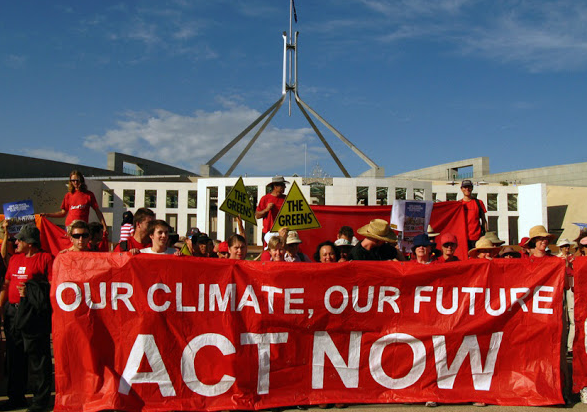
Additional oil pipelines to the Pacific are promoted but only Kinder Morgan is actually proceeding. Here preliminary efforts to double the existing line to Burnaby to carry diluted bitumen from the tar sands have been delayed by blockades and court action. One other project to export to Asia appears to be proceeding; it involves the dirtiest of all fossil fuels: thermal coal.  Port Metro Vancouver, a Federal Agency, has given a permit to ship thermal coal from Fraser-Surrey docks. The coal to be exported is mined in Wyoming and Montana. It is to be transported by rail to the docks, by barge to Texada Island and then by ships to Asia.

This proposal is also facing strong opposition. Fraser-Surrey docks are close to the center of heavily populated Metro Vancouver, directly across the Fraser from New Westminster. The permit is being appealed to the Federal Court by an environmental group, Ecojustice. The City of New Westminster is supporting the appeal as an intervener. City councils in Surrey, Burnaby, and Vancouver have voted to oppose the coal export permit. Communities along the rail route have also expressed their opposition. So has the Sechelt First Nation, whose traditional territory includes Texada Island.

The appeal is expected to argue that proper public hearings were not held;  communities near the port, along the rail lines and shipping lanes were not given fair opportunities to explain their health and pollution concerns. The appeal will make the case that the permit was tainted and should be overturned: Port Metro Vancouver had been instructed by the Harper government not to consider the impact these coal exports would have on global carbon emissions. Why is Canada not bound by international agreements to lower carbon emissions?

IPCC Warning Spurs Union Calls For Energy Democracy

By Sean Sweeney - Trade Unions for Energy Democracy, November 7, 2014

Disclaimer: The views expressed here are not the official position of the IWW (or even the IWW’s EUC) and do not necessarily represent the views of anyone but the author’s.

On November 2, 2014, the Intergovernmental Panel on Climate Change (IPCC) released its Synthesis Report, the final in the “Fifth Assessment Report” process. It builds on three reports released by the IPCC since early 2013.

The IPCC is a senior UN panel made up of thousands of climate scientists and this report marks its fifth ‘assessment’ since 1990 of the state of the climate and the present and future impacts of global warming.

The Synthesis Report reiterates what the IPCC has been telling us for a decade or more: “Climate change is being registered around the world and warming of the climate system is unequivocal. Since the 1950s many of the observed changes are unprecedented over decades to millennia.” The period from 1983 to 2012 was likely the warmest 30-year period of the last 1,400 years in the Northern Hemisphere. Atmospheric concentrations of carbon dioxide, methane and nitrous oxide are “unprecedented in at least the last 800,000 years”.

The report may be the same as previous IPCC reports in terms of the main messages and conclusions, but one thing is different. The 20 years of political inaction around climate, with its sad mixture of back-slapping and back stabbing by negotiators at scores of summits and meetings, has now created a situation where only bold and transformative interventions offer any hope of controlling runaway global warming. Even relatively conservative commentators and analysts now accept this to be true. Among the most important of these interventions involves expanding and deepening social ownership and democratic control of the world’s energy systems—energy democracy. This is needed in order to facilitate an energy transition from fossil-based power to renewable energy, a transition of sufficient speed and scale to be able to seriously address the climate crisis.

Among those embracing energy democracy are a growing number of unions working in partnership with allies in different social movements. Not all unions are convinced that energy democracy is either desirable or possible—especially given the political and economic power of the oil, coal and gas companies. And those unions either supporting the idea or at least open to it are engaging in serious discussions regarding what energy democracy would look like and how it could, alongside addressing pollution and emissions, also seriously address energy poverty, create jobs and advance equality. But everyone involved in the trade union debates on climate change accepts that ‘business as usual’ is simply not an option and the energy system has to be transformed within two or three decades. The IPCC’s report has again sounded the alarm about climate change, but we cannot evacuate the building because we have nowhere else to go.

Rick Berman Exposed in New Audio; Hear His Tactics Against Environmentalists and Workers' Rights

By Lisa Graves - P.R.Watch, October 30, 2014

Disclaimer: The views expressed here are not the official position of the IWW (or even the IWW’s EUC) and do not necessarily represent the views of anyone but the author’s.

Ecology.IWW.ORG Editor's Note: The recently revealed news about Rick Berman's playbook of dirty tricks aimed at anti-fracking climate activists should come as no shock. Berman is well known for his virulent anti-union and anti-consumer astroturf websites, but he is only one of the more outspoken capitalist commissars, of which there are many. If any more proof is needed that environmental activists and workers have a common adversary in the capitalist system, this should more than suffice:

Rick Berman, the king of corporate front groups and propaganda, has been caught on tape detailing his attacks on public interest groups in the labor and environmental movements, including on efforts to increase the minimum wage for workers.

As noted in a new story by Eric Lipton at The New York Times, Berman met with energy company executives at the posh Broadmoor Hotel earlier this year to raise money from them to attack groups representing citizens concerned about clean water, clean air, and the future of the planet. But Berman's "win ugly" tactics apparently did not persuade all of his prospective clients for his lucrative business of creating tax-exempt non-profit front groups that then contract with his for-profit PR firm to give corporations cover for his attacks on their opponents. The way Berman profits from this arrangement has spawned a legal complaint to the IRS.

An audio tape of Berman and his associate, Jack Hubbard, has been provided by a person at the Broadmoor event to the Center for Media and Democracy, which publishes PR Watch and has long tracked Berman's deceptive PR operations.

Readers can listen to the full tape here and read the transcript here.

The IPCC Report: Between Nightmare and Revolution

By Daniel Tanuro - Climate and Capitalism, November 6, 2014

Disclaimer: The views expressed here are not the official position of the IWW (or even the IWW’s EUC) and do not necessarily represent the views of anyone but the author’s.

The International Panel on Climate Change has now published its fifth Synthesis Report along with a Summary for Policy Makers. The diagnosis is no surprise:
  • Global warming is advancing. It is mainly caused by burning fossil fuels, and the negative consequences are more important than the positive effects.
  • It is probably still possible to avoid an average temperature increase  of more than 2°C compared to the pre-industrial period, but the policies followed for the last twenty years will lead to a warming of between 3.7 and 4.8 °C (between 2.5 and 7.8 °C, taking uncertainty into account) and “high risk of severe, widespread, and irreversible impacts globally.”

A palpable concern

The evaluation made in this fifth report is not fundamentally different from previous ones, but the confidence level of the warning is greater. Some areas of uncertainty are becoming clearer and the authors’ concern is more obvious than ever.

The phrase “virtually certain” (more than 99% probability) is used more and more in describing the likelihood this or that phenomenon. For instance, several centuries of melting  permafrost and rising sea levels are now considered “virtually certain,” even if emissions are drastically reduced,

Behind the “objective” scientific tone of the report, the IPCC is clearly sounding an alarm. The experts’ concern is palpable. This is particularly apparent in the fact that the summary for policy makers contains a section on the increased risk of “irreversibility and abrupt changes” beyond 2100. For example, we read that “The threshold for the loss of the Greenland ice sheet over a millennium or more, and an associated sea-level rise of up to 7 m, is greater than about 1°C but less than about 4°C of global warming.” So limiting the temperature rise to 2°C does not completely eliminate the risks of very profound changes to Earth’s ecosystems. [2]

Burkina Faso: Masses Rise Up Against Neo-Colonial Rule: Thousands hold signs and wear t-shirts honoring the revolutionary legacy of Thomas Sankara

By Abayomi Azikiwe - Global Research, November 4, 2014

Disclaimer: The views expressed here are not the official position of the IWW (or even the IWW’s EUC) and do not necessarily represent the views of anyone but the author’s.

Hundreds of thousands of people in Burkina Faso have forced the longtime imperialist-backed leader, President Blaise Compaore, to resign amid mass demonstrations and rebellions in several cities across the West African country. Compaore took power in a French-supported coup on Oct. 15, 1987 against revolutionary Pan-Africanist and socialist leader Capt. Thomas Sankara. 

Several political parties and movements that are seeking to reclaim the legacy of Sankara were very much in evidence during the unrest that reached a critical point on Oct. 30 when thousands stormed the parliament building and setting it alight. The legislative body was set to vote on a motion to extend the 27-year rule of Compaore, who although coming out of the military, ran for office repeatedly as a civilian candidate.

Compaore sought to reassert his authority by refusing to formally resign from the presidency until the evening of Oct. 31. Gen. Honore Traore announced after the rebellion on Oct. 30 that he was assuming power and dissolving parliament.

Immediately people within the various opposition parties began to object to the leadership of Traore. The following day Nov.1, yet another military leader emerged claiming to be in charge.

This time it was Lt. Col. Isaac Zida, the deputy commander of the elite presidential guard. Media reports emanating from Burkina Faso said that the military had endorsed the leadership of Zida.

After meeting with foreign diplomats on Nov. 3, Zida said that the military would hand over power to a civilian transitional authority which is acceptable to the people of the country. If the military leader does not move swiftly in this regard, there could be more violent unrest.

Corporate Conquistadors the Many Ways Multinationals Both Drive and Profit from Climate Destruction

By Philippa de Boissière, et. al. - The Democracy Center, November 2014

Multinational corporations are relentlessly expanding their operations into ever more vulnerable and remote regions of the planet. As they do so they both drive the climate crisis and exacerbate its impacts. They bear responsibility for a global crisis which affects us all, and they bring social and environmental destruction to the local communities where they operate. A further legacy of their oil drilling, industrial mining and mega hydroelectric projects is the erosion of those communities’ resilience just as the impacts of climate change begin to take effect. These same multinationals are also the biggest barrier to meaningful action on climate change, blocking urgently needed regulations and genuine transformational solutions.

Despite this, corporations are gaining increasing access to climate policy-making spaces, both at national and international level, allowing them to put forward their own so-called ‘solutions’. But their market-based techno-fixes are not aimed at tack-ling the crisis at all. Rather, they allow the biggest polluters to line their pockets with public money while continuing with business as usual. Denouncing the connections between corporations and our decision makers, and delegitimising their seat at the table, is crucial if we are to chart a different course.

At the UN climate talks (the UNFCCC), twenty years of negotiating have failed to solve the crisis. This is due, in large part, to the corporate capture of national- level government policy and of the UN process itself. In 2014 negotiators will meet in Peru at the heart of one of the world’s regions most vulnerable to climate change and already one of the hardest hit. In the Amazon and the Andes forests are being destroyed, glaciers are melting and climate patterns are changing at an alarming pace. Communities living in these regions are seeing their natural support systems and means of survival irreversibly damaged.

Read the report (PDF).

Billionaires' Carbon Bomb: The Koch Brothers and the Keystone XL Pipeline

By staff - International Forum on Globalization, November 2014

THE INTERNATIONAL FORUM ON GLOBALIZATION’S earlier report, Faces Behind a Global Crisis: U.S. Carbon Billionaires and the U.N. Climate Deadlock followed the flow of fossil fuels industry funds to find that Charles and David Koch are, in fact, the single largest financiers of efforts to stop the phase out of fossil fuels. This report reveals one reason for their spending: the Kochs’ enormous investments in tar sands could become “stranded assets” if Keystone XL, the Alberta Clipper, and other important infrastructure for tar sands expansion is not approved.

With more money (a combined net worth of $100B) than the world’s wealthiest man, Bill Gates ($86B) the Kochs outspent all other oil companies, even Exxon, in campaign contributions, lobbying expenses, denialist science, and myriad other activities since 1999 to stop solutions to today’s quickening global climate crisis.1 Unprecedented financial wealth combined with the Kochs’ fanatical belief in what they call “economic freedom” made them top spenders in the 2012 and 2014 U.S. elections. The Kochs have spent well over $22 million on traceable campaign donations since 1990, and almost four times that amount—about $76 million—on their lobbying expenditures since 1998 alone. This number does not include the vast sums of dark money moved through their web of influence, as mapped by IFG’s Kochtopus, and monitored by KochProblem.org, online tools to follow the Koch Cash moving through their influence network.

Since the 2010 U.S. Supreme Court ruling on Citizens United, “Koch Cash” has bought a radical faction in Congress that has seized the power of the purse, shrunk government by 8% via the sequestration, and restricted U.S. action on climate to President Obama’s narrow administrative authorities, which the Kochs are currently countering in court. Recent U.S. Supreme Court rulings on Koch-introduced legal cases have involved judges too friendly with the Kochs. These rulings undermine the legitimacy of the Court, the current composition of which is slated to continue to rule in the Kochs’ favor.

Read the report (Link).

Pages

The Fine Print I:

Disclaimer: The views expressed on this site are not the official position of the IWW (or even the IWW’s EUC) unless otherwise indicated and do not necessarily represent the views of anyone but the author’s, nor should it be assumed that any of these authors automatically support the IWW or endorse any of its positions.

Further: the inclusion of a link on our site (other than the link to the main IWW site) does not imply endorsement by or an alliance with the IWW. These sites have been chosen by our members due to their perceived relevance to the IWW EUC and are included here for informational purposes only. If you have any suggestions or comments on any of the links included (or not included) above, please contact us.

The Fine Print II:

Fair Use Notice: The material on this site is provided for educational and informational purposes. It may contain copyrighted material the use of which has not always been specifically authorized by the copyright owner. It is being made available in an effort to advance the understanding of scientific, environmental, economic, social justice and human rights issues etc.

It is believed that this constitutes a 'fair use' of any such copyrighted material as provided for in section 107 of the US Copyright Law. In accordance with Title 17 U.S.C. Section 107, the material on this site is distributed without profit to those who have an interest in using the included information for research and educational purposes. If you wish to use copyrighted material from this site for purposes of your own that go beyond 'fair use', you must obtain permission from the copyright owner. The information on this site does not constitute legal or technical advice.