You are here

climate change

The Global Fossil Fuel Subsidy Scam

By James Plested - Red Flag, May 30, 2015

Disclaimer: The views expressed here are not the official position of the IWW (or even the IWW’s EUC) and do not necessarily represent the views of anyone but the author’s.

Five trillion US dollars annually – that’s how much is being lavished in various forms of subsidies on the global fossil fuel industry, according to a recent report by the International Monetary Fund (IMF). US$10 million a minute – more than the health budgets of every country on earth combined.

We’re told that there’s not enough money for decent health care, education or welfare. But the equivalent of 6.5 percent of global GDP is being poured into an industry that’s driving the world to social and environmental catastrophe.

The shocking findings of the IMF’s working paper, “How large are global energy subsidies?”, are based on calculations of the true cost of fossil fuels when all their destructive environmental, health and other impacts are taken into account – what in economic terms are called “externalities”.

The most obvious of these externalities is climate change. Phenomena such as rising sea levels, increasing intensity and frequency of extreme weather events (droughts, floods, cyclones) and bushfires are already costing the world hundreds of billions of dollars annually.

But even this, according to the IMF’s analysis, is only a small part of it. The larger portion of the hidden costs of fossil fuels relates not to climate change, but rather to more “everyday” impacts such as the negative health effects of air pollution.

Astoundingly, the headline figures coming out of the working paper – subsidies totalling US$4.9 trillion in 2013, rising to US$5.3 trillion this year – are likely to be a significant underestimate. For a start, the IMF based its calculation of the cost of climate change on a highly optimistic US government model. The list of damaging impacts of the fossil fuel industry could also easily be broadened. A strong case could be made, for example, that the cost of wars associated with global competition for fossil fuels should also be included.

EcoUnionist News #51

Compiled by x344543 - IWW Environmental Unionism Caucus, June 9, 2015

Disclaimer: The views expressed here are not the official position of the IWW (or even the IWW’s EUC) and do not necessarily represent the views of anyone but the author’s.

The following news items feature issues, discussions, campaigns, or information potentially relevant to green unionists:

Lead Story:

Fracking the EPA:

Bread and Roses:

An Injury to One is an Injury to All:

Carbon Bubble:

Just Transition:

Other News:

For more green news, please visit our news feeds section on ecology.iww.org; Twitter #IWWEUC

It's Not the End of the World, But a Chance to Confront the Climate Crisis: The Politics of the California Drought

By Arun Gupta - CounterPunch, June 2, 2015

Disclaimer: The views expressed here are not the official position of the IWW (or even the IWW’s EUC) and do not necessarily represent the views of anyone but the author’s.

As if in compensation for a historic drought, California is being deluged by expressions of grim satisfaction that it is finally getting its comeuppance for environmental sins. Judgement was especially swift after California Gov. Jerry Brown imposed a 25 percent reduction in water usage for urban areas. The media asked if this is “The End of California?”, as well as declaring “So Long, California,” and “Dust Bowl 2.0.” One historian of California told the New York Times, “Mother Nature didn’t intend for 40 million people to live here.”

The conceit is nature is punishing humanity in the form of climate-change induced disaster. Except climate change does not appear to be the primary culprit of what is California’s most severe drought in the last 1,200 years. Scientists say the rainfall is “anomalously low—yet not unprecedented.” What’s making the drought exceptionally harsh is the added effect of a warming planet, which is drying out the soil. However, climate change is not a one-way cause and effect. For example, the entire Southwest will be afflicted with more frequent, intense and longer-lasting droughts, but California’s Northern Sierra Nevada watershed “may become wetter and … somewhat less drought-prone” over time.

Like the weather, climate change does not respect borders. The crisis may be most visible in California as reservoirs evaporate and lawns brown, but, as some point out, “this drought is America’s.” As such, the tendency to condemn California tells us more about U.S. society than the natural world. Believing the mega-drought signals the end of California is a form of secular end times.

The mainstream media, while sensationalistic, are more measured than the outlandish predictions found in the conspiratorial corners of the Internet: “California’s food supply to collapse,” “California economy at risk of collapse,” “housing collapse, municipal bankruptcies and a mass exodus of climate refugees.”

Much of the reaction is a mishmash of Christianity and pop culture that’s distinctly American. There is the puritanical disapproval of California’s hedonism. The idea of a cataclysmic rupture draws as much from Hollywood as it does from religious and political thought. Some also believe there will be tribulations, a staple of Sunday sermons and science fiction alike: Everyone who enjoyed the Edenic fruits of California will be thrown into a post-apocalyptic wasteland, and our salvation lies in returning to our eco-communal roots.

The problem with this thinking is imagining the apocalypse to be a singular event rather than a process. The apocalypse is already upon us; we just don’t notice it from our privileged perches. The effect of extreme weather is relatively modest over a continent-sized nation of 319 million. Record floods, hurricanes, and wildfires are caused as much by habitat loss, sprawl, and environmental mismanagement as by a destabilized climate. Add in invasive species, pollution, and deforestation, and this explains why the sixth great mass extinction in Earth’s history is now underway. But because the natural world we depend on is evermore synthetic and managed, we don’t experience this loss in our daily lives. Plus even if we mustered the effort to dial back global warming, there are at least seven other ecological crises degrading the biosphere.

6 Ways to Fight Climate Chaos

By Out of the Woods - Novara Wire, May 24, 2015

Disclaimer: The views expressed here are not the official position of the IWW (or even the IWW’s EUC) and do not necessarily represent the views of anyone but the author’s.

Climate change is an issue so big it can be paralysing. It doesn’t help with the paralysis that proposed solutions tend to be either hopelessly inadequate (change your lightbulbs! buy local!), or hopelessly ambitious (just replace capitalism with global eco-communes!). Out of the Woods is a blog focused on research and theory; obviously, we think that’s important, but it does leave people asking, “OK, but what should we actually do?” In our view, the only meaningful way to fight climate change is to fight the people whose interests and choices are wrecking the climate. In that spirit, here are six ways to become part of the global movement against fossil fuels and climate chaos.

1 Join Blockadia.

From Elsipogtog to Balcombe, a movement Naomi Klein has dubbed ‘Blockadia’ is developing to prevent new fossil fuel extraction. In the case of Elsipogtog this is part of wider indigenous struggles for the land. These kind of struggles have been at their strongest when strong waged through alliances between local residents and environmental activists. Potential ‘Blockadia’ flashpoints in the UK include the ‘new dash for gas’, stopping new coal coming online, and preventing road and airport expansion. With the government opening up large swathes of this country for fracking, Blockadia could be coming soon to a place near you.

2. From divestment to non-cooperation.

We think that divestment campaigns are unlikely to have much impact. This is because many fossil fuel companies are not publicly traded corporations. Those that are don’t typically raise investment capital through the stock market.

That said, divestment campaigns may serve a movement-building function. They have been prominent in universities, where – in the other direction – a lot of funding goes from fossil capital to university research. There are also many cases of curricula tailored to the fossil fuel industry. Divestment campaigns could serve as a springboard to wider demands for non-cooperation with fossil capital. That could start to impact the development of new fossil fuel reserves.

If the world is to avoid climate chaos, new reserves absolutely have to stay in the ground. In fact, at this point the best case scenario is probably mitigating climate chaos. Climate change isn’t a possibility that might happen in the future: it’s happening now and will continue. What we’re fighting over is how fast and how bad climate change will be.

3. Green syndicalism.

‘Green syndicalism’ is a term coined by anarchist organiser-turned-academic Jeff Shantz to describe radical worker-based ecological organising. For example, in the 1970s the Building Labourer’s Federation in Australia implemented ‘green bans’ against ecologically-damaging projects, as recounted in the inspiring film Rocking the Foundations.

Another example is the historic joint ‘Local 1’ of eco-activists Earth First! and revolutionary unionists the IWW, which organised timber workers against the destruction of old growth forest in northern California in the 1990s. Green syndicalist tactics include sabotage, workers tipping off external activists, and activists occupying work sites as a pretext for workers to down tools in unofficial work stoppages.

Elements of these kind of tactics have been used in the UK, such as the McLibel Support Campaign linking up with McDonalds Workers Resistance in the early 2000s, and the occupation of the Vestas wind turbine factory in 2009, following factory-gate agitation by environmentalists. The basic tenet of green syndicalism is that the interests of capital are opposed to those of both workers and the environment. This provides a strong basis for a ‘red-green alliance’, to counter workers and environmentalists being played off against each other in a capitalist ploy of divide and rule.

RTNA Says: "FLOOD THE SYSTEM!"

By RTNA - Rising Tide Portland, May 23, 2015

Disclaimer: The views expressed here are not the official position of the IWW (or even the IWW’s EUC) and do not necessarily represent the views of anyone but the author’s.

Starting this September, Rising Tide North America is calling for mass actions to shut down the economic and political systems threatening our survival.

Already, hundreds of thousands are streaming into the streets to fight back against climate chaos, capitalism and white supremacy.

This wave of resistance couldn’t be more urgent. To stop climate chaos we need a phenomenal escalation in organizing, participation and tactical courage. We need a profound social transformation to uproot the institutions of capitalism, colonialism, patriarchy, and white supremacy, the systems that created the climate crisis. And we need to link arms with allies fighting for migrant justice, dignified work and pay, and an end to the criminalization and brutal policing of black and brown bodies.

We need to #FloodTheSystem.

In the lead up to the United Nations climate talks in Paris, in December, we will escalate local and regional resistance against systems that threaten our collective survival. Together, we will open alternative paths to the failing negotiations of political elites.

This is not another protest. It is a call for a massive economic and political intervention. It is a call to build the relationships needed to sustain our struggles for the long haul. To build popular power along the intersections of race, class, gender and ability. To collectively unleash our power and change everything.

Here in the Pacific Northwest, we are mobilizing locally.  If you want to get involved, let us know.  And if you already know you are willing to take direct action to address the climate crisis and stop the fossil fuel projects in our region, sign the Rising Tide Regional Pledge of Resistance.

See you at the barricades.

Warning from My Future Self (Jean Tepperman and Alfred Twu)

By Jean Tepperman and Alfred Twu - Sunflower Alliance, 2015

In this 34-page comic book for both youth and adults, 16-year-old Gabe Sanchez of East Oakland tells the story of how he and his grandfather time-travel 50 years into the future. His 60-year-old self tells him the story of how climate change has shaped his life: the superstorm that destroyed his home and livelihood, the collapse of California agriculture, and more. But 60-year-old Gabe also shows the many ways people today are fighting to stop fossil fuels and build a green economy. Gabe and Grandpa return to 2016 determined to join the movement for climate justice.
Read the report (PDF).

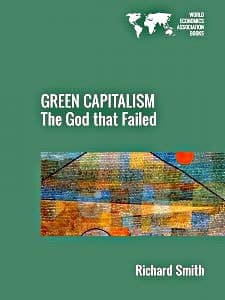
Green Capitalism: the God That Failed

By Richard Smith - World Economics Association - 2015

This book is a collection of five essays that deal with the prime threat to human life on Earth: the tendency of global capitalist economic development to develop us to death, to drive us off the cliff to ecological collapse. It begins with a review of the origins of this economic dynamic in the transition to capitalism in England and Europe and with an analysis of the ecological implications of capitalist economics as revealed in the work of its founding theorist – Adam Smith. I argue that, once installed, the requirements of reproduction under capitalism – the pressure of competition, the imperative need to innovate and develop the forces of production to beat the competition, the need to constantly grow production and expand the market and so on, induced an expansive logic that has driven economic development and overdevelopment, down to the present day.

In successive essays I explicate and criticize the two leading mainstream approaches to dealing with the ecological consequences of this over-developmental dynamic – décroisance or “degrowth”, and “green capitalism”. I show that the theorists and proponents of no-growth or de-growth – like Herman Daly or Tim Jackson – are correct in arguing that infinite economic growth is not possible on a finite planet, but that they’re wrong to imagine that capitalism can be refashioned as a kind of “steady state” economy, let alone actually “degrow” without precipitating economic collapse. There are further problems with this model, which I also investigate. I show that the theorists and proponents of “green capitalism” such as Paul Hawkin, Lester Brown and Frances Cairncross are wrong to think that tech miracles, “dematerialization”, new efficiencies, recycling and the like, will permit us to grow the global economy – more or less forever – without consuming and polluting ourselves to death. I show that while we’re all better off with organic groceries, energy-efficient light bulbs and so on, such developments do not fundamentally reverse the eco-suicidal tendencies of capitalist development, because in any capitalist economy the environment has to be subordinated to maximizing growth and sales, or companies can’t survive in the marketplace. Yet infinite growth, even green growth, is impossible on a finite planet.

In the final essays I argue that since capitalism can only drive us to ecological collapse, we have no choice but to try to cashier this system and replace it with an entirely different economy and mode of life based on: minimizing not maximizing resource consumption; public ownership of most, though not necessarily all, of the economy; large-scale economic planning and international coordination; and a global “contraction and convergence” between the North and the South around a lower but hopefully satisfactory level of material consumption for all the world’s peoples. Whether we can pull off such a transition is another question. We may very well fail to overthrow capitalism and replace it with a viable alternative. That may be our fate. But around the world, in thousands of locations, people are organizing and fighting against corporate power, against land grabs, against extreme extraction, against the incessant commodification of our lives. Here and there, as in Greece and China, ruling classes are on the defensive. All these fights have a common demand: bottom-up democracy, popular power. In this lies our best hope. This little book is intended as more ammunition for that fight.

Read the report (Link).

ITUC calls global union climate summit

By the International Trade Union Congress - Climate and Capitalism, May 18, 2015

Disclaimer: The views expressed here are not the official position of the IWW (or even the IWW’s EUC) and do not necessarily represent the views of anyone but the author’s.

The International Trade Union Congress (ITUC) is hosting an international climate summit for 200 trade unionists from all over the world in Paris on the 14th and 15th of September. The climate jobs campaigns in several countries will be part of the conference, and we urge any trade unionists interested in the idea of climate jobs to come.

The details of the call from the ITUC are:

Trade Union Climate Summit – will you be there?
Paris, 14 – 15 September 2015

Is this you? Climate change is your concern and a just transition to a zero carbon economy is a struggle you are passionate about. Your union has taken a commitment to support climate action and you have plans or ideas for union actions in the fight to ‘decarbonize’ our world.

If you want to come to the conference what you need to do is:

Send an email to Anabella.rosemberg@ituc-csi.org, and include the following:
Your name, your union, and your country.
And indicate that the leadership of your union supports your nomination as a delegate.
There will be some support for a small number of delegates but the support of your union would be necessary.

There are likely to be more than 200 people who want to be delegates. If so, the organizers will select people with an eye to a balance of countries and between the global south and the global north, and get back to you with an invitation by the end of June.

Anarchist Anti-Fascists Join London People's Climate March

By Urban Pictures UK - YouTube, March 7, 2015

Disclaimer: The views expressed here are not the official position of the IWW (or even the IWW’s EUC) and do not necessarily represent the views of anyone but the author’s.

Anti-Fascist & anti-capitalist anarchist protesters - with face masks, dressed in black and waving black & red flags - joined 20,000 people marching through Central London. It was part of a climate rally, an annual demo to highlight the issue of global climate change. They then invaded Parliament Square in defiance of local by-laws.

Food, Farming and Climate Change: It’s Bigger than Everything Else

By Ryan Zinn - Common Dreams, April 13, 2015

Disclaimer: The views expressed here are not the official position of the IWW (or even the IWW’s EUC) and do not necessarily represent the views of anyone but the author’s.

Record-breaking heat waves, long-term drought, “100-year floods” in consecutive years, and increasingly extreme superstorms are becoming the new normal. The planet is now facing an unprecedented era of accelerating and intensifying global climate change, with negative impacts already being widely felt. While global climate change will impact nearly everyone and everything, the greatest impact is already being felt by farmers and anyone who eats food.

When we think of climate change and global warming, visions of coal-fired power plants and solar panels come to mind. Policy discussions and personal action usually revolve around hybrid cars, energy-efficient homes and debates about the latest technological solutions. However, the global agriculture system is at the heart of both the problem and the solution.

Pages

The Fine Print I:

Disclaimer: The views expressed on this site are not the official position of the IWW (or even the IWW’s EUC) unless otherwise indicated and do not necessarily represent the views of anyone but the author’s, nor should it be assumed that any of these authors automatically support the IWW or endorse any of its positions.

Further: the inclusion of a link on our site (other than the link to the main IWW site) does not imply endorsement by or an alliance with the IWW. These sites have been chosen by our members due to their perceived relevance to the IWW EUC and are included here for informational purposes only. If you have any suggestions or comments on any of the links included (or not included) above, please contact us.

The Fine Print II:

Fair Use Notice: The material on this site is provided for educational and informational purposes. It may contain copyrighted material the use of which has not always been specifically authorized by the copyright owner. It is being made available in an effort to advance the understanding of scientific, environmental, economic, social justice and human rights issues etc.

It is believed that this constitutes a 'fair use' of any such copyrighted material as provided for in section 107 of the US Copyright Law. In accordance with Title 17 U.S.C. Section 107, the material on this site is distributed without profit to those who have an interest in using the included information for research and educational purposes. If you wish to use copyrighted material from this site for purposes of your own that go beyond 'fair use', you must obtain permission from the copyright owner. The information on this site does not constitute legal or technical advice.

