You are here

climate change

Walmart’s Dirty Energy Secret: How the Company’s Slick Greenwashing Hides its Massive Coal Consumption

By Stacy Mitchell and Walter Wuthmann - Institute for Local Self reliance, November 2014

In October 2014, at an event broadcast live from Walmart’s Arkansas headquarters, the company’s top executives took the stage to extol its environmental leadership. The announcements they made that day would be covered widely by the press, including the Boston Globe, Guardian, and New York Times.

The event opened with a video listing Walmart’s achievements over the preceding months: “We signed our largest multi-state solar power purchase agreement,” the narrator says, over a shot of workers installing new, glossy solar panels. “We were recognized by President Obama for announcing that we will double the number of on-site solar energy projects.” Then Walmart’s CEO, Doug McMillon, and its vice president of sustainability, Manuel Gomez, addressed the crowd. “You get one point for launching a goal,” said Gomez, “and nine points for execution... and what you saw in the video is exactly what we’re doing: executing against these goals.”

But off the stage and out in the real world, Walmart’s sustainability initiatives are heavy on admiration-inducing goals and astonishingly light on execution. Nearly a decade ago, the company pledged to shift to 100 percent renewable energy and acknowledged its responsibility to reduce its climate emissions as quickly as possible. Today, however, Walmart remains as deeply committed as ever to the dirtiest fuels, especially coal. It derives only 3 percent of its U.S. electricity from its renewable energy projects, down from 4 percent two years ago.

In this first-of-its-kind analysis, ILSR provides new information about Walmart’s energy mix and environmental footprint. We calculate the total electricity use, coal-fired power consumption, and resulting carbon emissions of every Walmart store and distribution center in the country in 2013. We also evaluate the company’s renewable energy projects, finding that they are too small and located in the wrong places to have much of an impact on Walmart’s coal use and climate emissions.

Our analysis finds that Walmart’s electricity consumption entails burning a staggering amount of coal: 4.2 million tons a year. That’s enough to give every kid in America a stocking filled with 126 pounds of the sooty stuff as a holiday present. Or, to measure it another way: If you dumped coal on a football field, you’d have to pile it 35 feet high, from end-zone to end-zone, just to power Walmart’s U.S. stores for one week. Walmart sources more of its electricity from coal (40 percent) than the U.S. as a whole (39 percent) — a remarkable fact for a company that has touted its environmental responsibility for years. Indeed, we find that Walmart alone consumes 0.5 percent of all the electricity produced from coal in U.S., a stunning figure given the size of the entire national economy and population.

Read the report (PDF).

The Fossil Fuel Bailout: G20 Subsidies for Oil, Gas and Coal Exploration

By Elizabeth Bast, Shakuntala Makhijani, Sam Pickard, and Shelagh Whitley - Oil Change International, November 2014

Governments across the G20 countries are estimated to be spending $88 billion every year subsidising exploration for fossil fuels. Their exploration subsidies marry bad economics with potentially disastrous consequences for climate change. In effect, governments are propping up the development of oil, gas and coal reserves that cannot be exploited if the world is to avoid dangerous climate change.

This report documents, for the first time, the scale and structure of fossil fuel exploration subsidies in the G20 countries. The evidence points to a publicly financed bailout for carbon-intensive companies, and support for uneconomic investments that could drive the planet far beyond the internationally agreed target of limiting global temperature increases to no more than 2ºC.

It finds that, by providing subsidies for fossil fuel exploration, the G20 countries are creating a ‘triple-lose’ scenario. They are directing large volumes of finance into high-carbon assets that cannot be exploited without catastrophic climate effects. They are diverting investment from economic low-carbon alternatives such as solar, wind and hydro-power. And they are undermining the prospects for an ambitious climate deal in 2015.

Read the report (PDF).

Book Review Symposium: This Changes Everything; Capitalism vs. the Climate

By Noel Castree, Juan Declet-Barreto, Leigh Johnson, Wendy Larner, Diana Liverman, and Michael Watts - Academia.Edu, November 2014

In Naomi Klein’s latest book, This Changes Everything: Capitalism vs. the Climate (Simon & Schuster, 2014), the activist, journalist, and author lays out an argument that will probably be familiar to many readers of Human Geography . Carbon is not the problem, but rather a symptom of the real problem: global capitalism. The purpose of this Human Geography book review symposium is to give serious academic consideration to Klein’s ideas, arguments, and visions of a carbon-free future. Thus in the pages that follow, six geographers—Noel Castree, Juan Declet-Barreto, Leigh Johnson, Wendy Larner, Diana Liverman, and Michael Watts—weigh in with their readings and critiques of Klein’s book. Following these six reviews and concluding the symposium is the full text of the hour-long interview conducted by John Finn with Klein in late 2014.

Read the text (Link).

As Casualties Mount, Scientists Say Global Warming Has Been "Hugely Underestimated"

By Dahr Jamail - TruthOut, October 20, 2014

Disclaimer: The views expressed here are not the official position of the IWW (or even the IWW’s EUC) and do not necessarily represent the views of anyone but the author’s.

As we look across the globe this month, the signs of a continued escalation of the impacts of runaway anthropogenic climate disruption (ACD) continue to increase, alongside a drumbeat of fresh scientific studies confirming their connection to the ongoing human geo-engineering project of emitting carbon dioxide at ever-increasing rates into the atmosphere.

A major study recently published in New Scientist found that "scientists may have hugely underestimated the extent of global warming because temperature readings from southern hemisphere seas were inaccurate," and said that ACD is "worse than we thought" because it is happening "faster than we realized."

As has become predictable now, as evidence of increasing ACD continues to mount, denial and corporate exploitation are accelerating right along with it.

Noam Chomsky: The Dimming Prospects for Human Survival From nuclear war to the destruction of the environment, humanity is steering the wrong course

By Noam Chomsky - Alternet, October 21, 2014

Disclaimer: The views expressed here are not the official position of the IWW (or even the IWW’s EUC) and do not necessarily represent the views of anyone but the author’s.

A previous article I wrote explored how security is a high priority for government planners: security, that is, for state power and its primary constituency, concentrated private power - all of which entails that official policy must be protected from public scrutiny.

In these terms, government actions fall in place as quite rational, including the rationality of collective suicide. Even instant destruction by nuclear weapons has never ranked high among the concerns of state authorities.

To cite an example from the late Cold War: In November 1983 the U.S.-led North Atlantic Treaty Organization launched a military exercise designed to probe Russian air defenses, simulating air and naval attacks and even a nuclear alert.

These actions were undertaken at a very tense moment. Pershing II strategic missiles were being deployed in Europe. President Reagan, fresh from the "Evil Empire" speech, had announced the Strategic Defense Initiative, dubbed "Star Wars," which the Russians understood to be effectively a first-strike weapon - a standard interpretation of missile defense on all sides.

Naturally these actions caused great alarm in Russia, which, unlike the U.S., was quite vulnerable and had repeatedly been invaded.

Newly released archives reveal that the danger was even more severe than historians had previously assumed. The NATO exercise "almost became a prelude to a preventative (Russian) nuclear strike," according to an account last year by Dmitry Adamsky in the Journal of Strategic Studies .

Nor was this the only close call. In September 1983, Russia's early-warning systems registered an incoming missile strike from the United States and sent the highest-level alert. The Soviet military protocol was to retaliate with a nuclear attack of its own.

The Soviet officer on duty, Stanislav Petrov, intuiting a false alarm, decided not to report the warnings to his superiors. Thanks to his dereliction of duty, we're alive to talk about the incident.

Security of the population was no more a high priority for Reagan planners than for their predecessors. Such heedlessness continues to the present, even putting aside the numerous near-catastrophic accidents, reviewed in a chilling new book, "Command and Control: Nuclear Weapons, the Damascus Accident, and the Illusion of Safety," by Eric Schlosser.

It's hard to contest the conclusion of the last commander of the Strategic Air Command, Gen . Lee Butler, that humanity has so far survived the nuclear age "by some combination of skill, luck and divine intervention, and I suspect the latter in greatest proportion."

The government's regular, easy acceptance of threats to survival is almost too extraordinary to capture in words.

In 1995, well after the Soviet Union had collapsed, the U.S. Strategic Command, or Stratcom, which is in charge of nuclear weapons, published a study, "Essentials of Post-Cold War Deterrence."

A central conclusion is that the U.S. must maintain the right of a nuclear first strike, even against non-nuclear states. Furthermore, nuclear weapons must always be available, because they "cast a shadow over any crisis or conflict."

Thus nuclear weapons are always used, just as you use a gun if you aim it but don't fire when robbing a store - a point that Daniel Ellsberg, who leaked the Pentagon Papers, has repeatedly stressed.

Read the entire article here.

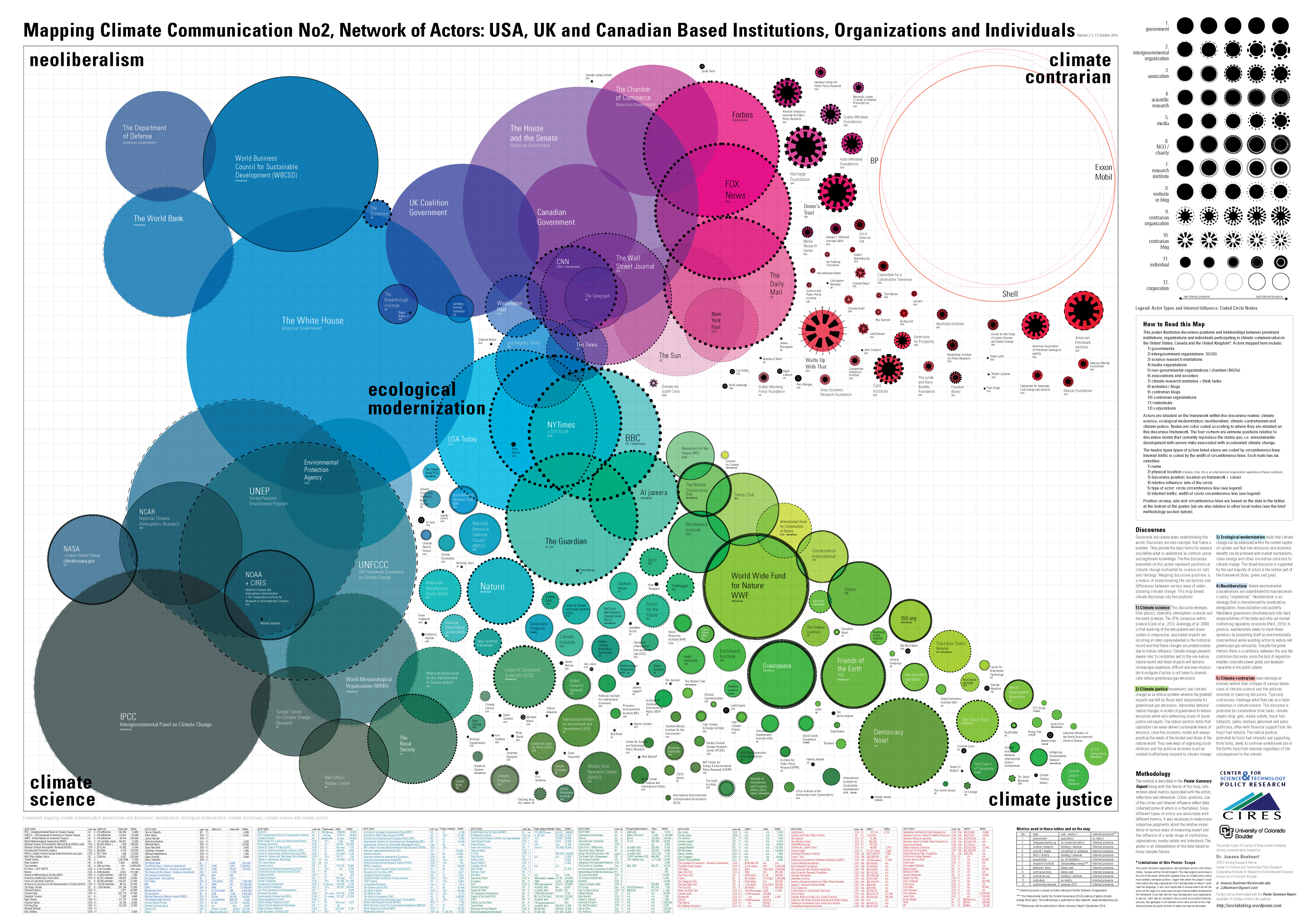
Mapping Climate Justice

By Dr Joanna "Jody" Boehnert - EcoLabs, October 16, 2014

Disclaimer: The views expressed here are not the official position of the IWW (or even the IWW’s EUC) and do not necessarily represent the views of anyone but the author’s.

Web Editor's Note: The IWW Environmental Unionism Caucus is featured on the climate map as one of the "climate justice" organizations.

The Mapping Climate Communication Project illustrates key events, participants and strategies in climate communication.

1) Climate Timeline visualizes the historical processes and events that have lead to various ways of communicating climate change. Key scientific, political and cultural events are plotted on a timeline that contextualizes this information within five climate discourses. These reveal very different ideological, political and scientific assumptions on climate change.

2) Network of Actors displays relationships between 237 individuals, organizations and institutions participating in climate communication in Canada, United States and the United Kingdom.

Details about this project can be found in the Mapping Climate Communication: PosterSummary Report. This report can be downloaded here:


The maps reveal how specific details in climate communication are contextualized within complex debates. For example:

  • How does a climate march impact the volume of media coverage of climate change?
  • How does the work of the climate denial industry potentially impact climate policy?
  • Do popular movies and books on climate result in activity in the climate movement?
  • What are the relationships between organizations active in climate communication?

By illustrating key events and actors over time and within five discourses this work makes links between disparate factors and reveals dynamics that contribute to public understanding of climate change.

The project also explores politicised issues in climate communication by using a discourse approach to analyse the various strategies and ideologies held by those organizations, institutions and individuals participating in climate communication in the public realm. This report describes the impact of neoliberal dogma and modes of governance on climate communication as one of the central problems preventing a global response to climate change. Theorizing the impact of neoliberalism on climate change communication and policy is key to an understanding of why emissions continue to rise despite the significant work by the climate science community and the environmental movement over the past four decades.

Twenty Things YOU Can Do To Address the Climate Crisis!

By Patrick Robbins - This Changes Everything, October 6, 2014

Disclaimer: The views expressed here are not the official position of the IWW (or even the IWW’s EUC) and do not necessarily represent the views of anyone but the author’s.

Getting your mind around climate change is hard. Confronting it requires us to deal with the ways that coal, oil, and gas have shaped nearly every aspect of our world, from our built environments to our economic systems — even our ideologies and patterns of thought. But that doesn’t mean there aren’t concrete actions each of us can take, right now. Here are 20 examples of things YOU can do (some details are US-specific).

1. Reorganize the mode of production so that surplus and capital is distributed equally throughout society, and workers have decision-making power over their labor.

2. Find out about fossil fuel projects being built or proposed in your neighborhood (most of which can be found in the records of the Federal Energy Regulatory Commission or the Environmental Protection Agency) and mobilize your community against them. Read these excellent resources on how to start organizing your community and spread them far and wide.

3. Understand that while climate change affects us all, there are specific populations who are more vulnerable than others — these are low-income communities, communities of color, coastal communities and communities on the frontlines of fossil fuel extraction. Find a frontline organization near you and offer to support their work. Ask them what kind of help they need and take direction from them.

4. Lay off the policeman, the commodities trader, the real estate agent and the speculator in your head.

5. Read about what the crisis could potentially look like — go HERE or HERE or HERE or HERE or HERE — and think about what this could mean for you personally, or for people and places you love.

Video: Boots Riley On Workers Revolution At Oakland Climate Rally

By Steve Zeltser - Labor Video Project, September 21, 2014

Disclaimer: The views expressed here are not the official position of the IWW (or even the IWW’s EUC) and do not necessarily represent the views of anyone but the author’s.

Boots Riley spoke and performed with a fellow artist at the Oakland Climate rally on September 21, 2104. He discussed the need to organize workers to make fundamental change in the system.

How To Make Fighting Climate Change Work For Workers

By Andrew Breiner - Think Progress, October 2, 2014

Disclaimer: The views expressed here are not the official position of the IWW (or even the IWW’s EUC) and do not necessarily represent the views of anyone but the author’s.

At first glance, it looks grim.

The EPA indicated Thursday that industry in the U.S. released more carbon dioxide (CO2) in 2013 than 2012, the wrong trend when we need to be making large cuts to get global warming under control. Meanwhile a report from the Center For American Progress and the University of Massachusetts’ Political Economy Research Institute (PERI) shows that we’re nowhere near cutting CO2 enough to prevent catastrophic global warming. If we continue with business as usual, U.S. emissions in 2030 will actually be slightly higher than they were in 2010, 80 percent higher than they need to be. Even with the “full implementation of the best clean energy policies currently considered achievable,” what the authors call the “aggressive reference case”, we’d still be well above the International Panel on Climate Change (IPCC) target, by 40 percent.

EIA Reference Case is where the Energy Information Administration expects us to be on our current track. The aggressive case includes current efforts to reduce CO2. And the final case is the study authors' recommendation.

“I kind of fell off my chair,” Robert Pollin, one of the report’s authors, said in a phone interview. “If you look at the institutions that do serious models of our energy future over the next generation or so, they’re saying we’re not going to control climate change. That’s the most likely scenario. That’s shocking.” But this report makes the case that there’s still hope. “The results from our research say that we can achieve the emissions reduction target through very significant action,” Pollin said, but “we can achieve it.”

“As long as we’re committed, it’s not beyond reach.”

In the report, “Green Growth: A U.S. Program for Controlling Climate Change and Expanding Job Opportunities,” the authors lay out how the government should take action to cut carbon in extensive detail. On energy efficiency, for example, the report describes specific ways of improving efficiency, and how much energy they can be expected to save, from the realm of consumer appliances to industrial practices in the pulp and paper industry. And efficiency is where the authors expect to see a lot of progress.

Screen Shot 2014-10-02 at 10.06.21 AM “The single biggest opportunity,” Bracken Hendricks of the Center for American Progress said, “is the urgency of retrofitting buildings to use less energy.” That has the benefit of being a very labor-heavy task, as is much of the work needed to cut carbon. “When you invest in clean economy,” Hendricks said, “you’re taking dollars from extractive resources and investing them in high-skill, high wage jobs.”

The report estimates 4.2 million jobs would be created by its recommendations, and 2.7 million after accounting for the loss of fossil fuel jobs. With a labor market of 155 million, that might not seem like so much, Pollin said, “but in an all else equal world, that’s a 1.5 to 2% reduction in the unemployment rate.”

And lower unemployment means more bargaining power for workers. “It directly contradicts the notion that investing in the environment means job losses, that it’s bad for jobs,” Pollin said. The Green Growth plan would also include money to retrain workers who lose their jobs as the economy shifts away from fossil fuels. Since concern for workers is at the forefront of the report, Pollin said, “we’ve taken a lot of pains on transitional policies for workers.”

One million dollars in spending on fossil fuels results in only 5.3 jobs if spent in oil, natural gas, and coal, the report says, compared with 16.7 jobs if spent in clean energy investments. Spending on renewables not only creates high-skill, high wage jobs at a higher rate than spending on fossil fuels, but it also creates a good number of low-wage jobs with opportunity for advancement. “It really creates an opportunity to create career ladders and training opportunities into the middle class,” Hendricks said.

Government spending would be an essential part of making this plan a reality, but not nearly as much as one might think for an effort to contain catastrophic global warming. The total yearly investments, public and private, needed to make the Green Growth plan a reality would be only $200 billion, which is 1.2 percent of total U.S. gross domestic product. The total government expenditure per year would average $55 billion, which is 1.4 percent of the total government budget. “There’s a window to make the investments that need to be done,” Hendricks said, “but it’s a small window and rapidly narrowing.”

While there’s a lot out there saying in the abstract what we need to do to limit climate change, action can sometimes seem impossible and far-off. But this is an actual road map, Hendricks said, “on the investments in technology, infrastructure, and communities,” that will actually solve the problem. And it translates “into a very compelling roadmap on how to rebuild the economy.”

Video - Save the Climate or Save Capitalism?

By Dennis Trainor, Jr - Acronym TV, October 1, 2014

Disclaimer: The views expressed here are not the official position of the IWW (or even the IWW’s EUC) and do not necessarily represent the views of anyone but the author’s.

Pages

The Fine Print I:

Disclaimer: The views expressed on this site are not the official position of the IWW (or even the IWW’s EUC) unless otherwise indicated and do not necessarily represent the views of anyone but the author’s, nor should it be assumed that any of these authors automatically support the IWW or endorse any of its positions.

Further: the inclusion of a link on our site (other than the link to the main IWW site) does not imply endorsement by or an alliance with the IWW. These sites have been chosen by our members due to their perceived relevance to the IWW EUC and are included here for informational purposes only. If you have any suggestions or comments on any of the links included (or not included) above, please contact us.

The Fine Print II:

Fair Use Notice: The material on this site is provided for educational and informational purposes. It may contain copyrighted material the use of which has not always been specifically authorized by the copyright owner. It is being made available in an effort to advance the understanding of scientific, environmental, economic, social justice and human rights issues etc.

It is believed that this constitutes a 'fair use' of any such copyrighted material as provided for in section 107 of the US Copyright Law. In accordance with Title 17 U.S.C. Section 107, the material on this site is distributed without profit to those who have an interest in using the included information for research and educational purposes. If you wish to use copyrighted material from this site for purposes of your own that go beyond 'fair use', you must obtain permission from the copyright owner. The information on this site does not constitute legal or technical advice.