You are here

ecosocialism

Towards Workers' Climate Action

By Traven Leyshon - Solidarity, March 2016

Workers and Trade Unions for Climate Solidarity:
Tackling climate change in a neoliberal world
By Paul Hampton
Rutledge, 2015, 211 pages, $54.95 kindle.

For Workers’ Climate Action:
Climate Change and Working-Class Struggle
By Paul Hampton
http://tinyurl.com/hl86nm4, 54 pages, £4.

[The workers had] “done more for the future of green energy and green jobs in the UK in two weeks than the government has done in 12 years.” — National Union of Rail, Maritime and Transport Workers President Bob Crow speaking of the Vestas factory occupation.
“The myth that the environment movement is the preserve of the do-gooding middle class must be exploded. It is, in fact, the workers who are most affected by the deterioration of the environment and it is therefore up to the trade union movement to give it a higher priority to fighting to improve it.” — Builders’ Labourers Federation Secretary Jack Mundey.

“The AFL-CIO Executive Council therefore calls upon the President to refrain from signing the proposed Kyoto Protocol to the U.N. Framework Convention on Climate Change.” — AFL-CIO Executive Council statement, January 30, 1998.

IN THE FACE of capital’s ecocidal embrace of extreme energy, unprecedented numbers of people are mobilizing in climate marches, bravely engaging in direct actions to stop the expansion of fracked gas pipelines. There is also a growing anticapitalist, climate justice wing, including an ecosocialist current.

While workers are participating in these “inter-classist” protests, we are told that “they do not participate as workers, with a consciousness of their specific role…the working class is now in the rearguard of the struggle over the climate, while peasants and indigenous peoples are in the front line with anticapitalist demands.” (Daniel Tanuro, Confronting the Ecological Emergency, http://www.solidarity-us.org/node/4521)

Paul Hampton, a trade union researcher in Britain, addresses these issues offering a Marxist perspective on the potential role of the working class in climate politics, as well as the tasks of revolutionaries, in this pamphlet and book (which originated as a PhD thesis on climate change and employment relations).

In his introduction Paul poses key questions for climate politics:

“Whether workers organized in trade unions possess the interest and power to tackle dangerous climate change, and whether unionised workers can become strategic climate actors.”

“Whether trade unionism in the twenty-first century can succeed in reinventing itself as a social movement capable of tackling climate change.”

Workers and Trade Unions for Climate Solidarity focuses primarily on the interrelation of climate and class politics; on union climate debates, policies and practices worldwide and in the United Kingdom; on UK workplace green reps; and on the 2009 Vestas occupation, in which workers at a wind turbine factory occupied the workplace to try to stop closure.

Nothing to do, nowhere to go, nothing to say: How the broad climate movement has failed us

By James Jordan - Links, January 13, 2016

Image: Activists deliver the Our Power Plan to the EPA’s regional office in San Francisco on January 19, 2016 (Facebook/CEJA)

It has been a month since the UN climate summit in Paris, aka COP 21. One might expect the kind of ebb and flow we often see in popular movements. Interest in climate issues, the cause of the day during the summit, might be expected to wane and move to the back burner of public discourse until such time as another development pushes it forward again.

However, climate change is fundamentally different. It is going to get worse — we will be getting slapped in the face with this one for a long, long time, even under the best scenarios. Only a few weeks after COP 21, the world experienced a wave of floods and extreme weather exacerbated by global warming. In the US, there were record-setting floods along the Mississippi River. In South America, floods caused the evacuation of 180,000 persons. In Scotland, floods cut across class lines to threaten a historic castle neighboring the Queen's Balmoral residence, its foundation being eaten away by the swollen Dee river. Meanwhile, oil wars and drought continue to drive an immigration crisis in Syria and throughout the Middle East and Northern Africa. The issue of climate is not the “struggle du jour” - it is going to be the main course for quite a while.

Shamefully, the broad, “mainstream” climate movement in the so-called “developed” world is woefully inadequate to address this concern. It is not producing the kind of real life strategies, analysis and resistance that current conditions call for. Right now, the dominant character of this movement is actually holding us back, not pushing us forward. It is a movement that trumpets ambiguous desires for sustainability, but is all too silent when it comes to meaningful demands.

What we got from COP 21 was an accord that set inadequate and unenforceable carbon emissions limits; failed to guarantee reparations or support for the poorest, most exploited nations to develop alternative technologies; adopted market-based schemes that entrench international inequality; ignored the demands of indigenous peoples; and refused to address the huge and negative climate impact of US militarism and resource wars. Of course, no one expected such measures to be passed, so it might be justly claimed as a victory that any kind of agreement or protocol was passed at all. As has been noted, had the agreement been enforceable, the Republican-dominated US Congress would have quashed that government's participation. But what victory there has been is a Pyrrhic one.

The good news from Paris was those groups that defied the ban on public marches and protests instated following the November 13 terrorist attacks. There were some 200 protesters arrested on November 29, the opening day of the summit, when they broke ranks with officially-tolerated activities and took to the streets, despite authorities having “preventatively” detained a number of activists before the summit began. There was also the December 6 flotilla of indigenous peoples protesting the exclusion of indigenous rights from the accord minus a brief mention in the preamble. The flotilla exposed the machinations of the US, European Union, Australia and others to exempt indigenous rights from the body of the agreement. It was refreshing to hear of these and others who refused to cooperate with this gag rule.

Around the world people are getting radicalized and making bold efforts to save this biosphere we know and love. In the US, Flood the System called for and carried out multiple climate justice actions. The Global Climate Convergence is continuing its work to build a Peoples Climate Strike. Groups like the Indigenous Environmental Network and Climate Justice Alliance are confronting the legacy of colonialism and its damage to land and water. Fossil Fuel Student Divestment Network is organizing to divest universities from the oil and coal companies. Still, the reality is that the broad climate movement in the “developed”world has mostly been a failure and an obstacle to building an effective and truly relevant movement.

Paris climate talks produce hot air

By Carl Sack - Socialist Action, January 20, 2016

Photo: Demonstration for climate justice near the Arc de Triomphe in Paris, Dec. 12. David Sassoon / Inside Climate News

After 10 days of talks at the COP 21 climate conference in Paris, negotiators from 195 countries celebrated the adoption of an agreement that calls for a goal of limiting global warming to 1.5o Centigrade above pre-industrial levels.

On one hand, the agreement goes farther than any previous accord to acknowledge the need for a rapid reduction of greenhouse gas emissions. Its preamble includes the “principle of equity” that rich countries must do more than poor countries. It even pays lip service to indigenous rights, gender equality, and a “just transition of the workforce.” It calls for holding the global average temperature “well below 2o C above pre-industrial levels”—the suicidal temperature ceiling advocated by the U.S. and European countries—and aspires to limit the temperature rise to 1.5o C. Many poorer nations pushed for the 1.5o target.

On the other hand, despite the enlightened preamble, the document is utterly empty of any concrete measures to curb planet-destroying carbon emissions. It relies on countries to set their own “intended nationally determined contributions” or INDCs, which are to be updated every five years. The language used is revealing; INDCs are voluntary pledges that are non-binding and therefore have no real impact.

The agreement does not lay out any roadmaps for how individual countries will achieve their pledges. It fails to even mention reducing the consumption of fossil fuels beyond a vague reference to “domestic mitigation measures.” Even if all countries were to follow through on all of the pledges made just prior to the Paris conference, scientists at the Potsdam Institute for Climate Impact Research peg the result as a disastrous 2.7o C warming by the year 2100—just 0.9 degrees below the “business-as-usual” scenario.

Worse, like its predecessors, the Paris agreement endorses counterproductive market-based carbon-trading schemes. Carbon markets introduced under the Kyoto Protocol (called the “Clean Development Mechanism”) have attracted rampant corruption, promoted big development projects like hydropower dams that displaced sustainable communities, and ultimately collapsed due to a lack of demand for carbon offsets. Forest protection credits, sold as carbon offsets under the UN REDD program, have accelerated corporate land grabs in developing countries and hastened the conversion of natural forests into private monoculture tree plantations.

Provisions of the agreement could also be interpreted as promoting speculative carbon-capture technologies and risky geo-engineering schemes.

NASA climate scientist James Hansen called the agreement “a fraud” and “a fake.” “It’s just bullshit for them to say: ‘We’ll have a 2C warming target and then try to do a little better every five years.’ It’s just worthless words. There is no action, just promises,” Hansen said in an interview with The Guardian. Hansen supports a carbon tax with public redistribution of the proceeds as a means of curbing fossil fuel use.

Perhaps proving Hansen’s point, the Paris talks do not seem to have spurred any immediate action to curb emissions by the world’s worst polluters. In fact, just before the Paris talks, President Barack Obama signed a transportation bill including a provision that fast-tracks environmental review of new oil and gas pipelines and strictly limits lawsuits aimed at stopping such projects. Just after the talks, he signed a spending bill that ended the 40-year-old oil export ban, allowing U.S. fossil fuel corporations to ship crude oil overseas.

Collapsing the levels, Consolidating Our efforts

By SN Nappalos - Recomposition, December 11, 2015

Recomposition Introduction: Approximately 5 years ago work began on something called the intermediate analysis. A few members of the Recomposition editorial group contributed pieces, worked in groups, and tried to shape their work around the issues raised in the analysis. Between 2010 and today stand a lot of changes and a different landscape for radical action. The maturing of the world financial crisis, series of popular protest movements, and conservative responses have shifted the field from where we stood just a short time ago. Today we present a piece by Scott Nicholas Nappalos exploring what was useful and harmful in the intermediate analysis, and what lessons can be drawn for revolutionary unionists in North America specifically and for the libertarian left more generally. 

The intermediate level first confronted me after the 2004 bicoastal wildcat strike where the Industrial Workers of the World (IWW) had attempted to organize a national coordination of the various autonomous local groups of truckers who have come together. That followed a series of debates within the Portland IWW branch, where I was a member, over the role of revolutionaries in building a union. I began a draft on the intermediate analysis during the period of 2004-2006, but returned to it more seriously a few years later in Miami when things had calmed down and in dialogue with other comrades there. In 2010-2011, I contributed to a series of pieces on the intermediate level as part of group discussions within Miami Autonomy & Solidarity, an anarchist communist political organization I was a member of. These reflections came out of years of rumblings, discussions, and experiments by anarchists trying to find ways to apply their ideas to workplace and community organizing in the North American . Nearly as soon as the words hit the page a series of struggles began to test our ideas; first the Madison protests, then Occupy, and later others.

The three or so years that followed the publishing of pieces on the intermediate level led to more discussion and distribution than anyone likely imagined. In a couple cases other groups consciously adopted the terminology and the debate spread outside North American circles through libertarian networks. In today’s environment of unstable quietness, many are looking around, taking stock, and picking up old debates to help sort out the events of the past years beginning with the crisis in 2008. It’s obvious that there’s been a spate of protests that set the decade apart from the past 30 years, though they’ve remained short-lived and largely localized so far. Vast changes are afoot with sections of the public more open to our politics than any time in recent history, though that hasn’t yet translated into any real sustained advances. Some years and modest experiments behind us, it is a good opportunity to re-evaluate the strategy and analysis.

There is no need to beat the drum and reiterate the arguments bit by bit here, but instead interested folks can look to pieces I wrote: Defining Practice: the intermediate level of organization and struggle[1], the three-part piece called Towards a Theory of Political Organization for our Time[2], and also somewhat related the co-authored article with Adam Weaver Fighting for the Future: The necessity and possibility of national political organization for our time.[3] The quick summary is that there are two frames to the analysis. The first, the intermediate level, is a tool for looking at the social world and categorizing different types of activity to understand them better. The mass level is an idealized space where all the struggles of all the social actors take place like giant unions or community organizations that encompass entire classes. The political level takes place where specific ideologies, strategies, and politics are coordinated in that larger field. The intermediate level is where people come together based on shared strategy and experiences to coordinate their activity within struggles; more broad than the ideological unity of the political level, and more narrow than the mass level it is working within.

The second framing of the analysis deals specifically with intermediate organizations, which is to say organizations that occupied the space roughly between unions and political parties/organizations. Intermediate organizations are ones constructed with distinct tasks from mass or political ones, and unlike the first aspect of the analysis are physically and actively separate. In the first we are talking about activities that can co-exist alongside others in a variety of formats, the second is specific organizations that imperfectly reflect those activities.

The simplest examples of intermediate organizations are tendencies within social movements. These groups organize militants around a shared platform of various sorts to take action within an organization such as a union or community group. This spans from relatively ideologically broad such as Soldiers of Solidarity[4] in the UAW, to groups for action with broader political orientation such as the communist party’s Trade Union Education League and later Trade Union Unity League’s unions[5] or the Unemployed Councils of the Great Depression[6], and overtly political tendencies such as the Federacion Estudiantil Libertaria[7] in Chile today which organizes anarchists on specific proposals for action and demands within the student unions. Many organizing projects however tend to act as intermediate organizations of militants without having another overarching social organization they work within.

Controversially I’d argue that projects of the anarcho-syndicalist variety in fact act like intermediate organizations. Really there’s two ways to look at it: our concept of unions is too narrow, or revolutionary unions/projects represent something altogether different from parties and unions. One way to come at the intermediate level is to question all of this, and say the idea of non-political mass organizations is utopian, they’re inherently involving all levels of activity: political, mass, and intermediate. In one sense the dominant idea of what unions and organizing projects are (for left thinkers anyway) has become incredibly narrow; essentially apolitical groups that try to win demands for the whole of the class or some section of the class.

This scenario is far from universal in fact, because historically it was rarely if ever the case. It has been common for unions to fight around a range of issues from housing, immigration, and the oppression of ethnicities and women with examples in the IWW, FORA, CNT, and FAU but also reformist unions.[8] The meaning of union is interpreted as about the workplace narrowly defined. However in South America, to take an example, unions came out of resistance societies which were unions of workers and proletarians organized around a variety of different collective needs and projects. Resistance societies were a militant off shoot of mutual aid networks that included things like women’s issues, housing, workplace, and political issues that affected the class like militarism, anti-clericalism, immigration, and health. [9][10] This was perhaps always the norm for revolutionary unions, but not unheard of for reformist unions growing out of the environment of working class communities of past generations. Lately SEIU and other recuperative unions have started funding non-workplace organizing with non-members often with the goal of electoral victories, begging the question.

The focus of unions only narrowed in the US with their institutionalization after the NLRA when they became more fully integrated into capitalism. Political and social struggles overlapped with workplace activities, and unions were often grouped around political outlook. Outside the US, most of the world has a parliamentary system for unions where workers choose between them based on their political ideology. Moreover American unions and non-profits are largely ideological organs of the Democratic Party in terms of their activity, funding, and vision. So even today the idea of neutral mass organizations is a bit utopian.

Another way to think about these projects is that certain groups play a special role. They are different from run-of-the-mill unions, community groups, etc. While it’s true all groups are political in some sense, anarcho-syndicalist unions, revolutionary community groups, and solidarity networks have a unique relationship between their ideas and practices. They all use activity to build movement and have a connection between their goals, ideals, and actions in a way that political organizations and more broad unions don’t. In this way maybe they don’t fit neatly into any of the levels and occupy space between them all. Whether we widen the concept of mass organization, or we alter how we understand groups like the IWW, CNT, Solidarity Networks, or other such projects, the outcome is the same in practice. Intermediate organization tried to capture some of that nuance.

Towards a New Anti-Capitalist Politics

By Jerome Roos - ROARMag, December 15, 2015

Humanity finds itself at an inflexion point. On the one hand, global capitalism is producing and aggravating a series of existential crises that may well undermine the very preconditions for a dignified human life—or any form of human life—on this planet. On the other, the only political force that could possibly do something to counter this inexorable drive towards catastrophe—the international left—has long since been run into the ground by a four-decade neoliberal offensive, leaving its social base fragmented and atomized, its organizational structures in tatters.

In the wake of this world-historic defeat, we are confronted on a daily basis with the devastating consequences of our contemporary powerlessness. Far from retreating in the wake of the global financial crisis of 2008-‘09, neoliberalism has intensified its war on democracy and doubled down on the structural violence of austerity and dispossession. Meanwhile, we look on helplessly as wealth and power continue to be concentrated in ever fewer hands, while common goods and public services are mercilessly sacrificed at the altar of the marketplace.

We stand defenseless as high finance and big business mount an all-out offensive against the last-remaining vestiges of the welfare state, while mass surveillance and state control are expanded across the board. We are powerless as barriers to capital are knocked down in secretive trade deals while national borders are militarized and new walls erected everywhere to keep out the unwanted other. We feel paralyzed as families are evicted from their homes, protesters brutalized by police, and the bodies of refugees continue to wash up on our shores.

Amidst the growing uncertainty of a hyper-competitive 24/7 information economy, in which indebtedness, unemployment and precarity are rapidly becoming the generalized conditions of life for the majority, we are overcome by exhaustion, depression and anxiety. At the same time, a sense of existential gloom is settling in as global temperatures and sea levels continue their seemingly unstoppable rise, while planetary life-support systems are being destroyed at a truly terrifying pace.

From Hollywood blockbusters to best-selling books, late-capitalist culture knows all too well how to wax poetics about the collapse of civilization—yet its critics seem to have lost all capacity to imagine even the most moderate reforms to prevent this dystopian fiction from becoming reality.

We may continue to speak of a crisis of capital, but what really confronts us is a crisis of the left.

For all its tragedies and failures, at least the old left was once driven by hopes and visions of a better future. Today, all such aspirations seem to have been abandoned. As Franco ‘Bifo’ Berardi has astutely put it, the future has been cancelled—and the left, unmoored from its post-capitalist imaginary, has been cast hopelessly adrift in the process. In this conjuncture, we may continue to speak of a crisis of capital, but what really confronts us is a crisis of the left.

COPing out: what will it take to overcome the environmental movement’s impasse?

By Nicholas Beuret - Novara Media, December 4, 2015

The activist part of me is pissed off at the French government for banning the protest marches that planned to target the UN Climate Change conference (known as the COP21) in Paris this December. It would have been amazing to see thousands of people taking to the streets demanding climate justice and breaking the stale grey commentary surrounding international climate change politics. That bit of me hopes the protests still go ahead.
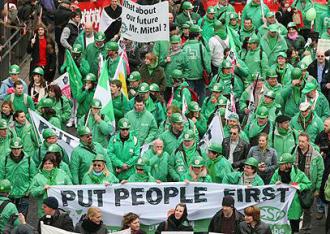
But another part of me hopes no one turns up at all, and is actually glad the marches won’t happen. Not out of despair, or in some sneering ultra-left sense, but because the environmental movement is stuck and protests like the ones planned for the COP are part of the reason for the current impasse. I hope people don’t turn up because, in the end, spectacular protests such as these are making things worse.

Despite 20 years of activism…

We are heading towards a 3-4C global temperature rise. Despite creative actions, grassroots climate movements and committed NGO campaigns (and even some government action) climate change hasn’t been stopped. Sure enough, we shouldn’t dismiss what has been achieved. That climate change might be limited to 3-4C is actually an achievement, which has happened largely due to the campaigns of environmentalists and the emergence of a strong public belief that climate change has to be tackled by governments. But it’s not enough, not by a long shot. It is not enough according to the standards governments, scientists and activists hold themselves to. A 3-4C rise in global temperatures is actually disastrously bad.

The red line many in the climate movement have been pushing is a maximum increase of no more than 2C – a rise which is possibly too dangerous already. The maths of staying below 2C relies on global emissions peaking this year. What is becoming increasingly clear is that it is probably too late to stay below a 2C rise in global temperatures.

Despite 20 years of activism climate politics is stuck. Climate change is a problem so big, so complicated (everything has to change) and so urgent (it has to happen now, now, now) that for the most part the environmental movement finds itself with few options for action. Because climate change means changing everything, any progress on a small, local or even regional scale feels inadequate. Because it’s so complicated it seems resistant to democratic politics – just imagine what it is going to take to get everyone to agree on how we are going to solve the problem, even on a local scale. Because it’s so urgent there is no time for negotiating with people, a third of whom don’t think climate change is all that serious anyway. It is for all these messy, difficult reasons that climate change protests take the form of mass spectacular actions like the ones planned for the Paris COP21.

The COP21 protest isn’t so different to the actions that happened at COP15 in 2009, or any of the ones before that. It’s also not so different from Climate Camp or, going further back, most of the summit protests of the anti-globalisation movement. In each case you had a symbol of a global problem around which people could mobilise, and in each case you had no real opportunity to affect the thing being protested against. What happened in each case – and what will continue to happen – is what we could call ‘militant lobbying’. These actions were/are stunts intending to put pressure on governments to act, even when carried out in the name of anti-state politics or anti-authoritarian practice. They can’t be anything else.

While they are almost always billed as direct actions, what makes an action ‘direct’ is its capacity to disrupt or stop something without recourse to some other power. A useful example would be the anti-roads movement in the UK. The government of the day had scheduled a massive programme of road construction, often through existing neighbourhoods or woods. People banded together to form local campaigns against the specific roads, and created a number of action camps which physically blocked road construction. One by one the camps fell, but not before costing the government large sums of money and slowing the project down immensely. In the end the disruption became too much and the government cancelled most of the programme.

We can contrast the anti-roads movement with the planned actions at COP21. In Paris, at best they will block some delegates from leaving a meeting that will have concluded, the content of which will have largely been decided over the prior months of negotiations. Which means the planned protests won’t affect the outcome, and won’t affect climate change in any way directly either. The action is and can only be intended to put pressure on governments to make a stronger agreement. But then, given the scale, complexity and urgency of climate change, who else could possibly deal with it as an issue?

Climate change and the summit smokescreen

Ian Angus interviewed by Phil Gasper - Socialist Worker, December 2, 2015 (this article also appeared on Climate and Capitalism)

President Barack Obama joined world leaders at the UN climate summit--officially called the 21st Congress of the Parties for the United Nations Framework Convention on Climate Change, or COP 21--in Paris this week, and promised to work for an "ambitious" agreement to reduce greenhouse gas emissions that cause global warming. But climate justice activists who are trying to put forward an alternative vision--in spite of a ban on protests by the French government after the November 13 terror attacks--say that much more is needed than the leaders of the world's most powerful governments are willing to consider.

Ian Angus is a Canadian activist, editor of the ecosocialist journal Climate and Capitalism and co-author of Too Many People? Population, Immigration, and the Environmental Crisis. He talked to Phil Gasper about what to expect from the Paris summit and what the climate justice movement will need to take up next.

THE COP 21 talks are starting in Paris. What can we expect from these? Is there any chance there will be a significant agreement that comes out of them?

MY GUESS is that they will try to produce something that looks better than the Copenhagen accord, and there's a good chance that they'll succeed. The real issue is whether the agreement means much in practice.

All of the major countries have announced targets for emissions reductions. But as many people have pointed out, first of all, even if every single one of those targets is achieved--and we know we won't be--the temperature increase will still be way over two degrees Celsius. In addition, most of the countries that have put in those submissions haven't actually made concrete plans to do anything. They've announced goals, but there's no program for achieving them.

It remains to be seen whether anything serious is adopted. I don't think we will get mandatory reductions--that seems extremely unlikely. And of course, there's always the possibility that the whole thing could blow up, but that also seems unlikely. I think Obama wants to get something at this point in his career, so I suspect we will get good theater and something that looks okay on paper, and not much will happen as a result.

WHY IS it so difficult for them to come up with a serious proposal that will actually make a difference to the climate situation?

FUNDAMENTALLY, GOVERNMENT negotiators say "we'll reduce emissions," but they don't say "we will reduce our use of fossil fuels," which is what they must do to reduce emissions seriously and long term.

Fossil fuels are so fundamental to the operation of capitalism and the world today that serious reductions, if they were even tried under capitalism, would lead to a period of extraordinary economic disruption. Entire industries would have to stop functioning while they retool, and other industries would just have to disappear.

The only time we've had significant reductions in emissions in a major country was after the break-up of the Soviet Union, when the economy of Russia collapsed. And even that didn't produce the level of emissions reductions we'd like to see. So the difficulty in reaching agreement is, ultimately, that they aren't willing to reorient their economies away from fossil fuels, because fossil fuels are embedded in the way capitalism works.

From Climate Crisis to Solar Communism

By David Schwartzman - Jacobin, December 1, 2015

IWW EUC Note: readers should be aware that the term "communism" here does not mean "bureaucratic state capitalism", and can be inclusive of ecosocialism, post-scarcity-anarchism, and/or green syndicalism (depending on one's implementation of the ideas discussed here):

The proposals elites are offering at COP21 wouldn’t halt climate change. What would a socialist solution look like?

Jacobin Editor's Note: Leaders from 147 countries have assembled in Paris for COP 21, the most important climate summit since the 2009 Copenhagen meeting. But climate justice activists worry the result will be the same: platitudes and handwringing, with no firm commitment from Global North countries to drastically curb carbon emissions.

What, then, would a just solution look like?

David Schwartzman, a biogeochemist and professor emeritus at Howard University, has been thinking and writing about climate and energy issues for many years. He recently spoke with Jacobin about the state of the climate crisis, the connection between global warming and the military-industrial complex, and why “the communist horizon in the twenty-first century, if there is to be one, will be solar communist.”

What is the current consensus on the climate crisis?

According to Climate Interactive — a major monitor of climate change — based on public commitments from the major carbon-emitting countries, projected warming by 2100 will be 3.5°C (6.3°F), or 1.5°C above the 2°C warming limit (above the pre-industrial global temperature) agreed upon at the 2010 Cancun Climate Change Conference. The United Nations now gives a somewhat lower projected warming of 2.7°C (4.9°F).

Moreover, some leading climate scientists now think that even the 2 degree limit is too high. For example, NASA climate scientist Jim Hansen describes the 2 degree limit as a “prescription for disaster” because of projected impacts such as sea level rise and acidification of the ocean. His assessment is reinforced by a newly published study in the Proceedings of the National Academy of Sciences. This evidence reinforces the long-term demand of many poor countries for a 1.5 degree limit.

What about fossil-fuel reduction? Is that making an impact?

Roughly 60 percent of greenhouse gas emissions come from fossil-fuel use, with coal, natural gas (due to methane leakage into the atmosphere), and tar sands oil having the highest carbon footprint. Conventional liquid oil has the lowest carbon footprint, about three-fourths that of coal. (The other greenhouse gases derived from human activity include nitrous oxide, the breakdown product of nitrate fertilizer, with methane also coming from agriculture.)

China is the world’s leading carbon emitter, almost double that of the second-place United States.

The big three — China, the US, and the European Union —produce 55 percent of global carbon dioxide emissions. China has committed to leveling off its emissions by 2030 (using carbon emission trading), while the US promises to reduce its greenhouse emissions 26–28 percent by 2025 relative to 2005 emissions.

As Naomi Klein has recently argued — citing the assessment of the Tyndall Centre for Climate Research — the US goal falls far short of what is required for even the 2-degree goal, which would require reductions of at least 8 to 10 percent per year.

Projected warming, in combination with lackluster efforts to cut emissions, has created an imminent crisis. This is the reality check for serious activists. Any remaining possibility of keeping warming below 2°C will require rapid and radical cuts in global carbon emissions — starting with the fossil fuels with the highest carbon footprint — and the simultaneous creation of a viable global wind and solar power infrastructure.

What kind of "just transition"?

By Michael Ware - Socialist Worker, December 1, 2015

The climate justice movement knows what it is against, but what are we fighting for? Michael Ware, of System Change Not Climate Change, has some answers:

EVERYONE BUT a few Republican crackpots now acknowledge that the planet faces a climate emergency. But the bosses at ExxonMobil had a bit of a head start.

A company memo was unearthed this year showing that the oil giant knew since 1977 from its own scientists that burning fossil fuels contributed to global warming. But the findings were hidden, and Exxon continued to be climate change deniers for decades to come.

This revelation speaks volumes about how short-term profits trump everything under capitalism, even human survival. Exxon's research pointed toward what we are living through today: increased temperatures globally, drought, mass flooding, more intense hurricanes, crop failures, extinctions, melting polar regions, rising sea levels, ocean acidification, water scarcity, and on and on.

Already, climate change causes 300,000 to 400,000 deaths per year, mostly in the Global South, according to a study conducted on behalf of the UN several years ago.

In order to keep the increase in global temperatures under 1.5 degrees Celsius by mid-century and avoid catastrophic environmental changes, greenhouse gas emissions must be reduced by 5-10 percent each year. Already, the global temperature increase has been almost 1 degree Celsius.

The emergence of a green capitalism sector, increased energy efficiencies and limited expansion of renewable energy have done little to bring down the estimates of average temperature increases. Without a radical change of course, the increase will be between 4 and 6 degrees Celsius by the end of the century.

Clearly, just educating politicians and business leaders about the threat isn't enough. We need movements and protests strong enough to force big changes in the way humans produce and consume energy.

The urgency around halting climate change creates a unique political dynamic. The need for social change is always urgently felt by the oppressed, but for the first time, we have an environmental timer showing that the huge task of transitioning to a sustainable world must take place in this century, or humanity will face the consequences of an inhospitable planet.

Fighting for this kind of change will necessarily threaten capitalism. Yet it's hard for most people to envision a world without corporations, car culture, oil wars, oppression and a market for everything, including pollution.

Paths Beyond Paris: Movements, Action and Solidarity Towards Climate Justice

By various - Carbon Trade Watch, December 2015

Over twenty years have passed since governments within the United Nations Framework Convention on Climate Change (UNFCCC) began to discuss the impending climate crisis. Year after year, we witness the talks moving further away from identifying the root causes of climate change while the increasing impacts affect even more peoples and regions. Every meeting has given more space for corporate involvement and less to the voices of those directly affected by these climate policies. Despite the promoters’ fancy “green” campaigns and videos, the main focus at the climate negotiations continues to be about saving the free-market economy for those who are holding the cards – the biggest transnational corporations and financial institutions. The same corporations that are largely behind the destruction of forests, rivers, diversity, territories – as well as the violation of human and collective rights and so on – are also the main polluters and plunderers of the Earth.

The climate crisis poses a real threat to the current economic model which is based on the continuous extraction and production of fossil fuels, hydrocarbons and “natural resources” such as land, minerals, wood and agriculture. If talks were to seriously address climate change, there would need to be a discussion on the many ways to support the hundreds of thousand of small-scale farmers, fishers, Indigenous Peoples, forest-dwelling communities and others whose territories and livelihoods are at risk from capital expansion, and how to transition to different economic systems where fossil fuels could be kept underground; where the consumption “mantra” would shift towards more local, diverse and collective discourses and practices. However, the hegemonic and colonial powers are once more violently closing doors, creating more “structural adjustments” and, ultimately, harming the people who are the least responsible for current and historical pollution levels suffering the most from the impacts.

The fallacy that we can continue with the same economic model is irremediably flawed, bankrolled by big polluters, and intrinsically linked to land and livelihoods grabbing, especially in the Global South. Nonetheless, mechanisms like carbon markets, which expand the extractivist and free-market logic, continue to be promoted as unilateral, program- matic “solutions” to mitigate climate change and address deforestation and biodiversity loss. From carbon trading to forests and biodiversity offsets, the climate crisis has been turned into a business opportunity, worsening the already felt impacts, especially for those who are the least responsible. Debates over molecules of carbon being accounted for and “moved” or “stored” from one location to the other detracts from the necessary debates on shifting away from extraction, unjust power structures and oppression. While being fully informed of the causes of climate change, international climate negotiations strive to ensure that the hegemonic economic model expands and rewards polluters.

The consequence is that “climate policies” (aka economic policies) finance the most destructive industries and polluters, often destroying genuinely effective actions that support community livelihoods and keep fossil fuels in the ground. Moreover, these policies further the “financialization of nature” process, which presupposes the separation and quantification of the Earth’s cycles and functions – such as carbon, water and biodiversity – in or-der to turn them into “units” or “titles” that can be sold in financial and speculative markets. With governments establishing legal frameworks to set these markets in place, they also have provided the financial “infrastructure” for negotiating financial “instruments”, by using derivatives, hedge funds and others. While financial markets have a growing influence over economic policies, the “financialization of nature” hands over the management to the financial markets, whose sole concern is to further accumulate capital.

Read the report (PDF).

Pages

The Fine Print I:

Disclaimer: The views expressed on this site are not the official position of the IWW (or even the IWW’s EUC) unless otherwise indicated and do not necessarily represent the views of anyone but the author’s, nor should it be assumed that any of these authors automatically support the IWW or endorse any of its positions.

Further: the inclusion of a link on our site (other than the link to the main IWW site) does not imply endorsement by or an alliance with the IWW. These sites have been chosen by our members due to their perceived relevance to the IWW EUC and are included here for informational purposes only. If you have any suggestions or comments on any of the links included (or not included) above, please contact us.

The Fine Print II:

Fair Use Notice: The material on this site is provided for educational and informational purposes. It may contain copyrighted material the use of which has not always been specifically authorized by the copyright owner. It is being made available in an effort to advance the understanding of scientific, environmental, economic, social justice and human rights issues etc.

It is believed that this constitutes a 'fair use' of any such copyrighted material as provided for in section 107 of the US Copyright Law. In accordance with Title 17 U.S.C. Section 107, the material on this site is distributed without profit to those who have an interest in using the included information for research and educational purposes. If you wish to use copyrighted material from this site for purposes of your own that go beyond 'fair use', you must obtain permission from the copyright owner. The information on this site does not constitute legal or technical advice.

