You are here

green-anarchism

A post-capitalist farming experiment – Potentials, problems and perspectives

By Von Jan-Hendrik Cropp - Keimform.de, September 27, 2014

Disclaimer: The views expressed here are not the official position of the IWW (or even the IWW’s EUC) and do not necessarily represent the views of anyone but the author’s.

“From each according to his ability, to each according to his need” – Marx, Critique of the Gotha Program

Potentials

Since one and a half years around 70 people are involved in a post-capitalist farming experiment. Situated in the middle of Germany a collective of 5 growers is feeding around 65 supporters, year-round with a full supply of vegetables. The production is organised along the needs and abilities of the community.

Internally the growers collective evaluates the needs of each “worker”. Both in financial terms (“wage”) and concrete needs (e.g. a place to live). Those needs have to be met in order to enable the individuals to sustainably organise within the project. This happens independently from the evaluation of the amount of time that each grower is willing to commit to the project (“working hours”). If both of this results in a feeling of enough resources to start growing, a budget is calculated summing up all production costs (including “wages”) and running investments of a one-year production.

This budget is then presented at a general assembly to the supporters who want to be fed by the collective. Each of them anonymously fills out a contract in which voluntary contributions are noted. These include regular financial contributions, skills (e.g. working on the land, massages for the growers) and resources (e.g. machinery and land) that people can offer. The commitment for delivery (both of veggies and contributions) in one-year long. Ideally, after this first bid, all of the growers collective’s needs and their budget are met. If not, another round of bids has to be made. In this process we aim at fulfilling needs non-monetarily wherever possible but monetarily wherever necessary.

In a second step the vegetable needs of the supporters are evaluated in order to enable a needs-oriented planning and production. The signed contract also includes other agreements around collective decision-making, criteria for the failure of the project, collective risks and responsibilities and so on.

To stress: Except for a commitment to the project through signing the contract, no more contribution is required be entitled the vegetables.

The harvest throughout the year is then shared in depots, twice a week, around the region. The distribution is organised by the supporters. It doesn’t consist of normed boxes but of pools of vegetables from which every supported can take according to their needs. Several tools in the depots are used to create transparency about the stocks of that day. Furthermore the community as a whole is encouraged to form working groups to organise beyond the basic production, such as in theoretical reflection, processing of left-overs, storage of produce; among others. If the working groups need any form of support (money, skills ressources) to function well, this can be discussed and solved in the generally assembly.

After the Climate Movement: Ecology and Politics in the 21st Century (1/2)

By Javier Sethness Castro and Alexander Reid Ross - CounterPunch, September 15, 2014

This is part one of a two-part interview. The next part is forthcoming:

Edited by CounterPunch regular Alexander Reid Ross and newly published by AK Press, Grabbing Back: Essays Against the Global Land Grab assembles a formidable collection of articles and reports written by scholars and activists from North and South alike who are concerned with the distressing acceleration of massive land-expropriations executed by capitalist interests in recent years. Otherwise known as the “New Scramble for Africa,” the “New Great Game,” or the “Global Land Rush,” the global land grab has involved the acquisition by foreign power-groups of anywhere between 56 and 203 million hectares of lands belonging to Southern societies since the turn of the millennium. The corporations responsible for this massive privatization scheme hail from both wealthy and middle-income countries: India, South Korea, Israel, Germany, Saudi Arabia, Singapore, China, and the U.S., among others.

In part, the global land grab can be explained by the progression of ecological degradation, particularly through climate change, as combined with the desire of the ruling classes of these countries to ensure food security for their populations—the fate of local populations in the countries whose lands are colonized for export-oriented production be damned. Another factor has to do with the vast concentration of wealth in the hands of the transnational financial aristocracy, who are lending out capital less readily now during the Great Recession than before, such that they have more capital on hand with which to invest in overseas land ventures. However, not all the territory which has been usurped by corporations and banks of late is to be dedicated exclusively to food production; much of it instead will be directed toward the cultivation of agrofuels (biofuels) that are slated to replace petroleum to a limited extent as a base or transitional fossil fuel, with this being a situation that can be expected greatly to exacerbate food insecurity and starvation in the countries whose governments welcome (re)colonization. The scale of investment in agrofuels is truly staggering, in light of plans to occupy almost 6 percent of the territory of Liberia and 10 percent of that of Sierra Leone with African palm plantations; a similar if more immediately acute dynamic is unfolding in Indonesia and Malaysia, whose vast swathes of tropical rainforests are being expeditiously torn down in favor of palm oil crops. Summarized briefly and correctly by Sasha and Helen Yost, this process is one whereby land-based communities are dispossessed in order to “feed the industrial nightmare of climate change.”

Green Anarchism: Towards the Abolition of Hierarchy

By C. B. - Anarchist News, August 30, 2014

Disclaimer: The views expressed here are not the official position of the IWW (or even the IWW’s EUC) and do not necessarily represent the views of anyone but the author’s.

In the last few decades new forms of activism have begun to emerge that concerned not merely the fate of human society, but of the non-human world – including non-human animals and the environment – as well. In their most radical forms, these struggles culminated in what has been termed by some as ‘eco’ or ‘green’ anarchism. Green anarchism can be taken to consist in any political doctrine that takes some of the key components of anarchist thought – whatever these are deemed to be – and applies them towards critiquing the interaction of humans with the non-human world. This definition is a good start, but is perhaps like many definitions of anarchism unsatisfactorily vague. This essay will propose a more specific definition of green anarchism, which will later be explained as the political doctrine that strives for the abolition of hierarchy in general.

In order for this to make sense, it will first be necessary to say some important things about social anarchism, and in particular its emphasis upon opposing social hierarchy, and from here this perspective will be applied to explain what is meant by green anarchism. I will then tie in some of the most exciting topics of green anarchist thinking – namely animal rights and social ecology – and for this reason I hope that this essay will provide a solid introduction to those that are new to the topic. I will then conclude with an adventurous assertion: green anarchism, as it is here understood, represents the most developed and the most coherent expression of anarchist thinking. I hope that the reader will be enticed (or outraged) enough by this claim to accompany me on an understanding of why I think it is fair.

The green anarchist perspective can be described as emerging from a more general anarchist outlook, which will be described here as ‘social anarchism’. Social anarchism: the view that all social hierarchy should be abolished. What is meant by ‘society’ will be taken to refer quite simply to the human world, whilst what is meant by ‘hierarchy’ is a system of domination that involves the subordination of the interests of one individual or group of individuals by another. Accordingly, we can see that social anarchism strives to eliminate hierarchy from the human world entirely, or in other words that it desires for human relations to be ordered amongst genuine equals, meaning that no one human should have the right to treat another – formally or informally – as their property.

Social anarchism has much in common with more orthodox strains of radical thought, such as classical anarchism, which tends primarily towards opposing the State, as well as Marxism, which maintains instead an economic focus on class and capitalism. Whilst social anarchism shares these aims in common, where it diverges from these ideologies is in its refusal to recognise the State or capitalism as being at the foundation of all that is wrong with today’s world. Rather, as according to a perspective that is broader and more radical, it regards the State and capitalism as being at the surface of a complex structure of domination that casts its roots much deeper: hierarchy.

Slaughter the Planet or Exterminate Capitalism? Time To Choose

By Dennis Trainor Jr - Acronym TV, September 2, 2014

Disclaimer: The views expressed here are not the official position of the IWW (or even the IWW’s EUC) and do not necessarily represent the views of anyone but the author’s.

Humanity is flying headlong over a climate cliff  and reversing course does not project to be very profitable for the global elite.

So, without a growing number of us holding their feet to the ever warming fire, a much need reversal will not happen and the corporately controlled main stream media will continue to portray this topic as one where there are two sides to the story. Consider this typical news copy, filed by the AP, describing the 2012 UN Climate meeting, “the two decade old talks have not fulfilled their main purpose, reducing the greenhouse gas emission that scientists say are warming the earth.” (Emphasis added)

What is that extraneous phrase always included – “that scientists say” included as a qualifier? I mean, it is not as if the AP would, in captioning a satellite picture of Earth, would write, “here is a picture of the planet earth, which scientists say is not flat.”

Don’t come to New York for the Peoples Climate March… Come to grow the Eco-Resistance!

Suggestions on how to chip away at the empire in the Empire State this September:

By Panagioti - Earth First! Newswire, August 22, 2014

Disclaimer: The views expressed here are not the official position of the IWW (or even the IWW’s EUC) and do not necessarily represent the views of anyone but the author’s.

As the days of action surrounding the UN climate talks in NYC get closer, the internal sparks are already starting to fly with debates over who is annoyingly liberal, who is fronting with empty militant rhetoric, who is affiliated with Zionism and who is pro-Palestinian, which unions might be down and which are most likely to sell out the planet for promise of a few jobs, etc…

This is a call to resist the temptation of spending long nights trolling the internet on the above topics in the following month. Rather than scroll through endless posts, tweets and comments, wracking your brain to aim your limited characters with precision*, why not occupy your thoughts with questions such as these:

With a month to go, now is the time to start figuring out meaningful participation that can build momentum beyond of a march-and-go-home scenario.

People's Climate March: An invitation to change everything?

By Brad Hornick - rabble.ca, Jun 24, 2014

Disclaimer: The views expressed here are not the official position of the IWW (or even the IWW’s EUC) and do not necessarily represent the views of anyone but the author’s.

A very large and loud event is about to reshape New York City once again this September and likely propel social change across the continent. A convergence of organizations under the banner of the "People's Climate March," have pledged to make this event in New York City an opportunity for an unprecedented climate mobilization. Offering no less than an "invitation to change everything" and to "take a stand to bend the course of history", hundreds of diverse organizations (green NGOs, academic, peace, religious, labour, civil-rights, etc.) have already lent their names to the initiative.
The target date is September 19, 2014, when United Nations Secretary-General Ban Ki-moon is organizing Heads of State and Government, along with corporate and civil society leaders to discuss climate change. This is the first global climate meeting since the disastrous UN climate conference in Copenhagen in 2009. The meeting is not officially part of the United Nations Framework Convention on Climate Change (UNFCCC), but is a call by Ban Ki-moon to "scale-up, cooperate and deliver concrete action" and will come one year before countries attempt to conclude another global climate agreement in 2015.

The rationale for Ban Ki-moon is to sidestep the formalized discussions within regular UNFCCC processes and to challenge "those who make the decisions" which for the organizers means a heavy corporate presence. Ki-moon is providing a stage for individual leaders to make individual pledges, and declare their own ambitions (in the midst of hopelessly inadequate official response to massive evidence of impending global ecological catastrophe in the our short-term future). For organizers of a counter climate demonstration, this has all the ingredients of a perfect storm.

To gauge the Peoples' Climate March's potential to "change everything" it is critical to understand the context in which this is all occurring. History produces moments when objective conditions are more propitious, yet never determinative, of revolutionary change. It takes human agency to animate history, but acting in the right moment helps. In terms of objective conditions on the economic front, one need not look any further than the recent and now ubiquitous words of Thomas Piketty who explains that "when accumulated wealth grows to extreme proportions…it becomes especially destabilizing" and that since the 1980s we have had "powerful forces pushing towards divergence… towards extremely high levels of inequality."

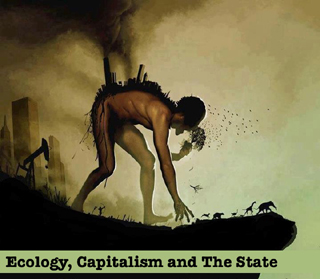
Ecology, Capitalism and The State

By L.S.R. - Edinburgh Anarchist Federation, June 21, 2014

Disclaimer: The views expressed here are not the official position of the IWW (or even the IWW’s EUC) and do not necessarily represent the views of anyone but the author’s.

Modern civilisation as we know it faces a number of major threats. Escalating economic inequality and an increasingly atomised society could lead to large-scale social breakdown. The depletion of natural resources is having a profound effect on the environment. As climate change continues to worsen, the ecosystems upon which human and non-human life depend are subjected to intolerable conditions. States across the globe have long since acquired the means by which to exterminate the species several times over, and given the continued plundering of natural resources in the pursuit of profit, the possibility of a nuclear war over what's left doesn't seem too unlikely.

These crises are often portrayed in the mass media as though they are separate from one another. They have different causes and thus, they can be dealt with in isolation. However, this approach is proving itself to be inadequate, given that these crises are continuing to deteriorate, and accumulating evidence suggests that, far from being separate, these crises are linked to one another, culminating in a 'perfect storm'.

Solidarity Economies: A Guerrilla War Against Capitalism

By Beverly Bell and Jessica Hsu - Toward Freedom, June 3, 2014

Disclaimer: The views expressed here are not the official position of the IWW (or even the IWW’s EUC) and do not necessarily represent the views of anyone but the author’s.

At the first World Social Forum at the end of the 1990’s, participants started looking for alternatives. There are a lot of authors who started to theorize about different forms of economies. They started to rescue the idea of solidarity economy, based on the experience of cooperatives, indigenous practices, practices from different parts of the world and different economies.

This came to be called the solidarity economy, basically a concept rescued by Chilean sociologist Luis Razeto Migliaro. It refers to different economic practices in which monies and profits are at the service of the common good. They are practices based in the articulation of collaborative and cooperative process among people, and where the center of the actions is the well-being of people.

Solidarity economy goes far beyond a simple practice. It’s a science that is taking shape and that is based, to a certain point, on the contributions of Marxism and contributions about the labor economy developed by Marxists. For me, I add five elements. First is self-management: a way to democratize the management of the economy. Second is gender: the participation of women through employment and recognition of domestic work as a contribution to the economy. Third is fair trade at an international level, a movement which shows the market is false. Fourth is food sovereignty, based on the rights of people to produce and to consume what they produce. Fifth is ecological economywhich can be changed to savethe biospherewhich is the entire systemof life, the social, political and natural processes that comprise life on our planet. Ecological economy is also an indigenous concept,an expression of how the relationship among humans and between nature and life can be harmonized,because solidarity economies look at the preservation of life. I'm not just talking about human life, but of all life, of Earth, the Cosmos. It is based on a state of interdependent coexistence with people. It recognizes that our happiness is based on that spirit; not in consumption, not in competing and showing that I am better or bigger than you, but simply: I give you, you give me, we share, and from that blooms a new form of culture. I hope that a new cycle will begin where human spirit and love shall be the dominant forces on the planet.

New Environmentalists Are Taking Bold Action - It's Working

By Kevin Zeese and Margaret Flowers - Alternet and Popular Resistence, May 23, 2014

Disclaimer: The views expressed here are not the official position of the IWW (or even the IWW’s EUC) and do not necessarily represent the views of anyone but the author’s. 

No longer dominated by the traditional “Big Green” groups that were taking big donations from corporate polluters, the new environmental movement is broader, more assertive and more creative. With extreme energy extraction and climate change bearing down on the world, environmental justice advocates are taking bold actions to stop extreme energy extraction and create new solutions to save the planet.  These ‘fresh greens’ often work locally, but also connect through national and international actions.

The recent national climate assessment explains why the movement is deepening, broadening and getting more militant. The nation’s experts concluded that climate change is impacting us in serious ways right now.  It is no longer a question of whether climate change is real – the evidence is apparent in chaotic seasonal weather; floods caused by heavier downpours of rain and deeper droughts; more severe wildfires in the West; the economic impacts of rising insurance rates, as well as challenges for farming, maple syrup production, and finding seafood in the oceans, among many others.

The U.N. Intergovernmental Panel on Climate Change (IPCC) recently issued its third report. The world’s scientists found that taking action now to mitigate climate change is less expensive than doing nothing. German economist Ottmar Edenhofer, a co-chair of the IPCC committee wrote: “We cannot afford to lose another decade. If we lose another decade, it becomes extremely costly to achieve climate stabilization.” Previous reports have warned of the dangers of human-induced climate change, e.g. faster sea level rise, more extreme weather, and collapse of the permafrost sink, which would further accelerate warming; as well as a breakdown of food systems, more violent conflicts, and making some currently habited and arable land virtually unlivable.

The IPCC and national assessment create a sense of urgency even though the reality is these documents understate the risks and the need to end the use of fossil fuels.  This week it was reported that the IPCC’s language was toned down during the political review in which countries that produce carbon fuels, like Saudi Arabia, Brazil, China and the United States, edited language to protect fossil fuel interests.

The effects of the race to extract every ounce of fuel from the Earth can’t be hidden. A report this week found US oil spills increased by 17% in 2013, with more than 20 per day leaking 26 million gallons of oil, fracking wastewater and more. In February significant five fossil fuel accidents were reported in four days. This week Los Angeles was the latest to experience the impact of an oil spill when 50,000 gallons of crude oil flowed down their streets and required evacuation.  The adverse environmental and health effects of all forms of energy extraction are coming to light from mountain top removal for coal in Appalachia to uranium mining in the West. Even four years after the oil spill in the Gulf of Mexico, there is no restoration in sight.

Climate Change and Human Alienation

By Javier Sethness - Dissident Voice, April 26, 2014

Disclaimer: The views expressed here are not the official position of the IWW (or even the IWW’s EUC) and do not necessarily represent the views of anyone but the author’s.

[The] self-alienation [of humanity] has reached such a degree that it can experience its own destruction as an aesthetic pleasure of the first order.
– Walter Benjamin1

At the end of last year, the Humanist Workers for Revolutionary Socialism (HWRS) published a provocative position paper which presents their analysis of the climate crisis: “Alienation, Climate Change, and the Future of Humanity.” Aside from discussing the very real threat which anthropogenic climate disruption poses to humanity and terrestrial nature generally considered, the HWRS in this essay develop a theory of human alienation based on the thought of Karl Marx and Erich Fromm and posit such alienation as the main obstacle for the emergence today of radical mass-movements from below that would check the increasingly fatal trends toward unprecedented levels of suffering and death and global ecocide promised by climate catastrophe. Being Leninists, however, the HWRS recommend “revolutionary” party leadership as a means of directing the alienated masses toward the enacting of anti-capitalist social transformation and the rational mitigation of climate destruction. Clearly, such a recommended solution is highly problematic—yet the HWRS paper presents enough critical points for reflection and contemplation to merit a brief discussion of it here.

Pages

The Fine Print I:

Disclaimer: The views expressed on this site are not the official position of the IWW (or even the IWW’s EUC) unless otherwise indicated and do not necessarily represent the views of anyone but the author’s, nor should it be assumed that any of these authors automatically support the IWW or endorse any of its positions.

Further: the inclusion of a link on our site (other than the link to the main IWW site) does not imply endorsement by or an alliance with the IWW. These sites have been chosen by our members due to their perceived relevance to the IWW EUC and are included here for informational purposes only. If you have any suggestions or comments on any of the links included (or not included) above, please contact us.

The Fine Print II:

Fair Use Notice: The material on this site is provided for educational and informational purposes. It may contain copyrighted material the use of which has not always been specifically authorized by the copyright owner. It is being made available in an effort to advance the understanding of scientific, environmental, economic, social justice and human rights issues etc.

It is believed that this constitutes a 'fair use' of any such copyrighted material as provided for in section 107 of the US Copyright Law. In accordance with Title 17 U.S.C. Section 107, the material on this site is distributed without profit to those who have an interest in using the included information for research and educational purposes. If you wish to use copyrighted material from this site for purposes of your own that go beyond 'fair use', you must obtain permission from the copyright owner. The information on this site does not constitute legal or technical advice.