You are here

green-anarchism

Get Intersectional! (Or, Why Your Movement Can't Go It Alone)

By Kristin Moe - Yes Magazine, April 4, 2014

Disclaimer: The views expressed here are not the official position of the IWW (or even the IWW’s EUC) and do not necessarily represent the views of anyone but the author’s.
"Intersectionality" has evolved from a theory of how oppression works to a notion of how people can fight it.

"There is no such thing as a single-issue struggle because we do not live single-issue lives." –Audre Lorde

Here’s the scenario: This year’s epic drought devastates agriculture in California. Water use is rationed, so the cost of grain goes up, and, because cattle eat grain, the cost of beef goes up too. To cut expenses, the owners of a fast food restaurant cut a worker's wages and benefits by a couple bucks an hour. Next month he won’t be able to send money to his wife and kids back in Mexico, where the same drought is also decimating farms—and may be contributing to even more northward migration.

What’s the origin of the restaurant worker’s predicament?

Is it climate change, which makes droughts more severe and more likely to persist? Is it the labor policies that allowed the worker's wages to be cut? Or is it that NAFTA has flooded the Mexican market with cheap, U.S.-grown corn since 1996, forcing him to leave his family’s farm and migrate to California in the first place?

The likely answer is that it’s a little bit of everything. “People don’t have one dimensional identities as human beings,” says Brooke Anderson—a Labor Fellow at the Oakland-based nonprofit, the Movement Generation Justice and Ecology Project—and the issues that affect them aren’t one-dimensional, either.

There’s a word for this kind of thinking: "intersectionality." And while the word has been around for more than 25 years, it’s being used more and more frequently all over in social justice movements today, from climate to reproductive rights to immigration. It’s a way of thinking holistically about how different forms of oppression interact in people’s lives. More recently, it's also led to a more collaborative form of organizing that reflects that, rather than taking on one issue at a time.

Anarchist Materialism: Can We Start Having a Revolutionary Labor Strategy?

IWW Disclaimer: The views expressed here are not the official position of the IWW (or even the IWW’s EUC) and do not necessarily represent the views of anyone but the author’s.

Authors' Disclaimer: This piece is designed to challenge some prevailing attitudes of Class Struggle Anarchists in the US.  The arguments should not be seen as a critique of individual behavior but rather of structural tendencies which hopefully will produce a constructive discussion. 

It should be apparent to anyone viewing the labor movement in the US that it has arrived at a turning point.  Despite economic stagnation and a reduction in comparative household wages, business unions are in a weaker position than they have been in almost 100 years.  Meanwhile there seems to be a lack of discussion about how radical labor militants can seize this opportunity to become relevant… much less win.  If we want a revolutionary change in economic and social structures, then it is necessary to build the power and capacity that can actually achieve it.

However, in order to build power, we must first determine where power lies.  One such way is to map out economic and community structures and find out where anarchist militants can be the most useful.  In labor organizing it is vital to understand the demographics and profit generation of specific industries, capital investment, percentage of GDP, modes of production (the manner and relationships of production), transportation choke points, and important utilities (such as power companies) just to name a few.

From there it is important to develop and prioritize a strategic orientation.  What are the stages that the US needs to go through in order to actually overthrow the system?  First the current period should be thought out.  What are the current realities both in terms of where our strengths are and that of the rest of the left and working class, as well as our opponents?  Is capital in advance or retreat?  Are we in a moment of structural reorganization and if so, where in the country?  Manufacturing may be shrinking in the Midwest but retooling in the Southwest and growing in the Southeast.  There could be increasing mechanization in the ports, but also expansion to keep up with growing population demand.  Food production may be shifting in scale, labor, and products as it becomes industrialized or shifts to accommodate trade agreements.  But this must be researched to determine the exact material conditions that exist.  Only then can we decide how to begin social insertion and develop mature national strategies.

In Each Other we Trust: Coining Alternatives to Capitalism

By Jerome Roos - Roar Magazine, March 31, 2014

Disclaimer: The views expressed here are not the official position of the IWW (or even the IWW’s EUC) and do not necessarily represent the views of anyone but the author’s.

Beyond God and state, it’s money that rules. Can we still imagine alternatives? And what role will recent innovations like Bitcoin play in the struggle?

One doesn’t need to subscribe to Gilles Deleuze’s somewhat obscurantist post-structuralism to recognize that the French philosopher made at least two extremely prescient observations. First, his hypothesis in the early 1990s that Foucault’s disciplinary society, with its schools, prisons and mental asylums, had ceased to be the paradigmatic mode of governmentality under neoliberalism and was instead giving way to a nascent “state of control.” And second, his related observation that in this emerging control society the money-form assumes renewed centrality within the reproduction of capitalist power relations. “Beyond the state,” Deleuze wrote, “it’s money that rules, money that communicates, and what we need these days isn’t a critique of Marxism, but a modern theory of money as good as Marx’s that goes on from where he left off.”

Interestingly, Deleuze tied these two observations together with the chains of debt, which he considered to be the “universal condition” of capitalist control. In his widely-cited Postscript of 1992, he wrote that “man is no longer man confined, but man in debt.” I was reminded of these prescient words when I attended the fascinating MoneyLab conference in Amsterdam last weekend. Organized by the Institute of Network Cultures, the event brought together a smattering of intellectual superstars like Saskia Sassen and Franco ‘Bifo’ Berardi, alongside a diverse and international group of scholars, artists, activists, hackers and heterodox economists, including past ROAR contributors Max Haiven and Brett Scott. The central aim of the groundbreaking interdisciplinary gathering was to explore “experiments with revenue models, payment systems and currencies against the backdrop of ongoing global economic decline.”

Redefining Green Anarchism - That Dreaded "I" Word

By That Green Union Guy - December 31, 2013

Disclaimer: The views expressed here are not the official position of the IWW (or even the IWW’s EUC) and do not necessarily represent the views of anyone but the author’s.

The IWW (and green syndicalists) want to replace capitalism with "One Big (earth destroying) Factory", or so the story goes among some self-described radicals who would so quickly dismiss us.

To say the IWW has an I-dentity crises would be the mother of all understatements. For half a century, we Wobblies have struggled to disabuse people of the widely believed--though completely erroneous--notion that the "I" in "IWW" stands for "International". No, we're not the "International Workers of the World," we're the Industrial Workers of the World.

It would be a major digression to explain how the "International" mislabeling came about. We're not really certain even we know, and that is not actually the heart of the matter I wish to address. Thanks to recent scholarship and a spate of really good books about the One Big Union, perhaps resulting from the IWW's centenary in 2005, people are finally getting the actual "I-dentity" of our first initial right (finally). Of course, this carries with it a new set of I-dentity problems.

For many people, The word "industrial" conjures up images of a factory, with scenes from Upton Sinclair's The Jungle or other exposés of satanic mills vividly dominating those visions. Along with that notion, the horrors of Fordist factory regimentation of the worst sort enter their minds, and not without good reason.

As someone who actually worked in a factory (a steel processing warehouse in Fremont, California to be precise) albeit briefly (five months during the late spring and summer of 1997), I can attest to the veracity of what it's like to work in one of them. It's anything but paradise--though of course--I was working under capitalist economic conditions and the business union that allegedly "represented" me was a more than willing collaborator to them.

The machines were loud and dusty--not to mention greasy (lubricated with whale fat, no less!), the facility fraught with dangers, and the work rules stiffly regimented. Although there was a good deal of safety training (in fact we had weekly, hour-long meetings), it was still very much a death trap. No doubt the union, in this case, ILWU Local 6, had much to do with the token safety measures, but in spite of the union, the place was a deeply alienating work environment.

The minds of my fellow workers had been deeply and thoroughly colonized. Most of them were quite reactionary, and--being a male dominated work environment, deeply sexist and homophobic. They saw the union as an outside agency, and (rightfully) criticized it for its class collaborationism (if the myriad examples of graffiti decrying "Local Sux" evident throughout the grounds was any indication). However, such sentiments were no doubt welcomed or even tacitly encouraged by the bosses, and a year or two after I was "laid off" under somewhat questionable grounds, the union was busted when the facility relocated to Stockton, California.

One needn't work in a factory to understand it, though. During the post war boom, enough working class people did work in factories, and their stories have been passed on through family lore. If that isn't enough, there are plenty of accounts of what factory life is like. Consider, for example, Judi Bari's expose of working conditions in the Louisiana-Pacific sawmills of Mendocino County based on the first hand accounts of at least two mill workers.

When some hear that the "I" stands for "industrial", they immediately flash on such nightmare visions and assume that we Wobblies envision that the new society that we hope to build within the shell of the old will look like that! (horrors!!!)

Capitalism Must Die (Stephanie McMillan)

By Stephanie McMillan - Open Source, November 16, 2013

The purpose of this project is to contribute to a collective process of analyzing our objective conditions and clarifying concepts in service to the struggle to defeat capitalism. It rests on, and elaborates, several basic premises. Premises:

  • The capitalist system is evil and omnicidal. It needs to stop.
  • It will not disappear or collapse by itself. If allowed to continue, it will devour all life on Earth.
  • Capitalism can only be eliminated by overthrowing it in a collective revolutionary process. It can not be reformed out of existence, escaped, or replaced from within.
  • Capitalism is a continuously expanding mode of production. Capital struggles for its own self-reproduction. Capitalists accumulate surplus value, which is converted into more capital, through the exploitation of workers as they convert the natural world into commodities.
  • The fundamental contradiction of capitalism is capital vs. labor. Its manifestation is the social relationship of domination of one class (workers) by another (capitalists). Its expression is class struggle.
  • The working class, or proletariat, is in an antagonistic and strategic position in relation to capital. In liberating itself, it liberates all the dominated classes.
  • The proletariat is the only class able to offer an alternative to capitalism. All other classes will tend to reproduce it or some other form of class society.
  • In the current crisis of global capitalism, objective conditions are ripening for revolution, but subjectivity (ideology, or consciousness) is lagging, weakening popular mass struggles.
  • In order to fulfill its historical mission, the proletariat must become class conscious and appropriate its own theory, which is the synthesized knowledge gained from its own struggles.
  • Theory is collectively constructed in the process of class struggle. It can’t develop separate from practice. In the dialectical relationship between theory and practice, practice is primary and determinate. Theory is for the purpose of practice, to transform social relations.

PDF File

Capital Blight - The Root of the Problem

By x344543 – October 8, 2013

Disclaimer: The views expressed here are not the official position of the IWW (or even the IWW’s EUC) and do not necessarily represent the views of anyone but the author’s.

I really would rather not be writing this; I honestly wish that I didn’t feel that it was necessary. However, some things simply cannot be left unaddressed.

As one of the half dozen or so charter members of the IWW’s Environmental Unionism Caucus, I comb through a good deal of class struggle and/or environmental news sources, since one of our goals is raising awareness. These sources come from a variety of directions, including syndicalist, socialist, anarchist, progressive environmentalist, and deep green (though not Deep Green Resistance, because of the latter’s transphobia and rigid primativist tendencies). Naturally, one of the most logical sources for this last tendency is Earth First!. Rarely is any source 100% in line with what I and my fellow “Green Wobblies” think represents our position (loosely defined though that may be), and Earth First! is no exception. That which doesn’t fit is generally ignored, and we “stand aside” as they say in the language of modified consensus process. Sometimes, however, our sources will publish something so egregiously wrong, in our opinion, that we feel compelled to respond.

Saturday, October 5, 2013, Earth First! re-published just such a story, called Thanks A Lot, Nebraska, by the Tucson chapter of Root Force (TURF).

What is Root Force you ask? Here’s their mission statement:

Root Force (Fuerza Raíz) is a campaign that recognizes the fundamental connection between the oppression of the Earth and the oppression of its people. The precursor to ecocide and genocide is the separation of people from the land so that both can be exploited. Thus Root Force is a biocentric campaign, asserting that no oppression can be overcome without addressing the relationship a society has with the Earth. To achieve either social or ecological justice, we must achieve both.

Therefore, Root Force aims to help dismantle the system that is killing and enslaving our planet and its people. This will be achieved by (1) identifying the system’s strategic weak points, and (2) targeting those points, thus providing an offensive component to existing ecodefense, international solidarity, and anti-colonialist efforts.

One strategic weak point is the U.S. dependence on the resources of Latin America. The exploitation of these resources is dependent on transportation, energy, and communications infrastructure. Hence this U.S.-based campaign focuses its efforts on opposing infrastructure expansion projects in Latin America, such as Plan Puebla Panama (PPP) and the South American Regional Infrastructure Integration Initiative (IIRSA).

The campaign provides a framework for people to take effective action in solidarity with local resistance to these projects without traveling to Latin America. It is structured to allow for a diversity of tactics, to be undertaken by a wide network of autonomous individuals and groups.

This seems reasonable enough; in fact, I cannot find any really objectionable position in this mission statement at all. Much of it could easily mesh with the Preamble to the IWW Constitution, so having established that, I find the content of the article itself to be quite disturbing.

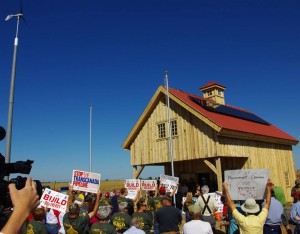
Essentially, TURF is miffed that a coalition including Nebraska ranchers and farmers, the Nebraska Farmer’s Union, Bold Nebraska, 350.org, Sierra Club, Credo, and billionaire Tom Steyer are protesting the impending construction of the controversial Keystone XL Pipeline by constructing a wind- and solar- powered barn in its projected pathway.

Granted there are many criticisms one could make of this action, such as the fact that a great many of these folks are capitalists or enablers of capitalists, the fact that Keystone XL is not the only pipeline we need to worry about, or the obvious fact that Keystone could simply build the pipeline somewhere else (there are enough rural counties sufficiently beholden to corporate fossil fuel interests to ram through the permits barn or no barn), but in spite of these shortcomings, there are lot of good things that could be said about the project as well, including—in my opinion at least—the advocacy of renewable energy, such as wind and solar which could allow a state such as Nebraska which has a fairly good abundance of both to potentially generate all of its own electricity and perhaps even export a bit.

No doubt doing so would lessen that state’s reliance on fossil fuels, and though some of those are extracted and refined locally, the impact of those on the environment effects us globally in ways that greatly outweigh any significant impact from wind and solar. Certainly that would seem to fit the mission of Root Force would it not? Evidently the answer is a resounding “no”. Root Force is overwhelmingly opposed to renewable energy arguing that it simply props up the existing system and perpetuates the destruction of the Earth (and to be certain, the Earth First! Journal published Root Force's position paper on renewables in February 2009).

To Stave Off Zombie Apocalypse, Organize a New Society Within the Shell of the Old

By x365097 - Southern Maine IWW, July 13, 2013

Disclaimer: The views expressed here are not the official position of the IWW (or even the IWW’s EUC) and do not necessarily represent the views of anyone but the author’s.

Let’s think back to late summer, 2008 — half a decade ago, right about now. It had been more than five years since the invasion of Iraq by the US, and nearly six years since the invasion of Afghanistan. The PATRIOT Act was still in the news, there was massive anti-Bush agitation from liberals and the left, and many people were looking forward to a change of regime — any change — in 2009.

The financial catastrophe that would soon arrive, however, punctuating the presidency of George W. Bush like a second 9/11, would make matters unfathomably worse, complicating the US economy for years to come and paving the way for the austerity agenda to trample workers’ hard-won economic rights like Orwell’s proverbial jackboot to the face. Of course, there had been preliminary signs of trouble; those had been plain to see. But when the blows finally started hammering down, they caught almost everyone unprepared.

Individualist survivalists, already bolstered by the much-hyped threat of terrorism, came out of the woodwork to sell emergency water filters and K-rations to the gullible and (somewhat justifiably) afraid. The average American worker hunkered down, usually alone or with a few family members, and prayed that the worst — a foreclosure, an eviction — might pass them by. And the media told us endless stories about the struggle to survive amid the mindless hordes who would ravage the remains when it all finally broke down outside the “Green Zone” of Wall Street.

It didn’t — and still doesn’t — have to be this way.

Why revolutionary syndicalism?

By Tom Wetzel - Ideas and Action, October 31, 2012

Disclaimer: The views expressed here are not the official position of the IWW (or even the IWW’s EUC) and do not necessarily represent the views of anyone but the author’s.

1. A Strategy for Workers Liberation

Capitalism is at its heart an oppressive and exploitative economic system. The core is the class structure, in which the majority are dispossessed of the means of production of goods and services, and must submit to bureaucratic production regimes. These regimes control our labor so as to pump out wealth privately accumulated by the plutocrats at the top of the heap (and paying high salaries to the bureaucratic class of managers and high-end professionals), and backed up by the coercive force of the state. Working people are thus an oppressed class, although it is also internally quite heterogeneous and various sub-groups are oppressed in various diverse ways.

The working class can’t be free and can’t ultimately ensure well-being for itself unless it can take over the control of the process of production (which includes transportation and distribution and production of services), and the land and all the means of production, becoming masters of production, in control of our own work of and technological development. To do this means dismantling the institutional power of the bureaucratic/managerial and capitalist classes, so that we are not subordinate to any dominating class. As Ralph Chaplin put it in “Solidarity Forever”:

All the world that’s owned by idle drones is ours and ours alone.
We have laid the wide foundations; built it skyward stone by stone.
It is ours, not to slave in, but to master and to own.

Workers self-management of all of social production is thus a necessary condition for working class liberation. If we don’t control production some other class will, and then we’re not free. This means there must be a mass worker movement that has the capacity and aspiration to take over the means of production, and continue social production under direct worker’s management. This takeover of production is not all there is to social emancipation but this is very basic in that the working class cannot liberate itself if it doesn’t do this.

Also, by “takeover of production” I do not mean that the existing workplaces and techniques of production are continued without change, but with workers replacing management. I also mean that the working class then sets up a system of working class control that re-organizes social production, works to change technology, works to develop worker skills to break down hierarchical divisions of labor, changes production to ensure our species survival through a change in ecological impacts, and in general works to make social production more socially beneficial. Breaking down the present class division between subordinate workers and middle management and professionals also requires major changes in the educational system and the way that learning is linked with social production.

But to achieve its liberation the working class needs to have a strategy. Part of the point to the focus on the struggle between workers and bosses is that this provides a lever for changing society. Workers have the potential to exert power here because the flow of profits to the capitalists requires our cooperation in production. Thus the ability to bring production to a halt is a potential form of power the working class has. Again, to quote Ralph Chaplin:

They have taken untold millions that they never toiled to earn,
But without our brain and muscle not a single wheel can turn.
We can break their haughty power, gain our freedom when we learn
That the union makes us strong.

END: CIV—Against Jensen and for a Real Ecological and Working Class Revolution

By, DB - September 1, 2011

The following article was submitted to First of May for publication. The author, DB, is a friend, comrade, and fellow organizer in the IWW. It is a critique of the Derrick Jensen inspired film, End:CIV.

Derrick Jensen represents the current peak synthesis of primitivist and insurrectionist thought. And while both trends are declining within anarchism thanks to the global upswing of mass struggle against austerity, like in Egypt, Wisconsin, Spain, and so on, such trends are still able to get a good event together in Minneapolis, like the hundred or so people who attended the showing of END: CIV, a movie inspired by Jensen’s writing, and like it, a dead end for any relevant conversation on the present moment.

There are deep, insolvable failures in Jensen’s work with regard to revolution, collapse, and militancy, but let us begin with the strengths of Jensen’s approach so we can demolish his politics without losing what value they contain.

Strengths of Jensen’s thought

First, they correctly tie the atrocities committed to the earth to the atrocities committed to human beings and note the connection between capitalism, colonialism, and the destruction of the earth.

Second, they notice the major human crisis and transition in which we find ourselves in, a capitalist transition as US power declines, a transition from the energy staple of the whole economy—oil—and the real possibility of significant climate change.

Third, they point out the inadequacy of current responses, green capitalism, change through consumption, and so on, and the craziness of projects like ethanol, the tar sands, fracking, and so on.

Fourth, and finally, they emphasize that a militant, and indeed, revolutionary response is crucial to making necessary changes, and that nonprofit, corporate, and nonviolent approaches are not sufficient.

Earth First! Means Social War: Becoming an Anti-Capitalist Ecological Social Force

By Liam Sionnach - Earth First! Journal, April 3, 2009 [PDF Available]

Glossary of Terms

affect:

1. A material influence or alteration that produces empowerment. 2. To act upon (as a person or a person’s mind or feelings) so as to provoke a response; influence. Affective struggle changes those struggling, as well as the world around them.

effect:

The power to produce external results. Her protest had no effect.

desire:

A productive force; the information that circulates through bodies and produces action. We don’t have desires, we are produced through and as vessels of desire.

social war:

The narrative of “class struggle” developed beyond class to include the complexities and multiplicities of all social relations. Social war is conflict within all hierarchical social relations.

This is another contribution to the ongoing discussion about evolving EF! — perhaps beginning again, from a different angle.

Pages

The Fine Print I:

Disclaimer: The views expressed on this site are not the official position of the IWW (or even the IWW’s EUC) unless otherwise indicated and do not necessarily represent the views of anyone but the author’s, nor should it be assumed that any of these authors automatically support the IWW or endorse any of its positions.

Further: the inclusion of a link on our site (other than the link to the main IWW site) does not imply endorsement by or an alliance with the IWW. These sites have been chosen by our members due to their perceived relevance to the IWW EUC and are included here for informational purposes only. If you have any suggestions or comments on any of the links included (or not included) above, please contact us.

The Fine Print II:

Fair Use Notice: The material on this site is provided for educational and informational purposes. It may contain copyrighted material the use of which has not always been specifically authorized by the copyright owner. It is being made available in an effort to advance the understanding of scientific, environmental, economic, social justice and human rights issues etc.

It is believed that this constitutes a 'fair use' of any such copyrighted material as provided for in section 107 of the US Copyright Law. In accordance with Title 17 U.S.C. Section 107, the material on this site is distributed without profit to those who have an interest in using the included information for research and educational purposes. If you wish to use copyrighted material from this site for purposes of your own that go beyond 'fair use', you must obtain permission from the copyright owner. The information on this site does not constitute legal or technical advice.


