You are here

green unionism

Appeal from Railroad Workers United: No Single Employee Crews!

Public Comment Period Extended to June 15th at 11:59 PM EDT 

Tell the FRA:

"No Single Employee Train Crews!"

Email Your Message today!

Dear RWU Members & Supporters:

On March 15th, the Federal Railroad Administration (FRA) offricially announced a Proposed Rule on the whole question of crew staffing for trains in the United States. After careful consideration, RWU has come to the only conclusion possible: the Proposed Rule provides a road map for any and all rail carriers to obtain the FRA's blessing to run trains with a single employee. Therefore, RWU cannot support this Proposed Rule, period.

We continue to agree with the joint statement from nearly 7 years ago that the BLET and the UTU made in a joint Petition filed in June 2009 with the FRA on the question of traincrew  staffing which reads: “No conditions exist where one-person operations are safe.”  And since the Proposed Rule is predicated on the "safe" operation of trains with a single crew member, we must urge the FRA to promulgate a Rule that outlaws the practice. We urge all RWU members and all railroad workers to contact the FRA and tell them in plain language: "No single employee train crews!"

  • To write/FAX the FRA, click HERE.
  • To email the FRA, click HERE.
  • To view the RWU Letter to the FRA on the Proposed Rule, click HERE.
  • To view the FRA Proposed Rule, Click HERE.
  • To view the RWU Editorial on the Proposed Rule Click HERE.
  • To view a comprehensive article entitled "What's Wrong with Single Employee Train Operations?" with 21 reasons why they are unsafe and unworkable, click HERE.
  • To view the most recent RWU Resolution to Oppose Single Employe Operating Crews from March 2nd, 2015, see below or click HERE.
  • To view the original RWU Resolution on Single Employee Train crews from January 5th, 2010, click HERE
  •  

Union Members Don’t Oppose Environmental Protections: They’re Actually More Likely To Support Them

By Jeremy Brecher and Todd Vachon - In The Times, May 23, 2016

Union workers attacking environmentalists—it has become a trope of our time. But what do union members actually think about the environment?

In a study soon to be published in Labor Studies Journal, we report our findings on workers attitudes and behaviors regarding a variety of environmental issues. In particular, we examine the attitudes and behaviors of unionized workers to see how they may differ from the non-union respondents. The results might surprise those whose images of worker attitudes come only from the mainstream media.

Looking at data from national surveys, we find that union members are on average more likely than the general population to display pro-environmental attitudes and behaviors.

For example, in the General Social Survey (GSS), people were asked to agree or disagree with the statement “We worry too much about the future of the environment and not enough about prices and jobs today.” Forty-three percent of nonunion respondents disagreed—but 48 percent of the unionized respondents disagreed.

People were asked if they had signed a petition about an environmental issue in the past five years. Twenty-five percent of the general population said yes—but 32 percent of union members said yes.

Eight percent of the population belonged to a group whose main aim is “to preserve or protect the environment.” But 12 percent of union members belonged to an environmental organization.

Overall, we analyzed 19 survey items pertaining to the environment. On 13 of them, union members expressed more pro-environment sentiments than non-union members at a statistically significant level. On the remaining six items, there were no statistically significant differences between union members and the rest of the population.

This finding runs against the mainstream media mantra of “jobs versus the environment,” a frame which portrays unionized workers as self-interested and materialistic, putting their own personal gains above all else, including the environment. A more informed historical analysis would reveal a long record of environmental concern among unionized workers and their organizations that overlaps and intermingles with the sporadic “news event” conflicts that occasionally flare up between workers and environmentalists.

“Energy Without Injury”: From Redwood Summer to Break Free via Occupy Wall Street

By Desiree Hellegers - Counterpunch, May 23, 2016

On Sunday, May 15, more than a hundred climate change kayaktivists took to the waters of Padilla Bay in Anacortes, Washington, risking arrest to land on the banks of the Tesoro oil refinery. In the shadow of the refinery smoke stacks, they unfurled banners calling attention to the potentially lethal risks that fossil fuel workers confront each day on the job. “Seven Dead, No More Casualties, Tesoro Explosion April 2, 2010” read one banner focused on Tesoro’s checkered workplace safety record. “Solidarity is Strength, We are all workers,” read another banner. Yet another called for a “Just Transition,” as kayaktivists knelt on the ground, paddles in hand, in what organizers described as a demonstration of respect for the workers killed at the refinery, and for those still working in the refinery. The messaging on the banks of the refinery signaled the central challenge that climate change activists confront in trying to find common ground—if not common cause–with refinery workers.

The Anacortes actions were part of a global two-week wave of activism spanning six continents under the shared rallying cry to “Break Free” from fossil fuels. As actions unfolded in the U.S. from Albany, NY and Washington, D.C. to Chicago, Denver and Los Angeles, more than a thousand activists converged on Anacortes, just south of the Canadian border. The aim of activists was to confront, by land and sea, the role of big oil in rising global temperatures and sea levels–and to disrupt the flow of oil to the Shell and Tesoro refineries.

In the face of activists’ resolve to blockade the oil shipments to the port, both Shell and Tesoro suspended tanker and rail transport for the duration of the three-day action. Nonetheless, an estimated 150 activists camped out on the rails for two nights before the police moved in in the early hours of Sunday, May 15, arresting 52 activists and charging them with criminal trespassing.

In a phone interview, Eric Ross, organizing director of the Backbone Campaign out of Vashon, Island, WA, which handled much of the logistical planning and coordination for the water-based Break Free events in Anacortes, indicated that the workers at Tesoro, who daily face toxic exposure on the job, are among the many “casualties of extractive industries” and the byproduct of the “reckless endangerment” that defines the behavior of multinational corporations, whose main focus is on “extracting money.” “They’ve chosen to make their billions by extracting resources from communities that don’t consent to that reckless endangerment of our children, our communities and our climate,” Ross observed. Ross heralded the three-day cessation of oil transportation as a victory for Break Free: “I think it’s a really impressive show of the power of our movements and just how afraid these extractive industries are of organized people.”

Zarna Joshi, an activist with the grassroots group Women of Color Speak Out, was one of several speakers who addressed kayaktivists on the banks of Fidalgo Bay before they struck out for the banks of the Tesoro refinery. In a phone interview, Joshi described the Break Free action as the culmination of “a real building of momentum” over the past two years. She indicated that in the Pacific Northwest, climate activists have been “building relationships with people in labor, building relationship with people in the First Nations—particularly Salish Sea First Nations—building community and building trust.”

In fact, an entire day of the three-day event was devoted to a Native-led march and ceremonies at March Point in the shadow of the Shell refinery. While the 1855 Point Elliott Treaty included March Point within the boundaries of the Swinomish Reservation, an executive order by President Ulysses S. Grant in the 1870s redrew the boundaries of the reservation to exclude March Point, ultimately opening it up for development by Shell and Tesoro. Last year, Shell was “fined $77,000 by the Washington State Department of Labor & Industries for an uncontrolled release of toxins that sickened residents and sent at least two people to the hospital.”

Skagit County, Joshi observed, “has one of the highest levels of cancer in the entire state, and those levels of cancer are linked to the pollution coming from the refineries.” Activists, Joshi said, “were standing in solidarity with workers, and not just with workers at these refineries, but with workers around the whole region whose jobs are being threatened by the fossil fuel empire, by climate change, by health crises.”

Among the participants in the Anacortes actions was Laurie King, former long term organizer with Portland Jobs with Justice, now retired, who planned to attend one of a number of workshops focused on effecting a “just transition” for workers currently employed in the fossil fuel industry. “I’m a union activist, so I’ve been asking a lot of questions about what do the workers think and what kind of jobs do people think of fighting for for the workers. I think that this whole movement has to be a two-pronged movement and that the same energy that goes into the desire to save the planet for everyone also has to be into a just transition with the same fervor, the same degree of planning and we have to figure out really concrete ways to have a just transition.” Over her decades of union organizing, King observed, “I’ve talked to many, many workers, and if they had a choice, of course they’d rather be doing things that are not hurting themselves or the planet. The thing is that it isn’t easy to find another well paying job, and we environmentalists have to deal with that in the most deep way and not just slough it off.” King went on to observe, “I think we have to be just as fervent about fighting for jobs for the workers who are in the fossil fuel industries at the same time that we’re fighting against fossil fuel structures.”

EcoUnionist News #105

Compiled by x344543 - IWW Environmental Unionism Caucus, May 25, 2016

The following news items feature issues, discussions, campaigns, or information potentially relevant to green unionists:

Lead Stories:

Ongoing Mobilizations:

The Thin Green Line:

Just Transition:

Bread and Roses:

This Is What Insurgency Looks Like

By Jeremy Brecher - Labor Network for Sustainability, May 22, 2016

In a small church in the Albany, NY’s low-income, predominantly African-American South End, forty people were gathered for a community meeting. They were organizing a protest against trains carrying potentially explosive oil – dubbed by the residents “bomb trains” — that were running through their neighborhood. City Counselor Vivian Kornegay told the group that many municipalities had opposed the bomb trains and other dangerous fossil fuel infrastructure, but had little power to protect their residents; it was up to a “people’s movement” to do so. “What we want is for all of us to be free, healthy, and safe – and for our planet to be a better place to live.”

Maeve McBride, an organizer for 350.org, explained that the protest was part of a global campaign of direct action and civil disobedience aiming to keep 80% of all fossil fuels in the ground. Pastor Mark Johnson of the St. John’s Church of God in Christ said, “I heard at a meeting last night that we have a constitutional right to clean water and clean air.” Maeve McBride explained that the action was part of a “new wave” that was drawing on a “new paradigm” – “using civil disobedience to protect the public trust,” which included water, air, and the climate itself.

Organizers had met with officials from the police and sheriff’s offices and reported, “they abhor the trains – and are very supportive of us.” Then the group received direct action training. They read out loud the “action agreement” pledging nonviolent behavior and mutual support. Then they lined up to march and while police officers (played by the trainers) ordered them to move away, they scrambled onto an imaginary railroad track. Later that evening the steering committee for Albany Break Free planned outreach to supporting organizations, phone banks, canvassing, leafleting, and details of the action.

The Albany organizers had learned about the “new paradigm” when 350.org North American co-organizers of Break Free From Fossil Fuels had decided to use the “public trust” principle to frame US Break Free actions and formed a Break Free Public Trust Work Group to spread the idea. Some on the The Break Free Albany steering committee had participated in the working group’s webinar on using the public trust doctrine, and they decided to integrate the Public Trust Proclamation into their “topline message” and to hand out the Break Free Public Trust Proclamation to all participants. (The Proclamation appears at the end of this article.]

A week before the action the Albany Break Free steering committee defined their basic message. Potentially explosive crude oil “bomb trains” roll through Albany and surrounding communities, polluting the air and contributing to the climate crisis. Primarily low-income communities of color are put at risk. The urgent need to address climate change means that fossil fuels have to be left in the ground and a transition made to a “twenty-first century renewable energy economy.” They called for an end to all new fossil fuel infrastructure, including pipelines, power plants, compressor stations, and storage tanks. And they called for a just transition away from fossil fuel energy with training and jobs for affected workers, so “no worker is left behind.”

A Just Transition: Break Free

By John Paul Wright - RailroadMusic.Org, May 17, 2016

There is a suggestion called a Just Transition that is floating around parts of the labor and environmental communities. To fully understand this term, we as workers, community members, union members and activists would need to explore,

  1. What we used to have.
  2. When and how we transitioned historically.
  3. Where we want to go.

In 1803, President Thomas Jefferson, shortly after the Louisiana Purchase, commissioned a U.S Army expedition called the Corps of Discovery. The task was to map and claim the west before Britain and other European powers tried to claim it. Part of the mission was to find a water transportation route to the Pacific Ocean. In 1805, the Lewis and Clark expedition set sight on the Pacific Ocean. After finding no direct water route, they returned to St Louis in 1806. it took industry and the U.S Government sixty-four years after Lewis and Clark returned, to connect the nation by rail, from sea to shining sea.

In 1869, Leland Stanford, railroad baron and co-founder of Stanford University, drove the “golden spike” that connected the rails of the first transcontinental railroad. The railroad spike sits in the Cantor Arts Center at Stanford University. Before the spike was driven into the ceremonial railroad cross tie at Promontory Point, Utah, the United States had not yet been connected, ocean to ocean with a transportation policy.

As the railroad companies grew and people moved at speeds never before traveled across land, small communities were rapidly becoming connected to larger markets. Farming communities had access to rail transportation and industries popped up in the railroad towns. In 1913, Ford starts mass production on his first assembly line. On June 29th, 1956, the National Interstate and Defense Highways Act was enacted. It took industry 43 years to get a policy in place, that would give the automobile industry the green light to further transition this country from rail transportation of people, to personally owned vehicles.

The trucking industry was born, the railroad transitioned from steam to diesel fueled locomotives. The movement of industrial commodities replaced the passengers that were owning personal transportation. The nation’s population rapidly grew with the workers needed to build these new innovations and dreams. New industries were created with investment and taxation. The nation was more, so called secure, or was in a better position militarily, hence the name of the government policy that created the nation’s highway system.

Of course, this is a broad over simplification of many ideas, policies, historical facts and timelines. There were many other policies that were discussed and pitched. There were many laws, taxes and industrial failures and successes, as well as, iconic brands, dreams and ways of life that were transitioned or simply disappeared as one industry won favor over another.

EcoUnionist News #104 - Special #BreakingFree 2016 Edition

Compiled by x344543 - IWW Environmental Unionism Caucus, May 17, 2016

The following news items feature issues, discussions, campaigns, or information potentially relevant to green unionists:

Lead Stories:

Ongoing Mobilizations:

The Thin Green Line:

Just Transition:

Bread and Roses:

An Injury to One is an Injury to All:

Whistleblowers:

Carbon Bubble News #104

Compiled by x344543 - IWW Environmental Unionism Caucus, May 17, 2016

A supplement to Eco Unionist News:

Lead Stories:

Other Carbon Bubble News:

Utility Death Spiral News:

For more green news, please visit our news feeds section on ecology.iww.org; Twitter #IWWEUC; Hashtags: #greenunionism #greensyndicalism #IWW. Please send suggested news items to include in this series to euc [at] iww.org.

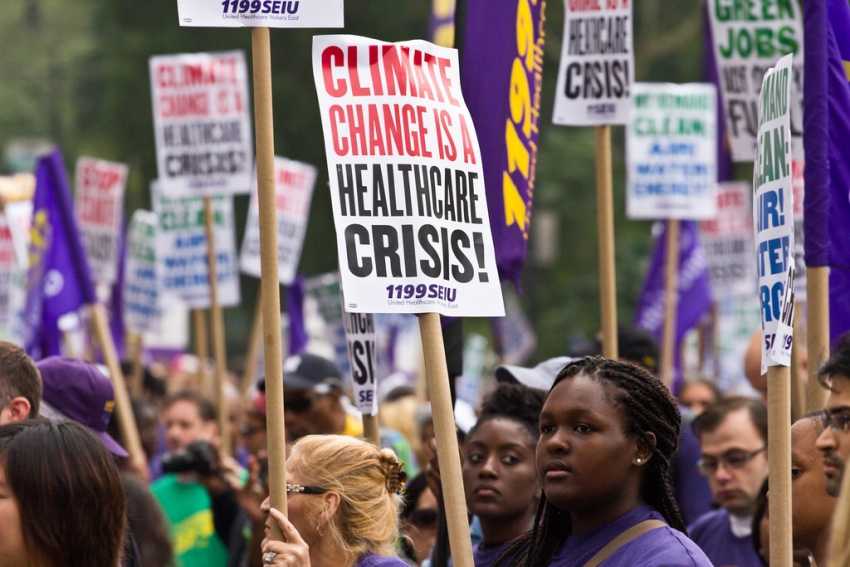
SEIU 1021 Resolution in support of Climate Justice Work

By SEIU 1021 - Resolution Adopted April 13, 2016

Note: The IWW is not affiliated with SEIU or any of its locals. This is posted for informational purposes only.

I. Climate Change is real. It is here. It is advancing. The only question is how bad things will become. We in Local 1021, our neighbors, and communities are already experiencing the effects of Climate Change in our work and lives. In California, headlines have focused on the drought caused by climate change, but the real effects will be far deeper and more severe than even that.

II. The world's scientists are almost unanimous in reporting that our environment is about to cross a point of no return that could endanger human life itself. This past year, SElU leaders and members were in Paris for the COP 21 meeting where the United States and 158 other countries established the ambitious goal of limiting the world's temperature rise to between 1.5 and 2 degrees Celsius, in order to avoid the worst effects of climate change.

III. Climate Change is largely fueled by carbon energy sources whose emissions are overwhelming our earth's ability to absorb that carbon. The buildup of carbon in our atmosphere is trapping heat and cooking our planet.

IV. Our economic system depends on extracting and depleting resources and creating waste at unsustainable levels. The environment is treated as an unlimited resource and waste dumping ground. Products are designed to be disposable to spur new sales and waste.

V. The same economic system that treats our environment as disposable also treats workers as disposable-leading to our country's extreme economic inequality. When corporations search the globe for ever lower wages and working conditions to produce the same product, it means wealth for a few but reductions in standard of living for the rest of us.

VI. SEIU's 21st Century Blueprint Committee report identified Climate Change and Income Inequality as major trends that are inherently linked, and that pose major challenges to all of us. The committee report states that: "...it is poor and working people who typically bear the greatest impact of pollution and extreme weather. In this respect, climate change is not only a global threat, but also major expressions of inequality."

VII. The combination of Economic lnjustice and Environmental lnjustice dumps a double dose of hurt on poor people, communities of color and other marginalized people that have historically borne the brunt of pollution and environmental hazards in their neighborhoods, resulting in severe and chronic health problems as we see in lower income communities from Richmond to Fresno to South LA.

VIII. For too long, our government at all levels and our public employees have been subjected to unprincipled attacks that undermine the value of our democracy and the services our communities rely upon. As Climate Change deepens, only public institutions will be able to develop the plans and marshal the resources needed to mitigate its worsening impact.

IX. As Public Employees and Members of SElU Local 1021 we are in a unique and strategic position to prove that government and our Unions defend the "Common Good" and are a force for good in our community. As Union Members and Working People, we have the ability to fight for solutions to climate change that specifically prevent disproportionate impacts on our communities and are "dedicated to improving the lives of workers and their families and creating a more just and humane society."

X. As public sector workers, we are responsible to education and create good environmental programs, policies, and solutions. We must demand the resources, training and capacity to do so; and must also fight to capture savings from innovations and efficiency so they are equitably shared with workers.

XI. We know that Winning for Working People requires building strong organizations and Alliances with Allies to fight for both Economic and Environmental Justice; and both SElU and Local 1021 have begun to build these alliances through local and national fights for economic and environmental justice.

Therefore be it resolved: SElU Local 1021 Leaders recognize Climate Change as a challenge and threat to the welfare of our Union's Members, workers, and communities everywhere; SElU Local 1021 Leaders recognize that while our Union's program of Organizing works to build power for members to win greater economic, social and racial justice, our efforts alone are not enough to win the "more humane society," all workers deserve; and we must partner with Allies in all progressive movements, and particularly Climate Change and Environmental Justice movement if we are to protect the healthy planet that all workers deserve;

SElU Local 1021 Leaders also recognize that we must work with our Allies to recognize and fight for Climate Change solutions that recognize the legitimate rights of workers to organize, their demands for economic justice and security, and the need for a Just Transition for workers in industries impacted by the move away from carbon to renewable energy sources.
To Accomplish these Goals SElU Local 1021 Leaders commit to making Climate Justice a part of our Union's Program. Some of these goals may include:

  • Educating Members, Officers and Staff about climate change and the need for climate justice. To include illustrating the interconnectedness and impact on, working people and our larger fights for economic and racial justice.
  • Developing a program of Action on Climate Change that puts to use our skills and expertise as Union Members and Public Employees to promote solutions that contribute to mitigating and adapting to the Climate Crisis and that protect and advance the rights and interests of all workers and our communities as a part of our Union Work, including areas such as but not limited to:
    • Common Good Campaigns
    • Bargaining Demands
    • Labor Management Partnerships
    • Political, Policy and Budgeting Work
    • Participation in State, County, Local "tables," where mitigation
    • and adaptation policies are being developed
    • Movement Coalition Building with Allies
    • Mobilizing Members to Action

Climate, Jobs, and Justice: A plan for a just transition to a climate-safe economy

By Jeremy Brecher - Labor Network for Sustainability, May 12, 2016

Can we radically reduce the climate-destroying greenhouse gases (GHGs) we put into the atmosphere, yet also increase jobs for American workers, protect those whose jobs may be threatened by climate policies, and reduce America’s inequality and injustice? A series of reports from The Labor Network for Sustainability and Synapse Energy Economics shows we can.

The plans to create jobs and build a more just society by putting people to work protecting the climate are laid out in the LNS Climate, Jobs and Justice Project. They project an effective, workable program for a just transition to a climate-safe economy. They include a broad national jobs program and detailed studies of local, state, and regional plans that provide opportunities for organizing around and creating economic alternatives while developing examples that can inspire further changes at a national level.

The Clean Energy Future

The Climate, Jobs, and Justice project begins with a report titled “The Clean Energy Future: Protecting the Climate, Creating Jobs and Saving Money,” prepared for the Labor Network for Sustainability [1] (LNS) and 350.org, [2] with research conducted by a team led by economist Frank Ackerman of Synapse Energy Economics. [3] It shows that the United States can reduce GHG emissions 80 percent by 2050 — while adding half-a-million jobs annually and saving Americans billions of dollars on their electrical, heating, and transportation costs. While protecting the climate has often been portrayed as a threat to American workers’ jobs and the U.S. economy, this report shows that a clean energy future will produce more jobs than “business as usual” with fossil fuels and will save money to boot.

Pages

The Fine Print I:

Disclaimer: The views expressed on this site are not the official position of the IWW (or even the IWW’s EUC) unless otherwise indicated and do not necessarily represent the views of anyone but the author’s, nor should it be assumed that any of these authors automatically support the IWW or endorse any of its positions.

Further: the inclusion of a link on our site (other than the link to the main IWW site) does not imply endorsement by or an alliance with the IWW. These sites have been chosen by our members due to their perceived relevance to the IWW EUC and are included here for informational purposes only. If you have any suggestions or comments on any of the links included (or not included) above, please contact us.

The Fine Print II:

Fair Use Notice: The material on this site is provided for educational and informational purposes. It may contain copyrighted material the use of which has not always been specifically authorized by the copyright owner. It is being made available in an effort to advance the understanding of scientific, environmental, economic, social justice and human rights issues etc.

It is believed that this constitutes a 'fair use' of any such copyrighted material as provided for in section 107 of the US Copyright Law. In accordance with Title 17 U.S.C. Section 107, the material on this site is distributed without profit to those who have an interest in using the included information for research and educational purposes. If you wish to use copyrighted material from this site for purposes of your own that go beyond 'fair use', you must obtain permission from the copyright owner. The information on this site does not constitute legal or technical advice.