More Green versus Yellow Unionism in Oakland

By That Green Union Guy - IWW Environmental Unionism Caucus, June 26, 2016

Author's note: this article is an update to an earlier piece, titled Green versus Yellow Unionism in Oakland.

Update: The City of Oakland voted 7-0, with one member absent, to ban coal handling, storage, and exports in the Port of Oakland on Monday, June 27, 2016. Over 50 union members supporting the ban on coal were present, and many spoke in favor of the ban.

As the No Coal in Oakland campaign comes to its climax, a vote by the Oakland City Council on whether or not to ban the storage and handling of coal exports (originating from coal mined in Utah) through the Port of Oakland, the developers who had hoped to sneak this plan through unnoticed by all, are pulling out all of the stops to try and salvage their failing schemes that have, thus far, blown up in their faces.

(Rather than recap all of the numerous details of this campaign here, readers are encouraged to visit the official No Coal in Oakland site as well as the No Coal in Oakland archives, maintained by members of the Sunflower Alliance, one of the No Coal in Oakland coalition members.)

One of the persistent lies, regurgitated again and again by the developers, is the claim that those of us who oppose coal exports are anti-jobs, anti-worker, and anti-union. This is complete nonsense.

For the record, many of the principal organizers with No Coal in Oakland are current or retired union members themselves. Additionally, a total of twenty-one Bay Area unions have gone on record opposing coal exports through this proposed facility (but these same unions are not opposed to an export terminal itself, or the exports of non-fossil fuel commodities, of which there are several tens of thousand potential options, all of which would create just as many jobs, if not more so, than coal exports).

These 21 unions include two unions to which this author belongs (the Bay Area General Membership Branch of the IWW and the San Francisco Region of the Inland Boatman's Union (IBU), an affiliate of the ILWU).

They also include unions representing workers in the port of Oakland, including the aforementioned IBU as well as ILWU Locals 6, 10, and 34, and SEIU 1021. (For a complete list of those that have pledged their opposition to coal exports, see this page, but note that some of the unions are listed in categories other than "Labor Unions"), and many more.

Furthermore, in September of 2015, the Alameda County Central Labor Council passed a resolution opposing coal exports.

Various union members and officials--in coalition with residents, environmentalists, public health providers, faith leaders, community leaders, small business owners, educators, and students--have spoken out against coal at City Council meeting after City Council meeting. They've lead canvassing efforts to raise awareness about the environmental and public health dangers of coal among Oakland's neighborhoods. They've organized several events to drum up support for the No Coal campaign, including a very successful and well attended picnic and community forum at a neighborhood park on May 21, 2016.

The coalition has demonstrated its dedication to intersectionality by supporting Black Lives Matter, the Anti-displacement coalition, and the Fight For $15 campaigns. The No Coal in Oakland campaign is composed predominantly of working people and working class retirees (though there are some small business people involved in the campaign as well). The coalition members share a commitment to a clean, livable, affordable, multi-ethnic and inclusive Oakland with good paying union jobs.

In fact, the No Coal in Oakland campaign has been nothing short of exemplary in the matter of green unionism.

It is the height of hypocrisy and cynicism for the project developers to claim that the No Coal in Oakland campaign is anti-jobs.

Meanwhile, the supposed "union" and "worker" support for coal exports, in classic yellow unionism fashion, is nothing more than an astroturf front group for the capitalist developers profiteering ambitions. The few unions whose officials support the project (namely the Teamsters and Building Trades) are hardly bastions of democratic, rank and file driven unionism. The Teamsters remain highly divided, with the local leadership (which is largely aligned with Jimmy Hoffa Jr's faction) opposed by a sizable Teamsters for a Democratic Union opposition faction (though this faction has not taken a stand on the matter of coal).

As detailed in the previous installment in this series, Green versus Yellow Unionism in Oakland, the developer has already attempted to create the illusion of grassroots rank and file union member "support" (mostly from non-English speaking Laborers' Union members) for coal exports at a City Council meeting on September 21, 2015, timed deliberately to undermine the Alameda County Central Labor Council's resolution against coal exports, but the attempt failed miserably, as the rank and file workers admitted to the assembled media reporters that they were being used. (The pro-coal developers later also tried the same stunt with a small group of faith leaders--who, as it turns out, has essentially taken bribes from the developer to support coal exports--when a much larger group of faith leaders spoke out against coal).

None of the developer's subterfuge should be surprising, given the amount of dirt and conflicts of interest the No Coal in Oakland campaign has been able to dig up--including the fact that the developer has a direct financial connection to Bowie Resources, the (non union) mining company that will be extracting the coal in the first place, or that California Governor Jerry Brown, himself, has a deeply entwined financial relationship with Phil Tagami, the speculator driving this project. (again, for the sake of brevity, all of these details are left to the readers to explore for themselves on the No Coal in Oakland site).

Furthermore, it's not surprising that the developer is still trying to create the illusion of community and worker support for coal exports.

The Revolution Will Be On Rail, Part I

By Matt Stannard - Occupy.Com, June 14, 2016 (image by Jon Flanders)

Trains have the ability to move America into a post-carbon economy with fewer cars, cleaner air and stronger communities. But railroad bosses are telling their workers they have to support more oil and coal extraction, and faster, more dangerous train routes in order to keep their jobs.

John Paul Wright is concerned about this contradiction. The husband and father is a locomotive engineer, union and labor organizer, and a singer of protest songs. As the national lead organizer for [Railroad Workers United] and a member of the organization’s steering committee, part of his job is bringing together railroad unions who’ve been told by the bosses that they have incompatible views and interests. “This is the very nature of big business craft unionism,” he tells me. “The workers are caught in the middle.”

Wright says that “the railroad could be the most efficient way to move anything we move today. But we’ve been sold on an economy that doesn’t represent our best interests.”

Part of our job as storytellers and advocates for a new economy is to articulate how the interests of working people converge with those of a healthy and just planet. Trains are a crucial part of that picture. “The railroads built the small towns, passenger service was the transportation policy before cars,” Wright says, “and small farming communities had access to larger markets.”

But now, the trains and often the land on which they travel are owned by big corporations. “So us workers are forced to move whatever America wants. We move coal, oil, products from sweatshops overseas, fertilizer, plastics, etc,” he says. All because corporate capitalism “sees no profit in a transportation policy built on service and access.”

This isn’t just the market following around people’s preferences like a faithful dog. The story of the decline of public transportation and railways is one of criminal manipulation by capitalists, not honest brokering. In the first half of the 20th century, a group of executives colluded to buy and literally dismantle the electric train systems in many of America’s major cities in order to artificially create a market for oil, cars, trucks and eventually an interstate system.

America’s public transit was like a Library of Alexandria for the United States: if it had survived and been regularly upgraded, we’d have quite a system today, one that would likely be transitioning to completely renewable power, as smaller nations are in the process of doing.

The potential ecological and socioeconomic benefits of rail are overwhelming. For transport of goods, trains are four times more fuel efficient than trucks. They also reduce highway gridlock, lower greenhouse gas emissions, and reduce pollution. For personal travel, trains emit on average between 80 and 90 percent less carbon output than airplanes per passenger.

Although some trains still run on diesel and oil, and a growing number of cars are hybrid or totally electric, trains could make the jump forward by going totally renewable, as they have in other countries. And a well-planned and executed mass transit system could make travel virtually free, replacing vehicles that are expensive to buy and maintain.

As usual it comes down to who makes the decisions: citizens and railway workers, or corporate shareholders and bosses. The corporations are in control now, and the results are unsafe trains that are about to become even less safe due to labor-saving proposals to decrease crew members; trains speeding through ecologically sensitive areas carrying lethal crude oil and frequently causing spills and explosions; and a passenger transit system that doesn’t come close to living up to its efficiency potential. Contrary to what the railway bosses are telling workers and the public, these issues are interrelated and must be part of an agenda for economic and ecological justice.

Why work and workers matter in the environmental debate

By Caleb Goods - Green Agenda, March 19, 2016

It is not hard to imagine that the world of work is a place of deep ecological impact that will be fundamentally changed by endeavours to green the economy. The implications of climate change for all workers and employers are enormous: the International Labour Organisation (ILO) suggests that 80 per cent of Europe’s CO2 emissions come from industrial production. Thus, the world of work is a critical site of ecological harm and therefore needs to be a site of deep environmentally focused transformation. The interconnection between work and climate change has lead Professor Lipsig-Mumme to conclude, ‘[g]lobal warming is likely to be the most important force transforming work and restructuring jobs in the first half of the twenty-first century’.1 The reality is all work and industries must fundamentally change, and will be changed by the climate we are creating as we enter a new geological epoch – the Anthropocene2 Climate change is challenging the future of work in highly polluting industries, such as coal, and climate change related events are already impacting workers. For example, a 2015 heat wave in India resulted in taxi unions in Kolkata urging drivers to avoid working between 11am and 4pm to reduce the risk of heat exhaustion.

The question of how work-related environmental impacts could be reduced is urgent. It is clear that all jobs and all workplaces will need to be significantly greener to preserve a liveable planet. I am not suggesting that jobs in highly polluting fossil fuel industries can be greened, greening work will require industry restructuring and transformation, but it will demand the closing down of some industries in the medium to longer term. Thus, the transition I am referring to here, the “greening” of our economy, is a societal transformation whereby economic, social and political processes are shifted away from an economic growth imperative to an ecological feasibility focus that demands work, and all that this encompasses, is both environmentally and socially defensible.

Unfortunately, the complexity around transitioning the Australian economy and work to a greener future is currently skirted over in political discussions, and tends to be presented as a straightforward transition via environmental efficiency, greener consumer lifestyles and technologies, or overlaying broad environmental aims onto existing industries and jobs. More particularly, the challenges for workers in this transition are rarely dealt with adequately. In what follows I argue that continuing to leave workers’ concerns aside is an unacceptable option for workers, the environment, the environment movement and government.

It’s happening: 2016 is the year of climate disobedience

By Kara Moses - Red Pepper, June 14, 2016

Something truly incredible is happening. We're only half way through it, but 2016 is a record-breaking year. The second week of May was extraordinarily spectacular, with records being smashed left right and centre. As tens of thousands of people took direct action in the biggest ever global wave of civil disobedience targeting the world's largest fossil fuel infrastructure projects, energy produced from renewables soared to new heights while coal collapsed to an all-time low, multiple global temperatures records were smashed by the biggest margins ever and Arctic sea ice fell to its lowest ever extent for May.

The 'Break Free' fortnight of action kicked off with Reclaim the Power shutting down the UK's largest opencast coal mine, and went on to see 4,000 people shut down one of Germany’s largest coal mines and power plants for three days; 2,000 people brought the world's largest coal port in Australia to a standstill, and major refineries, rail infrastructure, pipelines, power stations and banks were shut down and disrupted. People took bold action in countries with repressive regimes; Turkey, Nigeria, Brazil, South Africa. The Philippines and Indonesia saw some of the biggest mobilisations, with 10,000 people marching to oppose a new coal-fired power plant in Batangas.

Historic turning point

As thousands stepped up to demand an end to fossil fuels and a switch to renewables, across multiple countries their demands were lived out in reality. In remarkable synchronicity, and what some experts have described as a 'historic turning point', coal generation fell to zero in the UK for the first time in over 100 years. This happened four times in a week (the same week as Break Free) having previously never happened since the first coal-fired generator opened in London in 1882. (This follows a record-breaking day one month earlier when, for the first time, solar produced more power than coal for a full 24 hours). In the same week, Germany's renewables supply met the country's demand (on the third day of occupation of the coal mine and power station), while Portugal ran on renewables for more than four days straight.

Stark reminder

It wasn't all good news though. As a stark reminder of why this sea change is so urgently needed, that same week NASA declared that 2016 was set to be the hottest year ever, probably by the largest margin ever, as April was confirmed to be the hottest April on record - the seventh month in a row to have broken global temperature records, and smashing the previous record for April by the largest margin yet. This was the third month in a row that the monthly record had been broken by the largest margin ever. When the string of record-smashing months started in February, scientists started talking about a 'climate emergency'.

This came just days after news of the world reaching a 'point of no return' with global concentrations of carbon dioxide reaching the 400 parts per million (ppm) milestone at two important measuring stations, one of which (Cape Grim, Australia) sits in a region of stable CO2 concentrations – climate scientists believe it will never again fall below that point. There is no going back now, a grim forecast indeed.

The record temperatures of recent months are wreaking havoc with ecosystems across the world; a more literal sea change triggered the third recorded global coral bleaching, affecting 93% of the Global Barrier Reefs. In the northern parts of the reef, it’s expected the majority of coral is dead. Meanwhile Arctic sea ice falls to its lowest ever extent for the month of May, prompting fears that this year could set the record of worst ever summer sea ice melt.

Remarkably also during the Break Free fortnight, Shell spilled nearly 90,000 gallons in the Gulf of Mexico - the largest amount of oil since BP's 2010 Deepwater Horizon disaster - just shy of qualifying as a 'major' spill under the Coast Guard’s classification system.

All this happened in the space of one fortnight. The fortnight the climate justice movement has been talking about for nearly a year, just the beginning of the promised 'escalation' after the Paris agreement which was predictably inadequate to address the scale of the problem. World governments may have agreed to limit warming to 1.5C but with no legal obligations and no commitments to end fossil fuels, it’s up to us to keep it in the ground. And around the world, people are doing just that and taking matters into their own hands.

What makes me tired when organising with middle class comrades

By Nicole Vosper - The Guardian, June 8, 2016

have many middle class friends and comrades whom I adore, this post certainly isn’t directed at everyone. But after years and years of organising, coming up against similar frustrations, and after lots of conversations between working class mates, I want to write about what is draining about working with some middle class activists.

It’s important to flag up that I’m writing this as a white, cis woman in England and I’m aware of the privilege that carries. I’m worried this piece will ignite a backlash, so I’m asking middle class folks that are triggered by this to perhaps talk to other middle class people and not email me about it. For once, please, just listen and reflect.

Also, because I want to be as constructive as possible, at the end of the post I’ve listed some of the character traits of middle class friends and organisers who don’t drive me up the wall.

Anyhow, here goes …

A Climate Plan that Works for Workers

By James Hutt - Our Times, Summer 2016

For the first time in over a decade, Canada has a government that is not ideologically opposed to even talking about climate change. Instead of criminalizing environmentalists, muzzling scientists and actively lobbying on behalf of the oil industry, Trudeau has promised a new age of cooperation.
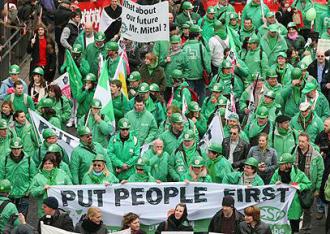
Before the election, he committed to developing a national climate strategy by the end of 2016. Last March, all 13 provincial and territorial leaders met in Vancouver to develop that framework.

As the next step, Trudeau has promised to hold countrywide consultations to give people input into the development of the strategy. This is the perfect moment for the labour movement to lead the fight for a solution that tackles unemployment and catastrophic climate change.

By tackling inequity and creating good, unionized jobs, a climate strategy could represent a giant leap forward for the labour movement — but only if we force politicians to act.

Toronto Teach-In Poses Climate Justice Alternative

By John Riddell - East End Against Line 9, June 6, 2016

The People's Climate Plan Teach-in, held in Toronto June 4,[1] took great strides forward in presenting a forceful alternative to the inadequate and deceptive climate action proposals of Canada's federal government. In the opening session, five leading climate activists presented a coherent, unified climate justice strategy, proposing effective action to save the world from climate disaster interlocked with practical measures to assist working people and the poor who are the first victims of global warming. Displayed in the meeting, held in the University of Toronto, were the banners: “Pipelines = Climate Change”; “Stop Line 9”; and (in French) “Leave Fossil Fuels in the Ground.”

After lunch, the more than 100 participants split up into training groups of half a dozen to develop skills for effective intervention in the “public consultation” meetings the Trudeau government proposes to hold over the coming three months.

People's Climate Plan

The proposed framework for this intervention is the People's Climate Plan (PCP),[2] a simple structure of three principles (or “pillars”) to guide those taking part in such gatherings.

“We've been to three of these consultations, and we know how they're organized,” PCP activists explained. “Government facilitators divide participants into small groups and then give each group a topic designed to force discussion into a channel favourable to government policy. “For example, they ask ‘How can we combine economic growth with emissions reductions?’ – implying that tar sands expansion is part of the bargain. If you accept the question on their terms, you've already lost the argument.”

If environmentalists argue at cross purposes or try to make too many different points, their voices can be sidelined and ignored. Those speaking for climate justice need to unite around a common focus and strategy. The PCP proposes three principles to assure this focus:

  • Science: keep fossil fuel reserves in the ground.
  • Economics: a rapid transition to a clean energy economy.
  • Justice: for Indigenous peoples, workers affected by the transition, and victims of climate change.

When government facilitators pose inappropriate themes, the PCP spokespersons suggested that we use an “ABC” approach:

  • A: Acknowledge the question posed by the organizers.
  • B: Bridge over to the question you wish to address, which should be aligned with one of the three PCP principles.
  • C: Provide Context to sustain your view, preferably with a personal anecdote or insight that illustrates why you care so much about the issue.

Achieving this degree of focus may seem a tall order for environmental and social activists. Often we use discussion periods to express a broad and seemingly chaotic range of personal viewpoints. We rightly prize our diversity. Yet when entering a discussion structured by a government with quite alien goals, PCP activists suggested, we must harmonize and unify our approaches.

Crude Awakening: A new air district rule might prevent increased Canadian tar sands production at Bay Area refineries

By Will Parrish - North Bay Bohemian, June 8, 2016

In recent years, oil corporations have intensified their push to make the San Francisco Bay Area and other areas of the West Coast into international hubs for refining and shipping of one of the world's most carbon-intensive and polluting fuel sources: the Canadian tar sands.

In April, that long-standing effort spilled into Santa Rosa mailboxes. Constituents of 3rd District supervisor Shirlee Zane received a letter, addressed to Zane herself, from a group called Bay Area Refinery Workers.

"As a member of the Bay Area Air Quality Management District," the letter read, "you'll soon vote on a proposal that will impact our jobs, our refineries and the important work we do refining the cleanest gasoline in the world."

It asked that Zane "please remember that the Bay Area refineries provide more good-paying union jobs than any private sector employer in the region."

Twelve refinery employees provided signatures, but the letter was produced and mailed by an organization called the Committee for Industrial Safety, which is bankrolled by the oil giants Chevron, Shell, Tesoro and Phillips 66. According to state and federal records, each corporation annually provides the group between $100,000 and $200,000 to advocate on their behalf.

The letter's apparent aim was to influence Zane's upcoming vote on a little-known but potentially far-reaching Bay Area Air Quality Management District (BAAQMD) regulation called Refinery Rule 12-16 that's aimed at reducing greenhouse gas (GHG) emmissions. If enacted, the measure would make the BAAQMD the nation's first regional air district to go beyond state and federal mandates in regulating refinery GHG emissions, the pollutants that fuel global climate change.

Zane is one of the BAAQMD's 24 directors, along with elected officials from nine Bay Area counties extending from Santa Clara in the South Bay to Sonoma and Napa. They will determine the measure's fate at a yet-to-be-scheduled meeting later this year.

Staff members at BAAQMD have proposed four alternative forms of Refinery Rule 12-16. But only one has the support of a coalition of environmental groups and the unions that represent refinery employees: a quantitative limit, or cap, on GHGs.

Processing the tar sands would dramatically increase greenhouse gas pollution at the refineries under the BAAQMD's jurisdiction, and advocates from groups like Oakland's Communities for a Better Environment (CBE), an environmental justice organization, say an emissions cap would turn back what they call the "tar sands invasion" from the San Francisco Bay Area.

Critics warn that without the cap, the oil industry will continue pursuing new tar sands infrastructure on the West Coast at a frenetic pace. "We've seen them come at us at a 10 times faster rate in the last few years," says CBE senior scientist and refinery expert Greg Karras. "Up and down the refinery belt, refineries are retooling for the tar sands and creating infrastructure for export of refined tar sands products overseas."

Experts have warned of the effects of a significantly expanded production of the tar sands—a sticky mixture of sand, clay and bitumen trapped deep beneath Canada's boreal forest. It would lock in dramatic increases in global temperatures and result in devastating impacts to ecosystems and human societies throughout the globe. A 2015 report in the journal Nature found that trillions of dollars' worth of known and extractable coal, oil and gas reserves (including nearly all remaining tar sands and all Arctic oil and gas) should remain in the ground if global temperatures are to be kept under the safety threshold of 2 degrees centigrade that's been agreed to by the world's nations at the Paris climate summit last year.

In an ecologically minded region like the Bay Area, an emissions cap to stop a dramatic increase in regional tar sands production (and tar sands exports from local ports) might seem like a political no-brainer. But staff and some members of BAAQMD say they are concerned that GHG emissions averted in the Bay Area would simply occur somewhere else, since the oil industry would increase production elsewhere. Doing so would render Refinery Rule 12-16 ineffectual in curbing climate pollution because other regions might not be so attentive.

Karras and other advocates believe the opposite is true. The cap offers local elected officials a rare opportunity, they say, to make a significant contribution to heading off the catastrophic impacts of global warming.

Railroad Workers United Former Co-Chair and Organizer Mark Burrows Speaks at Chicago Break Free Rally

On Sunday, May 15th in Whiting, Indiana, former RWU Co-Chair Mark Burrows was invited to speak to a group of community members and environmental activists about rail safety. Mark touched on the Lac Megantic tragedy and frame-up of railroad workers in Canada, crew fatigue and single employee train crews.

Welcome to Appalachia’s Gulag Archipelago

By Skyler Simmons - Earth First! Journal, June 2, 2016

Exile in the Mountains

It is hard to imagine the hollers and hills of southern Appalachia ever being a place of punishment. With its lush coves filled with ginseng, ramps, towering oaks, and tulip poplars. Its abundant springs, creeks and rivers teaming with trout, crawdads, and hellbenders. The thousands of family farms and backyard gardens providing sustenance, health, and independence. For most of us lucky enough to call this place home, it is pretty much paradise.

The residents of the gated community of Wallens Ridge, however, would beg to differ. Wallens Ridge is a supermax prison in the economically depressed coalfields of southwest Virginia. The facility, completed in 1999, was sold to this struggling community as an economic boon for a region where coal jobs were quickly disappearing.

Shortly after its opening, Wallens Ridge received a fresh shipment of bodies to fill up its cells, not to mention the state coffers. These bodies were 109 men from a private prison run by the security firm Wackenhut in New Mexico. Sick of the inhumane conditions, torture, and violence endemic in prisons, up to 290 prisoners rioted, destroying property, setting fires in four housing units and causing massive damage in August 1999. In the melee, one prison guard was killed.

The state’s response was swift. In the words of New Mexico Corrections Secretary Rob Perry, “The only thing you can do is act with an iron fist, and that’s what we’re going to do.” Another prison official commented, “A lot of people say they should be sent to a barge or an island, this is the closest thing we’ve got to it.”

It turns out that Wallens Ridge was the perfect island of exile that prison officials desired for these rebellious inmates. Shipped nearly 2,000 miles away from New Mexico, they were subject to another form of torture, isolation from family and friends who could not afford to travel across the county for visits. In addition, an overwhelmingly rural, white prison guard staff was sure to deal with the predominately black and brown prisoners ruthlessly. And that they did.

Upon arrival at Wallens Ridge, the New Mexico inmates were subject to vicious beatings and electroshocks with stun guns, all while the guards shouted racist slurs. According to the Richmond-Times Dispatch, inmate Hector Torres was repeatedly asked if he was, “one of the corrections officer-stabbing Mexicans.” Each time he said “No”, the guards shocked him with a stun gun. Remarking on the conditions at the prison, an attorney representing some of the New Mexico inmates in a civil right lawsuit said, “The knowing and deliberate nature of it is really startling… It was as close to a concentration camp or an experience of slavery as anyone would expect to come in this country.”

Wallens Ridge is not unique. An identical supermax prison called Red Onion was built in 1998 in Pound, VA on mine land donated by Pittston Coal Company about 20 miles away. Noted for having the highest rate of solitary confinement of any prison in Virginia, a 1999 Human Right Watch report found that at Red Onion, “racism, excessive violence and inhumane conditions reign inside.” Many inmates, such as New Afrikan Black Panther Party member Kevin “Rashid” Johnson, say they were sent to this supermax prison, not for their crimes on the outside, but as punishment for speaking out against abuse on the inside.

Even with the importing of out of state prisoners and a “tough on crime” attitude, a year after Wallens Ridge and Red Onion were built, the prisons sat only half full. So what did the Virginia legislature do? They created the aptly, if not draconian, named Virginia Exile Program which included mandatory 5 year sentences in a supermax prison for persons convicted of possession of a gun and cocaine, or any felon in possession of a gun. Sure enough, the prisons filled up. As a matter of fact it was so successful that the prisons are now horribly overcrowded.

Pages

The Fine Print I:

Disclaimer: The views expressed on this site are not the official position of the IWW (or even the IWW’s EUC) unless otherwise indicated and do not necessarily represent the views of anyone but the author’s, nor should it be assumed that any of these authors automatically support the IWW or endorse any of its positions.

Further: the inclusion of a link on our site (other than the link to the main IWW site) does not imply endorsement by or an alliance with the IWW. These sites have been chosen by our members due to their perceived relevance to the IWW EUC and are included here for informational purposes only. If you have any suggestions or comments on any of the links included (or not included) above, please contact us.

The Fine Print II:

Fair Use Notice: The material on this site is provided for educational and informational purposes. It may contain copyrighted material the use of which has not always been specifically authorized by the copyright owner. It is being made available in an effort to advance the understanding of scientific, environmental, economic, social justice and human rights issues etc.

It is believed that this constitutes a 'fair use' of any such copyrighted material as provided for in section 107 of the US Copyright Law. In accordance with Title 17 U.S.C. Section 107, the material on this site is distributed without profit to those who have an interest in using the included information for research and educational purposes. If you wish to use copyrighted material from this site for purposes of your own that go beyond 'fair use', you must obtain permission from the copyright owner. The information on this site does not constitute legal or technical advice.


