You are here

trade unions

A just transition to sustainable jobs

By Bill Onasch - Socialist Action, February 22, 2017

The Trump administration wasted no time before launching a veritable blitzkrieg on all fronts in pursuit of an “alt-right” America First agenda. But resistance has been swift and massive.

In addition to various movements mobilizing we also heard from scientists. Agence France Presse (AFP) reported: “Comments by U.S. President Donald Trump on nuclear weapons and climate change have helped make the world less safe, the Bulletin of the Atomic Scientists warned … moving its symbolic ‘Doomsday Clock’ 30 seconds closer to midnight.”

This heightened warning by atomic scientists about two overarching crises closely followed an announcement by climate scientists at the National Oceanic and Atmospheric Administration that, for the third consecutive year, 2016 had been the hottest since record keeping began in 1880.

Trump replaces an Obama administration that offered token gestures to reduce greenhouse gas emissions, which are the prime culprit in heating our planet, while at the same time also promoting fossil-fuel expansion through destructive fracking of gas and oil.

Now, the 45th president has dismissed global warming as a job-killing hoax perpetrated by China to sabotage the American economy. Rather than presenting any of his signature “alternative facts” to bolster this fantastic conspiracy theory, he has focused on the job-killing argument. Jobs are a big and legitimate concern of the working-class majority.

US Labor Unions Push Back At Trump On Pipelines And Environmental Deregulation

By Seth Sandronsky - Mint News Press, February 17, 2017

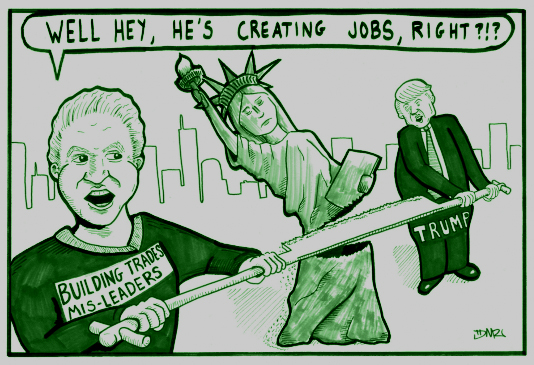
President Donald Trump claims that his energy policy creates high-wage construction jobs. Some of organized labor in the United States agrees with him, including North America’s Building Trades Unions, which is affiliated with the AFL-CIO, the country’s largest federation of unions.

On Jan. 24, NABTU released a statement in support of Trump after the president issued an executive order for completion of the Keystone XL and Dakota Access pipelines to move fossil fuel around North America.

“We are grateful that President Trump understands that 32 percent of today’s construction industry workforce is employed on energy projects, amounting to over 2 million workers, and that projects such as the Keystone XL and Dakota Access pipelines are significant job creators that generate above-average wages and benefits for hard-working Americans,” said the statement prepared by the alliance of 14 national and international unions in the building and construction industry that represent over 3 million skilled craft professionals in the United States and Canada.

In April of 2015, well before Trump was elected to the Oval Office, Sean McGarvey, president of NABTU, addressed the union’s ties to the Koch energy titans, major funders of the GOP and its tea party wing. In an interview with Kent Hoover, Washington Bureau chief of The Business Journals, McGarvey explained:

“Even if you look at Koch Industries — they’re one of our biggest clients. You’ll never see us making public statements saying negative things about Koch Industries. They’re a huge client of ours. Do we agree with some of the things that they supposedly support? No. Do we understand why they do it? Yeah, Ok, because they’re looking for political advantage for a political point of view, and the Democrats don’t see it the way they see it. And other unions in the labor movement tend to be much more Democratic unions. And if you can hurt the labor movement, i.e. you hurt the Democratic Party. It’s just a system that we really don’t want to be engaged or involved in.”

According to OpenSecrets, a project of the Center for Responsive Politics, Koch Industries spent $9.84 million on political lobbying in 2016. This followed years of a heavy spending from the Kansas-based multinational corporation, which had spent $10.83 million on lobbying in 2015 and $13.7 million in 2014. In the 2016 election cycle, Koch Industries donated more than $1.86 million to GOP Congressional candidates and just $23,000 to Democratic candidates, OpenSecrets reports. The top Republican recipients were the recently appointed CIA director, Mike Pompeo, a representative from Kansas who received $71,100 from Koch Industries; Sen. Roy Blunt of Missouri, who received $40,700; and Speaker of the House Paul Ryan, a representative from Wisconsin, who received $39,522.

Yet there are other views of the U.S. labor movement as the Trump administration wages a “shock and awe” campaign of rolling back climate and environment-related rules.

Brothers and Sisters, It’s Time to Fight

By Kevin Norton - Labor Notes, February 15, 2017

The speed of events since Trump’s inauguration has made my head spin. The administration’s absolute onslaught against women, environmentalists, Muslims, immigrants, and the government itself began on day one. So I was a little shocked to see some of the building trades union leadership meet so happily with our nation’s first orange president.

“We have a common bond with the president,” Building Trades President Sean McGarvey said. “We come from the same industry. He understands the value of driving development, moving people to the middle class.” McGarvey also commented that President Obama had never met with the trades.

Some enthusiastic Trump supporters have lit up my Facebook page with stories about how he is going to “Make America Great Again.” One wrote, “I was told Trump was anti-union... Being an informed voter, I knew it was hogwash... here’s the proof.” He left a link to an article about the new president’s meeting with the union leaders.

Fawning over Trump Shuts Out Our Movement’s Future

By Len Shindel - Labor Notes, February 15, 2017

Surrounded by key union leaders, Trump was relaxed and smooth. He thanked the Sheet Metal Workers for their work on his hotel down the street—even as an electrical contractor was suing his company after allegedly getting stiffed on the job.

Union leaders clapped when Trump announced he was trashing the Trans-Pacific Partnership. Trump said their members would soon be needed to complete a load of new projects as he terminated the “disastrous” trade policies that had sent jobs out of the country.

He assured them they would be building new Ford plants and pharmaceutical manufacturing facilities for companies like Johnson and Johnson. The union leaders said they also asked Trump to move ahead, despite widespread protests, on the Keystone XL Pipeline and the Dakota Access Pipeline.

Is It Time for the AFL and the CIO to Part Ways Again?

By Ruth Needleman - Portside, February 6, 2017

Now more than ever we need a strong united labor movement. We do not, however, have one.

The Trump administration has further deepened the wedge dividing workers by hosting the Building and Construction Trades leaders on January 25, 2017. Trump dangled before their eyes his rejection of an already dead TPP trade deal, and, even more to their liking, a commitment to build pipelines, in particular, the Dakota Access pipeline and the Keystone XL pipeline. 

The AFL-CIO had already disappointed members and allies nationally when Trumka, president of the AFL-CIO, came out in support of the pipelines during the massive protests organized by indigenous nations at Standing Rock. Trumka pointed to jobs. But what kind of jobs and for whom and at what cost? There are jobs and then there are jobs with justice.  Temporary construction jobs on the pipelines for the building trades would come at the expense of clean water, land, environmental and indigenous rights.

Nonetheless, Sean McGarvey, president of the North American Building Trades, called the pipeline jobs “an economic lifeline.” In a letter to President Trumka, dated September 14, 2016,  McGarvey referred to the Standing Rock protestors as “environmental extremists,” and “professional agitators.” He denounced the Amalgamated Transit Union (ATU), National Nurses United (NNU), Communications Workers of America (CWA), and the American Postal Workers Union (APWU) for their support of the Standing Rock Sioux Nation. He claimed that building trades members “have been subjected to intimidation, vandalism, confrontation, and violence.”

His insulting tirade went on to say, “Now, rather unfortunately but I suppose not surprisingly, it seems the same outdated lowest common denominator group of so-called labor organizations has once again seen fit to demean and call for the termination of thousands of union construction jobs…I fear that this has once again hastened a very real split within the labor movement.” Further on he added, “It is both offensive and inappropriate for them as General Presidents to be so narrow minded, disregard facts, dismiss and disparage careers in the Building Trades, support lawlessness and violence at the workplace, and jump to the beckon call of outside interests and politicians at the expense of AFL-CIO members.”(sic)

Now the Trades are embracing Trump; “We have a common bond with the president,” according to McGarvey.  Terry O’Sullivan of the Laborers International, a dinosaur on climate issues and environmental concerns, stressed Trump’s “remarkable courtesy and the commitment to creating hundreds of thousands of working-class jobs.” Union Participants described their meeting with Trump as “incredible.”

McGarvey’s “all-out verbal assault and slanders directed at me and other union leaders,” answered APWU president Mark Dimondstein, “will not go unanswered. First, I do not answer to Brother McGarvey, nor seek his permission for the views of the APWU,” Dimondstein stressed. “Nor will I be intimidated by him and his innuendos and insults.”

Also responding to the ideas promoted by the Trades were over 3 million women who protested against Trump and many against the pipeline. The immigrants, Muslims, African Americans, Latinos, LGBTQ activists and Indigenous nations who stand to lose so much are the heart of the US working class and labor movement. The ever-shrinking labor unions, down again in 2016 to 10.7% of the workforce, (only 6.4% of the private sector) cannot afford to turn their back on members and allies, thereby surrendering to right-to-work, frozen minimum wages, lost access to health care, all in exchange for pipeline jobs.

The problem with these Trades misleaders is their narrow self-interested philosophy and practice of looking out only for themselves and their willingness to throw other workers under the bus.  Bill Fletcher, Jr, journalist and black labor activist, compared the collaboration of these Trades’ leaders with Trump to the Vichy government’s collusion with Hitler in France during World War II. A harsh but sadly accurate comparison.

IWW Resolution Against DAPL and KXL

Resolution passed by the IWW General Executive Board - January 28, 2017

Whereas: Neither the Dakota Access Pipeline nor the Keystone XL Pipeline will provide anywhere near the number of permanent union jobs the promoters of these projects promise they will, and

Whereas: Far more permanent union jobs can be created at comparable wages by repairing existing pipeline infrastructure, such as water mains in Flint, Michigan, or repairing leaks in existing pipelines (which, if unfixed, release harmful amounts of methane, a known greenhouse gas that contributes to global warming); and

Whereas: Far more jobs currently exist in the growing renewable energy sector than in the declining fossil fuel sector; and

Whereas: Though these renewable energy jobs are currently, typically nonunion, unions if so determined, could easily develop a successful organizing program, using solidarity unionism, that could revitalize the currently struggling labor movement; and

Whereas: Neither pipeline project will deliver the promised "energy security" or "energy independence" promised by their promoters, including the Building Trades and AFL-CIO Union officials among them; and

Whereas: oil pipelines, such as the aforementioned pipelines tend to leak and create unnecessary risk to the surrounding environment both through methane gas leaks and crude oil spills; and

Whereas: such pipelines endanger the communities along their routes, including many indigenous communities whose tribal sovereignty has been often ignored or violated during the permitting process by agencies subject to regulatory capture by the capitalist interests that promote them; and

Whereas: the construction of these pipelines will contribute to the acceleration of already dangerous levels of currently existing greenhouse gas emissions which are contributing to the already dangerous levels of climate change, which could lead to a dead planet with no jobs of any kind; and

Whereas: many unions, including the IWW, have already publically stated opposition to one or both the Dakota Access Pipeline and Keystone XL Pipeline; and

Whereas: President Donald Trump's "executive orders" that ostensibly "clear a path" for the completion of the aforementioned pipelines  and mandate that they be constructed using US manufactured steel are contradictory in nature and are designed primarily to divide workers and environmentalists over the false dichotomy of "jobs versus the environment", which is utterly false as previously described;

Be it Resolved that: the IWW reaffirms its opposition to the construction of the Dakota Access Pipeline and officially declares its opposition to the construction of the Keystone XL Pipeline; and

Be it Further Resolved that: the IWW stands in solidarity with the First Nations, union members, environmental activists, and community members who oppose both; and

Be it Further Resolved that: the IWW urges rank and file members of the Building Trades, Teamsters, and other unions who have declared support for these pipelines to call upon their elected officials to reverse their support; and

Be it Finally Resolved that: the IWW demands that the promoters of these pipelines develop a "just transition" plan for the pipeline workers that would be affected by the cancellation of these pipeline projects.

US railroads demand concessions from 145,000 workers

By Jeff Lusanne - World Socialist Web Site, December 31, 2016

Major US freight railroads terminated long drawn-out contract negotiations with rail unions last month and invoked provisions for federal mediation. The railroads leading the contract talks are demanding that workers pay more for health care, accept minimal raises and agree to new concessions on working conditions.

The contract negotiation covers 145,000 employees in 11 unions, the largest of which are the United Transportation Union (UTU/SMART), Brotherhood of Locomotive Engineers and Trainmen (BLET), and Brotherhood of Maintenance of Way Employees (BMWED). Representatives from most of the largest US railroads—Union Pacific, Burlington Northern Santa Fe, Norfolk Southern, Kansas City Southern, and CSX—form the National Carrier’s Conference Committee (NCCC), which carries out the negotiations. Additional railroads and employees are covered or influenced by the contract, which sets the standard for the industry.

Negotiations began two years ago and agreements expired on December 31, 2015, but rail workers continue to labor under the previous contract. The railroads appear to be biding their time until the Trump administration takes office, a factor they apparently see working to their advantage.

Typical of railroad management’s attitude is a December 15 statement that declares, “Now is not the time for excessive demands. Railroad employees are among the most highly compensated in the nation.” That leads to a link describing compensation that is full of misleading data. That wages surpassed the inflation rate in the last 10 years is presented as an outrage. The wages that the railroad bosses decry often come from working far more than 40 hours a week, in potentially extreme circumstances.

Most egregious, perhaps, is the bulleted statement claiming that workers enjoy “11 national holidays and three weeks of vacation each year.” Railroads operate on nearly every major national holiday, and have strict “absenteeism” policies that penalize what they consider excessive time off. Notoriously, there is no schedule for operating employees, and they often work 12-hour shifts, longer if travel time is included, and are frequently away from home. A common challenge faced by many railroad workers is being forced to miss family events, holidays, and even funerals.

Presently, employees pay at least $229 a month for health coverage, but the railroads are insisting that this is “below average” and must rise. The BMWED notes that it offered “savings” in health care that do not cost any railway worker or the railroads any money, raising the question of whether the unions are proposing lower-quality health plans for workers. Nevertheless, the railroads rejected that proposal.

The railroads have welcomed the intervention of the National Mediation Board, a federal agency that coordinates labor-management relations. Its three members consist of two Democrats and one Republican, and membership will likely change with the new administration.

The Railway Labor Act of 1926 was designed to prevent any possibility of a railroad strike. Whenever the mediation board declares an impasse in the negotiations—which could take months or even years—a 30-day cooling off period begins, during which negotiations continue. After that period, railroads could lock out employees, or unions could call a strike, unless the president authorizes a Presidential Emergency Board. The unions, tied to the Democratic Party, entirely accept this framework, so that even as negotiations have progressed, railroads have been able to impose cuts without opposition.

For their part, the major railroad unions are concerned that the huge concessions demanded by railroads could spark a rebellion by workers. Dennis Pierce, the national president of the BLET, writes that “the level of concessions that were demanded on our health and welfare benefits [are] way beyond anything rail unions have seen in decades” and that the low wage increases would not even cover increased health care costs.

The rail unions have overseen decades of concessions and a dramatic drop in railroad employment (from 1.5 million in 1947 to less than 250,000 today.) The two crewmembers in the cab of a freight train are split between two unions, the BLET and the UTU/SMART, which have a history of working with the railroads to gain an edge by offering concessions.

In 1994, the BLET asked engineers to cross the UTU (conductors) picket line at Soo Line railroad. Some 98 percent of the engineers refused to do so.

Unions stand at Standing Rock

By staff - NW Labor Press, December 14, 2016

The standoff at North Dakota’s Standing Rock Sioux Reservation — with Indian tribes and supporters on one side, and police and private security for the Dakota Access Pipeline on the other – also finds labor union members on both sides.

North America’s Building Trades Unions and the AFL-CIO have come out in favor of the project moving forward, because it’s a big source of union jobs. But other labor organizations have declared support for pipeline protesters, and in Oregon and Washington, a number of union members have traveled to Standing Rock to take part in the massive protest encampment — a nonviolent uprising that has united Indian tribes nationwide.

Roben White — a retired union painter and former president of Painters Local 10 — is one of them. White is of mixed Lakota Sioux and Cheyenne ancestry on his father’s side, and he’s an enrolled member of the Oglala Lakota tribe at the Pine Ridge Indian Reservation in South Dakota. He’s also a staunch unionist who says he was pained to see unions take a stand he disagrees with.

The Standing Rock Sioux object to the pipeline chiefly because of the potential risk to their water supply. When complete, the Dakota Access Pipeline would pump 470,000 barrels a day of light crude oil through a 30-inch-wide, 1,172-mile-long pipeline from the Bakken Oil Fields of northwestern North Dakota through South Dakota and Iowa to refining facilities in Illinois. The pipeline’s route was originally supposed to cross the Missouri River just upstream from Bismarck, North Dakota, but because of concerns that an oil spill could wreck the city’s water supply, the route was changed to cross just upstream from the Standing Rock Sioux Reservation. The pipeline would cross half a mile north of the reservation, 92 feet underneath the Standing Rock Sioux water supply — Lake Oahe, a reservoir formed by a Missouri River dam.

To protest that course, in April, members of the tribe established a “spiritual camp” on Army Corps of Engineers land along the banks of the Missouri river. By August, it had become the largest gathering of Native American tribes in more than a century. With protesters attempting to stop construction, North Dakota Gov. Jack Dalrymple declared a state of emergency Aug. 19. Private security contractors, joined by police reinforcements from six states, deployed in armored personnel carriers, and used rubber bullets, tear gas grenades, pepper spray, and sound cannons against unarmed protesters. On Sept. 3, security guards attacked nonviolent protesters with pepper mace and dogs.

Then on Sept. 9, Department of Justice, Department of the Interior and Department of the Army asked that the pipeline company voluntarily halt construction within 20 miles of Lake Oahe, after a federal judge denied the Standing Rock Sioux Tribe’s request for a temporary injunction.

Shortly after that, national AFL-CIO President Richard Trumka weighed in with an official statement on the pipeline: “The AFL-CIO supports pipeline construction as part of a comprehensive energy policy,” he declared Sept. 15. “Pipeline construction and maintenance provides quality jobs to tens of thousands of skilled workers,” Trumka said. Community involvement is important, Trumka said, particularly in situations involving places of significance to Native Americans, but, he added, “once these processes have been completed, it is fundamentally unfair to hold union members’ livelihoods and their families’ financial security hostage to endless delay.… Furthermore, trying to make climate policy by attacking individual construction projects is neither effective nor fair to the workers involved.”

Reacting to Trumka’s statement, White, the former Painters Local 10 president, picketed with half a dozen other local unionists outside the Sept. 23 annual awards banquet of the AFL-CIO’s Southwest Washington Labor Roundtable.

“I’m all labor. I live and breathe it,” White said. “I’m not questioning the fact that they want those jobs. I made my living in the building trades too. But there is a point that we need to take responsibility. … How ‘bout fixing the pipelines that are busting all over the place? How ‘bout changing the infrastructure so we don’t have to use so much oil and gas?”

For the Standing Rock tribe, protest banners say, “water is life.” But for many union construction workers, pipelines are how they earn their living. After the federal agencies requested a halt to construction, five national union presidents wrote to President Obama. “The [Dakota Access pipeline] project is being built with an all-union workforce and workers are earning family-sustaining wages, with family health care and retirement contributions,” wrote the presidents of Operating Engineers, Electrical Workers, Teamsters, United Association and Laborers. “However, the project delays are already putting members out of work and causing hardships for thousands of families.”

The pipeline is providing work for an estimated 4,500 members of building trades unions.

But a number of labor organizations not directly involved with the project issued statements supportive of the protests, including Amalgamated Transit Union, American Postal Workers Union, Communications Workers of America, National Nurses United, and Service Employees International Union (SEIU).

‘An injury to one is an injury to all’

By Angela K. Evans - Boulder Weekly, December 1, 2016

Since July, thousands of people have joined the Standing Rock Sioux in North Dakota as they protest the Dakota Access Pipeline (DAPL), which is slated to carry up to 570,000 barrels of crude oil every day for 1,172 miles from North Dakota to Illinois. The protesters, who call themselves “water protecters,” have been joined by members of other Native American tribes, environmentalists, international sympathizers and members of several labor unions.

Liam Cain, a card-carrying member of Laborers International Union of North America (LIUNA) out of Cheyenne, Wyoming, first traveled to North Dakota after he heard that large trade unions such as LIUNA and AFL-CIO called on the governor of North Dakota to protect union members working on the pipeline by sending in the National Guard.

“If anyone knows anything about the labor movement or labor history, they know it’s a deeply hypocritical and soulless thing for them to do. It aligns them as the junior partners in capitalism and divorces them from whatever was good with the labor movement in terms of the working-class and fighting for the working-class population. …

“This is actually a union I’m a part of,” he continues. “I may have philosophical disagreements with people who are in this union but this isn’t a philosophical disagreement. This is a soulless, disgusting thing that the International [Union] signed off on and the rank and file is not all on board with.”

Originally from Humboldt County, California, Cain first joined LIUNA in 2008 to work on a major pipeline being built through Cheyenne, and he has worked on several mainline pipeline construction projects since. Lately, he’s spent more of his time fighting wildfires around the country but still picks up jobs on pipelines during the off season.

In North Dakota, Cain joined up with the Labor for Standing Rock delegation, a group of workers in a variety of unions who have traveled to Standing Rock to show their solidarity with the Native Americans and environmentalists protesting the pipeline.

San Diego Labor Opposes Dakota Access Pipeline

By Jim Miller - OB Rag, December 12, 2016

The Dakota Access Pipeline (DAPL) and the heroic struggle against it have ignited a big battle inside of American labor. Earlier this fall an excellent article in Common Dreams outlined the split over DAPL at the national level with key trades unions and AFL-CIO leader Richard Trumka backing the pipeline and criticizing the protests while other large national unions were issuing statements supporting the Standing Rock resistance.

Here in California and elsewhere, Trumka’s letter in support of the pipeline received strong condemnation.

For instance, a response to it that I penned as chair of the California Federation of Teachers Climate Justice Task Force challenges the AFL-CIO leader in the strongest possible terms:

“In sum, your statement is factually inaccurate, morally suspect, politically inept, and does not stand for the values that should guide a progressive union movement worth being a part of in an era of stark threats to the future of our children.”

I have yet to receive a response.

Pages

The Fine Print I:

Disclaimer: The views expressed on this site are not the official position of the IWW (or even the IWW’s EUC) unless otherwise indicated and do not necessarily represent the views of anyone but the author’s, nor should it be assumed that any of these authors automatically support the IWW or endorse any of its positions.

Further: the inclusion of a link on our site (other than the link to the main IWW site) does not imply endorsement by or an alliance with the IWW. These sites have been chosen by our members due to their perceived relevance to the IWW EUC and are included here for informational purposes only. If you have any suggestions or comments on any of the links included (or not included) above, please contact us.

The Fine Print II:

Fair Use Notice: The material on this site is provided for educational and informational purposes. It may contain copyrighted material the use of which has not always been specifically authorized by the copyright owner. It is being made available in an effort to advance the understanding of scientific, environmental, economic, social justice and human rights issues etc.

It is believed that this constitutes a 'fair use' of any such copyrighted material as provided for in section 107 of the US Copyright Law. In accordance with Title 17 U.S.C. Section 107, the material on this site is distributed without profit to those who have an interest in using the included information for research and educational purposes. If you wish to use copyrighted material from this site for purposes of your own that go beyond 'fair use', you must obtain permission from the copyright owner. The information on this site does not constitute legal or technical advice.