You are here

reports

(Working Paper #4) Power to the People: Toward Democratic Control of Electricity Generation

Press Release - Trade Unions for Energy Democracy, June 24, 2015

Unions welcome new report highlighting the need to ‘reclaim’ and democratize the energy system and to promote publicly owned renewable power

Globally, the energy system is failing to protect workers and communities.  Airborne and water pollution levels are out of control, especially in Asia. Energy-related emissions continue to rise as more fossil-based power comes on line. Union leaders say the struggle for democratic control of electrical power generation is central to the struggle for a healthier, safer and fairer world. A major scale-up of publicly owned but democratically controlled renewable power is required. Public renewable power will make it possible to conserve energy, control and then reduce demand, and begin to make transport as well as electrical power less dependent on fossil fuels. A truly “just transition” for workers and communities will require re-asserting the public good over private greed.

A new Trade Unions for Energy Democracy (TUED) working paper titled Power to the People: Toward Democratic Control of Electricity Generation shows how “another energy is possible, and absolutely necessary.” It succinctly explains the failure of profit-driven approaches to either emissions reductions or controlling energy demand. The TUED paper, published by the Rosa Luxemburg Stiftung–New York Office, examines the actual and potential content behind the term energy democracy in order to help unions get a better grasp of what is happening now and what could happen in the future. It discusses the major “fronts” on which the struggle for democratic control of power generation is currently expressing itself: cooperatives in the renewable energy sector and their potential contribution to energy democracy, as well as recent attempts to reclaim electrical power generation at the municipal level. The 4-part paper also examines the historical experience of the “public works” approach to energy transition during the New Deal in the United States and, in particular, the Rural Electrification Administration—a model of state-cooperative interaction and partnership replicated successfully in numerous countries during the post-World War II period. It proposes that a “Renewable Energy Administration” is needed today.

Unions and social movements have the power to help create a new energy system, one that will be located at the heart of a new political economy grounded in equity, true sustainability, and economic democracy. This paper, co-authored by Sean Sweeney (Murphy Institute, CUNY) Kylie Benton-Connell (New School for Social Research) and Lara Skinner (Worker Institute at Cornell) explores concrete possibilities for moving toward this goal.

According to Sweeney, the coordinator of TUED, “The paper is not a blueprint. It shows what is happening, and also what needs to happen in order to reduce emissions and pollution in a way that shifts power toward workers and communities. Its main message is, if we want to control atmospheric warming and to protect our common home, then we have to get serious about reclaiming and democratizing energy.  Unions in different countries and from all sectors are increasingly aware of the need to do this.”

Sustainable and Safe Recycling: Protecting Workers Who Protect the Planet

By GAIA - Partnership for Working Families, MassCOSH, and the National Council for Occupational Safety and Health, June 23, 2015
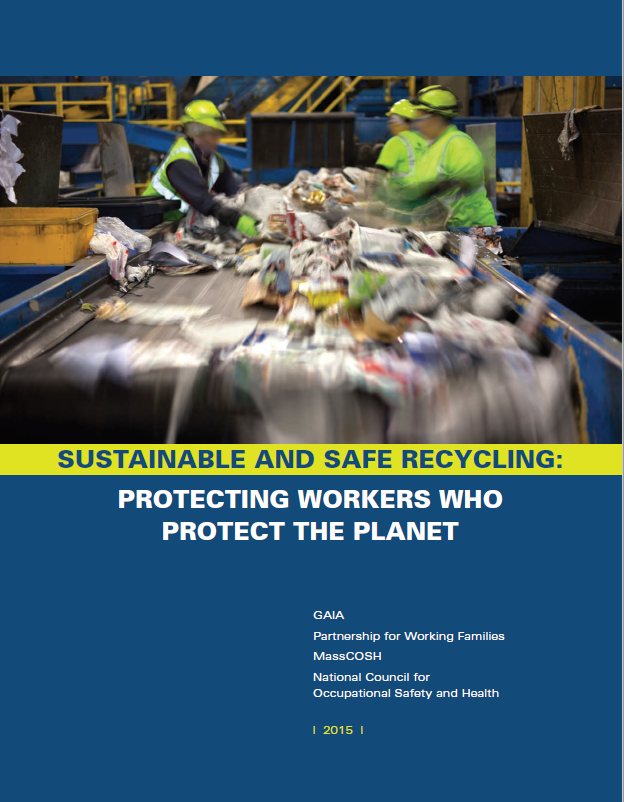
Zero waste is the future. Growth in the recycling economy has the potential to not only conserve the environment, but also create 1.5 million new jobs. But research indicates that recycling work can be dangerous, with injury rates more than double the national average. By addressing this problem, local governments have an opportunity to secure the sustainability and health of their cities while ensuring that recycling jobs are good jobs. Recyclers deserve safe working conditions, as they protect public health and the planet from waste, pollution, and resource depletion.

The environmental necessity of recycling is well-established: achieving a 75% recycling rate would yield greenhouse gas emission reductions equivalent to shutting down one-fifth of all U.S. coal power plants (Tellus 2011). A growing number of cities recognize recycling as a key component of their local climate action plans (West Coast Climate and Materials Management Forum 2012). In short, recycling provides proven benefits for clean air and waste reduction, and along with other zero waste strategies it can offer a critical pathway for municipalities to achieve sustainable growth.

Recycling can also play a key role in urban job creation strategies. At our current national recycling rate of 34.5%, the U.S. recycling industry employs nearly 1 million people and generates billions of dollars of economic activity annually (Tellus 2011, USEPA 2012).

Studies have shown that recycling creates at least 10 times as many jobs per ton of waste as disposal in either incinerators or landfills, and that investments in recycling, composting, and recycling reliant manufacturing could produce 1.5 million more jobs across the country.

But recycling workers face serious hazards on the job. In too many cities across the country, sorters work in loud and dusty facilities where they are often exposed to extreme temperatures. Working long hours, they lean over conveyor belts sorting materials – pulling out things that don’t belong, ensuring the best quality materials are bundled together for the highest value. They work with heavy equipment in dangerous situations – climbing onto and into massive conveyor belts and balers to clean them. They maneuver past huge front-end loaders and forklifts, and walk by heavy bales of material that, when unsafely managed, can fall on workers who are in the wrong place at the wrong time. Moreover, they deal with an array of inherently unsafe materials that should not be on the recycling line – used needles, chemicals, dead animals and broken glass. As a result of these unsafe conditions, recycling workers face above-average injury rates and are sometimes even killed on the job.

Many recycling sorters are employed by temp agencies, further increasing the likelihood that they won’t have the training or experience needed to do their job safely. But it doesn’t have to be this way. Occupational hazards can be mitigated, and in some cases eliminated, with a combination of engineering controls, improved safety systems, work practices, and extensive training.

There are important actions and best management practices that cities can and should take to improve recycling jobs. Cities that offer curbside recycling service generally contract with private companies to process recyclable materials collected from households. To ensure safe and dignified recycling jobs, municipal governments must require rigorous health and safety standards in recycling contracts.

This report offers a unique inside look at the working conditions faced by recycling workers across the United States, as well as a series of specific policy recommendations that municipal decision makers should follow to improve industry accountability and health and safety outcomes. It also includes practical recommendations for public education programs that can prevent dangerous materials from entering the recycling stream. Our analysis is based on occupational health studies, OSHA reports about health and safety violations, articles from news media and industry trade publications, interviews with recycling workers, and first-hand observation of recycling work.

Our findings underscore the need for urgent action to improve health and safety conditions for recycling workers. Improving the recycling sector overall is not only possible – it’s imperative for averting today’s ecological crises, and protecting the health and well-being of this important group of climate workers who protect us all.

Read the report (PDF).

Replace Hazelwood Primer

By David Spratt - Climate Action Moreland, June 2015

Hazelwood Power Station (HPS) was built between 1964 and 1971, and comprises 1542 megawatt (MW) of capacity over eight generators. It was privatised by the Victorian Liberal Party Kennett government in 1996 for $2.35 billion.If HPS had stayed in public hands, it would likely have been decommissioned in 2005, but in 2004 the Bracks Labor government extended its operations till 2031, allowing Hazelwood to move a road and a river to access 43 million tonnes of brown coal deposits in a realignment of the mining licence boundaries. The owners have a 30-year mining licence due for renewal in 2026.HPS and the land on which it operates are owned by the Hazelwood Power Partnership. Since 7 June 2013, the four partners have been subsidiaries of International Power (Australia) Holdings Pty Ltd. This company is in turn jointly owned by subsidiaries of Engie (formerly GDF Suez SA) (72 per cent ownership) and Mitsui & Co Ltd (28 per cent ownership). Engie is a global energy company with corporate headquarters in France. Mitsui & Co Ltd is a global trading company with corporate headquarters in Japan.Currently HPS produces more than 10,000 gigawatt hours (GWh) of energy annually and is supplied with up to 18 million tonnes of coal each year from the adjacent Hazelwood mine, releasing around 16 million tonnes of greenhouse gases annually. Today HPS provides approximately 21 per cent of Victoria’s baseline electricity supply.
The Victorian Government has expressed a desire (though it does not yet have a policy) for a significant expansion of renewable energy in Victoria. This has widespread community support and must be done quickly and at a large scale because climate change is already dangerous. Scientists warn that two degrees Celsius of warming could occur in just two decades, so preserving a safe climate and a healthy future requires rapid de-carbonisation.

Expanding renewable energy requires coal-generating capacity to be removed from the market because oversupply is crowding out and preventing new investment. The Australian energy market operator says there are about eight gigawatts of surplus generating capacity across the national market, equivalent to five Hazelwood power stations. This includes up to 2.2 gigawatts of brown coal generation that is no longer required in Victoria in 2015, which is greater than Hazelwood’s capacity. Power companies have been lobbying government for capacity to be reduced, and senior Victorian energy department bureaucrats are aware of the need to close coal power stations in order to roll out renewables.

The Victorian Government has committed to being a leader on climate change. Closing down excess coal generation is a key test of the government’s climate credentials. Coal-fired power stations are the world’s largest source of planet-warming carbon dioxide emissions. Victoria cannot make the necessary emissions reductions without addressing the operations of Hazelwood and/or Yallourn power stations.

Hazelwood power station is old, unsafe and dirty. Based on emissions intensity, it is the third-dirtiest coal power station in the world and the dirtiest in Australia, releasing around 16 million tonnes of greenhouse gases annually, almost three per cent of total Australian greenhouse emissions. The Hazelwood majority owner, Engie (formerly GDF Suez), owns the third-most polluting coal-power station fleet in the world. The full – health and carbon pollution – social costs of Hazelwood totalling $900 million per year are borne by the community, rather than the plant’s owners.

A steady stream of local jobs can be created in the Latrobe Valley with the rehabilitation of mines and decommissioning of plant, which will require a significant workforce stretching well over a decade. The Latrobe Valley needs a strong jobs package and an economic transition plan and new industries because the move from coal to clean wind and solar renewable energy is now both urgent and inevitable.

Hazelwood power station and mine are a health hazard to local residents, exemplified by the autumn 2014 mine fire. The owners of Hazelwood have abused their social licence and forfeited the right to profit from a power station that is now a major health hazard – both to local people and to all peoples who face the uncertainties of living in a hotter and more extreme climate.

In July 2010, the Victorian Labor government promised to start shutting Hazelwood and passed climate legislation providing the reserve power to regulate emissions from existing brown coal-fired generators. Restoring the government’s capacity to regulate emissions would be complementary to actions being taken by other governments, including in the United States and Europe.

Read the report (PDF).

The Fossil Fuel Industry and the Case for Divestment

By staff - Toronto350, April 10, 2015

The governments of the world — including the governments of Canada, the United States (U.S.), the United Kingdom (U.K.), China, Brazil, and the 27 European Union (EU) members — have agreed we should avoid raising global temperatures to more than 2 ̊C above pre-industrial levels.1 This is the threshold at which the major governments of the world have agreed that climate change becomes “dangerous”. In 2009, an article in Nature warned that failing to constrain warming to below 2 ̊C “would threaten the ecological life- support systems that have developed in the late Quaternary environment, and would severely challenge the viability of contemporary human societies”. In the Summary for Policymakers from their Fifth Assessment Report, the Intergovernmental Panel on Climate Change (IPCC) explains:

Without additional mitigation eforts beyond those in place today, and even with adapta- tion, warming by the end of the 21st century will lead to high to very high risk of severe, widespread, and irreversible impacts globally.

Based on hundreds of thousands of years of evidence on how the climate responds to greenhouse gases (GHGs), we can calculate the total quantity of all fossil fuels we can burn, adding the carbon they contain to the atmosphere, while still giving ourselves a good chance of avoiding a 2 ̊C increase.7 To do so we must keep future GHG pollution to no more than 565 billion tonnes (gigatonnes) of carbon dioxide (CO2).8 At the same time, we know that burning the world’s proven reserves of coal, oil, and natural gas would produce 2,795 gigatonnes of CO2 — nearly ive times as much as it would be safe to burn.91011 The University of Toronto (U of T) can play a role in helping humanity stay within these planetary limits by choosing to sell its investments in fossil fuel companies.

Download a copy of this resolution here (PDF).

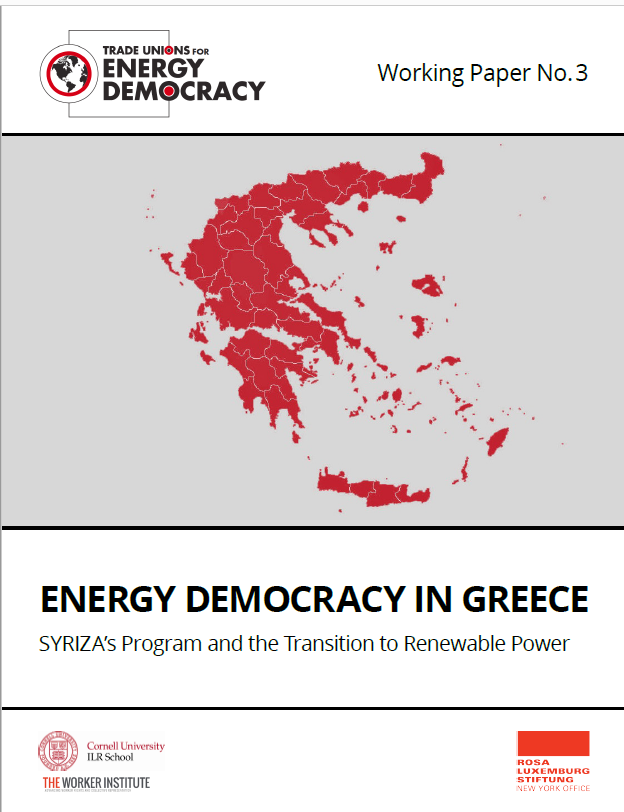
(Working Paper #3) Energy Democracy in Greece: SYRIZA’s Program and the Transition to Renewable Power

By Sean Sweeney - Trade Unions For Energy Democracy, February 4, 2015

Since the financial crisis of 2008 and the subsequent “Great Recession,” governments have mostly scaled back or deemphasized their climate protection and “green” commitments. Lack of public funds and concerns about growth, competitiveness, and unemployment are frequently cited as explanations for this apparent loss of both ambition and urgency. The “green growth” narrative that colored various countercyclical “stimulus” spending packages from 2009-10 has been largely abandoned.

This has in turn slowed the deployment of renewable energy and thrown the UN climate negotiations into paralysis. During the recent talks in Lima (COP 20) it became clear that a global climate agreement seems very unlikely to emerge from the “deadline COP” in Paris in late 2015.

The goal of this paper is to show how economic crisis and austerity, which today serves as the perfect cover for inaction and reversals on climate protection and ecological sustainability, could actually spur a radical departure from the slow and stuttering progress of the recent past. The paper looks at the opportunities for such a departure in Greece, a country mired in debt, high unemployment, and on the receiving end of a full-blown austerity program. But Greece is also a country where the radical Left could soon be in power led by a party, SYRIZA, that’s committed to nothing less than the “ecological transformation of the economy.”

But how can such a transformation be carried out? How can a country like Greece—facing enormous challenges—be an ecological leader and perhaps an exemplar for a new course? Can a SYRIZA or SYRIZA-led government break new ground in terms of fusing a viable leftgreen project in the face of crushing odds?

Download (PDF).

Fracking Frenzy: How the Fracking Industry is Threatening the Planet

By Robert Galbraith, Gin Armstrong, and Kevin Connor - Public Accountability Initiative, February 2015

The global development of ‘unconventional’ fossil fuels (UFF) such as shale gas has provoked much debate involving scientists,industry, political decision-makers, environmental groups and civil society. More than a decade of large- scale development in North America has left a legacy of environmental damage, primarily resulting from the use of high- volume horizontal hydraulic-fracturing (also known as ‘fracking’) to extract the unconventional oil and gas. Despite the controversy surrounding this technique, the numerous unknowns and uncertainties concerning its impacts and the growing number of questions about the economic benefits of this industry, oil and gas operators are eager to identify new opportunities and so are engaged in a battle to make frackingpublicly and socially acceptable worldwide.

Read the report (PDF).

Frackademia in Depth; An analysis of the oil and gas industryʼs case for fracking

By Robert Galbraith, Gin Armstrong, and Kevin Connor - Public Accountability Initiative, February 2015

In the wake of New York Stateʼs decision to ban fracking, drilling proponents have criticized Governor Andrew Cuomo and his administration for basing the decision on “pseudo science”and “junk science.” When asked about the New York fracking ban at his 2015 “State of American Energy” press conference, American Petroleum Institute President and CEO Jack Gerard called for “more thoughtful consideration as to economics, environment, and sound science –because the science is clearly on the side of development and on the side of industry.”

Over the years, some of this science has proven less than reliable. In a trend that became known as “frackademia,”several universities issued industry-friendly fracking studies that the institutions later retracted and walked back due to erroneous central findings, false claims of peer review, and undisclosed industry ties. The studies bore the hallmarks of an industry effort to manipulate and corrupt the scientific debate around fracking, much like the tobacco industry manipulated the scientific debate around the dangers associated with smoking.

This report suggests that those studies, rather than being isolated cases, were consistent with a larger pattern – pro-fracking scholarship is often industry-tied and lacking in scientific rigor. An in-depth look at frackademia reveals that many of these kinds of studies have been produced by industry and its allies in academia, in government, and in the consulting world.

The report approaches this topic by analyzing a broad set of fracking studies that the industry has put forward to help it make its case. Specifically, the report considers an extensive list of over 130 studies compiled by an oil and gas industry group, Energy in Depth. The list was specifically used to convince the government of Allegheny County, Pennsylvania, home of the city of Pittsburgh, to lease mineral rights under its Deer Lakes Park to Range Resources for gas drilling. Though that decision was a relatively minor one in the context of the nationwide fracking debate, the list provides a telling window onto the fracking research that the industry believes is fit for public consumption, and which it uses to make the case that the science around the issue is settled.

The report assesses the relative independence and quality of the studies by identifying and classifying each studyʼs industry ties –through funders, authors, and issuers –and determining whether it was peer-reviewed.

Read the report (PDF).

The Land Grabbers of the Nacala Corridor: A new era of struggle against colonial plantations in Northern Mozambique

By staff - UNAC and GRAIN, February 2015

A report by Mozambique’s National Farmers’ Union (UNAC) and GRAIN shows there is a colonial-style scramble for Africa’s farm lands under way. Politically-connected companies based in offshore tax havens have grabbed hundreds of thousands of hectares of farmland from peasants in Mozambique.

Read the report (PDF).

A just transition for all: Can the past inform the future?

By various - International Labour Office, 2015

2015 is a decisive year for global agreements on Sustainable Development and climate change. The ILO calls for a just transition for all towards a greener and more socially sustainable economy. This Journal is focussing on drawing lessons from a few transition experiences in order to analyse how successfully (or not) these processes were managed in the past and how future transitions might be handled in a just manner. Challenges such as policy coherence, consultations and participation by all relevant stakeholders are addressed and lessons learned on these issues are highlighted in the Journal.

Read the report (Link).

Europe's energy transformation in the austerity trap

By Béla Galgóczi - European Trade Union Institute, 2015

Our planetary limits demand a radical transition from the energy-intensive economic model based on the extraction of finite resources, which has been dominant since the first industrial revolution, to a model that is both sustainable and equitable.

Unfortunately however, energy transformation in Europe has, after a promising start, fallen hostage to austerity and to the main philosophy underpinning the crisis management policies in which overall competitiveness is reduced to the much narrower concept of cost-competitiveness. Regulatory uncertainty, design failures built into incentive systems, and unjust distribution of the costs, have also contributed to the reversal of progress in energy transformation currently observable across Europe.

In this book three country case studies highlight the different facets of these conflicts, while additional light is thrown on the situation by an account of the lack of progress in achieving energy efficiency.

By way of conclusion, a mapping of the main conflicts and obstacles to progress will be of help in formulating policy recommendations. Ambitious climate and energy policy targets should be regarded not as a burden on the economy but rather as investment targets able to pave the way to higher employment and sustainable growth. It is high time for this perception to be recognised and implemented in the context of Europe’s new Investment Plan, thereby enabling clean energy investment to come to form its central pillar. A shift in this direction will require an overhaul of the regulatory and incentive systems to ensure that the need for just burden-sharing is adequately taken into account.

Read the report (Link).

Pages

The Fine Print I:

Disclaimer: The views expressed on this site are not the official position of the IWW (or even the IWW’s EUC) unless otherwise indicated and do not necessarily represent the views of anyone but the author’s, nor should it be assumed that any of these authors automatically support the IWW or endorse any of its positions.

Further: the inclusion of a link on our site (other than the link to the main IWW site) does not imply endorsement by or an alliance with the IWW. These sites have been chosen by our members due to their perceived relevance to the IWW EUC and are included here for informational purposes only. If you have any suggestions or comments on any of the links included (or not included) above, please contact us.

The Fine Print II:

Fair Use Notice: The material on this site is provided for educational and informational purposes. It may contain copyrighted material the use of which has not always been specifically authorized by the copyright owner. It is being made available in an effort to advance the understanding of scientific, environmental, economic, social justice and human rights issues etc.

It is believed that this constitutes a 'fair use' of any such copyrighted material as provided for in section 107 of the US Copyright Law. In accordance with Title 17 U.S.C. Section 107, the material on this site is distributed without profit to those who have an interest in using the included information for research and educational purposes. If you wish to use copyrighted material from this site for purposes of your own that go beyond 'fair use', you must obtain permission from the copyright owner. The information on this site does not constitute legal or technical advice.

