You are here

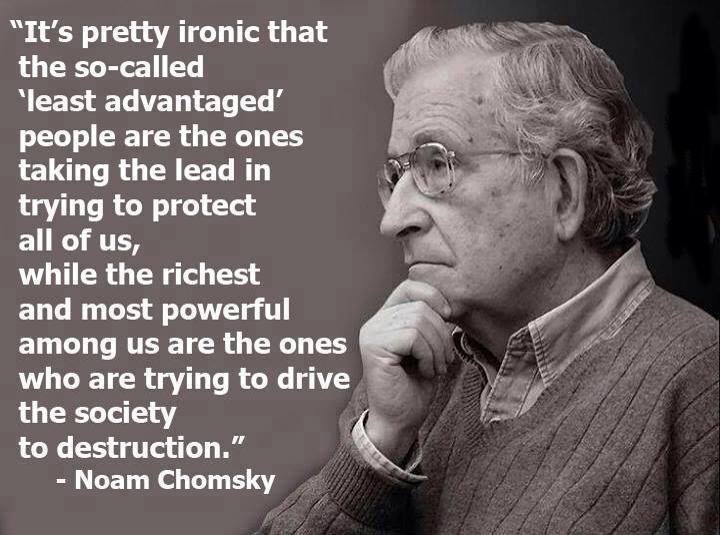
Noam Chomsky

Noam Chomsky: The Kind of Anarchism I Believe in, and What's Wrong with Libertarians

Noam Chomsky interviewed by Michael S. Wilson - Infoshop News, August 1, 2015

Disclaimer: The views expressed here are not the official position of the IWW (or even the IWW’s EUC) and do not necessarily represent the views of anyone but the author’s. The following is the adapted text of an interview that first appeared in Modern Success magazine.

So many things have been written about, and discussed by, Professor Chomsky, it was a challenge to think of anything new to ask him: like the grandparent you can’t think of what to get for Christmas because they already have everything.

So I chose to be a bit selfish and ask him what I’ve always wanted to ask him. As an out-spoken, actual, live-and-breathing anarchist, I wanted to know how he could align himself with such a controversial and marginal position.

Michael S. Wilson: You are, among many other things, a self-described anarchist — an anarcho-syndicalist, specifically. Most people think of anarchists as disenfranchised punks throwing rocks at store windows, or masked men tossing ball-shaped bombs at fat industrialists. Is this an accurate view? What is anarchy to you?

Noam Chomsky: Well, anarchism is, in my view, basically a kind of tendency in human thought which shows up in different forms in different circumstances, and has some leading characteristics. Primarily it is a tendency that is suspicious and skeptical of domination, authority, and hierarchy. It seeks structures of hierarchy and domination in human life over the whole range, extending from, say, patriarchal families to, say, imperial systems, and it asks whether those systems are justified. It assumes that the burden of proof for anyone in a position of power and authority lies on them. Their authority is not self-justifying. They have to give a reason for it, a justification. And if they can’t justify that authority and power and control, which is the usual case, then the authority ought to be dismantled and replaced by something more free and just. And, as I understand it, anarchy is just that tendency. It takes different forms at different times.

Anarcho-syndicalism is a particular variety of anarchism which was concerned primarily, though not solely, but primarily with control over work, over the work place, over production. It took for granted that working people ought to control their own work, its conditions, [that] they ought to control the enterprises in which they work, along with communities, so they should be associated with one another in free associations, and … democracy of that kind should be the foundational elements of a more general free society. And then, you know, ideas are worked out about how exactly that should manifest itself, but I think that is the core of anarcho-syndicalist thinking. I mean it’s not at all the general image that you described — people running around the streets, you know, breaking store windows — but [anarcho-syndicalism] is a conception of a very organized society, but organized from below by direct participation at every level, with as little control and domination as is feasible, maybe none.

Noam Chomsky: Can Civilization Survive Capitalism? Could a functioning democracy make a difference?

By Noam Chomsky - Alternet, February 2, 2015

Disclaimer: The views expressed here are not the official position of the IWW (or even the IWW’s EUC) and do not necessarily represent the views of anyone but the author’s.

There is “capitalism” and then there is “really existing capitalism.”

The term “capitalism” is commonly used to refer to the U.S. economic system, with substantial state intervention ranging from subsidies for creative innovation to the “too-big-to-fail” government insurance policy for banks.

The system is highly monopolized, further limiting reliance on the market, and increasingly so: In the past 20 years the share of profits of the 200 largest enterprises has risen sharply, reports scholar Robert W. McChesney in his new book “Digital Disconnect.”

“Capitalism” is a term now commonly used to describe systems in which there are no capitalists: for example, the worker-owned Mondragon conglomerate in the Basque region of Spain, or the worker-owned enterprises expanding in northern Ohio, often with conservative support – both are discussed in important work by the scholar Gar Alperovitz.

Some might even use the term “capitalism” to refer to the industrial democracy advocated by John Dewey, America’s leading social philosopher, in the late 19th century and early 20th century.

Dewey called for workers to be “masters of their own industrial fate” and for all institutions to be brought under public control, including the means of production, exchange, publicity, transportation and communication. Short of this, Dewey argued, politics will remain “the shadow cast on society by big business.”

The truncated democracy that Dewey condemned has been left in tatters in recent years. Now control of government is narrowly concentrated at the peak of the income scale, while the large majority “down below” has been virtually disenfranchised. The current political-economic system is a form of plutocracy, diverging sharply from democracy, if by that concept we mean political arrangements in which policy is significantly influenced by the public will.

There have been serious debates over the years about whether capitalism is compatible with democracy. If we keep to really existing capitalist democracy – RECD for short – the question is effectively answered: They are radically incompatible.

It seems to me unlikely that civilization can survive RECD and the sharply attenuated democracy that goes along with it. But could functioning democracy make a difference?

Noam Chomsky: Are We on the Verge of Total Self-Destruction? If you ask what the world is going to look like, it’s not a pretty picture

By Noam Chomsky - Tom Dispatch, January 19, 2015

Disclaimer: The views expressed here are not the official position of the IWW (or even the IWW’s EUC) and do not necessarily represent the views of anyone but the author’s.

What is the future likely to bring?  A reasonable stance might be to try to look at the human species from the outside.  So imagine that you’re an extraterrestrial observer who is trying to figure out what’s happening here or, for that matter, imagine you’re an historian 100 years from now -- assuming there are any historians 100 years from now, which is not obvious -- and you’re looking back at what’s happening today.  You’d see something quite remarkable.

For the first time in the history of the human species, we have clearly developed the capacity to destroy ourselves.  That’s been true since 1945.  It’s now being finally recognized that there are more long-term processes like environmental destruction leading in the same direction, maybe not to total destruction, but at least to the destruction of the capacity for a decent existence.

And there are other dangers like pandemics, which have to do with globalization and interaction.  So there are processes underway and institutions right in place, like nuclear weapons systems, which could lead to a serious blow to, or maybe the termination of, an organized existence.

Noam Chomsky: The Dimming Prospects for Human Survival From nuclear war to the destruction of the environment, humanity is steering the wrong course

By Noam Chomsky - Alternet, October 21, 2014

Disclaimer: The views expressed here are not the official position of the IWW (or even the IWW’s EUC) and do not necessarily represent the views of anyone but the author’s.

A previous article I wrote explored how security is a high priority for government planners: security, that is, for state power and its primary constituency, concentrated private power - all of which entails that official policy must be protected from public scrutiny.

In these terms, government actions fall in place as quite rational, including the rationality of collective suicide. Even instant destruction by nuclear weapons has never ranked high among the concerns of state authorities.

To cite an example from the late Cold War: In November 1983 the U.S.-led North Atlantic Treaty Organization launched a military exercise designed to probe Russian air defenses, simulating air and naval attacks and even a nuclear alert.

These actions were undertaken at a very tense moment. Pershing II strategic missiles were being deployed in Europe. President Reagan, fresh from the "Evil Empire" speech, had announced the Strategic Defense Initiative, dubbed "Star Wars," which the Russians understood to be effectively a first-strike weapon - a standard interpretation of missile defense on all sides.

Naturally these actions caused great alarm in Russia, which, unlike the U.S., was quite vulnerable and had repeatedly been invaded.

Newly released archives reveal that the danger was even more severe than historians had previously assumed. The NATO exercise "almost became a prelude to a preventative (Russian) nuclear strike," according to an account last year by Dmitry Adamsky in the Journal of Strategic Studies .

Nor was this the only close call. In September 1983, Russia's early-warning systems registered an incoming missile strike from the United States and sent the highest-level alert. The Soviet military protocol was to retaliate with a nuclear attack of its own.

The Soviet officer on duty, Stanislav Petrov, intuiting a false alarm, decided not to report the warnings to his superiors. Thanks to his dereliction of duty, we're alive to talk about the incident.

Security of the population was no more a high priority for Reagan planners than for their predecessors. Such heedlessness continues to the present, even putting aside the numerous near-catastrophic accidents, reviewed in a chilling new book, "Command and Control: Nuclear Weapons, the Damascus Accident, and the Illusion of Safety," by Eric Schlosser.

It's hard to contest the conclusion of the last commander of the Strategic Air Command, Gen . Lee Butler, that humanity has so far survived the nuclear age "by some combination of skill, luck and divine intervention, and I suspect the latter in greatest proportion."

The government's regular, easy acceptance of threats to survival is almost too extraordinary to capture in words.

In 1995, well after the Soviet Union had collapsed, the U.S. Strategic Command, or Stratcom, which is in charge of nuclear weapons, published a study, "Essentials of Post-Cold War Deterrence."

A central conclusion is that the U.S. must maintain the right of a nuclear first strike, even against non-nuclear states. Furthermore, nuclear weapons must always be available, because they "cast a shadow over any crisis or conflict."

Thus nuclear weapons are always used, just as you use a gun if you aim it but don't fire when robbing a store - a point that Daniel Ellsberg, who leaked the Pentagon Papers, has repeatedly stressed.

Read the entire article here.

Mobilizing for Justice in the Anthropocene: Autogestion, Radical Politics, and the Owl of Minerva (2/2)

By Javier Sethness Castro and Alexander Reid Ross - Notes toward an International Libertarian Eco-Socialism, September 18, 2014

This is part II of an interview on Grabbing Back: Essays Against the Global Land Grab (AK Press, 2014). Read part I here.

In the interviews you hold with Chomsky and Hardt in Grabbing Back, both thinkers point out the irony whereby the so-called “socialist” governments that have been elected throughout much of Latin America in recent years—Venezuela, Bolivia, Ecuador, and Uruguay, for example—notoriously have in fact been engaged in a significant intensification of the extractivist trends which their neoliberal precedecessors oversaw. This developmentalism has inexorably brought these “Pink Tide” governments into conflict with indigenous peoples, and it certainly has not been auspicious for nature, however much posturing Rafael Correa and Evo Morales like to advance in terms of the “rights of nature.” The fate of Ecuador’s YasuníNational Park is emblematic in this sense. As editor of Upside-down World, Grabbing Back contributor Benjamin Dangl has written at length on these tensions. How do you see indigenous concepts like sumak kawsay (“living well”) as realistic alternatives to State-capitalist depredation?

I think the implications of Dangl’s analysis of extractivism is as important today as, say, Rosa Luxemburg’s work on the Accumulation of Capital in the 1910s or David Harvey’s work on the Limits to Capital in the 1980s, and it fits with some really important thinking going on by people like Silvia Rivera CusicanquiRaúl Zibechi, and Pablo Mamani Ramírez. The Pink Tide governments are interesting to me, because they show how rhetoric centered around land can lead to a kind of fixation on natural resources and infrastructure, which precludes the Prebisch-style development of the Third World. So I wonder, does the focus on “the land” come about through the export-based economies that were generated by the annihilation of industrial infrastructure vis-à-vis globalization, and does it also reflexively work to thrust into power a so-called populist leadership that makes gains in the social wage by simply speeding up the process?

Chomsky: U.S. Plunges the Cradle of Civilization into Disaster, While Its Oil-Based Empire Destroys the Earth's Climate

By Noam Chomsky - AlterNet, September 5, 2014

Disclaimer: The views expressed here are not the official position of the IWW (or even the IWW’s EUC) and do not necessarily represent the views of anyone but the author’s.

It is not pleasant to contemplate the thoughts that must be passing through the mind of the Owl of Minerva as the dusk falls and she undertakes the task of interpreting the era of human civilization, which may now be approaching its inglorious end.

The era opened almost 10,000 years ago in the Fertile Crescent, stretching from the lands of the Tigris and Euphrates, through Phoenicia on the eastern coast of the Mediterranean to the Nile Valley, and from there to Greece and beyond. What is happening in this region provides painful lessons on the depths to which the species can descend.

The land of the Tigris and Euphrates has been the scene of unspeakable horrors in recent years. The George W. Bush-Tony Blair aggression in 2003, which many Iraqis compared to the Mongol invasions of the 13th century, was yet another lethal blow. It destroyed much of what survived the Bill Clinton-driven UN sanctions on Iraq, condemned as "genocidal" by the distinguished diplomats Denis Halliday and Hans von Sponeck, who administered them before resigning in protest. Halliday and von Sponeck's devastating reports received the usual treatment accorded to unwanted facts.

One dreadful consequence of the US-UK invasion is depicted in aNew York Times "visual guide to the crisis in Iraq and Syria": the radical change of Baghdad from mixed neighborhoods in 2003 to today's sectarian enclaves trapped in bitter hatred. The conflicts ignited by the invasion have spread beyond and are now tearing the entire region to shreds.

Noam Chomsky: Our Govt. Is Capable of Creating Total Catastrophe for Humankind

By Noam Chomsky - Alternet, July 1, 2014

Disclaimer: The views expressed here are not the official position of the IWW (or even the IWW’s EUC) and do not necessarily represent the views of anyone but the author’s.

The question of how foreign policy is determined is a crucial one in world affairs.  In these comments, I can only provide a few hints as to how I think the subject can be productively explored, keeping to the United States for several reasons.  First, the U.S. is unmatched in its global significance and impact.  Second, it is an unusually open society, possibly uniquely so, which means we know more about it.  Finally, it is plainly the most important case for Americans, who are able to influence policy choices in the U.S. -- and indeed for others, insofar as their actions can influence such choices.  The general principles, however, extend to the other major powers, and well beyond.

There is a “received standard version,” common to academic scholarship, government pronouncements, and public discourse.  It holds that the prime commitment of governments is to ensure security, and that the primary concern of the U.S. and its allies since 1945 was the Russian threat.

There are a number of ways to evaluate the doctrine.  One obvious question to ask is: What happened when the Russian threat disappeared in 1989?  Answer: everything continued much as before.

The U.S. immediately invaded Panama, killing probably thousands of people and installing a client regime. This was routine practice in U.S.-dominated domains -- but in this case not quite as routine. For first time, a major foreign policy act was not justified by an alleged Russian threat. 

Instead, a series of fraudulent pretexts for the invasion were concocted that collapse instantly on examination. The media chimed in enthusiastically, lauding the magnificent achievement of defeating Panama, unconcerned that the pretexts were ludicrous, that the act itself was a radical violation of international law, and that it was bitterly condemned elsewhere, most harshly in Latin America.  Also ignored was the U.S. veto of a unanimous Security Council resolution condemning crimes by U.S. troops during the invasion, with Britain alone abstaining. 

All routine.  And all forgotten (which is also routine).

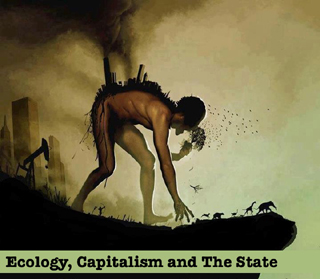
Ecology, Capitalism and The State

By L.S.R. - Edinburgh Anarchist Federation, June 21, 2014

Disclaimer: The views expressed here are not the official position of the IWW (or even the IWW’s EUC) and do not necessarily represent the views of anyone but the author’s.

Modern civilisation as we know it faces a number of major threats. Escalating economic inequality and an increasingly atomised society could lead to large-scale social breakdown. The depletion of natural resources is having a profound effect on the environment. As climate change continues to worsen, the ecosystems upon which human and non-human life depend are subjected to intolerable conditions. States across the globe have long since acquired the means by which to exterminate the species several times over, and given the continued plundering of natural resources in the pursuit of profit, the possibility of a nuclear war over what's left doesn't seem too unlikely.

These crises are often portrayed in the mass media as though they are separate from one another. They have different causes and thus, they can be dealt with in isolation. However, this approach is proving itself to be inadequate, given that these crises are continuing to deteriorate, and accumulating evidence suggests that, far from being separate, these crises are linked to one another, culminating in a 'perfect storm'.

Noam Chomsky: How Climate Change Became a 'Liberal Hoax'

From The Nation - Uploaded January 24, 2011

Disclaimer: The views expressed here are not the official position of the IWW (or even the IWW’s EUC) and do not necessarily represent the views of anyone but the author’s.

Capital Blight - The Ghosts of Ayn Rand

By x344534, May 25, 2014

Disclaimer: The views expressed here are not the official position of the IWW (or even the IWW’s EUC) and do not necessarily represent the views of anyone but the author’s.

My path to green syndicalism was anything but a straight line. I was initially ignorant of anarchism and libertarian socialism, because what gets labeled "libertarian" in the United States of America is actually anything but anarchist or libertarian, but instead is the most extreme and dogmatic brand of capitalism.

Let's be absolutely clear here. Capitalism cannot survive without the state. It takes a massive, centralized, armed-to-the-teeth, authoritarian government to enforce business contracts, "private property" rights, virtual "intellectual property" rights (the idea that ideas can be owned and controlled), rent, usury, and the notion that corporations are individual people. Nobody in their right mind would voluntarily consent to a system of institutionalized inequality which results in starvation, homelessness, disease, squalor, wage slavery, sexism, racism, and ecological degradation if they had the freedom (yes, you heard me correctly, I said "FREEDOM!" that ever ubiquitous buzzword that capitalist ideologues cast so effortlessly about in defense of their way of life which is anything but free to those forced into subservience under its dictates) to choose.

What initially blocked my path to real libertarianism, meaning libertarian socialism was the twisted demented pretzel logic of the so called "libertarian" capitalists in their polysyllabic but ultimately empty peonage to their Laissez-faire capitalist religion.

One individual in particular, Bryan Caplan--who lived in the dorm room next to mine at the (state-funded) University of California at Berkeley--even tried to "convert" me to his faith by handing me a reading list if his holy prophets: Ludwig Von Mises, Murray Rothbard, Henry Hazlitt, F. A. Hayak, Robert Nozick, and--of course--Ayn Rand.

Naturally, I didn't bite. I had a good deal of exposure to the demented nonsense of Rand already, and any philosophy or economic theory that supported this crazy dingbat's contention that there's any "virtue" in selfishness or that big corporate business is "a persecuted minority" couldn't have anything useful to say to me.

Thanks to a combination of my intelligence, inquisitiveness, stubbornness, and some plain good luck, I found thinkers and philosophers who offered clues to real libertarian ideas. These included Noam Chomsky, Murray Bookchin, Vandana Shiva, Rudolf Rocker, Christipher Alexander, bell hooks, Martin Luther King Jr., Malcolm X, Neil Peart (yes, that's correct, the drummer and lyricist of Rush), Chuck D (of Public Enemy), Graham Purchase, John Bellamy Foster, Carl Sagan, William Least Heat Moon, Bakunin, Marx, Engels, and Kropotkin (among others). Then, I met Judi Bari.

Judi Bari clarified matters for me greatly and showed me how one could be a radical environmentalist and an advocate for class struggle at the same time. Plus, she kept mentioning this group called, "the IWW."

I had no idea who the IWW was or what it stood for. For all I knew they were the International Socialist Organization (whom I was well acquainted with, but not at all interested in joining). Then, one day when seeking out a workers' collective to try and join as an alternative to the horribly depressing and soul killing capitalist retail job I had managed to get after graduating from that fabled weapons laboratory we call a "public university", a spokesperson from a network of such shops clued me in to what the IWW was and is.

I had heard Noam Chomsky (who would later join the IWW himself) describe himself as an "anarcho syndicalist" and a "libertarian socialist", but never fully understood what those terms meant or what an economy and political system organized around those ideas would look like. The IWW revealed to me how that would work in practice.

And, thanks to the influence of Judi Bari and Earth First!, the IWW was (and is) in many ways the first organization to promote green syndicalist ideas in practice (though the IWW is not limited to those concepts).

Over the following years, I came to realize how easy it was to prove just how flawed the thinking of so-called "libertarian" capitalists actually are, and really all I need to have done was read the following passage from the Preamble to the IWW Constitution:

The working class and the employing class have nothing in common. There can be no peace so long as hunger and want are found among millions of the working people and the few, who make up the employing class, have all the good things of life.

As time passed and I gained life-experience I saw that capitalism and freedom are actually incompatible. Just to be sure, I read anarchist and socialist literature voraciously and the knowledge that I gained from doing so validated my experiences. My deepening understanding of the interconnectedness of the environment further showed me the flawed pseudoscience that the Ludwig Von Mises "Austrian" school of economics actually is, and I came to realize that ever more fully as I wrote my own book about the green syndicalist organizing efforts of Judi Bari.

As for Caplan, I assumed he'd passed into obscurity (after all, disciples of Ayn Rand are a dime a dozen. The capitalist class spares few expenses in funding ministries of propaganda to promote itself, and said ideologues serve that function all too effectively, but there's nothing particularly noteworthy about most of them). In this particular case, I was mistaken.

Pages

The Fine Print I:

Disclaimer: The views expressed on this site are not the official position of the IWW (or even the IWW’s EUC) unless otherwise indicated and do not necessarily represent the views of anyone but the author’s, nor should it be assumed that any of these authors automatically support the IWW or endorse any of its positions.

Further: the inclusion of a link on our site (other than the link to the main IWW site) does not imply endorsement by or an alliance with the IWW. These sites have been chosen by our members due to their perceived relevance to the IWW EUC and are included here for informational purposes only. If you have any suggestions or comments on any of the links included (or not included) above, please contact us.

The Fine Print II:

Fair Use Notice: The material on this site is provided for educational and informational purposes. It may contain copyrighted material the use of which has not always been specifically authorized by the copyright owner. It is being made available in an effort to advance the understanding of scientific, environmental, economic, social justice and human rights issues etc.

It is believed that this constitutes a 'fair use' of any such copyrighted material as provided for in section 107 of the US Copyright Law. In accordance with Title 17 U.S.C. Section 107, the material on this site is distributed without profit to those who have an interest in using the included information for research and educational purposes. If you wish to use copyrighted material from this site for purposes of your own that go beyond 'fair use', you must obtain permission from the copyright owner. The information on this site does not constitute legal or technical advice.