You are here

Trade Unions for Energy Democracy (TUED)

(Working Paper #7) An Illness to One is the Concern of All: The Health Impacts of Rising Fossil Fuel Use

By Svati Shah and Sean Sweeney - Trade Unions for Energy Democracy, September 2016

This paper has been written to help unions representing workers in all sectors get a clear sense of what is presently happening in terms of the health impact of fossil fuel use and what could also happen if present patterns in energy use continue into the future. The data are presented in a way that unions can use to more effectively advocate both for their members and the broader public.

Unions in health care can play—indeed are playing—an important role in addressing both the climate-related and the pollution-related dimensions of the unfolding health crisis, as can health and safety personnel working with or for unions in different sectors. But the health-related impacts of rising pollution levels and climate change are expected to affect the lives of workers across a range of occupations. Unions representing workers in emergency services, workers in transport systems, or workers who must work outdoors in agriculture or construction also have a particularly important role to play. The situation requires as unified a response as possible.

One of the striking features of fossil fuel use today is how much it reflects and reinforces class inequalities. It is well known that rich countries consume far more energy per per-son than poorer ones, but within both rich and poor countries there is often a huge gulf between the energy consumed by the rich and the energy consumed by the poor and working class. The same is true of emissions. A December 2015 study released by Oxfam calculated that the poorest half of the global population are responsible for only around 10% of global emissions yet live overwhelmingly in the countries most vulnerable to climate change while the richest 10% of people in the world are responsible for around 50% of global emissions.

Trade unions with the capacity to play more of an active role in resisting the expansion of fossil fuel use can be confident of the fact that they will be intersecting with a rising global movement that is confronting fossil fuel extraction, including “unconventional fuels” like shale gas and shale oil. The concerns that drive this movement are numerous. Along with climate and air quality concerns, struggles have been built around questions of water scarcity and contamination and the fight to defend land and livelihoods from “extractivist” energy companies.

Read the report (PDF).

Sean Sweeney of Trade Unions for Energy Democracy presentation to NZ ECO conference 2016

By Sean Sweeney - Trade Unions for Energy Democracy (YouTube), August 20, 2016

Sean Sweeney's introduces the work of Trade Unions for Energy Democracy to ECO conference 2016:

(Working Paper #6) Carbon Markets After Paris: Trading in Trouble

By Sean Sweeney - Trade Unions for Energy Democracy, March 11, 2016

The 2015 Paris Climate Agreement enshrines emissions trading schemes (ETSs) as a key mechanism for reducing emissions. But are ETSs effective?

Since the early 1990s, “putting a price on carbon” has been, perhaps, the primary policy proposal for fighting climate change by reducing greenhouse gas emissions. Whether through carbon taxes or “cap-and-trade” ETSs, proponents of carbon pricing see it as a way to guide investment toward green solutions without the need for more decisive government interventions. ETSs, in particular, have been favored by businesses and neoliberal policy makers seeking to limit emissions without disrupting business-as-usual.

It has been a decade since the European Union established the world’s largest ETS. In the long aftermath of the 2008-9 financial crisis, the price on carbon has been too low to incentivize investors to move away from fossil fuels.

Union Approaches

The European Trade Union Confederation (ETUC)—a supporter of the EU ETS—has called for policies that would raise the price on carbon while also expressing concern about “carbon leakage” —where companies move polluting activities (and associated jobs) to jurisdictions without price constraints on pollution. Such a position threads the needle of trade union debates around the EU ETS without resolving the underlying tensions—nor, it should be noted, shifting EU policy in any appreciable way. With the Paris Agreement giving an even more prominent role to carbon pricing, unions around the world are likely to face similar debates.

In the TUED Working Paper Carbon Markets After Paris, TUED Coordinator  Sean Sweeney argues that it is time for unions to reevaluate their stance on emissions trading. Market-based solutions may be appealing to business interests and their political allies, but it’s going to take direct governmental action to guide a transition to a just, democratic, and sustainable energy system and a low-carbon economy.  The now battered neoliberal consensus finds public and democratic ownership and control of a key economic sector to be anathema, but it is precisely what is needed if we are serious about combating climate change.

TUED Disclaimer: This paper represents the views of its author.  The opinions expressed here may or may not be consistent with the policies and positions of unions participating in TUED. The paper is offered for discussion and debate.

Strategies For Climate Justice And A Just Transition

By Environmental Justice League of RI - RI Future, January 15, 2016

The Environmental Justice League of Rhode Island (EJLRI) has created a brilliant position paper, “National Grid’s Liquefied Natural Gas (LNG) Liquefaction Facility: Toxic Hazards in the Port Providence: Proposals for a Just Transition” that eviscerates National Grid‘s plans to build a new liquefaction facility for fracked LNG at Fields Point in South Providence. Over the next few days RI Future will be presenting the EJLRI’s position paper in its entirety.

Solutions and Alternatives

The information presented in the previous posts show that in addition to not being necessary, National Grid’s proposed LNG Liquefaction Facility would be dangerous and would contribute to existing environmental racism. LNG Liquefaction is not needed in Rhode Island in general, and it certainly should not be placed in the most toxic and most impoverished part of the state.

The immediate solution is to stop this facility from being built. The Federal Energy Regulatory Commission (FERC) needs to deny National Grid LNG LLC’s application, and the RI Department of Environmental Management (RI DEM) and RI Coastal Resources Management Council (RI CRMC) need to deny the state level permits.

That being said, ­ the proposed liquefaction facility is not the only problem outlined in this position paper. Even without the added significant risks of the liquefaction facility, the existing LNG storage tank, the Motiva oil terminal, the Univar chemical plant, the Enterprise LPG terminal, and other facilities in the area all pose significant environmental health hazards, and create the overall context of environmental racism. Toxic and hazardous facilities are dangerous for communities and dangerous for workers. Yet families are dependent on them for jobs, municipalities are dependent on them for tax income, and the way our socio­economic system is set up we are all collectively dependent on the products they produce. Regardless of our dependency, the reality of climate science is that the fossil fuel / petrochemical industry is rapidly pushing our planet past its limits, producing present and future catastrophic impacts, and making people sick, ­especially front-line communities of color and indigenous communities. Our dependency on these industries is literally killing us.

As an organization, the EJ League is interested in big­ picture, long­ term, real solutions to interlocking crises that impact communities of color, marginalized communities, and planetary ecosystems. We are members of three national coalitions of grassroots, membership ­based organizations: Right to the City, Grassroots Global Justice, and Climate Justice Alliance. Together, and lead by our members and our communities, we are developing and sharing solutions that address these intersecting crises from the grassroots. These community­ based solutions are in opposition to the corporate top­ down false solutions that pretend to address a single symptom while reinforcing the underlying root causes of the problems.

True solutions are rooted in the work of grassroots internationalism, and using the framework of a “Just Transition”. We are collectively building a different context and a different system, an economy for people and the planet. The Just Transition framework emerged from partnerships between environmental justice and labor organizations. In the words of the Just Transition Alliance, “together with front-line workers, and community members who live along the fence ­line of polluting industries, we create healthy workplaces and communities. We focus on contaminated sites that should be cleaned up, and on the transition to clean production and sustainable economies.”

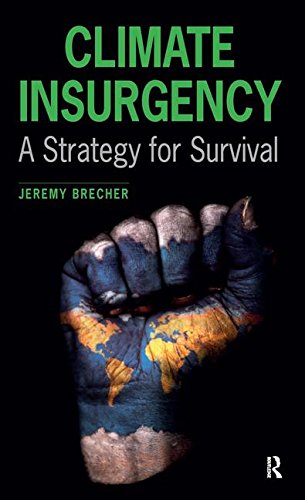
Climate Insurgency After Paris

By Jeremy Brecher - CounterPunch, January 11, 2016

In December of 2015 – the earth’s hottest year since recordkeeping began — 195 nations met in Paris to forge an agreement to combat global warming. The governments of the world acknowledged their individual and collective duty to protect the earth’s climate — and then willfully refused to perform that duty. What did they agree to, and how should the people they govern respond?

The 195 nations meeting in Paris unanimously agreed to the goal of keeping global warming “well below 2 degrees Celsius” and to pursue efforts “to limit the increase in temperatures to 1.5 degrees Celsius.” Despite that goal, the Paris agreement also permits the greenhouse gas (GHG) emissions that cause global warming to continue rising.

Under the Paris agreement, governments put forward any targets they want – known as Intended Nationally Determined Contributions (INDCs) – with “no legal requirement dictating how, or how much, countries should cut emissions.”[1] These voluntary commitments don’t come into effect until 2020 and generally end in 2025-2030.

Today there are 400 parts per million (ppm) of carbon in the atmosphere, far above the 350 ppm climate scientists regard as the safe upper limit. Even in the unlikely event that all nations fulfill their INDC pledges, carbon in the atmosphere is predicted to increase to 670 ppm by the end of this century.[2] The global temperature will rise an estimated 3.5 degrees Celsius (6.3 degrees Fahrenheit) above pre-industrial levels.[3] For comparison, a 1-degree Celsius increase has been enough to cause all the effects of climate change we have seen so far, from Arctic melting to desertification. In short, the agreement authorizes the continued and even increased destruction of the earth’s climate.

US negotiators were adamant that the agreement must not include any binding restrictions on emissions. Secretary of State John Kerry told fellow negotiators that he “wished that we could include specific dates and figures for emissions cuts and financial aid” to developing countries, but “this could trigger a review by the US Senate that could scuttle the entire agreement.”[4] When US lawyers discovered a phrase declaring that wealthier countries “shall” set economy-wide targets for cutting their GHG pollution, Kerry said, “We cannot do this and we will not do this. And either it changes or President Obama and the United States will not be able to support this agreement.” “Shall” was changed to “should” without so much as a vote.[5]

The breathtaking gap between the Paris agreement’s aspiration to hold global warming below 2 degrees Celsius and the agreement’s actual commitments is indicated by an analysis by Climate Interactive and MIT Sloan. The current US pledge to drop GHG emissions 26 percent below 2005 levels by 2025, along with the pledges of other countries, will lead to a global temperature increase of 3.5 degrees Celsius (6.3 degrees Fahrenheit) above pre-industrial levels. To reduce warming to 1.8 degrees Celsius (3.2 degrees Fahrenheit) will require the US to increase its INDC from 26 percent below 2005 levels to 45 percent by 2030, and for other countries to make comparable reductions.[6]

Under the Paris agreement countries will monitor their emissions and reconvene every five years starting in 2023 to report on the results and perhaps ratchet up their INDCs. This has been characterized as creating a “name-and-shame” system of global peer pressure, “in hopes that countries will not want to be seen as international laggards.”[7]

On the last day of the Paris summit, a panel of leading scientists evaluated what would be necessary to achieve its targets. Prof. Hans Schellnhuber of the Potsdam Institute for Climate Impact Research said that to reach the 2-degree target the world would have to get CO2 out of its system by 2070. To reach the 1.5-degree target it would have to eliminate CO2 emissions by 2050. Johan Rockstrom of the Stockholm Resilience Center said that for any chance of reaching 1.5 degrees, the richest nations need to reach zero fossil fuel use by 2030.[8]

Unify Fights Against Austerity and Climate Change

By Asbjørn Wahl - Social Europe, December 18, 2015

The Climate Summit in Paris has once again reminded us of how vulnerable we are on planet earth. However, humanity is faced with a number of deep and challenging crises: economic, social, political, over food – and, of course, over climate change, which is threatening the very existence of millions of people. These crises have many of the same root causes, going to the core of our economic system.

Strong vested interests are involved. It is thus an interest-based struggle we are facing. All over the world, people are organizing and fighting against the effects of the crises. Trade unions are heavily involved in many of these struggles, and so are many other movements – single-issue as well as broader social movements. Increasingly, our entire social model, the way we produce and consume, is under question. The way out of these crises requires a system change and this can only be achieved if we are able considerably to shift the balance of power in society. This leaves us with the challenge of unifying movements and continuing struggles – particularly to bring anti-austerity together with the struggle against climate change.

Agreement, But No Solution

At the recent Paris Summit (COP21), the first ever truly global agreement to fight the climate crisis was concluded. Governments have been negotiating for more than 20 years (more or less since the Rio Summit in 1992) in order to achieve that. During this period, however, greenhouse gas (GHG) emissions have not been cut. Quite the opposite. Emissions have increased immensely, by more than 60 per cent. Transport emissions have increased 120 per cent over the last 30 years, and they are still rising all over the world – even at a rate that outweighs cuts in other economic sectors.

The stated aim of the Paris agreement is ambitious. The target of keeping global warming below 2oC was strengthened, so that governments should now “pursue efforts” to limit the temperature increase to 1.5oC above pre-industrial levels. The weakness of the agreement is that there is a huge gap between this aim and the measures agreed upon to reach it. Based on the voluntary pledges (so-called Intended Nationally Determined Contributions – INDCs) from all countries on how much they are prepared to cut their emissions, we are so far on course for a temperature increase of 3-4oC. This means climate catastrophe.

After Paris: A Global Movement for Climate Jobs

By Jonathan Neale - Global Climate Jobs, December 18, 2015

This post looks at the results of the Paris climate talks, and says what the climate movement and the social movements need to do next, how climate jobs fit into that, and what you can do to help build a campaign for climate jobs in your country.

The Paris Climate Talks

Many have hailed the result of the UN climate talks as a breakthrough, for two reasons. One: all of the countries of the world signed an agreement about climate change. Two: there are some good abstract hopes in that agreement.

But there are also concrete promises about emissions. Some countries have promised to cut emissions by a little in the next fifteen years. They may, or may not, keep their promises. Many more countries, with more emissions, have promised to increase their emissions by a lot. Taken together, these are promises to increase emissions every year between now and 2030. That’s the bottom line. (For the details, see our earlier post, Paris: World Promises to Increase Emissions.)

What We Need to do Now

The good news is that we have a growing and increasingly radical global climate movement. And the organisations who think the agreement is a breakthrough also think it is only a beginning. In addition most people in the climate movement saw the result of Paris coming, so we do not have a demoralised movement.

As we return from Paris, it is clear that the leaders of all the countries in the world have failed us. They did so because nowhere did we have the political and social power to make them take decisive action on climate. So now we have to build that power, country by country. The only force we have on our side is seven billion people. We have to mobilise them.

This will not be an easy or quick task. We all know that. After all, we need cuts of 80% in global emissions, as soon as possible. That means deep changes in energy use and society.

Two kinds of campaigns will be central. One is fighting to leave the coal, gas and oil in the soil. There will be a global day of action against fossil fuels in May; national campaigns; local resistance to pipelines, new mines, new drilling, new power stations, extreme energy, fossil few sponsorship, and investments in fossil fuels.

The other kind of campaign will be to build an alternative. If we are to leave the fossil fuels in the ground, we have to do four things. We need to replace fossil fuels almost entirely with renewable energy. To do that we need renewable energy for all our electricity. We need a switch from cars to public transport, and almost all transport run on renewable electricity. We need conversions of all homes and buildings to save energy, and then to heat and cool all buildings with renewable electricity. And we need to protect and extend the great forests.

We need to do thousands of other things, but those four things will make most of the difference. All that will take a lot of work – we estimate at least 120 million new jobs worldwide each year for 20 years. This is what we mean by ‘climate jobs’ – jobs that have a direct effect in cutting greenhouse gas emissions.

(For more detailed explanation in English, French or Spanish, see our booklet on Global Climate Jobs here.)

Moreover, we want government climate jobs programs to ensure a retraining and a permanent job to anyone who loses a high carbon job during the transition. That is only fair, and if we don’t do it we will split unions and communities.

‘We need social ownership and democratic control of energy’

By Tabby Spence - New Internationalist, December 16, 2015
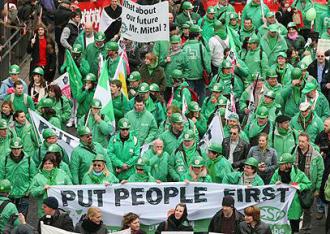
The dust has settled in Paris, where hundreds of thousands of delegates, journalists and activists spent the last two weeks buzzing around on little sleep and carrying heavy agendas. Despite the news of a ‘historic, world-saving agreement’ flooding the airwaves, tens of thousands flooded the streets on Saturday to express grief, despair, anger, defiance, and a commitment to continue strengthening the climate justice movement. According to the activists, who were literally drawing massive red lines through central Paris (and in other places around the world), the Paris Agreement permits governments to cross many important red lines representing the basic requirements for a just and liveable planet (you can see more detailed analysis on just how bad the deal really is here).

Given the decades of international meetings not yielding any cuts in greenhouse gas emissions (but rather growth by 63%), most of the civil-society groups were prepared for another epic failure at COP21. Yet many of these groups are developing strategies to drive scientifically adequate and historically fair transformations at local and national scales. A diversity of groups are working to remove the social licence of polluting corporations, the legality of company fiduciary duty over human lives and ecological systems, and the political and economic incentives granted to climate-warming industries.

While some of these groups have gained notoriety on social media for their creative actions, trade union groups and allies have been working quietly and diligently in their own locales to develop rapid phase-out plans for fossil fuel-emitting industries and vamping up renewables, as well as increasing energy efficiency in buildings, and reducing emissions in transport, food production and other important areas.

Jonathan Neale of the One Million Climate Jobs campaign in the UK explains, ‘These plans aim for a just transition – with the public creation of the climate jobs needed, a training programme for people leaving fossil sectors and moving into the new industries, and guaranteed work with decent pay for working people.’

Members of the Global Climate Jobs campaigns active in South Africa, Norway, Canada, the Philippines, the UK, New York State, and Mauritius held a number of workshops over the duration of the two weeks in Paris to explain how the existing campaigns in particular national contexts were developed, and to offer support for people who want to begin climate-jobs campaigns in their own countries. New campaigns are being launched in countries all over the world as a result of these discussions.

Trade Unions for Energy Democracy (TUED), like many of the climate jobs campaigns, emphasize the need for the jobs created to be public-sector jobs, and for the carbon-free energy, transportation and housing to be affordable and accessible for all.

The way forward is with ‘social ownership and democratic control of energy’, Sean Sweeney, founder of the Global Labor Institute, said at a sold-out event in Paris, titled ‘Now is not the time for small steps: solutions to the climate crisis and the role of trade unions’. Clara Paillard, who is the National Executive Secretary of the UK-based Public and Commercial Services Union, elaborated, emphasizing that addressing climate change is too important to be left to the market, and that the transition needs to be managed across scales by the public, not for short-term, private gains.

Leader of the British Labour Party Jeremy Corbyn and renowned writer and activist Naomi Klein joined for the lively conversation of the crucial link between the imperatives for social, economic and political transformation in the context of a warming climate. One of the panellists, leading trade unionist Josua Mata of Sentro (Philippines), posed one of the most salient and challenging questions: ‘If the deal is going to be so bad, why don’t we just reject it? Isn’t no deal better than a bad deal?’ Naomi Klein’s response was that, even if we want to, we don’t get to reject it.

The lack of democracy and the hold of powerful countries and interests over the international processes means that the local and national scales are the actual planes at which we can operate to bring about large-scale changes.

Many of the climate-jobs campaigns are gaining traction and, thanks to the tireless work of trade unionists, allies and other organizers for social justice, it looks like we may see large-scale 'operationalization of the first climate-jobs campaign in Canada within the year. The strategy of developing transitional blueprints on national or local scales, with an aim to put power back into the hands of the public, may be the best bet we have to massively rejig the world as quickly and democratically as possible.

How labor is working on climate justice

By Sean Petty - Socialist Worker, December 14, 2015

Many political leaders and the mainstream media are hailing the agreement signed by nearly 200 countries at the United Nations climate summit in Paris as "groundbreaking." But for the many thousands of people and hundreds of organizations struggling for climate justice, the deal struck at COP 21 doesn't go far enough--and not nearly fast enough.

Sean Petty, a pediatric ER nurse in New York City and member of the New York State Nurses Association, traveled to Paris during the two weeks of COP 21 to be part of protests and discussions organized by climate justice organizations. Here, he answered SW's questions about the presence of unions during the summit and what lies ahead for labor and the struggle to save the planet:

WHY WERE people from your union present at the climate talks?

FOR A number of reasons. Especially after Superstorm Sandy in 2012 caused heavy damage in large parts of New York City, including several public hospitals where our members care for patients, we have become very active in the movement to stop climate change.

We opposed the Keystone XL pipeline, we opposed fracking in our state, and we helped mobilize for the People's Climate March in September 2014. We also developed lunchtime educational meetings in our hospitals around climate change and are organizing a Climate Justice committee, which is something we hope other unions emulate.

We wanted to come to Paris to relate these experiences and join with other unions in sending a clear message that we have to keep global temperature rise below 2 degrees Celsius, and that the necessary transition to renewable energy has to happen on a world-historic scale, has to involve the creation of good, union jobs, and has to happen through a massive expansion of public investment in energy, infrastructure and transportation.

HOW WAS the union presence organized during the COP 21?

THE MAIN global federation of unions is the International Trade Union Congress (ITUC), and it is the official voice of unions within negotiations. The ITUC also organized a two-day series of workshops called the "Trade Union Forum on Climate and Jobs," where a number of unions contributed to panel discussions around different aspects of the climate crisis.

The ITUC also held workshops at the broader assembly of climate justice organizations called the "Sommet citoyen pour le climat" (People's Climate Summit), which took place in Motreuil, a close suburb of Paris, over the weekend of December 5-6.

The ITUC's main objective in the talks over the last decade or so was to fight for two words to be included in any final agreement: "just transition." This language was included in drafts leading up to the COP 21, but was dropped pretty early on during negotiations.

This triggered a significant action on December 10, where as many as 400 members of the union delegation and their allies staged a sit-in for several hours in the social space adjacent to the talks. This was a somewhat bold move, as the French ban on protests, imposed following the November 13 terrorist attacks in Paris, was still in effect. The French authorities chose not to have a confrontation and allowed to action to proceed without incident.

The protest gained attention for this issue. But the strategy of focusing on getting vague language into a nonbinding agreement as the primary focus of international trade union action has to be questioned. The stakes are way too high for such low expectations.

"Liberté Is Not Just A Word": Klein, Corbyn Call for Mass Protest at COP21

By Nadia Prupis - Common Dreams, December 8, 2015

"By taking to the streets, we will be clearly and unequivocally rejecting the Hollande government's draconian and opportunistic bans on marches, protests, and demonstrations."

Video: At a packed meeting in Paris, Naomi Klein, supported by UK Labour Party leader Jeremy Corbyn, calls for mass civil disobedience to break the ban on demonstrations on December 12. Trade unionists and others discuss the real solutions to climate change: an end to fossil fuels, energy democracy, and a just transition to millions of cllimate jobs.

Additional Speakers: Sean Sweeney (Trade Unions for Energy Democracy), Lyda Forero (Transnational Institute–TNI, Columbia), Josua Mata (Philippino Workers Central–SENTRO, Philippines), Clara Paillard (Public & Commercial Services Union–PCS, United Kingdom) and Judy Gonzalez (New York State Nurses Association, USA)

In Paris on Monday, a panel of activists, including author Naomi Klein and UK Labour Party leader Jeremy Corbyn, spoke to a packed crowd on the role of the global labor sector in the climate justice movement and called for mass civil disobedience to break French President François Hollande's ban on demonstrations during the COP21 summit.

Klein spoke candidly about the global climate agreement being hammered out by world leaders this month, stating, "The deal that will be unveiled in less than a week will not be enough to keep us safe. In fact, it will be extraordinarily dangerous."

Wealthy nations have set up inadequate climate targets that could allow average global temperatures to rise by 3 or 4 degrees Celsius, Klein said—far higher than the agreed-on threshold of 2°C, which scientists say would cause catastrophic extreme weather events. The deal is going to "steamroll over crucial scientific red lines... it is going to steamroll over equity red lines... it is going to steamroll over legal red lines."

"Which is why on December the 12th, at 12 o'clock—that's 12-12-12—many activists will be peacefully demonstrating against the violation of these red lines," Klein said, prompting a round of applause from the audience of roughly 800 trade unionists and other workers and activists.

Pages

The Fine Print I:

Disclaimer: The views expressed on this site are not the official position of the IWW (or even the IWW’s EUC) unless otherwise indicated and do not necessarily represent the views of anyone but the author’s, nor should it be assumed that any of these authors automatically support the IWW or endorse any of its positions.

Further: the inclusion of a link on our site (other than the link to the main IWW site) does not imply endorsement by or an alliance with the IWW. These sites have been chosen by our members due to their perceived relevance to the IWW EUC and are included here for informational purposes only. If you have any suggestions or comments on any of the links included (or not included) above, please contact us.

The Fine Print II:

Fair Use Notice: The material on this site is provided for educational and informational purposes. It may contain copyrighted material the use of which has not always been specifically authorized by the copyright owner. It is being made available in an effort to advance the understanding of scientific, environmental, economic, social justice and human rights issues etc.

It is believed that this constitutes a 'fair use' of any such copyrighted material as provided for in section 107 of the US Copyright Law. In accordance with Title 17 U.S.C. Section 107, the material on this site is distributed without profit to those who have an interest in using the included information for research and educational purposes. If you wish to use copyrighted material from this site for purposes of your own that go beyond 'fair use', you must obtain permission from the copyright owner. The information on this site does not constitute legal or technical advice.