






You are here
Trade Unions for Energy Democracy (TUED)
 The following news items feature issues, discussions, campaigns, or information potentially relevant to green unionists:
 The following news items feature issues, discussions, campaigns, or information potentially relevant to green unionists:
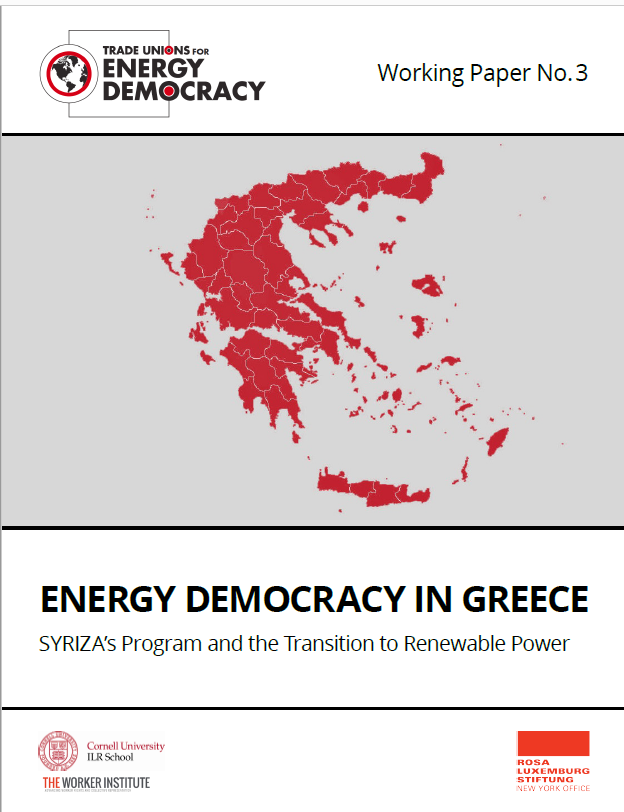 Since the financial crisis of 2008 and the subsequent “Great Recession,” governments have mostly scaled back or deemphasized their climate protection and “green” commitments. Lack of public funds and concerns about growth, competitiveness, and unemployment are frequently cited as explanations for this apparent loss of both ambition and urgency. The “green growth” narrative that colored various countercyclical “stimulus” spending packages from 2009-10 has been largely abandoned.
 On November 2, 2014, the Intergovernmental Panel on Climate Change (IPCC) released its
  The international community shares today more scientific evidence than it needs to inform decision making on climate change. The impacts on peoples’ lives, livelihoods and prosperity if we fail to act now will be calamitous. Yet the opportunities for social progress and decent work behind an ambitious climate protection agenda are such that it would be irrational to let go this unique time in history where we can still solve the problem.
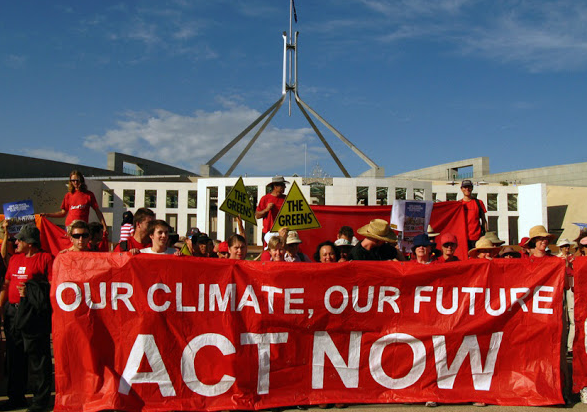
 From teachers to transit workers, civil servants to electricians, the People’s Climate March will have more organized-labor participation than any environmentalist effort in U.S. history.
 New York City and key national unions like the Service Employees International Union and Communication Workers of America are stepping up to support the People's Climate March in NYC September 21, in a broad coalition. But some green radicals from labor groups say unions need to create their own climate protection strategy that democratizes the energy sector.
 This paper has been written for unions and unionists who are perhaps in the early stages of their engagement with climate change and who feel they might benefit from knowing “the story so far” in terms of trade union involvement.
 The
The The Fine Print I:
Disclaimer: The views expressed on this site are not the official position of the IWW (or even the IWW’s EUC) unless otherwise indicated and do not necessarily represent the views of anyone but the author’s, nor should it be assumed that any of these authors automatically support the IWW or endorse any of its positions.
Further: the inclusion of a link on our site (other than the link to the main IWW site) does not imply endorsement by or an alliance with the IWW. These sites have been chosen by our members due to their perceived relevance to the IWW EUC and are included here for informational purposes only. If you have any suggestions or comments on any of the links included (or not included) above, please contact us.
The Fine Print II:
Fair Use Notice: The material on this site is provided for educational and informational purposes. It may contain copyrighted material the use of which has not always been specifically authorized by the copyright owner. It is being made available in an effort to advance the understanding of scientific, environmental, economic, social justice and human rights issues etc.
It is believed that this constitutes a 'fair use' of any such copyrighted material as provided for in section 107 of the US Copyright Law. In accordance with Title 17 U.S.C. Section 107, the material on this site is distributed without profit to those who have an interest in using the included information for research and educational purposes. If you wish to use copyrighted material from this site for purposes of your own that go beyond 'fair use', you must obtain permission from the copyright owner. The information on this site does not constitute legal or technical advice.
 This site is not the official webpage of the Industrial Workers of the World.