You are here

Judi Bari

KPFA FM Radio Broadcast: Repression Against Environmental Activists - Terra Verde, June 27, 2014

Terra Verde, KPFA 94.1 FM - June 27, 2014 at 2:00pm, Hosted By Laura Garzon Chica

Disclaimer: The views expressed here are not the official position of the IWW (or even the IWW’s EUC) and do not necessarily represent the views of anyone but the author’s.

(On this show) we explore the condemnation of eco-activism as terrorism punishable under the law (or outside the law) in the name of national security. Does the government's attack on civil disobedience signal an end to a legitimate democracy in the USA? What does the corroding of civil liberties and the gutting of the Bill of Rights mean for those who struggle to protect our environment, ourselves as a species, and other creatures? What about corporations and the intelligence industrial complex at large? How do these non-state actors engage in the push to prosecute environmentalists involved in nonviolent direct action as terrorists and/or spies? Guests Will Potter, Shahid Buttar, and Steve Ongerth tackle these questions with host Laura Garzon Chica.

Download this clip (mp3, 5.13, megabytes)

Play this clip in your Computer's media player

Capital Blight - Aristocracy Forever

By x344543 - June 12, 2014

Disclaimer: The views expressed here are not the official position of the IWW (or even the IWW’s EUC) and do not necessarily represent the views of anyone but the author’s.

When the union leaders' payoffs by the bosses has begun,
There will be no labor trouble anywhere beneath the sun,
For the AFL trade unions and the management are one,
The union keeps us down.

Chorus
Aristocracy forever,

--lyrics excerpted from Aristocracy Forever, by Judi Bari

It happens far too often. Big corporate industrial polluters rape and pillage the Earth, whether by tar sands mining, fracking, mountaintop coal mining, offshore oil drilling, clearcut logging, and more. What's more, much of what they extract they export elsewhere, choosing to remove even the economic benefits of local production from the affected community. These corporations claim to be "good neighbors", but they suck up all the wealth (in the form of profits), and they outsource the costs to the community. And the workers who actually do the labor to produce all of this wealth? Not only are they not paid the full value of their labor, they're often the first to bear the brunt of the toxic pollution and chemical poisoning these companies create in their wake.

It's no wonder that time and time again we witness communities organizing and mobilizing opposition to this state of affairs, often assisted by environmental organizations of various types. What's curious, however, is how often the unions (if the workers in these facilities are fortunate enough to have union representation) defend the companies and even promote the companies' messages--even though it's ultimately not in the workers' interest to do so.

Workers and Environmentalists of the World, Unite!

By Stefania Barca - RoarMag.org, June 3, 2014

Disclaimer: The views expressed here are not the official position of the IWW (or even the IWW’s EUC) and do not necessarily represent the views of anyone but the author’s.

The conflict between labor and the environment is a neoliberal construct. What we need is a broad coalition that can fundamentally transform production.

Nowadays it sounds so familiar, almost natural: the mutually exclusive demands and apparently opposing agendas of labor and the environmentalist movement. But in fact, this artificial division is nothing more than a crucial neoliberal strategy to divide two of the most powerful social movements of the industrial era, whose alliance could be a dangerous liaison with the capacity to call into question the very essence of the capitalist “treadmill of production.” It is thus essential that labor and environmental/public health organizations gain a historical perspective on their current state of conflict and become aware of the revolutionary potential of a common political project.

One place where this fact has become much clearer in recent years is the Italian city of Taranto, Apulia, where a number of citizens’ organizations and “committees” emerged in response to one of the most serious occupational, environmental and public health crises of the last decade. These organizations and committees have now begun mobilizing different resources and forms of action — from cyber-activism and film-making to street demonstrations and campaigning — to fight against the occupational blackmail of a local employer. At the last May Day celebrations, they managed to gather more than 100,000 people for a self-organized, crowd-sourced mass concert, held in open competition with the one traditionally organized in Rome by the trade unions confederation and RAI, the national public television.

Capital Blight - The Ghosts of Ayn Rand

By x344534, May 25, 2014

Disclaimer: The views expressed here are not the official position of the IWW (or even the IWW’s EUC) and do not necessarily represent the views of anyone but the author’s.

My path to green syndicalism was anything but a straight line. I was initially ignorant of anarchism and libertarian socialism, because what gets labeled "libertarian" in the United States of America is actually anything but anarchist or libertarian, but instead is the most extreme and dogmatic brand of capitalism.

Let's be absolutely clear here. Capitalism cannot survive without the state. It takes a massive, centralized, armed-to-the-teeth, authoritarian government to enforce business contracts, "private property" rights, virtual "intellectual property" rights (the idea that ideas can be owned and controlled), rent, usury, and the notion that corporations are individual people. Nobody in their right mind would voluntarily consent to a system of institutionalized inequality which results in starvation, homelessness, disease, squalor, wage slavery, sexism, racism, and ecological degradation if they had the freedom (yes, you heard me correctly, I said "FREEDOM!" that ever ubiquitous buzzword that capitalist ideologues cast so effortlessly about in defense of their way of life which is anything but free to those forced into subservience under its dictates) to choose.

What initially blocked my path to real libertarianism, meaning libertarian socialism was the twisted demented pretzel logic of the so called "libertarian" capitalists in their polysyllabic but ultimately empty peonage to their Laissez-faire capitalist religion.

One individual in particular, Bryan Caplan--who lived in the dorm room next to mine at the (state-funded) University of California at Berkeley--even tried to "convert" me to his faith by handing me a reading list if his holy prophets: Ludwig Von Mises, Murray Rothbard, Henry Hazlitt, F. A. Hayak, Robert Nozick, and--of course--Ayn Rand.

Naturally, I didn't bite. I had a good deal of exposure to the demented nonsense of Rand already, and any philosophy or economic theory that supported this crazy dingbat's contention that there's any "virtue" in selfishness or that big corporate business is "a persecuted minority" couldn't have anything useful to say to me.

Thanks to a combination of my intelligence, inquisitiveness, stubbornness, and some plain good luck, I found thinkers and philosophers who offered clues to real libertarian ideas. These included Noam Chomsky, Murray Bookchin, Vandana Shiva, Rudolf Rocker, Christipher Alexander, bell hooks, Martin Luther King Jr., Malcolm X, Neil Peart (yes, that's correct, the drummer and lyricist of Rush), Chuck D (of Public Enemy), Graham Purchase, John Bellamy Foster, Carl Sagan, William Least Heat Moon, Bakunin, Marx, Engels, and Kropotkin (among others). Then, I met Judi Bari.

Judi Bari clarified matters for me greatly and showed me how one could be a radical environmentalist and an advocate for class struggle at the same time. Plus, she kept mentioning this group called, "the IWW."

I had no idea who the IWW was or what it stood for. For all I knew they were the International Socialist Organization (whom I was well acquainted with, but not at all interested in joining). Then, one day when seeking out a workers' collective to try and join as an alternative to the horribly depressing and soul killing capitalist retail job I had managed to get after graduating from that fabled weapons laboratory we call a "public university", a spokesperson from a network of such shops clued me in to what the IWW was and is.

I had heard Noam Chomsky (who would later join the IWW himself) describe himself as an "anarcho syndicalist" and a "libertarian socialist", but never fully understood what those terms meant or what an economy and political system organized around those ideas would look like. The IWW revealed to me how that would work in practice.

And, thanks to the influence of Judi Bari and Earth First!, the IWW was (and is) in many ways the first organization to promote green syndicalist ideas in practice (though the IWW is not limited to those concepts).

Over the following years, I came to realize how easy it was to prove just how flawed the thinking of so-called "libertarian" capitalists actually are, and really all I need to have done was read the following passage from the Preamble to the IWW Constitution:

The working class and the employing class have nothing in common. There can be no peace so long as hunger and want are found among millions of the working people and the few, who make up the employing class, have all the good things of life.

As time passed and I gained life-experience I saw that capitalism and freedom are actually incompatible. Just to be sure, I read anarchist and socialist literature voraciously and the knowledge that I gained from doing so validated my experiences. My deepening understanding of the interconnectedness of the environment further showed me the flawed pseudoscience that the Ludwig Von Mises "Austrian" school of economics actually is, and I came to realize that ever more fully as I wrote my own book about the green syndicalist organizing efforts of Judi Bari.

As for Caplan, I assumed he'd passed into obscurity (after all, disciples of Ayn Rand are a dime a dozen. The capitalist class spares few expenses in funding ministries of propaganda to promote itself, and said ideologues serve that function all too effectively, but there's nothing particularly noteworthy about most of them). In this particular case, I was mistaken.

Judi Bari Day: May 24, 2014

By Karen Pickett - Indybay.org, May 20, 2014

Disclaimer: The views expressed here are not the official position of the IWW (or even the IWW’s EUC) and do not necessarily represent the views of anyone but the author’s.

Join us to commemorate the 24th anniversary of the bombing of Judi Bari & Darryl Cherney & attack on Earth First! - With a Speak-Out, Sing-Out, and show of solidarity

Sat., May 24 -- Gather @ 11:30 am at Park Blvd @ E.33rd, near MacArthur, Oakland, California
To mark the moment of the bombing: 12 noon

Bring musical instruments, poems & your voice.

A bit of history: Earth First! activists Judi Bari & Darryl Cherney were subjects of a bomb attack in Oakland on May 24, 1990 as they were organizing for Redwood Summer. They were charged with bombing themselves by the FBI & OPD; Earth First! was smeared, & a serious investigation was never done. Judi & Darryl sued the FBI & OPD for civil rights violations, winning the case in 2002. Judi Bari died in 1997. Activists continue to investigate the bombing.

Judi famously said [when asked by an FBI representative if there was anything the FBI could do to restore Bari's confidence in them as an investigative agency], “Find the bomber and fire him!”

We will never forget.

We will never give up.

Arriving at May Day: Lockdowns, Throwdowns, and Direct Action

By the Earth First! Journal Staff - Earth First! Journal, May 1, 2014

Disclaimer: The views expressed here are not the official position of the IWW (or even the IWW’s EUC) and do not necessarily represent the views of anyone but the author’s.

When the Global Climate Convergence announced the Earth Day to May Day series of events and actions, it revealed a gap between daily reality and Hallmark posturing. More than 100 actions—such as the occupation of the DEQ in Portland, Oregon, by Rising Tide—have taken place in dozens of cities as part of the Climate Convergence.

Over the last few days, IWW fellow workers in California have protested the Koch Bros PetCoke Facility in Pittsburg, the Chevron Refinery in Richmond, and Crude by Rail at the Union Pacific’s Ozal Train Yard in Martinez.

One Wob organizer named Elliot Hughes U-locked himself to the gate of the Koch Brothers facility to halt business as usual. “Our goal is the liberation of the people on the planet that is our home. With the increasing amount of industrial disasters, we cannot wait any longer because the health and safety of all workers of the world is on the line.”

EF! shares numerous crucial membranes with the IWW and the labor movement, dating back to Judi Bari’s founding of the IWW timber workers local #1 in Northern California in the late 1980s. The goal of uniting loggers against Maxxam’s junk bond dealing, land grabbing, and clear cutting was to restore timber lands to the public interest. While some hardcore EF!ers were repulsed by the notion of chatting up loggers, let alone working to move timber lands into the hands of communities that would take part in “sustainable logging,” most agreed that the terms were vastly superior to clear cutting old growth.

Indeed, growth from the Redwood Summer movement at the turn of the 1990s fed the entire radical movement, developing critical understandings that would be cultivated and emerge in Seattle 1999 and again during Occupy. According to stories passed down to us over the years, activists being shot at in Northern California’s redwood forest by the same loggers they were trying to organize later on that night in the barroom would, ten years down the line, take part in the free states of Cascadia, and the No Borders Camp of the Sonoran desert five years later.

In the words of Buenaventura Durutti, “The bourgeoisie might blast and ruin its own world before it leaves the stage of history. We carry a new world here, in our hearts. That world is growing in this minute.” The inter-generational movement of Earth First! grows in the interstices of stories and ideologies, yet we often lag behind when it comes to social analysis.

The AFL-CIO's Keystone Pipeline Dreams

By x344543, x356039, x362102, and x363464 - February 9, 2014

Disclaimer: The views expressed here are not the official position of the IWW (or even the IWW’s EUC) and do not necessarily represent the views of anyone but the author’s.

The IWW maintains that we must not only abolish wage slavery, we must also, "live in harmony with the Earth". The same economic forces that subject the working class to wage slavery are those that are destroying the planet on which we all live. Logically, if the business unions are not fighting to abolish wage slavery, it follows that they will be unable to take a meaningful stand on environmental issues.

Therefore it comes as no surprise that the AFL-CIO President, Richard Trumka has officially declared his support for the Keystone XL Pipeline, specifically stating, “there’s no environmental reason that [the pipeline] can’t be done safely while at the same time creating jobs.”

He has further gone on to speak in favor of increasing natural gas exports, opining,

“Increasing the energy supply in the country is an important thing for us to be looking at…all facets of it ought to be up on the table and ought to be talked about. If we have the ability to export natural gas without increasing the price or disadvantaging American industry in the process, then we should carefully consider that and adopt policies to allow it to happen and help, because God only knows we do need help with our trade balance.”

Do we really need to elaborate on the foolishness in suggesting that Keystone XL is either good for the environment or creating jobs, because it most certainly is neither, and we can readily prove that.

To begin with, it’s not the construction of the Keystone XL Pipeline itself that’s the primary issue, but what will inevitably be transported through it that is the bone of contention. Nobody disputes that it will transport oil extracted from Canadian tar sands mining, and such oil will be anything but green.

Cole Strangler's article in In These Times, Angering Environmentalists, AFL-CIO Pushes Fossil-Fuel Investment Labor’s Richard Trumka has gone on record praising the Keystone pipeline and natural gas export terminals, lays out a fairly strong case that Trumka’s claims are false, stating:

The anti-KXL camp has long argued that construction of the pipeline will facilitate the extraction of Alberta’s tar sands oil, one of the dirtiest fossil fuels on the planet. Many also oppose Keystone XL on the grounds that its route crosses the Ogallala Aquifer, one of the world’s largest underground sources of fresh water. “We invite President Trumka to come to Nebraska and visit with farmers and ranchers whose livelihoods are directly put at risk with the Keystone XL pipeline,” says Jane Kleeb, executive director of Bold Nebraska, which has organized local opposition against the pipeline. “To say the pipeline will not harm our water is ignoring real-life tragedies witnessed by all of us with the BP explosion, the Enbridge burst pipe into the Kalamazoo River and tar sands flowing down the street in Mayflower, Arkansas.”

“Brendan Smith, co-founder of the Labor Network for Sustainability, a group that works with labor unions and environmental groups to fight climate change, took issue with Trumka’s argument that Keystone would create jobs.  “There is plenty of work that needs to done in this country, and we can create far more jobs fixing infrastructure and transitioning to wind, solar and other renewable energy sources,” says Smith. “Why build a pipeline that will significantly increase carbon emissions and will hurt our economy when there is a more robust and sustainable jobs agenda on the table?”

However, the author’s critique barely scratches the surface.

Redefining Green Anarchism - That Dreaded "I" Word

By That Green Union Guy - December 31, 2013

Disclaimer: The views expressed here are not the official position of the IWW (or even the IWW’s EUC) and do not necessarily represent the views of anyone but the author’s.

The IWW (and green syndicalists) want to replace capitalism with "One Big (earth destroying) Factory", or so the story goes among some self-described radicals who would so quickly dismiss us.

To say the IWW has an I-dentity crises would be the mother of all understatements. For half a century, we Wobblies have struggled to disabuse people of the widely believed--though completely erroneous--notion that the "I" in "IWW" stands for "International". No, we're not the "International Workers of the World," we're the Industrial Workers of the World.

It would be a major digression to explain how the "International" mislabeling came about. We're not really certain even we know, and that is not actually the heart of the matter I wish to address. Thanks to recent scholarship and a spate of really good books about the One Big Union, perhaps resulting from the IWW's centenary in 2005, people are finally getting the actual "I-dentity" of our first initial right (finally). Of course, this carries with it a new set of I-dentity problems.

For many people, The word "industrial" conjures up images of a factory, with scenes from Upton Sinclair's The Jungle or other exposés of satanic mills vividly dominating those visions. Along with that notion, the horrors of Fordist factory regimentation of the worst sort enter their minds, and not without good reason.

As someone who actually worked in a factory (a steel processing warehouse in Fremont, California to be precise) albeit briefly (five months during the late spring and summer of 1997), I can attest to the veracity of what it's like to work in one of them. It's anything but paradise--though of course--I was working under capitalist economic conditions and the business union that allegedly "represented" me was a more than willing collaborator to them.

The machines were loud and dusty--not to mention greasy (lubricated with whale fat, no less!), the facility fraught with dangers, and the work rules stiffly regimented. Although there was a good deal of safety training (in fact we had weekly, hour-long meetings), it was still very much a death trap. No doubt the union, in this case, ILWU Local 6, had much to do with the token safety measures, but in spite of the union, the place was a deeply alienating work environment.

The minds of my fellow workers had been deeply and thoroughly colonized. Most of them were quite reactionary, and--being a male dominated work environment, deeply sexist and homophobic. They saw the union as an outside agency, and (rightfully) criticized it for its class collaborationism (if the myriad examples of graffiti decrying "Local Sux" evident throughout the grounds was any indication). However, such sentiments were no doubt welcomed or even tacitly encouraged by the bosses, and a year or two after I was "laid off" under somewhat questionable grounds, the union was busted when the facility relocated to Stockton, California.

One needn't work in a factory to understand it, though. During the post war boom, enough working class people did work in factories, and their stories have been passed on through family lore. If that isn't enough, there are plenty of accounts of what factory life is like. Consider, for example, Judi Bari's expose of working conditions in the Louisiana-Pacific sawmills of Mendocino County based on the first hand accounts of at least two mill workers.

When some hear that the "I" stands for "industrial", they immediately flash on such nightmare visions and assume that we Wobblies envision that the new society that we hope to build within the shell of the old will look like that! (horrors!!!)

Earth First! and the IWW, Part 4 - I Knew Nothin' Till I Met Judi

By x344543 - Industrial Worker, November 2013

"Every once in a while a new radical movement arises and illustrates the social firmament so suddenly and so dazzlingly that many people are caught off guard and wonder: “What’s going on here? Who are these new radicals, and what do they want?...
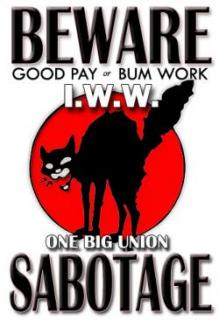
"This new movement...starts delivering real blows to the power and prestige of the ruling exploiters and their governmental stooges. This in turn inevitably arouses the hostility of the guardians of the status quo...who raise a hue and cry for the punishment and suppression of the trouble making upstarts...

"The new movement, with wild songs and high humor, captures the imagination of masses of young rebels, spreads like wildfire, turns up everywhere, gets blamed for everything interesting that happens, and all the while writes page after page in the annals of freedom and justice for all..."

These words were written by IWW member Franklin Rosemont in one of his four articles about Earth First! In the May 1988 edition of the Industrial Worker. In doing so, he brought the IWW squarely into the middle of a firestorm of controversy, and not just on the left, but in timber dependent rural communities as well.

On the left, Earth First! had been (with some justification) excoriated for the reactionary sounding positions taken by Dave Foreman, Ed Abbey, and Chris Manes on starvation among Africans, limiting immigration, and AIDS being "nature's" remedy for excess population, all of which were based on the wrongheaded notion that Thomas Malthus's views on population and starvation had any merit or any relevance to the environment (they don't).

Timber dependent communities lambasted Earth First! for entirely different reasons. Obviously, the bosses hated Earth First! because the latter threatened their profits. Timber workers--many of whom suffered from a sort of capitalist induced "Stockholm Syndrome", not the least of which was made worse by collaborationist business unions (where they existed at all)--echoed the bosses rhetoric, particularly when the capitalists used the word "jobs" when they actually meant profits. Earth First!'s association with tree spiking, and their stubborn refusal to jettison the tactic didn't help matters much.

Ironically, few on the left, and practically nobody in the corporate media paid any attention to what was going on in "ground zero" for the timber wars, California's northwestern redwood coast. Earth First! there had never used tree spiking, and they had gone to great lengths to express their sympathy for the timber workers' plight-identifying capitalist timber harvesting practices as the actual threat to the workers' livelihoods.

Capital Blight: To Wrench or Not to Wrench, a Response

By x344543 - October 29, 2013

Disclaimer: The views expressed here are not the official position of the IWW (or even the IWW’s EUC) and do not necessarily represent the views of anyone but the author’s.

A few days ago, I read To Wrench or Not to Wrench: A Brief History of Direct Action in the Environmental Movement and its Potential Consequences, Ethical Implications, and Effectiveness, by By Jeriah Bowser, of the Hampton Institute with particular interest, because it deals with a subject with which I have a good deal of familiarity. Having worked alongside Judi Bari and her fellow Earth First! - IWW Local #1 organizers, I learned a good deal from listening to the ongoing and evolving discussions and debates over strategy and tactics within both Earth First! and the IWW, and so Bowser's article immediately caught my attention.

To be certain, I wanted to make sure I read his piece very carefully, because the subject he covers is particularly contentious and--in my humble opinion--often misconstrued in any number of frustrating ways. I found some things to agree with in Hampton's piece, but there are some glaring errors and oversights in his argument, not to mention some very dangerous and damaging mistakes as well.

For starters, Bowser establishes a false dichotomy between environmental (or other) groups which "engage in direct action" and those that "stick to the democratic process". There are many that do both and see no contradiction in doing so. There is an old debate about "working within the system" versus "tearing the (rotten) system down". Certainly the IWW advocates the later in regards to capitalism ("capitalism cannot be reformed") philosophically, but as a matter of day-to-day survival the IWW is not adverse to working within established systems to make small gains, knowing full well that ultimately the IWW's intended end, the abolition of wage slavery and the establishment of a cooperative commonwealth (that lives in harmony with the Earth) cannot be achieved within the context of capitalism, no matter how much one tries to reform it. Often times, the IWW alsooutside the system through direct action, specifically at the point of production. Most times, the IWW favors the latter, but sometimes the boundaries aren't entirely clear. The same holds true with radical environmentalists.

On the flip side, Bowser either naively or even dangerously lumps all forms of "direct acton" together and all groups that engage in a whole range of direct action tactics into a single grouping. Specifically he conflates Earth First!, Earth Liberation Front (ELF), and Animal Liberation Front (ALF) into one category. I suppose that's essentially accurate on a certain level, and it's been a good long time since I have been an "active" Earth First!er (however that is defined), but when I was active in Earth First! (1995-98), we never engaged in or advocated some of the tactics commonly associated with either ALF or ELF, including, especially arson. Arson was not only not condoned, the Earth First! groups I worked with specifically eschewed such tactics as counterproductive and self destructive. To my knowledge, that is still the case, even if Earth First! favorably reports on the activities of ELF and ALF.

Bowser also makes few distinctions between the veritable aresnal of direct action tactics that exist, simply labeling "tree sitting, blocking logging roads, and street protests" as "passive, non-violent" civil disobedience, then mentioning "tree spiking, or driving huge nails into trees" as an escalation of Earth First!'s militancy. He then goes on to declare that the Billboard Liberation Front (BLF) escalated those tactics by "defacing" billboards (although, perhaps "culture jamming" would be a more accurate term, because simple defacement and repurposing the message into an anti-capitalist or ironic satire is substantially more meaningful) followed by "burning" (or) "cutting them down". I know of no proven examples of the latter, but I'll accept that I don't know everything and take the author at their word. However, the author then goes on to state that "arson slowly emerged as the preferred method of resistance, however, and was co-opted by other emerging environmental and animal rights groups- most notably the ELF and ALF," as if there were a logical and linear progression from one to the other, which is a dubious argument.

Pages

The Fine Print I:

Disclaimer: The views expressed on this site are not the official position of the IWW (or even the IWW’s EUC) unless otherwise indicated and do not necessarily represent the views of anyone but the author’s, nor should it be assumed that any of these authors automatically support the IWW or endorse any of its positions.

Further: the inclusion of a link on our site (other than the link to the main IWW site) does not imply endorsement by or an alliance with the IWW. These sites have been chosen by our members due to their perceived relevance to the IWW EUC and are included here for informational purposes only. If you have any suggestions or comments on any of the links included (or not included) above, please contact us.

The Fine Print II:

Fair Use Notice: The material on this site is provided for educational and informational purposes. It may contain copyrighted material the use of which has not always been specifically authorized by the copyright owner. It is being made available in an effort to advance the understanding of scientific, environmental, economic, social justice and human rights issues etc.

It is believed that this constitutes a 'fair use' of any such copyrighted material as provided for in section 107 of the US Copyright Law. In accordance with Title 17 U.S.C. Section 107, the material on this site is distributed without profit to those who have an interest in using the included information for research and educational purposes. If you wish to use copyrighted material from this site for purposes of your own that go beyond 'fair use', you must obtain permission from the copyright owner. The information on this site does not constitute legal or technical advice.