You are here

Judi Bari

Technology, Workers' Control, and the Environmental Crisis

By Tom Wetzel - Ideas and Action, Fall 1989

IWW EUC web editor's note: Alien Nation was an anti-civ and/or primitivist oriented green anarchist "caucus" within Earth First!, active around the time that Judi Bari became active in both Earth First! and the IWW (ca. 1988-90). Alien Nation was not affiliated with either Dave Foreman or Judi Bari, though they most often drew animosity from Foreman and his "wing" of that movement. They didn't last very long within Earth First!, though their ideas would later inform those of Live Wild or Die (LWOD) as well as Deep Green Resistance (DGR).

"…We…like your publication even though we disagree with your "technology" position. Our position is—simply put—that technology is not a neutral tool and until technology is being created by a classless society, any superstructure that attempts to maintain the infrastructure of class technology will be doomed to retain hierarchy. Just as we are anti-statist, we are anti-"specialized, hierarchical technology". Worker owned and controlled pollution is still pollution.

- Alien Nation"

Alien Nation's brief note raises a number of tough questions. Questions which cannot be answered very briefly, alas. The following remarks are my own, but I believe the views set forth here are similar to those of others in Workers Solidarity Alliance.

Contrary to what Alien Nation seem to suggest, we certainly do not have the position that "technology is a neutral tool," independent of the social structure In which It develops. As we said in our leaflet "Bhopal and workers rights"· (Ideas & Action #6):

We should question the assumption that technology is neutral or value-free in its moral or political content. The high-risk technology that went wrong at Bhopal did not spring from nowhere. It has a history a history inseparable from the emergence and development of the large, bureaucratic corporation, the central institution of big business.

"Technology" is know-how based on systematic bodies of knowledge. The available technology refines the limits of what is feasible at a given point in time in the modification of natural materials to make things useful to people. Note that "technology," in this sense, is not identical with the actual techniques that are implemented at a given time. That's because there may be alternative methods that are each "technically possible" at that time. The path of technical development that actually takes place is not determined by "technology" alone, but by the human priorities and social structures that govern technical decision-making.

Timberlyin' (newsletter, 1989-90)

Introduction by x344543, August 31, 2013:

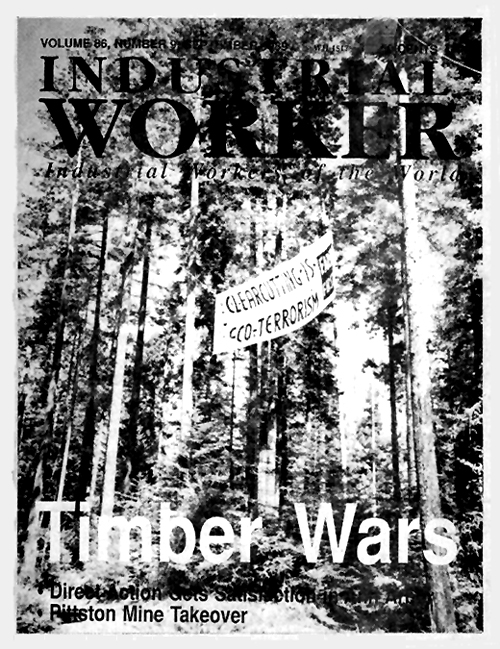
In her descriptions of the various efforts by Earth First! - IWW Local #1 to build alliances with timber workers on northwestern California's redwood coast, Judi Bari occasionally refers to an underground news letter called Timberlyin' published by a group of dissident Pacific Lumber workers, first in the article Timber Wars, published in the Industrial Worker in October 1989...

Pacific Lumber is another of the "big three" timber companies in the area. Until recently, it was a locally based, family-run operation paying good wages and amazing benefits. Pacific Lumber also treated the forest better than most and, because of its conservative logging and avoidance of clearcutting, has ended up owning most of the privately-owned old growth redwood that's left in the world.

But in 1986, Pacific Lumber was taken over in a leveraged buyout by MAXXAM Corporation, a high-finance holding company owned by Charles Hurwitz. Hurwitz financed the takeover with junk bonds, and is now liquidating the assets of the company to pay off the debt. But in this case, the assets of the company are the last of the ancient redwoods. Hurwitz has tripled the cut, instituting clearcutting. gutted the pension plan, and started working people overtime.

Employees reacted by attempting to organize an ESOP, or Employee Stock Ownership Plan, so that they could buy the company back and protect their jobs and community. As many as 300 people came to an ESOP meeting at its height. But Hurwitz, of course, refused to sell, and the ESOP plan died. MAXXAM expected everyone to just shut up and go back to work at that point. Instead some of the workers started publishing an underground paper called Timberlyin' (as opposed to the company's paper, Timberline), which lampoons management and, while rejecting the misleadership of both the ESOP and the AFL unions, calls on the workers to organize for self-protection.

Timber Wars: Footloose Wobs Urgently Needed

By Judi Bari, Industrial Worker, October 1989; Reprinted in Timber Wars, © 1994 Common Courage Press.

"You fucking commie hippies, I'll kill you all!" A shotgun blast goes off and the Earth First!ers scatter. What started as a peaceful logging road blockade had turned violent when a logger sped his truck through our picket line and swerved it towards the demonstrators. The loggers also grabbed and smashed an Earth First!er's camera and, for no apparent reason, punched a 50-year old protester in the face, breaking her nose.

The environmental battle in the Pacific Northwest has reached such a level of intensity that the press now refers to it as the Timber Wars. At stake is the survival of one of the nation's last great forest ecosystems. Our adversaries are giant corporations--Louisiana Pacific, Georgia Pacific, and MAXXAM in northern California, where I live, joined by Boise Cascade and Weyerhauser in Oregon and Washington.

These companies are dropping trees at a furious pace, clogging our roads no less than 18 hours a day, with a virtual swarm of logging trucks. Even old timers are shocked at the pace and scope of today's strip-logging, ranging from 1000-year old redwoods, one tree trunk filling an entire logging truck, to six-inch diameter baby trees that are chipped up for the pulp-mills and particleboard plants.

One-hundred-forty years ago the county I live in was primeval redwood forest. At the current rate of logging, there will be no marketable trees left here in 22 years. Louisiana Pacific chairman Harry Merlo put it this way in a recent newspaper interview: "It always annoys me to leave anything lying on the ground. We don't log to a 10-inch top, we don't log to an 8-inch top or a 6-inch top. We log to infinity. It's out there, it's ours, and we want it all. Now."

So the battle lines are drawn. On one side are the environmentalists, ranging from the big-money groups like Wilderness Society and Sierra Club to the radical Earth First!ers and local mountain people fighting the front line battles in the woods. Tactics being used include tree-sitting, logging road blockading, and bulldozer dismantling, as well as the more traditional lawsuits and lobbying.

On the other side are the big corporations and the local kulaks who do their bidding. Tactics used by them have included falling trees into demonstrators, suing protesters for punitive damages (and winning), buying politicians, and even attempting to ban the teaching at a local elementary school of a Dr. Suess book, The Lorax, which the timber companies say portrays logging in a bad light.

Waferboard, the Final Solution

Speech Given by Judi Bari at an Earth First! demonstration in front of L-P's chip mill near Ukiah, California, June 16, 1989 - reprinted in Timber Wars, © 1994 Common Courage Press.

We are at the site of the new Calpella chipping mill for Louisiana-Pacific. Starting this logging season, L-P has instituted a new logging practice that they call "logging to infinity." The log deck over there is stacked up with all kinds of little treetops and hardwoods. All kinds of stuff that's got no business on a log deck. it ought to be in the forest.

I want to point out that we are not here to protest against either the loggers or the mill workers or anyone who is an employee of Louisiana-Pacific. They don't have any more control over these logging practices than we do. At the beginning of this logging season, Louisiana-Pacific called a meeting in Willits of the people that are going to be logging for them to explain their new logging practices. And I want you to know that their own employees, their own contract loggers, many of them are just as disgusted with this as we are. That's how we found out about a lot of this stuff. one comment from an old-timer was, "When they start telling us to take the tops of trees, we know it's the end."

So the person we're here to protest is not the logger, not the mill workers. It's the president of Louisiana-Pacific, a man named Harry Merlo. Harry Merlo is the ultimate tree Nazi. he wants to cut every last tree and implement The Final Solution of waferboard in [Mendocino] county. Now you've all heard this quote, but I'm going to read it again 'cause you can't say anything about Harry Merlo as bad as what Harry says about himself. We can thank Mike Geniella of the Press Democrat for coming up with this quote. In an interview with Harry about his logging practices, Harry had this to say: "You know it always annoys me to leave anything on the ground when we log our own land. There shouldn't be anything left on the ground. We need everything that's out there. We don't log to a 10-inch top or an 8-inch top or even a 6-inch top. We log to infinity. Because it's out there and we need it all, now."

This maniac is actually in charge of most of the forest land in Mendocino County. Here are some astounding photos of what logging to infinity means.

These were taken on L-P cuts in the Mendocino National Forest, but it looks the same all over. Clearcuts, mudslides, devastation where the forest used to grow. So what we are dealing with here is a man who not only does not believe in obeying the laws of humans--as far as forestry practices--this man does not even believe in the laws of nature. Any farmer knows that you can't keep taking out of the soil without putting back into the soil, but Harry has not yet discovered this basic principle of nature. Fifty percent of the organic matter on the ground in a natural forest is decaying wood. Yet Harry wants to remove all this wood. His plan, he says, is to strip everything off the ground, leaving it completely bare and replant tree farms with 20-year rotations. According to Chris Maser, the forestry expert, there has never been a tree farm that survived beyond three generations. without putting something into the soil, the soil gets poorer and poorer and the trees just don't grow back. So what Harry is talking about if he implements his plan is desertification in 60 years. That's why we're here. That's why this is so serious.

Northwest Wobs Call for Support to Keep L-P Mill Open

By Darryl Cherney - Industrial Worker, March 1989.

"Activists have always touted that sustained yield equals sustained jobs. Therefore, by keeping the mills open forever, we would logically have to ensure forests forever to keep them going."

IWW and EF! member Darryl Cherney and other Northwest Wobs and radical ecodefenders have joined forces to take on the anti-labor, anti-environmentalist Louisiana Pacific lumber corporation and to prevent the corporation's planned closure of a Potter Valley mill in April. Cherney has made an important 12-point proposal to Gladys Simmons, a Public Affairs Officer of the Louisiana Pacific Corporation Cherney, who is a prominent environmental activist and songwriter, says that he is tired of the mainstream press trashing environmentalists as being anti-labor and of mill owners who blame environmentalists for mill layoffs and shut downs. He points to one industry spokesman at a gathering of the Eureka Chamber of Commerce in mid-December who was quoted as saying that environmentalists are making life difficult for the timber companies as they spend time and money fighting lawsuits instead of spending time and money in the forest cutting down trees.

With the second highest nationwide timber cut being reported (12.6 billion board feet) and Mendocino County reporting nearly triple the timber revenues from last year's cut on National Forest land, Cherney finds it "repulsive that industry is blaming environmentalists for shortages that over logging is creating." Cherney comments: "While MAXXAM/Pacific Lumber bemoans four lawsuits filed against them as anti-labor, they have in fact increased their workforce by 33% and nearly tripled their cut over 1985 levels. Another case is L-P's closing of the Potter Valley mill which doubled its shift only five years ago."

Cherney asks: "When will northcoast citizens learn that artificially increased production leads to massive busts shortly thereafter? With production and profits at an all time high, industry's criticism of environmentalists can only mean one thing: the bust is well on its way."

Cherney likens the industry's complaints about environmentalists to "a baby crying about a booboo on its little finger. L-P has million dollar publicity budgets, dozens of attorneys on retainer, high paid lobbyists in Sacramento and Washington, Representative Bosco and Assemblyman Hauser in their pockets, a stranglehold on the workforce, and ownership of millions of acres of timberland. Should a lawsuit tie up 1/10th of one percent of their timber base, you can hear them howl for miles."

"I'm asking environmentalists to fight to keep L-P's Potter Valley mill open." said Cherney. His proposal which has already challenged the industry's traditional public relations defense, has also challenged environmental circles, and has been greeted with enthusiasm from members of the Sierra Club, the Northcoast Greens, the Mendocino Environmental Center, the Wilderness Coalition, Save the North fork and the International Woodworkers of America.

Cherney also believes that workers are coming to see the importance of environmental concerns. At a recent Earth First! demonstration, MAXXAM/PL actually imported counter demonstrators from other companies because their own employees, who are currently attempting to buy back the company, would not defend the policies of corporate raider Charles Hurwitz.

Cherney mailed his pitch to L-P spokesperson. Glennys Simmons and has some words of concern about her job: "Glennys will be one of the first to go when L-P closes their Ukiah mill. They already have a PR person, Shep Tucker, in Humboldt County. Besides, PR is one of L-P's lowest priorities. Look how they announced layoffs just before Christmas, after many people had begun their shopping," said Cherney. "L-P's treatment of their employees is reflective of their forest management. They can't tell us whether they can keep their people employed four months from now, and they expect us to trust them with long range forest management."

Guilty, Guilty: Earth First! - IWW Greenhouse Demo

By Judi Bari -  Composite of two articles from Industrial Worker, March 1989 and Earth First! Journal, Nov. 1, 1988; A substantially shortened summary also appeared in the Mendocino Commentary, October 6, 1988.

Web Editor's Note: Both the Industrial Worker and Earth First! Journal versions of this article are abridged in different places (evidently they’re both excerpted from a common press release). The following represents a combination of both articles. This is the very first article Judi Bari wrote for the Industrial Worker.

The best thing about our regional Earth First! gath-erings are the demonstrations afterwards. I mean, as long as you’ve got 200 yahooing Earth First!ers together, you might as well do an action. So, in keeping with this venerable tradition, our California Rendezvous September 16–18, 1988, we decided to indict some of the criminals responsible for the greenhouse effect. After all, as Fellow Worker Utah Phillips told us, “The earth isn’t dying; it’s being killed, and the people killing it have names and addresses.”

So we decided to use a traditional Wobbly tactic of an all-day roving picket line with the theme of the Greenhouse Effect. We printed indictment forms (with blanks to fill in the company name) and whipped up a few big banners saying “Guilty Guilty-Greenhouse Effect Violator,” and prepared some indictment forms to lay on the perpetrators.

We had plenty of violators to pick from, but time constraints forced us to limit it to four—Simpson Pulp Mill, MAXXAM / Pacific Lumber Corporation (in Scotia, CA), Eel River Sawmills, and a public hearing on offshore oil.

Simpson was the most dramatic. We gathered in the morning drizzle at Arcata Plaza. By the time our caravan reached Simpson pulp mill, we were 100 strong. Truck drivers were surprised by the sudden appearance of a raggedy mob, just back from three days in the woods, blocking the entrance road to the Simpson plant. We stretched our banners out in the road and, as the Arcata Union described it, “As a truck tried to turn onto Samoa Blvd., the Earth First!ers stood firm in its way and started howling like coyotes.” The first truck stopped and we ran over to tell the driver that the IWW says take a break on us. That was fine with him, and he kicked back to enjoy the show. The driver coming the other direction, though, didn’t take it so easy. No damn hippies were gonna stop him from going to work—he was going to ram our line. “Stop Mr. Block!” chanted the crowd, but the truck kept coming until Earth First!er Corbin Solomon courageously dove under the front wheel of the moving semi. The driver stopped, cursed, then rolled forward. Our line held firm, and people started yelling “Brian Willson!”  as the truck wheels came within feet of Corbin’s body before it finally stopped.

IWW rep Billy Don Robinson jumped up on the truck’s running board to talk some sense into his fellow wage slave. But Mr. Block wasn’t in a talking mood, and took a swing at Bill Don. “No jobs on a dead planet!” chanted the crowd, as the standoff continued for 30 minutes, with trucks backed up down the highway in both directions. Finally the police showed up and ordered us to leave. Since we had more work to do that day, we cheerfully obliged, jumping into our cars loudly announcing “Eel River Sawmills next!” Then we proceeded to Pacific Lumber Corp., skipping Eel River for now and losing our police escort.

On the Garlon Trail - A Visit to L-P Spray Site Reveals Total Forest Devastation, Ineffective Chemicals, Minimal Watershed Protection

By I.M. Green (Don Lipmanson) - Anderson Valley Advertiser, June 5, 1985

Feeling a sort of morbid fascination, I've been drawn to the L-P spray sites for weeks. What does this Garlon chemical actually do to the forest? What is the appearance and smell of a spray site? How much herbicide gets into the water?

My first attempt to find answers involved an overflight of Juan Creek and the north fork of Big River. Flying northward from Little River airport, I had the chance to compare the thinned out appearance of selectively logged forests with the bald clearcuts so prevalent northeast of Fort Bragg.

The spray sites were unmistakable on account of their striking reddish brown color, dotted with green. In addition to one large, browned out blotch, there are erratic splotches at the periphery of the spray zone, raising unanswered questions about drift. It was also clear from the logging roads that the sites were accessible, although steep. The spray zones have recently been logged for conifers, so company claims that they are too inaccessible for manual hardwood release are nonsense.

From the air it seemed that conifers, madrones and oak were unaffected by the spraying. The required buffering of watersheds was questionable also. To get firmer answers to spray concerns, I decided to take a closer look.

It didn't take much asking around Comptche to find a guide who is familiar with L-P territory. We hadn't gone more than a couple hundred yards past the company gate before we came upon the most ravaged hillsides I have ever seen. On about one hundred acres there is no sign of life, other than some three inch saplings veiled behind black nylon screens. Little red and blue flags stand out here and there, indicating where recent conifer replanting has occurred. Otherwise, the whole hillside is barren, littered with burned out logs and stumps, uprooted oaks, and naked soil. Yarders and flame-throwing helicopters have been through here recently, and the desolation is eerie.

After this taste of normal L-P forest operations, our arrival in Poverty Gulch, ten weeks after herbicide spraying, was almost anticlimactic. Walking down the road, we suddenly saw an entire hillside dominated by the now familiar rust color of herbicide die-off. No particular odor remained. It was clear than the main victim was Ceanothus, or blue blossom. The top half or two-thirds of the sprayed Ceanothus have died out, with the leaves fried but still attached to the withered branches. Seen from up close, many of the dead leaves are spotted with a white fungus. Some madrone in the spray area appear to have died, also with leaves still attached. Other madrones and all the tan oak were green and thriving.

Although we saw several deer and many birds during out two mile hike toward the spray area, the poisoned hillside itself seemed abandoned by fauna. The overall impression is sterile, a place one wouldn't want to linger. Without protective gear, I didn't feel inclined to penetrate far into the spray zone to examine the effect on lichens, insects and worms.

In its ads, L-P claims that herbicides are a "key part" of their effort to increase the volume of timber which can be harvested from its lands. "Sites for new plantings are cleared with herbicides. Weed choked and strangled young trees are freed with herbicides," according to the company. Garlon is supposedly a systematic poison, killing "unwanted woody plants" (including oaks) from within.

“Sprayed Loggers” Tom Fales, Arlene Rial, Frank Fales, Wayne Thorstrom, Rick Rial, and Rod Cudney

Interviewed by Beth Bosk - New Settler Interview, Issue #3, April 1985

Were the loggers surprised that they had been sprayed?

That’s the story—it’s [Louisiana-Pacific’s] attitude towards them. When they arrived at the site they were told they were going to be sprayed—that there would be spraying. When they asked, “was it safe?” the LP people sort of laughed at them and said, “Well, the only, thing that happens is that 20 years from now your teeth are going to fall out,” and they laughed at them. And then they said, “Well, if you smell it, don’t breath.” And then the last statement was, “If it starts coming towards you, run like the dickens!”

—Dr. Mills Matheson, physician

Beth Bosk: In times to come, they will probably call Arlene Rial the ‘Rosa Parks’ of Fort Bragg.

Rosa Parks was the tired black housekeeper from Montgomery, Alabama who after working hard all day, refused to relinquish her seat at the front of a city bus. Remember what followed?

For the past twenty-four years, Arlene Rial has worked hard raising herself a sturdy son.

She was not about to see him damaged by a suspect chemical. And when unbeknownst, he was sent to work at a site where G-P was spraying the herbicide Garlon-4 and subsequently fell ill—along with every other logger working along the perimeter of the spray site—she refused to let it go unheeded.

The following interview is actually portions of conversations that took place on a Sunday afternoon at the home Arlene Rial shares with her son, Rick, and her husband Wayne Thorstrom. Thorstrom works as a hook tender for G-P.

The other voices belong to four other men who found themselves working adjacent to the spray site...Tommy Fales, Tom Fales, and Frank Fales.

“They do not look like the kind of men who complain,” is the way Fort Bragg Advocate reporter Martin Hickel summed up his impressions of these loggers.

The interview picks up in the middle of Arlene Rial’s story. She has related how she started putting two and two together when none of Rick’s slow pitch ball team showed up for practice. They had all worked around the spray site and they were all home sick. She then began making inquiries as to what chemical had been sprayed and what was known about it...

Arlene Rial: … I called the toxicity center in Texas to find out just what Garlon was and the gal there told me it was one atom removed from Agent Orange and I almost had a heart attack at that time. After that, I immediately called several different newspapers and I said, “Are you aware that they are spraying a dangerous chemical not only in our community, but around people who are working”—and that’s how the whole thing got started. I called Okerstrom logging and told him, “Get the men out of Juan Creek because it’s contaminated.”

This is in the morning. In the afternoon my son came home from work and said, “Gee, thanks a lot, mom. The boss came out and said, ‘Your mommy called’. And you know, with the loggers, that looks really bad.”

I told him, “Never you mind, I’m going to do what I have to do.” Anyway, Ricky was sicker and sicker and I finally found out that Mills Matheson knows a bit about toxicology and I called him and made an appointment for my son and I was going to drive over to Willits with him to see what was going on, instead another boy got sick on the job that day and so I said, “Both of you go,” and I’ll have a conversation with Dr. Matheson later.” Which I did and Mills said that nothing had ever been proven about Garlon and it does look like flu-like symptoms. He took a urine and blood sample and froze them—because the only people evidentially who can find out if Garlon is in the blood or the urine is Dow Chemical Company and this is the fox again guarding the hen house.

Aristocracy Forever

Lyrics by Judi Bari, 1979; 
Tune: Solidarity Forever (John Brown’s Body)
Included in the Little Red Songbook, IWW, 36th Edition
 

"Aristocracy Forever" was written as an entry in a union sponsored contest to write new lyrics to the old song while Bari was a member of the retail workers union. She said of it, "I don't know why it didn't win the contest."

--x332090

When the union leaders’ payoffs by the bosses has begun, 
There will be no labor trouble anywhere beneath the sun,
For the AFL trade unions and the management are one, 
The union keeps us down. 

Chorus 
Aristocracy forever, 
The union keeps us down. 

It is we who have to suffer through the daily drudgery, 
While Kirkland  pulls a hundred thousand dollar salary, 
Though be claims to lead the workers be is just a bourgeoisie, 
The union keeps us down. 

Chorus 

Documents by Judi Bari

Pages

The Fine Print I:

Disclaimer: The views expressed on this site are not the official position of the IWW (or even the IWW’s EUC) unless otherwise indicated and do not necessarily represent the views of anyone but the author’s, nor should it be assumed that any of these authors automatically support the IWW or endorse any of its positions.

Further: the inclusion of a link on our site (other than the link to the main IWW site) does not imply endorsement by or an alliance with the IWW. These sites have been chosen by our members due to their perceived relevance to the IWW EUC and are included here for informational purposes only. If you have any suggestions or comments on any of the links included (or not included) above, please contact us.

The Fine Print II:

Fair Use Notice: The material on this site is provided for educational and informational purposes. It may contain copyrighted material the use of which has not always been specifically authorized by the copyright owner. It is being made available in an effort to advance the understanding of scientific, environmental, economic, social justice and human rights issues etc.

It is believed that this constitutes a 'fair use' of any such copyrighted material as provided for in section 107 of the US Copyright Law. In accordance with Title 17 U.S.C. Section 107, the material on this site is distributed without profit to those who have an interest in using the included information for research and educational purposes. If you wish to use copyrighted material from this site for purposes of your own that go beyond 'fair use', you must obtain permission from the copyright owner. The information on this site does not constitute legal or technical advice.