You are here

agroecology

Double Whammy On Farmers

By Colin Todhunter - CounterPunch, December 12, 2016

Washington’s long-term plan has been to restructure indigenous agriculture across the world and tie it to an international system of trade based on export-oriented mono-cropping, commodity production for the international market and indebtedness to international financial institutions (IMF/World Bank).

This result has been the creation of food surplus and food deficit areas, of which the latter have become dependent on agricultural imports and strings-attached aid. Food deficits in the Global South mirror food surpluses in the North. Whether through IMF-World Bank structural adjustment programmes, as occurred in Africa, trade agreements like NAFTA and its impact on Mexico or, more generally, deregulated global trade rules, the outcome has been similar: the devastation of traditional, indigenous agriculture for the benefit of transnational agribusiness and the undermining of both regional and global food security.

In the 1990s, the IMF and World Bank wanted India to shift hundreds of millions out of agriculture. India was advised to dismantle its state-owned seed supply system, reduce subsidies and run down public agriculture institutions and offer incentives for the growing of cash crops. As the largest recipient of loans from the World Bank in the history of that institution, India has been quite obliging and has been opening up its agriculture to foreign corporations.

What would it take to mainstream “alternative” agriculture?

By Maywa Montenegro and Alastair Iles - Ensia, July 25, 2016

This Voices piece is published in collaboration with the academic journal Elementa. It is based on “Toward thick legitimacy: Creating a web of legitimacy for agroecology,” a peer-reviewed article published July 20 as part of Elementa’s New Pathways to Sustainability in Agroecological Systems forum.

The industrialized food system, studies have shown, is linked to greenhouse gas emissions, algal blooms, pesticide pollution, soil erosion and biodiversity loss, to name a few ecological troubles. Add to this a long list of social ills, from escalating rates of obesity to the demise of the family farmer and deadening of rural landscapes and rural economies across much of the U.S.

In 2010, the National Academies of Science updated its seminal 1989 publication “Alternative Agriculture” with a fresh look at the state of food and farming in America. Its expert panel concluded, “Growing awareness of unintended impacts associated with some agricultural production practices has led to heightened societal expectations for improved environmental, community, labor, and animal welfare standards in agriculture.”

Yet that growing awareness and those heightened expectations haven’t led to alternative agricultural systems becoming the norm in the U.S. Organic has made some headway, but many organic growers have been forced to imitate industrial farming: grow bigger, resort to monocultures instead of truly diversified fields, and sell to large supermarkets — forgoing many of the benefits alternative agricultural systems offer, such as natural pest control, pollination from native bees, and a smaller production scale conducive to family farmers and local food economies.

So, what gives industrialized agriculture such staying power despite its adverse impacts, even as alternatives offer such benefits? And how can more wholesome food production methods such as agroecology become conventional instead of alternative? To achieve real change in how food is produced and eaten, we need to change people’s expectations of what “normal” agriculture should look like.

Together We Can Cool the Planet

By Eugenia Izquierdo and IvanZigarán - La Via Campesina and GRAIN - December 2016

Based on the video Together we can cool the planet! co-produced by La Vía Campesina and GRAIN in 2015, we have created a comic book to support training activities of social movements and civil society organisations around climate change. This comic book looks at how the industrial food system impacts our climate and also explains what we can do to change course and start cooling the planet.

La Via Campesina and GRAIN have pointed out that the industrial food system is responsible for half of all greenhouse gas emissions. In the Americas, Asia, Europe and Africa, we have been denouncing the false solutions to climate change such as GMOs, the “green economy” and "climate-smart agriculture".

We say loud and clear: it is peasants and small farmers, along with consumers who choose agroecological products from local markets, who hold the solution to the climate crisis.

We must all rise to the challenge!

Read the report (PDF).

Watch the video, too:

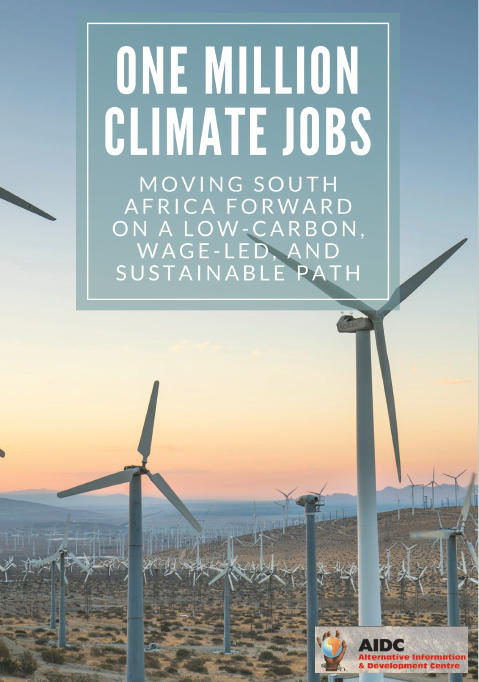
One Million Climate Jobs: Moving South Africa Forward on a Low-Carbon, Wage-Led, and Sustainable Path

By Brian Ashley, et. al. - One Million Climate Jobs - December 2016

The One Million Climate Jobs Campaign is an alliance of labour, social movements and popular organisations in South Africa that is campaigning for the creation of a million climate jobs as part of a collective approach to the crisis of unemployment and climate change. The Campaign was launched in 2011 and since then has been mobilising thousands of South Africans around real solutions to slowing down climate change, protecting the natural environment, improving the quality of life for all and moving towards a sustainable development path. Climate change will exacerbate inequality and poverty because it reduces access to food, water, energy and housing. Thus it is vital that social justice struggles around these issues incorporate struggles around climate change.

This booklet is a follow-up, six years later, to the first booklet that was produced in 2011. It is based on well- researched solutions for how South Africa can immediately begin a just transition, away from the Minerals-Energy Complex that continues to dominate the South African capitalist economy, to a low carbon economy in which the basic needs of communities are met in an equitable, sustainable and affordable way.

It recognizes that in these six years there have been many developments – for instance, renewable energy is now firmly established as part of the energy mix (although still a minor part); retrofitting buildings, and the development of environmentally friendly construction methods, is being developed, and the Rapid Bus Transit system is being slowly implemented in some municipalities.

But most of these solutions are being pursued within the logic of the market. It is not possible, we would argue, within these market parameters, to respond adequately to the enormous challenges facing us – what is needed is a publicly-driven solution for the shift to a sustainable, low-carbon future. The research that this booklet is based on begins to set out what such a transition could look like. We hope that it will be an important contribution to the ongoing work of building a political movement to struggle around these issues.

Download (PDF).

Food Sovereignty: A Strategy for Environmental Justice

By David Barkin - Climate and Capitalism, November 11, 2016

ABSTRACT:

Dominant approaches to rural development have proven unable to confront the structural challenges posed by a system where progress itself generates hunger and increasing environmental damage.

This article places its accent on the direct action of communities to organize themselves to satisfy their food and other basic needs and those of their regions with self-help strategies that could be applied in both rural and urban areas.

While generally applicable, this focus draws its inspiration from the experience of La Via Campesina, the largest social organization in the world, with chapters in more than 80 countries and 200 million members.

The food sovereignty approach offers a forward-looking strategy to social mobilization, confronting the scourge of rural disintegration while also addressing the pressing issue of environmental balance.

It proposes to direct political and social actions to the collective organization of communities to promote local mobilization and cooperation within and among communities, on a regional as well as on a much broader geographic scale.

It functions by integrating experts into a well-proven farmer-to-farmer approach for the exchange of information and materials conducive to improving productivity and promoting diversity in accordance with local customs while also creating possibilities for improving the quality of foods being produced and their nutritional impact.

Most organizations promoting food sovereignty consider agroecology to be the most effective approach to organizing production, emphasizing the use of locally available inputs and technologies as well as a diversity of cropping system adapted to local conditions.

New Report from Fair World Project Evaluates Certification Programs that Seek to Ensure Transparency and Integrity of Working Conditions for Farmworkers

By Api Podder - MySocialGoodNews, October 25, 2016
Leading Advocacy Group Evaluates Impact and Effectiveness of Seven Certification Programs in the Interest of Farmworker Justice

Press Release – PORTLAND, ORFair World Project, a project of the Organic Consumers Association, the nation’s largest network of green and ethical consumers, has released a new report titled, Justice in the Fields: A report on the Role of Farmworker Justice Certification and an Evaluation of the Effectiveness of Seven Labels. The new report evaluates seven certification programs that consumer brands use to provide a level of transparency to consumers on the social impact of their supply chain on workers. The findings in the report are based on the criteria farms must meet, how these standards are enforced and what role farmworkers and their representatives play in both program development and on-farm enforcement.

To read the Justice in the Fields report, go to: http://fairworldproject.org/campaigns/farmworker-justice/

The report details the realities of agricultural work globally: it’s difficult, dangerous, and can be poorly compensated. Farmworkers are often excluded from laws that protect other workers and even when they are included, the laws are often not well enforced. Labor unions can provide the function of negotiating better pay and conditions on behalf of workers they represent, but in reality union membership on farms is low, in part because of anti-union organizing. The report illuminates how, in recent years, certification programs have stepped in to fill the void and ensure justice and fair treatment for farmworkers on farms.

“It is tempting to see certification as a silver bullet,” says Kerstin Lindgren, Campaign Director of Fair World Project, “but any certification is only as good as its standards and enforcement mechanisms. Ultimately, any good program empowers farmworkers and works together with existing regulations and unions to strengthen their voice.”

Of the seven certification labels evaluated in the report, Fair World Project strongly recommends two of them: Agricultural Justice Project’s Food Justice Certified and Coalition of Immokalee Workers’ Fair Food Program. Two others are recommended with qualifications: Equitable Food Initiative’s Responsible Grown, Farmworker Assured, and Fairtrade International’s Fairtrade Certified.

“At their best, certification labels can raise the bar for worker justice on farms and lead consumers to purchase products that empower farmworkers,” said Dana Geffner, Executive Director of Fair World Project. “But conscious consumerism is just a small part of what’s needed—we hope that this report can inform and inspire people to engage in activism on behalf of all the people who grow our food, whether they work on a certified farm or not,” continues Geffner.

EcoUnionist News #119

Compiled by x344543 - IWW Environmental Unionism Caucus, August 31, 2016

The following news items feature issues, discussions, campaigns, or information potentially relevant to green unionists:

Lead Stories:

Ongoing Mobilizations:

The Thin Green Line:

Just Transition:

Bread and Roses:

EcoUnionist News #118

Compiled by x344543 - IWW Environmental Unionism Caucus, August 24, 2016

The following news items feature issues, discussions, campaigns, or information potentially relevant to green unionists:

Lead Stories:

Ongoing Mobilizations:

The Thin Green Line:

Just Transition:

Bread and Roses:

An Injury to One is an Injury to All:

Whistle Blowers:

EcoUnionist News #117

Compiled by x344543 - IWW Environmental Unionism Caucus, August 17, 2016

The following news items feature issues, discussions, campaigns, or information potentially relevant to green unionists:

Lead Stories:

Ongoing Mobilizations:

The Thin Green Line:

Just Transition:

Bread and Roses:

EcoUnionist News #111

Compiled by x344543 - IWW Environmental Unionism Caucus, July 6, 2016

The following news items feature issues, discussions, campaigns, or information potentially relevant to green unionists:

Lead Stories:

Ongoing Mobilizations:

The Thin Green Line:

Just Transition:

Bread and Roses:

Pages

The Fine Print I:

Disclaimer: The views expressed on this site are not the official position of the IWW (or even the IWW’s EUC) unless otherwise indicated and do not necessarily represent the views of anyone but the author’s, nor should it be assumed that any of these authors automatically support the IWW or endorse any of its positions.

Further: the inclusion of a link on our site (other than the link to the main IWW site) does not imply endorsement by or an alliance with the IWW. These sites have been chosen by our members due to their perceived relevance to the IWW EUC and are included here for informational purposes only. If you have any suggestions or comments on any of the links included (or not included) above, please contact us.

The Fine Print II:

Fair Use Notice: The material on this site is provided for educational and informational purposes. It may contain copyrighted material the use of which has not always been specifically authorized by the copyright owner. It is being made available in an effort to advance the understanding of scientific, environmental, economic, social justice and human rights issues etc.

It is believed that this constitutes a 'fair use' of any such copyrighted material as provided for in section 107 of the US Copyright Law. In accordance with Title 17 U.S.C. Section 107, the material on this site is distributed without profit to those who have an interest in using the included information for research and educational purposes. If you wish to use copyrighted material from this site for purposes of your own that go beyond 'fair use', you must obtain permission from the copyright owner. The information on this site does not constitute legal or technical advice.