You are here

green syndicalism

The Autonomous Earth Federation

By anonymous - May 2019

We are standing at a crucial crossroads. Not only does the age-old “social question” concerning the exploitation of human labor remain unresolved, but the plundering of natural resources has reached a point where humanity is also forced to politically deal with an “ecological question.” Today, we have to make conscious choices about what direction society should take, to properly meet these challenges. - Eirik Eiglad

In the wake of recent events, many anarchists and social ecologists have found their early concerns about Extinction Rebellion and Earth Strike confirmed: the movements appear destined for failure.

Activists under the green, black, and red are agreed that now, perhaps more than ever, an organised autonomous movement is needed to build towards insurrection and general strikes, as well as provide a clearly outlined ecological alternative to the capitalist industrial order based on one of communal ownership and democracy. What follows is the proposal for a rough set of guidelines towards the formation of a decentralised network of activists, united by a shared belief in this set of core principles:

  • Climate collapse is class war
  • Capitalism and centralisation have devastated our planet
  • Direct Action and Autonomy - not looking to elected representatives for reform
  • Climate issues are social issues
  • Consensus is key - All Power to the People!
  • Anti-Fascism
  • Rejection of the state and police
  • The climate struggle is an internationalist struggle
  • The climate struggle is an anti-racist, anti-ableist, anti-imperialist struggle

The Autonomous Earth Federation aims to establish an organised autonomous undercurrent within the wider climate and labour movements. There are no membership fees, no registration - anyone who agrees with our core principles can consider themselves a part of the AEF. We offer no support or affiliation to any political party, and have no officials or internal hierarchy - we are all leaders.

Sydney’s Green Bans: worker boycotts that saved the city

By Timothy Ginty - ROARMag, April 20, 2019

The destruction of heritage buildings, the encroachment of urban development onto green spaces and the gentrification of working class neighborhoods are flash-points of social conflict in expanding cities around the globe.

Communities that mobilize to protect their public spaces, services and culture can protest and call public meetings, or take to the courts and pressure the powers-that-be, but corruption, asymmetrical power and the influence of money can overpower them and make community consultation impotent. When all else fails and neighborhoods on the front line of speculative development are facing the wrecking ball, what options do they have to protect the commons of public space, services and culture?

Consider the radical and effective solution that emerged in Sydney in the 1970s: the Green Ban.

The people versus the speculators

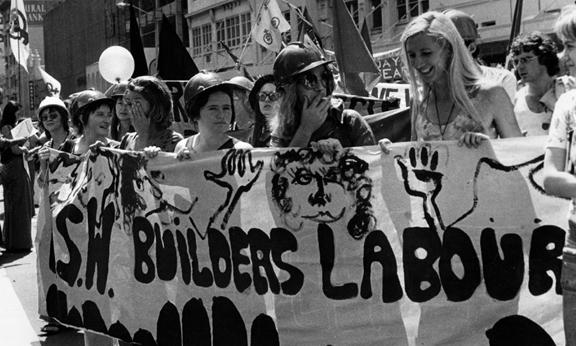
The Green Bans were a series of worker boycotts of projects considered socially, architecturally or environmentally damaging to the local community during Sydney’s speculative construction boom of 1971-1974. Unionized construction workers would simply leave their tools in their toolbox and refuse to enter the building site.

The boycotts were initiated not by union leadership, but by a public vote in open assemblies after a community requested the Builders Labourers’ Federation (BLF) to intervene.

In the first ever Green Ban dates in 1971, a group of middle-class women of the harbor-side suburb of Hunter’s Hill urgently asked the BLF to save the last piece of natural bushland on Sydney Harbor. Property developers had the site earmarked for a private housing development, and the “Battlers of Kelly’s Bush”, as the women became known, had exhausted all the legal and political options available to them.

The women called a public meeting to gauge local support for more direct action. Over 600 people attended showed up to request that the union boycott the development. Within months the development was stalled and ultimately discarded, its success sparking a wave of similar requests from other community groups facing socially, physically and environmentally destructive developments.

The union responded to these requests wherever significant community support existed. Local residents would cast votes in public assemblies to decide on a Green Ban, and the union would mobilize when those votes reflected large majorities. Democracy permeated every aspect of the actions, down to the commitment to translate the debates and discussions for the migrant laborers.

This insistence on democratic decision-making for bans and strikes saw the union membership boom throughout the 1970s, reaching some 11,000 laborers at its peak.

No Shortcuts: The Climate Revolution Must be Ecosocialist

By Daniel Tanuro - Life on the Left, April 15, 2019

This declaration was drafted by Daniel Tanuro* and adopted by the national leadership of Belgium’s Gauche Anticapitaliste. My translation, below, was initially published by Ian Angus in his excellent ecosocialist journal Climate & Capitalism. – Richard Fidler

The mobilization against climate change continues to build, gaining new social layers beyond the initial circles of environmental activists and tending toward a systemic critique of capitalist productivism with its underlying competition for profit. Particularly significant is the fact that young people are joining the struggle. On March 15 more than a million people, a majority of them youth, went on strike for the climate around the world in response to the call by the Swedish teenager Greta Thunberg. The movement is very deep, although at present it is limited to the major countries of the Global North. It reshuffles cards, upsets agendas and puts all the actors — politicians, trade unions, associations, social movements — on notice to answer two fundamental questions:

  1. Why are you not doing everything possible to limit to the maximum the terrible catastrophe that is growing day by day, and to do so in compliance with democracy and social justice?
  2. How dare you leave such a mess to your children and grandchildren?

A “Green New Deal”?: The Eco-syndicalist Alternative

By Tom Wetzel - Ideas and Action, April 15, 2019

Capitalist dynamics are at the very heart of the current crisis that humanity faces over global warming.

When we talk of “global warming,” we’re talking about the rapid — and on-going — rise in the average world-wide surface and ocean temperature. Thus far a rise of 0.8 degrees Celsius (1.4 degrees Fahrenheit) since 1880. According to an ongoing temperature analysis conducted by scientists at NASA’s Goddard Institute for Space Studies, two-thirds of this temperature increase has occurred since 1975. A one-degree rise in temperature might seem like no big deal. As the NASA scientists point out, however, “A one-degree global change is significant because it takes a vast amount of heat to warm all the oceans, atmosphere, and land by that much.”

We know that carbon dioxide emissions from the burning of fossil fuels is at the heart of the problem. For many centuries the proportion of carbon dioxide in the atmosphere ranged between 200 and 300 parts per million. By the 1950s the growth of industrial capitalism since the 1800s had pushed this to the top of this range — 310 parts per million. Since then the concentration of carbon dioxide in the atmosphere has risen very rapidly — to more than 410 parts per million by 2018. This is the result of the vast rise in the burning of fossil fuels in the era since World War 2 — coal, petroleum, natural gas.

The problem is rooted in the very structure of capitalism itself. Cost-shifting is an essential feature of the capitalist mode of production. An electric power company burns coal to generate electricity because the price per kilowatt hour from coal-fired electricity has long been cheaper than alternatives. But the emissions from burning coal travel downwind and cause damage to the respiratory systems of thousands of people — including preventable deaths to people with respiratory ailments. This is in addition to the powerful contribution to global warming from the carbon dioxide emissions. But the power firm doesn’t have to pay money for these human costs. If the firm had to pay fees that would be equivalent to the human cost in death, respiratory damage and contribution to global warming and its effects, burning coal would not be profitable for the power company.

Firms also externalize costs onto workers, such as the health effects of stress or chemical exposures. The “free market” pundit or hack economist might deny that companies externalize costs onto workers. They might say that wages and benefits paid to workers for each hour of work measure the cost of labor. But the human cost of work can be increased without an increase in the compensation paid to workers. If a company speeds up the pace of work, if people are working harder, if they are more tightly controlled by supervisors, paced by machines or software, this increases the cost in human terms.

Toxic chemicals used in manufacturing, in agriculture and other industries pose a threat to both the workers and to people who live in nearby areas. Usually working class people live in neighborhoods near polluting industries, and often these are communities of color. This is another form of capitalist cost-shifting.

State regulation of pesticides or air pollution often ends up acting as a “cover” for the profit-making firms. Despite the existence of pollutants generated by leaky oil refineries and pollutants emitted by other industries in industrial areas in California — such as the “cancer alley” of oil refineries in the Contra Costa County area  or the similar refinery zone in Wilmington — the government agencies set up to deal with air pollution in the Bay Area and Los Angeles County protected polluters for years by focusing almost exclusively on pollution generated  by vehicle exhaust. In this way the South Coast Air Quality Management District and the Bay Area Air Quality Management District have been an example of “regulatory capture” by corporate capital.

Power firms that generate vast amounts of carbon dioxide emissions — and firms that make profits from building fossil-fuel burning cars and trucks or from the sale of gasoline and diesel and jet fuel — have not had to pay any fees or penalties for the growing build up of the carbon dioxide layer in the atmosphere. The global warming crisis thus has its explanation in cost shifting and the search for short-term profits and ever growing markets — features that are at the heart of the capitalist system.

If global capitalism continues with “business as usual”, the warming will have major impacts — killer heat waves, more ocean heat pumping energy into hurricanes and cyclones, rising ocean levels from melting of ice in the polar regions and melting of glaciers, destruction of corals in the oceans, and a greater danger to the survival of many species of living things.

Yellow Vest Movement Struggles To Reinvent Democracy

By Richard Greeman - Popular Resistance, April 13, 2019

Act 21 While Assembly of Assemblies Meets, Macron Cranks Up Propaganda and Repression
After five months of constant presence at traffic circles, toll-booths and hazardous Saturday marches,  the massive, self-organized social movement known as the Yellow Vests has just held its second nationwide “Assembly of Assemblies.” Hundreds of autonomous Yellow Vest activist groups from all over France each chose two delegates (one woman, one man) to gather in the port city of St. Nazaire for a weekend of deliberation (April 5-7).

After weeks of skirmishing with the municipal authorities, the local Yellow Vests were able to host 700 delegates at the St. Nazaire “House of the People,” and the three-day series of general meetings and working groups went off without a hitch in an atmosphere of good-fellowship. A sign on the wall proclaimed: “No one has the solution, but everybody has a piece of it.”

Their project: mobilize their “collective intelligence” to reorganize, strategize, and prolong their struggle. Their aim: achieve the immediate goals of livable wages and retirements, restoration of social benefits and public services like schools, transportation, post offices, hospitals, taxing the rich and ending fiscal fraud to pay for preserving the environment, and, most ambitious of all, reinventing democracy in the process. Their Declaration ends with the phrase “government of the people, by the people, and for the people.” I often wonder if they know who coined it.

Labor organizer Jane McAlevey on why strikes are the only way out of our current crisis

Jane McAlevey interviewed by Sarah Freeman-Woolpert - Waging Nonviolence, April 10, 2019

Over the past year, a wave of teacher strikes — from Los Angeles to West Virginia — have won major victories for public education, including salary increases and smaller class sizes. Inspired in part by the Chicago teachers strike in 2012, they drew on years of grassroots organizing and strategic planning to build stronger unions and establish clear demands to address the major problems affecting the public education sector today.

According to longtime environmental and labor organizer Jane McAlevey, this recent wave of teacher strikes is also the perfect example of how change happens. It begins by developing a deep understanding of power, which then evolves into building small campaigns within a larger struggle to achieve measurable goals — all the while engaging in deep listening across differences, instead of self-selecting into single-minded silos.

Throughout her prolific writing — including two books, “Raising Expectations (And Raising Hell)” and “No Shortcuts: Organizing for Power in the New Guilded Age” — McAlevey lays out the foundations for what she calls a “credible plan to win.” A vital part of that, she argues, is understanding the mechanics and strategic steps of winning a campaign — something that is best achieved through the training and mentoring of emerging organizers and activists.

After her own period of learning — while being a student activist and living with farm workers in Nicaragua during the Sandanista revolution — McAlevey has dedicated her adult life to building grassroots power for progressive change. And right now, she says that mass strikes are the key to winning progressive victories in the Trump era. Ultimately, as she explained to me in the following conversation, labor strikes carry invaluable lessons for fighting — and winning — strategic grassroots campaigns.

There’s an important lesson to be learned in realizing that strikes do not just happen because people get pissed off. [In Los Angeles,] they had four years of really serious work leading up to the strike in January, with deadlines and backwards planning attached to it. There were eight serious structure tests conducted leading up to that strike — that’s what good planning and analysis looks like.

A crucial element in their understanding of power was knowing that they could not win that strike without the community on their side. They held huge meetings that were open to parents and students, not just teachers, to set the contract demands. Understanding that we can’t win traditional labor fights anymore without bringing the whole community with us is crucial.

What does this wave of teacher strikes tell us about effective organizing practices, and what are some of the wider implications of mass strikes at this political moment?

The Ecological Limits of Work: on Carbon Emissions, Carbon Budgets and Working Time

By staff - Autonomy, April 2019

Faced with accelerating technological progress and a deepening ecological crisis, a growing discussion sees a reduction in working hours as a multiple dividend policy, increasing, among other things, individual wellbeing, productivity and gender equality whilst simultaneously potentially contributing to a reduction in unemployment and greenhouse gas (GHG) emissions. One cannot help but feel reminded of some earlier sociotechnical visions of a society in which productivity gains would be shared broadly to allow for radically shorter working hours and thus a qualitatively better life.

Read the report (PDF).

Communism Without Workers: An Anarcho-syndicalist Critique Of The Communisation Current

By Ivysyn - LibCom, March 31, 2019

The communist, socialist, and Marxist movement has undergone a fundamental change since the late 1960s (as has the global capitalist system itself). While Stalinists, Trotskyists, and social democrats continue to hang around like a bad headache, much newer tendencies that claim to be innovative in theory and practice have cropped up to jockey for the position of interpreting communism through the modern capitalist system and it's adaptations since the late 20th century. Once such tendency which has gained some intellectual fan fair is "communisation". Various things go under this label, but this discussion will focus on the the tradition of "ultra-left" Marxism this label is often used to describe. Since the uprisings of 1968 by workers across the world (especially in France) and their repression by capitalist forces and, shockingly (depending on how you look at it), leftist parties and governments, certain Marxism oriented activists and thinkers have tried to redraw the lines of struggle for a communist society.

These militants have gone back to Marx's theory of value to emphasize value (in Marx's sense) as a social relation at the base of capitalism, and taken a critical stance toward the leftist efforts of the past from Leninist, to Anarchist, to social democratic. The basis of this "communisation current" is threefold; a critique of capitalism along with a critique of the existing left, from which fallows "communisation", or the strategy purposed by the "communisation current" for achieving communism. We will address all of these in order to evaluate communisation's ability to really provide a winning strategy for attaining a communist society. We start from the conclusion that a communist society is not only desirable, but necessary. For this reason we shall define communism to generally outline the fundamental necessity of it's success.

Avoiding “Hothouse Earth”: Organizing Against Climate Catastrophe and Extinction

By BRRN Radical Ecology Committee - Black Rose Anarchist Federation, January 24, 2019

Climate alarms are going off all over Earth, from the devastating wildfires that have raged recently in California to the mass-bleaching of the Great Barrier Reef, the warming of Antarctica from below, and the continued melting of Greenland, even in winter. In August of last year, 2017 was found to be the hottest year on record without an El Niño Southern Oscillation (ENSO) event, a cyclical phenomenon which periodically warms the Pacific Ocean, while the past four years (2018 included) have been the hottest on record.

Aptly summarizing our current predicament, Will Steffen and colleagues published “Trajectories of the Earth System in the Anthropocene” in the Proceedings of the National Academy of Sciences (PNAS) in August 2018. The authors describe the risks posed to the “Earth system” by biosphere degradation and the surpassing of environmental thresholds beyond which feedback loops such as reduced albedo effects (from lost ice and snow cover) and increased emissions (from forest fires, lost phytoplankton, and/or liberated methane) render global warming a self-perpetuating phenomenon. These conditions would result in the irrevocably infernal conditions of an imagined “Hothouse Earth.” (See the image below for a visual representation.) Steffen and colleagues are clear about the implications of this framing: “Collective human action is required to steer the Earth System away from a potential threshold and stabilize it in a habitable interglacial-like state.”

Courtesy Will Steffen et al.

Besides this infamous “Hothouse Earth” paper, several other new studies have illuminated the proverbial sword of Damocles hanging above us: in its October 2018 report, the Intergovernmental Panel on Climate Change (IPCC) concludes that we have at most 12 years to prevent catastrophic climate breakdown, defined as an exceeding of the globally agreed-upon target of an 1.5-2°C (2.7-3.6°F) increase in average global temperatures since the onset of industrial capitalism. Since the pre-industrial age, Earth has warmed by more than 1°C (1.8°F), so we are already on the knife’s edge. As the global temperature rises, risks to humanity and the rest of nature rise in tandem. See the Guardian graphic below for an illustration of some of the relationships between these risks.

In light of such cumulative risks, which the U.S. climatologist Michael Mann has likened to traversing a minefield—“The further out on to that minefield we go, the more explosions we are likely to set off”—the new IPCC report emphasizes the stark terms of the tasks before us.

“To keep warming under 1.5°C, countries will have to cut global CO2 [carbon-dioxide] emissions 45 percent below 2010 levels by 2030 and reach net zero by around 2050, the report found […]. To stay under 1.5°C warming without relying on unproven CO2 removal technology means CO2 emissions must be cut in half by 2030, according to the report.”

Staying Above Water-Migration as adaptation in the face of the climate crisis

By staff - Rising Tide, March 18, 2019

More than 30 years ago leading scientists from NASA began warning policymakers that global temperatures were warming as a result of the emissions of carbon and other greenhouse gasses. By the early 1990s, there was a broad and growing consensus within the global scientific community that human emissions of greenhouse gasses were causing significant changes to the global climate.

In the following decades, fossil fuel companies and corporate interests would continue to deny the mounting evidence and even the policymakers who recognized the potentially devastating impacts of global climate change would fail to take decisive action to curb the emissions of greenhouse gasses. At the same time, super storms like hurricanes Katrina and Sandy and Typhoon Haiyan would devastate entire regions, killing thousands and causing hundreds of billions of dollars in damages, providing dramatic examples of the gravity of the risks caused by climate change. Slower onset consequences including multi-year droughts in Somalia, the Sudan and Syria would destabilize entire regions fueling civil conflicts that displaced millions.

After decades of inaction and neglect, the climate crisis is here. Already the rapid warming of the earth is causing changes in weather patterns, increases in both the frequency and occurrence of extreme weather events, sea level rise, floods, droughts, wildfires, and increasing desertification of farmlands [1].

Together, all of these environmental changes are contributing to localized food shortages and conflict over increasingly scarce resources. Around the world, people are being forced to adapt to the changing environment, fortifying homes to withstand superstorms, changing crop patterns and seeking new sources of food and water. As the effects of catastrophic climate change continue to emerge, it is clear that some of the places that people are currently living will become uninhabitable and others will not be able to support current population levels. In the face of the climate crisis, tens of millions of people will likely use migration as a strategy for adapting to climate change, seeking shelter and sustenance in other parts of the world.[2]

Pages

The Fine Print I:

Disclaimer: The views expressed on this site are not the official position of the IWW (or even the IWW’s EUC) unless otherwise indicated and do not necessarily represent the views of anyone but the author’s, nor should it be assumed that any of these authors automatically support the IWW or endorse any of its positions.

Further: the inclusion of a link on our site (other than the link to the main IWW site) does not imply endorsement by or an alliance with the IWW. These sites have been chosen by our members due to their perceived relevance to the IWW EUC and are included here for informational purposes only. If you have any suggestions or comments on any of the links included (or not included) above, please contact us.

The Fine Print II:

Fair Use Notice: The material on this site is provided for educational and informational purposes. It may contain copyrighted material the use of which has not always been specifically authorized by the copyright owner. It is being made available in an effort to advance the understanding of scientific, environmental, economic, social justice and human rights issues etc.

It is believed that this constitutes a 'fair use' of any such copyrighted material as provided for in section 107 of the US Copyright Law. In accordance with Title 17 U.S.C. Section 107, the material on this site is distributed without profit to those who have an interest in using the included information for research and educational purposes. If you wish to use copyrighted material from this site for purposes of your own that go beyond 'fair use', you must obtain permission from the copyright owner. The information on this site does not constitute legal or technical advice.