You are here

green unionism

Final Straw: Autonomous Northern California Fire Relief Efforts

By Final Straw - It's Going Down, October 18, 2017

Listen and Download Here

I’d like to share a Final Straw Radio mini-episode, a conversation with Emilio of the currently unofficial Sonoma County IWW, or Industrial Workers of the World. This chapter doesn’t yet have an official charter but they were in the process or organizing one when the fires in Northern California started last week and have used this as a platform for fund-raising and trying to work out solidarity relief in Santa Rosa, the seat of Sonoma County.

For this chat, Emilio and I talk about the weather patterns of northern coastal California, relief efforts by the Red Cross and other NGO’s around shelter and care distribution, what their nascent chapter of the IWW is trying to do and related topics. To find more about their chapter, you can go onto Fedbook and stay tuned in the conversation for their relief phone number, a few material needs you can provide from a distance and ways to get involved if you’re in the area.

Reflections on Houston in a Time of Contradiction

By Samantha Harvey - Earth Island Journal, October 2, 2017

Last October I visited Houston for the first time. I grew up in the Midwest and have spent half my life in New York City — perhaps the least Texan person possible — but aside from a few cultural differences involving cowboy boots and biscuit-heavy restaurant menus, my background turned out to be good preparation. I was neither cowed by Houston’s skyscrapers nor confused by the hospitality of a Southern city’s people, familiar as the unsolicited smiles Midwesterners give complete strangers.

Because of this, perhaps, I found Houston comfortable, utterly pleasant, welcoming, warm, easy, and yet … the downtown streets at night were deserted, wide, silent. And the ten days or so I spent there transpired strangely, feeling at times much longer than ten days, flipping dramatically between blasting air conditioning and sopping gulps of hot humidity, women and men in slick suits with shiny shoes, women and men in drab clothing covered in dust, or seen from afar framed by open flames on pits of scrap metal.

In New York City it’s easy to feel resilient to the woes of the planet; even in the throes of Hurricane Sandy, many of us continued to eat well and sleep well above 42nd Street. But in Houston, the relentlessness of the heat, the stark discrepancy of bright cleanliness with belches of pollution down the road … in Houston, perhaps, I saw in sharper focus the inevitability of a future many are already living. A deepening divide between “insiders” and “outsiders,” the last gasps of an industry that suckles while it strangles. And today, of course, as the shock of Hurricane Harvey transforms into an increasingly familiar monotony of government bureaucracy, plodding clean-up, and despair of lives lost and put on hold, today it is up to all of us — victims and witnesses alike — to name these contradictions and fight for a more equitable future for all.

Puerto Rico, Elon Musk, and the Difference Between Environmentalism and Environmental Justice

By Courtney Parker - Intercontinental Cry, October 9, 2017

One more time for those in the back…but perhaps especially for those on the frontlines…there is a difference between environmentalism and environmental justice.

‘Environmentalism’ is a crucial ethos that has enjoyed a vital quickening in mainstream consciousness over the past decade or so, worldwide.

‘Environmental justice’ is an important layer to this burgeoning mass consciousness; and without it, environmentalism alone can harbor some latent flaws.

A crucial example of how environmentalism can be co-opted to promote certain causes or activities, at the expense of environmental justice, is uranium mining on Navajo land.

There are hosts of credible, well-meaning, scientifically minded people who support nuclear energy as a ‘clean energy alternative’ to coal and fossil fuels.

Yet, the uranium needed for that ‘alternative’ has to come from somewhere—and, the mining of it is anything but ‘clean’.

In the case of this radioactive ore, what is ‘clean energy’ for some, is unpotable water for others—namely, in the example cited above, the Dine.

‘Big Decision’: Will the US Spend What It Takes to Save Puerto Rico?

Brent Gregston - Who, What, Why, October 9, 2011

Will President Donald Trump, the self-styled “great builder,” authorize enough federal aid to rebuild Puerto Rico? Will Congress alleviate its crushing debt?

To prevent a mass exodus of Puerto Ricans, the Trump White House and Republican-controlled Congress will have to act fast.

Over two weeks after Hurricane Maria’s landfall on September 20, most of Puerto Rico’s 3.5 million people were still without power, potable water and telecommunications. Many have no jobs to go back to, since their businesses were destroyed. The government expects to run out of money by October 31, terminating its hurricane recovery effort.

The island’s young governor, Ricardo Rosselló, says Maria is the biggest catastrophe in the history of Puerto Rico. He hopes Puerto Ricans will be “treated equally,” despite its neo-colonial status as a US territory. Puerto Ricans were granted US citizenship 100 years ago, but have remained trapped in political limbo. They cannot vote for US president and have no voting representative in US Congress. Almost half of all Americans don’t know that Puerto Ricans are US citizens.

When Maria hit, Puerto Rico was already devastated by economic recession and bankruptcy, as well as a political and legal battle over who governs the island. Puerto Ricans were already migrating to the US mainland in record numbers.

The governor is panicking, worried that US Congress will deliver too little help, too late. “You’re not going to get hundreds of thousands of Puerto Ricans moving to the states, you’re going to get millions,” he said at a news conference hours ahead of Trump’s visit.

“There is going to be a big population loss out of this tragedy. As soon as travel resumes and is back to normal, there will be an exodus of families and individuals from the island. It’s inevitable,” said Héctor Figueroa, a native of Puerto Rico and president of the Service Employees International Union Local 32BJ.

After Hurricane Katrina, the population of New Orleans fell by 50% and has not recovered 12 years later.

Florida International University professor Jorge Duany notes that, even before Maria, Puerto Rico was in a “demographic crisis” because of migration — with a population decline of 9% since 2000. He expects it to accelerate “unless something miraculous happens in terms of recovery,” with much of the exodus “focused on Florida.”

The political implications of this demographic shift have led to intense speculation about how many Puerto Ricans will move to Florida — and register to vote. Their arrival could see it move from being a swing state to a Democratic one.

Puerto Rico: Building A Future Based On Mutual Aid

By Mutual Aid Disaster Relief - It's Going Down, October 14, 2017

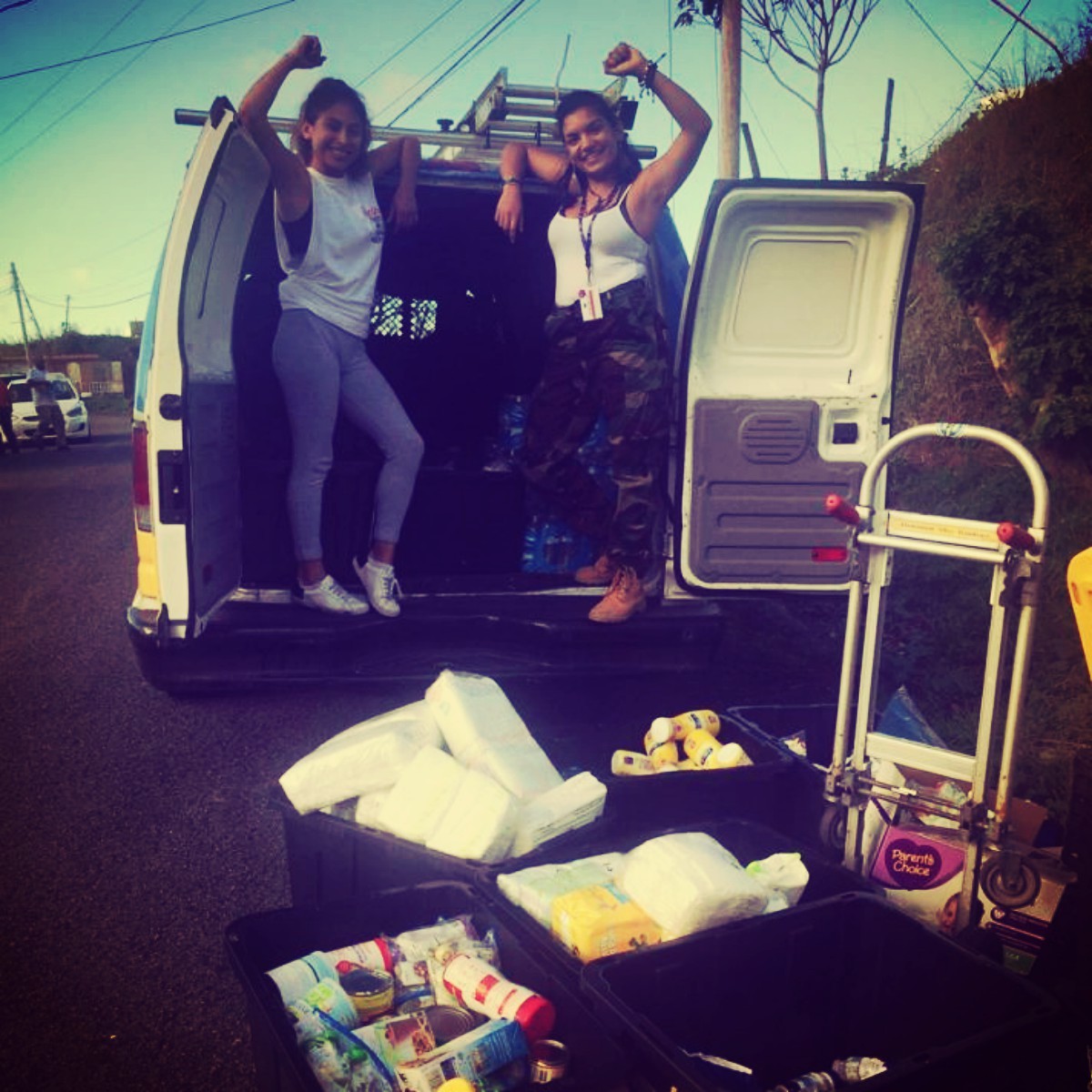
We drove through neighborhoods in the mountains with local residents and our comrades from Guaynabo, delivered food, cases of water, water purification tablets, and provided health care to elderly residents and their families sweltering in damaged homes, surrounded by narrow, perilous roads with no power and waning supplies. We are sharing our time, access to resources, knowledge, skills and quickly beating hearts to contribute to people’s survival and self-determination. It is all part of horizontal, participatory, solidarity-based, liberatory mutual aid disaster relief.

Mutual aid, itself, has been here since before Hurricane Maria and embodied by self-organized groups like Sonadora En Acción and Proyecto de Apoyo Mutuo Mariana. Larger, but also grassroots organizations like Taller Salud and Crowdrescuehq are also spearheading people-powered relief efforts. As wildfires blaze to the west, people in Mexico are still digging out rubble from the earthquake, Houston residents are still cleaning up flooded homes, and people impacted by Irma remain houseless in Florida, we know there is a long road ahead. This is to say nothing of the centuries old disasters of colonization.

On-the-Ground Reports Destroy Trump's Sunny Portrayal of Puerto Rico Recovery

Julia Conley - Common Dreams, October 11, 2017

The White House's rosy portrayal of Puerto Rico's recovery contrasts with the grim details relief workers are sharing about the reality on the ground.

According to numerous accounts of the recovery and a website set up by the Puerto Rican government, there is still a dire food and water shortage on the island. Only about ten percent of the island has electricity, and only a third of cell phone towers are in working order.

Yet in a White House's video posted on Twitter this week, Trump was shown shaking hands with hurricane survivors while triumphant music played and footage and on-screen text assured viewers that generator fuel is being delivered to hospitals, roads are quickly being cleared, and water is rapidly being brought to families in need. In both tweets and repeated public statements over recent days, Trump has shown he is far more concerned with garnering praise for his response to the disaster than with addressing the struggles Puerto Ricans continue to face.

On Tuesday, National Nurses United shared some of what the group's 50 volunteer nurses have observed—noting that 21 days after Maria swept through the U.S. territory, many federal workers on the island are still assessing damage rather than handing out supplies.

Nurses Demand Congress Act to Avert Further Public Health Calamity in Puerto Rico

By Charles Idelson - Common Dreams, October 11, 2017

WASHINGTON - In a letter to all members of Congress today, National Nurses United, whose disaster relief organization has placed 50 volunteer RNs on the ground in Puerto Rico, is pressing Congress to “take immediate action to prevent a further public health calamity in Puerto Rico”.

“The response to the crisis in Puerto Rico from the U.S. federal government has been unacceptable for the wealthiest country in the world,” wrote NNU RN Co-Presidents Deborah Burger and Jean Ross, citing eyewitness accounts by RNs on the ground, and the ongoing crisis of lack of water, food, and other emergencies faced by the island’s 3.5 million residents.

Among conditions our RNs witness, NNU notes, are:

  • People standing in line for hours in blistering heat waiting for desperately needed water and food, only to finally see federal disaster officials bringing paperwork “to collect data” rather than supplying critical supplies.
  • Residents continuing to live in houses with roofs blown off and soaked interiors where there is dangerous black mold growing that creates respiratory distress and illness.
  • Major areas away from urban centers where residents still have received no provisions, have no running water and no electricity.
  • A breakout of leptospirosis, a dangerous bacterial disease that has already claimed lives.
  • Numerous communities without clean water that are at risk of the outbreak of water-borne illness epidemics. 
  • Further, NNU notes a glaring disparity between the federal response to Hurricane Maria in Puerto Rico and the response to Hurricanes Harvey and Irma in Texas and Florida.  “The people of Puerto Rico are counting on your leadership to survive,” wrote Burger and Ross.

The Seeds of Agroecology and Common Ownership

By Colin Todhunter - CounterPunch, October 10, 2017

The increasingly globalised industrial food system that transnational agribusiness promotes is not feeding the world and is responsible for some of the planet’s most pressing political, social and environmental crises. Localised, traditional methods of food production have given way to globalised supply chains dominated by transnational companies policies and actions which have resulted in the destruction of habitat and livelihoods and the imposition of corporate-controlled, chemical-intensive (monocrop) agriculture that weds farmers and regions to a wholly exploitative system of neoliberal globalisation.

Whether it involves the undermining or destruction of what were once largely self-sufficient agrarian economies in Africa or the devastating impacts of soy cultivation in Argentina or palm oil production in Indonesia, transnational agribusiness and global capitalism cannot be greenwashed.

In their rush to readily promote neoliberal dogma and corporate PR, many take as given that profit-driven transnational corporations have a legitimate claim to be custodians of natural assets. There is the premise that water, seeds, land, food, soil and agriculture should be handed over to powerful, corrupt transnational corporations to milk for profit, under the pretence these entities are somehow serving the needs of humanity.

These natural assets (‘the commons’) belong to everyone and any stewardship should be carried out in the common interest by local people assisted by public institutions and governments acting on their behalf, not by private transnational corporations driven by self-interest and the maximization of profit by any means possible.

The Guardian columnist George Monbiot notes the vast wealth the economic elite has accumulated at our expense through its seizure of the commons. A commons is managed not for the accumulation of capital or profit but for the steady production of prosperity or wellbeing of a particular group, who might live in or beside it or who created and sustain it.

Unlike state spending, according to Monbiot, a commons obliges people to work together, to sustain their resources and decide how the income should be used. It gives community life a clear focus and depends on democracy in its truest form. However, the commons have been attacked by both state power and capitalism for centuries. In effect, resources that no one invented or created, or that a large number of people created together, are stolen by those who see an opportunity for profit.

We need only look at how Cargill captured the edible oils processing sector in India and in the process put many thousands of village-based workers out of work.  Or how Monsanto conspired to design a system of intellectual property rights that allowed it to patent seeds as if it had manufactured and invented them. Or how India’s indigenous peoples have been forcibly ejected from their ancient forest lands due to state’s collusion with mining companies.

As Monbiot says, the outcome is a rentier economy: those who capture essential resources seek to commodify them – whether trees for timber, land for real estate or agricultural seeds, for example – and force everyone else to pay for access.

While spouting platitudes about ‘choice’, ‘democracy’ and ‘feeding the world’, the corporate agribusiness/agritech industry is destroying the commons and democracy and displacing existing localised systems of production. Economies are being “opened up through the concurrent displacement of pre-existing productive systems. Small and medium-sized enterprises are pushed into bankruptcy or obliged to produce for a global distributor, state enterprises are privatised or closed down, independent agricultural producers are impoverished” (Michel Chossudovsky in The Globalization of Poverty, p16).

As described here, for thousands of years farmers experimented with different plant and animal specimens acquired through migration, trading networks, gift exchanges or accidental diffusion. By learning and doing, trial and error, new knowledge was blended with older, traditional knowledge systems. The farmer possesses acute observation, good memory for detail and transmission through teaching and story-telling. The same farmers whose seeds and knowledge were stolen by corporations to be bred for proprietary chemical-dependent hybrids, now to be genetically engineered

Large corporations with their proprietary seeds and synthetic chemical inputs have eradicated traditional systems of seed exchange. They have effectively hijacked seeds, pirated germ plasm that farmers developed over millennia and have ‘rented’ the seeds back to farmers. Genetic diversity among food crops has been drastically reduced, and we have bad food and diets, degraded soils, water pollution and scarcity and spiralling rates of poor health.

The eradication of seed diversity went much further than merely prioritising corporate seeds: the Green Revolution deliberately sidelined traditional seeds kept by farmers that were actually higher yielding.

We have witnessed a change in farming practices towards mechanised industrial-scale chemical-intensive monocropping, often for export or for far away cities rather than local communities, and ultimately the undermining or eradication of self-contained rural economies, traditions and cultures. We now see food surplus in the West and food deficit areas in the Global South and a globalised geopoliticised system of food and agriculture.

In India, Green Revolution technology and ideology has merely served to undermine indigenous farming sectors centred on highly productive small farms that catered for the diverse dietary needs and climatic conditions of the country. It has actually produced and fuelled drought and degraded soils and has contributed towards illnesses and malnutrition, farmer distress and many other problems.

What really irks the corporate vultures which fuel the current industrial model of agriculture is that critics are offering genuine alternatives. They advocate a shift towards more organic-based systems of agriculture, which includes providing support to small farms and an agroecology movement that is empowering to people politically, socially and economically.

Left And Right Have Nothing In Common On NAFTA

By Stephanie Basile - Popular Resistance, October 11, 2017

Contrary to popular belief.

Washington, DC – Today, the fourth round of renegotiations of the North American Free Trade Agreement (NAFTA) are taking place in Washington, DC. Protests are planned at multiple locations around DC, including a petition delivery of over 360,000 signatures to Congress demanding the elimination of the Investor-State Dispute Settlement (ISDS). United under the threat from continually expanding corporate power, the fight against NAFTA has brought together a cross-section of social movements, including unions, community groups, land reform movements, environmentalists, food safety groups, and internet rights organizations.

NAFTA, in effect since 1994, is an agreement between the US, Canada, and Mexico. There has been much written about the original deal that need not be repeated here, but suffice it to say that local economies have been eviscerated under a deal that expands the rights of corporate profits at the expense of working people in all three countries. Renegotiations of NAFTA began this past August, with each session rotating to take place in each of the three member countries.

Today’s negotiations are largely focused on the Investor-State Dispute Settlement (ISDS), which allows corporations to sue local governments in secret tribunals. What this translates to is taxpayers literally paying corporations for any unrealized profits due to such basic protections as clean water ordinances or other common sense legislation. Over the years, lawsuits brought by corporations against governments have forced taxpayers to pay billions of dollars to these corporations.

While most of these cases have been settled with little public scrutiny, the ISDS has had some notable moments in the spotlight, such as when UPS sued Canada for $156 million due to unfair competition from the Canadian Post Office, or John Oliver’s memorable 2015 segment critiquing the absurdity of the ISDS system.

President Trump’s presidential campaign made much fanfare over his opposition to free trade, and the media largely accepted the premise that his opposition to free trade would logically result in more jobs and better working conditions for US workers. Furthermore, the reporting on free trade often conflated Trump’s position with the leftist position, saying that they are both “anti-globalization.”

Clearly, the language used to discuss trade poorly captures its reality. The terms “free trade” and “globalization” conjure up ideas of multiculturalism and unity across borders. However, those ideas are not reflected in the actual policies that have been pursued by both major political parties over the last 30 years. Innocuous terms like “free trade” and “globalization” have become synonymous with global capitalism, a capitalism that is supported by international structures that work to greatly expand corporate power while limiting the rights of workers, consumers, and residents who are most affected by those very policies.

The debate is often framed as US corporations and US workers vs foreign corporations and foreign workers, giving the idea that a worker somehow has more in common with a corporation of their home country than with a fellow worker of another country. This allows Trump to favor corporations and pretend as though he’s favoring workers. The media seems to mostly accept this framework in its coverage of trade deals. The media also conflates global capitalism with openness and tolerance, as if the arrival of Coca-Cola in your country obviously leads to democracy.

Instead, the leftist position sees workers around the world, both in the US and abroad, sharing the same interests with each other, and being in opposition to corporate interests, whether that corporation is in the US or abroad. The dominant narrative that the far right and far left share similar positions on trade is wrong and it sorely misses the substance of the left’s critique. At its core, a leftist approach to the trade debate centers working and marginalized people in its analysis, regardless of what country they live in. The right’s pursuit to push US corporate interests at the expense of workers and the environment is in direct contrast to the left’s goals, of which protecting workers’ rights and the environment are fundamental.

Leftists understand the limitations of adopting the typical “Buy American” theme, including strategic errors both in its failure to address the problem of declining wages and working conditions, and in its more insidious implications in fueling xenophobia. If working standards are declining all over the world, products could be made in the US and still be made under sub-par working conditions. Leftists support organizing and pushing standards up for workers all over the world, as a means to improve conditions everywhere, including the US. As for what Trump wants for workers, when he announced plans to renegotiate NAFTA during his “Made in America” week this past July, Lori Wallach of Public Citizen went on Democracy Now to point out that what little we know of the re-negotiations is so vague as to be impossible to tell what it would actually mean for workers and the environment.

The leftist analysis sees that those with power at the top are breaking down borders for the purpose of more aggressively exploiting the people, land, and resources around the world, not for any interest in lofty multicultural goals. Money, goods, and intellectual property flow freely across borders, while the people at the whim of such corporate power face increasing restrictions in their movement, facing resistance in the form of both restrictive laws and the rise in xenophobic violence.

Leftists seek to go to the roots of the problem by critiquing the political and economic structures that work to further enrich a tiny ruling elite at the expense of everyone else. A leftist approach that prioritizes people at the grassroots level requires building an international working-class movement in which working and oppressed people across all countries challenge corporate power everywhere.

After The Storm, It’s Labor vs. Finance for the Future of Puerto Rico

By Richard Eskow - Common Dreams, October 13, 2017

Two opposing forces are fighting to reshape Puerto Rico in the wake of Hurricane Maria. Wall Street, which has been plundering the island for years, is trying to tighten its grip on the island. Meanwhile, organized labor is working to rebuild the island  – and to rebuild its own ranks in the process.

As our video reporting from Puerto Rico emphasizes, this confrontation reflects an ongoing battle for the future of the country. In one sense, Puerto Rico is the rest of the nation in extremis. Financial institutions have obtained a growing stranglehold over the island’s economy and manipulated politicians from both parties into prioritizing bank repayments over public need. The hungry have gone unfed, the sick have gone untreated, and needed infrastructure has gone unbuilt to meet the financial industry’s rapacious demands.

The financial industry had held the upper hand in Puerto Rico for years. It has lent money to the island’s financially troubled government at usurious terms, profited from the buying and selling of its debt while lobbying Washington to make sure the notes they hold takes priority over the public’s needs. Wall Street has encouraged the kind of predatory speculation that doesn’t just bet against the people of Puerto Rico, but rigs the game to make sure they lose.

Pages

The Fine Print I:

Disclaimer: The views expressed on this site are not the official position of the IWW (or even the IWW’s EUC) unless otherwise indicated and do not necessarily represent the views of anyone but the author’s, nor should it be assumed that any of these authors automatically support the IWW or endorse any of its positions.

Further: the inclusion of a link on our site (other than the link to the main IWW site) does not imply endorsement by or an alliance with the IWW. These sites have been chosen by our members due to their perceived relevance to the IWW EUC and are included here for informational purposes only. If you have any suggestions or comments on any of the links included (or not included) above, please contact us.

The Fine Print II:

Fair Use Notice: The material on this site is provided for educational and informational purposes. It may contain copyrighted material the use of which has not always been specifically authorized by the copyright owner. It is being made available in an effort to advance the understanding of scientific, environmental, economic, social justice and human rights issues etc.

It is believed that this constitutes a 'fair use' of any such copyrighted material as provided for in section 107 of the US Copyright Law. In accordance with Title 17 U.S.C. Section 107, the material on this site is distributed without profit to those who have an interest in using the included information for research and educational purposes. If you wish to use copyrighted material from this site for purposes of your own that go beyond 'fair use', you must obtain permission from the copyright owner. The information on this site does not constitute legal or technical advice.