You are here

renewable energy

Big Solar: Plundering the Mojave Desert

Disclaimer: The views expressed here are not the official position of the IWW (or even the IWW’s EUC) and do not necessarily represent the views of anyone but the author’s.
By Dan Fischer - Capitalism vs. the Climate, February 16, 2014 (used by permission)

“Some people look out into the desert and see miles and miles of emptiness. I see miles and miles of gold mine.”
-Governor Arnold Schwarzenegger at the start of Ivanpah Solar Power Facility’s construction

The world’s largest solar thermal energy facility, the Ivanpah Solar Power Facility, opened last Thursday in California’s Mojave Desert. Unfortunately, this is bad news for neighboring indigenous people, the desert tortoise, and local birds. It is an example of solar done wrong.

Ivanpah use mirrors to reflect sunlight, in order to heat and boil water. This produces steam, which spins turbines to produce electricity. When done at a small scale, it can be a clean and sustainable process. Photovoltaic solar panels, which convert sunlight directly into electricity, are even more democratic. They are easy to decentralize and put on rooftops.

In fact, Ivanpah’s grassroots opponents tend to strongly support solar power. The group Solar Done Right advocates decentralized solar energy as an alternative to mega-solar projects like Ivanpah. They argue that there is plenty of already-paved surface where we can safely install solar panels: rooftops, vacant parking lots, and former industrial sites known as brownfields.

According to the US Department of Energy, supplying all of the country’s electricity from solar photovoltaics would require 17 square miles of land in each state. Brownfields alone could provide 90 percent of the needed land!

Why 100% Renewable Energy Requires Libertarian Eco-Socialism

Disclaimer: The views expressed here are not the official position of the IWW (or even the IWW’s EUC) and do not necessarily represent the views of anyone but the author’s.

By Dan Fischer - Capitalism vs. the Climate, November 15, 2013 (used by permission)

It’s old news that humans can power society with 100% renewable energy. Back in 1964, the anarchist Murray Bookchin wrote a prescient essay on global warming and other ecological issues. “Solar devices, wind turbines, and hydroelectric resources taken singly do not provide a solution…Pieced together as a mosaic…they could amply meet the needs of a decentralized society,” he wrote (Ecology and Revolutionary Thought).

Grow or Die

This transition can only take place when we start confronting the system that caused climate change: capitalism. Capitalism is a system based on private property and wage labor, where a ruling class of people own and manage most of the economy. It is inherently anti-ecological.

Capitalism presents each business with a stark “grow or die” imperative. As a result, businesses have no choice but to keep producing more stuff and using more energy (see chart above). When a business buys a more expensive form of energy like wind, it will lose market share to its competitors who buy oil and natural gas. To appear sustainable, they sell false “solutions” like mega-hydro, fracking, nuclear power and cap-and-trade. These proposals are insulting to those who care about the planet.

Reinventing the Wheel - Teaching Old Hydro New Tricks

By x356039 - January 22, 2014

Disclaimer: The views expressed here are not the official position of the IWW (or even the IWW’s EUC) and do not necessarily represent the views of anyone but the author’s.

When discussing green, renewable energy something of a holy trinity of sources consistently emerges in every discussion: solar, wind, and water. Of the three the one receiving the least press these days as a possibility are those options and opportunities based on water power. This is understandable when one considers the first image that springs to mind when discussing the subject: towering tons of cold concrete caging the roaring rivers of the world to work for the whims of the wealthy and powerful.

There is little debate in spite of the incredible potential hydroelectric dams offer that they come at enormous environmental costs. At internationalrivers.org the consequences of these projects is summed up with very strong, damning words. In spite of the extensive studies regularly conducted on new dam sites the changes caused by construction lead to a number of unintended and deadly consequences for the local ecosystem. The most obvious is, of course, the diversion of the river's flow but the impact of this happens on more levels than immediately meets the eye. The creation of massive artificial reservoirs that result from the construction of these dams destroys the previously existing green water habitats of the rivers making them quite hostile to the native species. This leads to massive influxes of invasive species like snails, algae, and non-native predatory fish ensuring further ecological havoc. Added to this is the blocking of new sediment deposits, resulting in increased erosion and the lowering of the water table denying plant life of the needed moisture to thrive.

The negatives of hydroelectric dams don't stop there. Adding further insult to injury is the displacement of indigenous populations that often results from these massive building projects. According to a report titled, “Social Impacts and Social Risks in Hydropower Programs” submitted to the 2004 United Nations Symposium on Hydropower and Sustainable Development the number of people displaced in China and India over the past 50 years by such projects is staggering. Of the estimated 45 million people in China displaced by new industrial projects during this period at least half were forced out of their homes due to the construction of new dams with a new project in the Yunnan province expected to add tens of thousands more to their number. In India the number is believed to be at least fifty million and this trend shows no signs of slowing down. A recent report by Survival International argues hundreds of thousands of people are being displaced as we speak by new projects in Brazil, Malaysia, Guyana, Ethiopia, and Peru. The Ethiopian Gibe III Dam, expected to be the highest dam on the continent when it is completed in 2020, has already forced over 200,000 people from their homes and it still has six years to go.

If this was all there was to the story of hydropower then there is little doubt that any sane environmentalist would stay as far away from this source as possible and consign it to the same category as nuclear, coal, and other dirty sources of energy. Thankfully there are a number of recent innovations, many inspired by pre-industrial uses of water power, that show hydropower has a few more tricks up its sleeve that make it an equally necessary component in any green energy future. These new developments harness the potential offered by flowing rivers, the roll of the tides, and crashing waves in non-invasive, minimally impactful ways. What makes these even better is, like wind and solar power, these inventions can be implemented on a far smaller, more evenly distributed scale ensuring that all forms of renewable power remain truly grassroots power.

One Million Climate Jobs: Tackling the Environmental and Economic Crises

By Jonathan Neale, et. al. - Campaign against Climate Change, 2014

This booklet is about hope in the face of crisis. The economy is not working. Mass unemployment has lasted for years, and will last for many more. And at some point gradual climate change is going to turn into swift catastrophe. Dangerous climate change is a consequence of the work of the hands and brains of many men and women. It will take the hands and brains of many men and women to undo the damage. So many climate activists, and several trade unions, have decided to fight to make the government create one million climate jobs. This report sets out our case. To halt climate change we need drastic cuts in the amount of carbon dioxide and other greenhouse gases we put into the air. That means leaving most of the existing reserves of high carbon fuels – coal, oil and gas – in the ground. There are thousands of things we need to do to make that a reality. But three of them will make most of the difference.

We need workers to build enough wind power, solar power, wave power and tidal power to meet all our energy needs. We need workers to insulate and retrofit all our existing homes and buildings in order to conserve energy. And we need workers to run a massive public transport system powered by renewable electricity. We have people who need jobs, and jobs that must be done. So we want the government to hire a million people to do new climate jobs now in an integrated National Climate Service.Our estimate is that those workers could cut our CO2 emissions by 86% in twenty years. We can also create another half a million jobs in the supply line. And we can guarantee a new job to anyone who loses their job because of these changes.

This booklet explains how we can do all of this, and why we must. ‘Climate jobs’ are not the same as ‘green jobs’. Some green jobs help the climate, but ‘green jobs’ can mean anything – park rangers, bird wardens, pollution control, or refuse workers. All these jobs are necessary, but they do not stop climate change. Climate jobs are jobs that lead directly to cuts in emissions of greenhouse gases, and so slow down climate change. For instance, workers who build wind farms replace power stations that burn coal or oil. Workers who insulate buildings reduce the oil and gas we burn. Bus drivers reduce the amount of oil we burn in cars. We want a million new jobs. We don’t want to add up existing jobs and new jobs and say that now we have a million climate jobs. We don’t mean jobs that will be ‘created’ by some mysterious market process by 2030. We want the government to hire 90,000 new workers each month to do new climate jobs. In a year we will have a million new jobs.

Read the report (PDF).

Capital Blight: a Green-Syndicalist Responds to David Walters "Socialist" Defense of Nuclear Energy

By x344543 - November 22, 2013

Disclaimer: The views expressed here are not the official position of the IWW (or even the IWW’s EUC) and do not necessarily represent the views of anyone but the author’s.

I read with interest David Walters's recent article, "A Socialist Defends Nuclear Energy, wondering what I would find. I soon discovered there was very little credible "defense" and for that matter, not much "socialism" (other than the citation of various Marxist quotations that Marx and Engels would have bristled at given their context here) in it. In fact, it read to me as a typical capitalist defense of its standard operations wrapped in a rather threadbare and tattered red flag.

Michael Friedman has thoroughly debunked Walters's claims about the "safety" of (conventional) nuclear (fission) energy and the "ease" at dealing with the nuclear waste in his own piece so there is no utility in elaborating further on that matter. It is my intention to address the issues that Friedman didn't cover.

To begin with, if David Walters is so willing to overlook peer reviewed science and factual evidence that clearly shows that conventional nuclear fission energy is unsafe and the problem of nuclear waste not easily handled, he may as well also argue in favor of thorium based breeder reactors, nuclear fusion power, fracking, tar sands, "clean" coal, or even hydrogen fuel cells which are equally questionable technologies (and please note that I am not arguing in favor of any of these things here, though I think hydrogen fuel cells are worth a look at least).

Additionally, Walters lumps in all greens into a single, monolithic group, dominated by primitivism and Malthusianism. This is as inaccurate as arguing that all communists take their marching orders from Stalin. This is the rhetoric one expects to hear from the most reactionary elements of the capitalist class's punditocracy rather than an informed anti-capitalist. To me this is a clear indication that his entire argument is mere propaganda and has very little substance.

Socialists Debate Nuclear, 2: Still No Nukes!

By Michael Friedman - Climate and Capitalism, November 18, 2013: a response to A socialist defends nuclear energy, by David Walters.

Disclaimer: The views expressed here are not the official position of the IWW (or even the IWW’s EUC) and do not necessarily represent the views of anyone but the author’s.

Retired nuclear power plant operator David Walters seeks to make a socialist case for nuclear power as the alternative to fossil fuels. Unfortunately, he parts from the unfortunate and worn-out progressive infatuation with capitalist productivism, the technology that it employs and the technological determinism that justifies it and brings forth a host of magic bullet non-solutions for every problem it engenders. This is succinctly confirmed by his assertions that “the center of this discussion can be narrowed down to one technological and scientific issue: the generation, use, and distribution of energy” and “human use of energy set us apart from all other species, including the higher ones such as dolphins and apes.”

These formulations fly in the face of a Marxist understanding of human development, reducing ‘all hitherto existing human history’ to the history of energy development. That is technological determinism, no more. For Marxists, the “center” of this discussion is the capitalist mode of production, and concretely, its method of appropriation of human labor and natural resources.

Driven to privatize and turn the natural world into marketable commodities incorporating human labor, capital rips natural processes such as biogeochemical cycles or trophic webs to pieces in order to isolate profitable components. We are presented with abominations like monocrop agriculture, fracking and Fukushima.

This mode of production and the reductionist, mechanistic worldview attendant upon it, has turned Homo sapiens’ biological connections to the rest of the natural world upside down; under capitalism, humans are not only alienated from their labor, and each other, but from the nature with which they are inextricably bound. This is the cause of the environmental crisis. Global warming is far from the only major element of this crisis. Many ecologists regard the dramatic decline in biodiversity as just as devastating to humans and all life on this planet as global warming. Deforestation, ocean acidification, the proliferation of human waste and toxic contaminants, the introduction of genetically engineered organisms and invasive species, all of these are, of course interconnected consequences of the market economy, but it is meaningless to subsume them under the rubric of “generation, use and distribution of energy.”

We Have the Renewable Energy We Need to Power the World—So What’s Stopping Us?

By Tara Lohan - Reprinted with permission from Alternet, November 14, 2013

Disclaimer: The views expressed here are not the official position of the IWW (or even the IWW’s EUC) and do not necessarily represent the views of anyone but the author’s.

The environment is one bad news story after another.

The Pacific Ocean is warming at a rate faster than anything seen in the last 10,000 years and we may have the warmest Arctic in the last 120,000 years. We’re told to brace for more and worse droughts, floods, heat waves, and storms. Coastal communities may disappear from rising seas, entire island nations are going under.

If that all weren’t bad enough, there is a global wine shortage.

The bright side is that we aren’t being blindsided by an unknown enemy: Our relentless burning of fossil fuels is the big thing pushing us toward the brink. So it would figure that a solution to get us out of this mess would be pretty obvious.

That’s why it’s great that there are people like Mark Z. Jacobson, a professor of civil and environmental engineering at Stanford University. While it is one thing to say we want to stop burning fossil fuels, Jacobson (and a team of researchers) are telling us how to do it.

Jacobson was recently on the “David Letterman Show,” where he proclaimed that we have enough wind and solar to power the world.

Is he right? Can renewables really replace fossil fuels? If so, are we willing to do what’s necessary to get there? Let’s take a look at his work and some other new developments.

Fracking Capitalism: Action plans for the eco-social crisis

By staff - A World to Win, November 2013

The message has gone out to corporations everywhere: Britain is open for fracking. In response, campaign groups now exist the length and breadth of Britain in opposition to the plans to industrialise the countryside with tens of thousands of drilling sites. They are taking legal action, lobbying their representatives and protesting and occupying sites at considerable risk of police brutality.

But this grass roots movement is up against formidable adversaries. Corporations have the backing of the state and a public relations campaign led by the government is promoting the lie that fracking is safe and will lead to cheaper energy.

Yet public support for shale gas extraction continues to fall while backing for renewables grows. Government claims about jobs and lower gas prices are exposed for the grand deceptions they are. None of this will deter the Cameron government, however, which has thrown the weight of the state behind the frackers.

Read the report (Link).

Capital Blight - The Root of the Problem

By x344543 – October 8, 2013

Disclaimer: The views expressed here are not the official position of the IWW (or even the IWW’s EUC) and do not necessarily represent the views of anyone but the author’s.

I really would rather not be writing this; I honestly wish that I didn’t feel that it was necessary. However, some things simply cannot be left unaddressed.

As one of the half dozen or so charter members of the IWW’s Environmental Unionism Caucus, I comb through a good deal of class struggle and/or environmental news sources, since one of our goals is raising awareness. These sources come from a variety of directions, including syndicalist, socialist, anarchist, progressive environmentalist, and deep green (though not Deep Green Resistance, because of the latter’s transphobia and rigid primativist tendencies). Naturally, one of the most logical sources for this last tendency is Earth First!. Rarely is any source 100% in line with what I and my fellow “Green Wobblies” think represents our position (loosely defined though that may be), and Earth First! is no exception. That which doesn’t fit is generally ignored, and we “stand aside” as they say in the language of modified consensus process. Sometimes, however, our sources will publish something so egregiously wrong, in our opinion, that we feel compelled to respond.

Saturday, October 5, 2013, Earth First! re-published just such a story, called Thanks A Lot, Nebraska, by the Tucson chapter of Root Force (TURF).

What is Root Force you ask? Here’s their mission statement:

Root Force (Fuerza Raíz) is a campaign that recognizes the fundamental connection between the oppression of the Earth and the oppression of its people. The precursor to ecocide and genocide is the separation of people from the land so that both can be exploited. Thus Root Force is a biocentric campaign, asserting that no oppression can be overcome without addressing the relationship a society has with the Earth. To achieve either social or ecological justice, we must achieve both.

Therefore, Root Force aims to help dismantle the system that is killing and enslaving our planet and its people. This will be achieved by (1) identifying the system’s strategic weak points, and (2) targeting those points, thus providing an offensive component to existing ecodefense, international solidarity, and anti-colonialist efforts.

One strategic weak point is the U.S. dependence on the resources of Latin America. The exploitation of these resources is dependent on transportation, energy, and communications infrastructure. Hence this U.S.-based campaign focuses its efforts on opposing infrastructure expansion projects in Latin America, such as Plan Puebla Panama (PPP) and the South American Regional Infrastructure Integration Initiative (IIRSA).

The campaign provides a framework for people to take effective action in solidarity with local resistance to these projects without traveling to Latin America. It is structured to allow for a diversity of tactics, to be undertaken by a wide network of autonomous individuals and groups.

This seems reasonable enough; in fact, I cannot find any really objectionable position in this mission statement at all. Much of it could easily mesh with the Preamble to the IWW Constitution, so having established that, I find the content of the article itself to be quite disturbing.

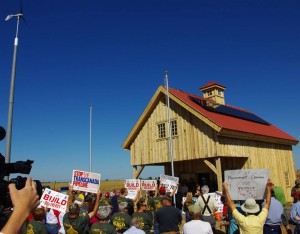
Essentially, TURF is miffed that a coalition including Nebraska ranchers and farmers, the Nebraska Farmer’s Union, Bold Nebraska, 350.org, Sierra Club, Credo, and billionaire Tom Steyer are protesting the impending construction of the controversial Keystone XL Pipeline by constructing a wind- and solar- powered barn in its projected pathway.

Granted there are many criticisms one could make of this action, such as the fact that a great many of these folks are capitalists or enablers of capitalists, the fact that Keystone XL is not the only pipeline we need to worry about, or the obvious fact that Keystone could simply build the pipeline somewhere else (there are enough rural counties sufficiently beholden to corporate fossil fuel interests to ram through the permits barn or no barn), but in spite of these shortcomings, there are lot of good things that could be said about the project as well, including—in my opinion at least—the advocacy of renewable energy, such as wind and solar which could allow a state such as Nebraska which has a fairly good abundance of both to potentially generate all of its own electricity and perhaps even export a bit.

No doubt doing so would lessen that state’s reliance on fossil fuels, and though some of those are extracted and refined locally, the impact of those on the environment effects us globally in ways that greatly outweigh any significant impact from wind and solar. Certainly that would seem to fit the mission of Root Force would it not? Evidently the answer is a resounding “no”. Root Force is overwhelmingly opposed to renewable energy arguing that it simply props up the existing system and perpetuates the destruction of the Earth (and to be certain, the Earth First! Journal published Root Force's position paper on renewables in February 2009).

Capital Blight - They Really Don't Know Clouds At All.

By x344543 - September 9, 2013

Disclaimer: The views expressed here are not the official position of the IWW (or even the IWW’s EUC) and do not necessarily represent the views of anyone but the author’s.

A recent discussion among IWW members about whether or not to change the default delivery option for the union's official organ, the Industrial Worker, from hard copy to PDF has touched on a larger debate over the "greenness" of "the cloud."(the many data centers that form the backbone of the Internet).

My attention was drawn to this debate by one of my fellow worker's reaction to the following statement from the current editor of our union's venerable publication, the Industrial Worker in reference to a change in the default option from a paper copy to an emailed PDF:

Go paperless, live in harmony with the earth and help save the union money!"

The union implemented this change to cut costs. The apparent environmental benefits are merely coincidental, though it's gratifying to see that the membership is taking the environmental tenets of the IWW Preamble seriously.

My aforementioned fellow Wobbly took exception to this statement thusly:

From some of what I have read, the physical maintenance of the digital world is anything but green, even though the idea that computers = lower pollution and energy consumption is to be found pretty much everywhere these days.

Below is a link to an article from the New York Times on the subject.  One of the key points is how much of the energy -- about 90-94% -- is wasted just keeping servers idling in case they need to be pulled in as backups.

The specific article he referenced, Power, Pollution, and the Internet actually quotes a slightly lower figure of 88 - 93%, but more about that later.

He then offered the following quotation to emphasize a comparison between data centers and the paper industry:

Nationwide, data centers used about 76 billion kilowatt-hours in 2010, or roughly 2 percent of all electricity used in the country that year, based on an analysis by Jonathan G. Koomey, a research fellow at Stanford University who has been studying data center energy use for more than a decade.

Datacenter Dynamics, a London-based firm, derived similar figures.

The industry has long argued that computerizing business transactions and everyday tasks like banking and reading  library books has the net effect of saving energy and resources. But the paper industry, which some predicted would be replaced by the computer age, consumed 67 billion kilowatt-hours from the grid in 2010, according to Census Bureau figures reviewed by the Electric Power Research Institute for The Times.

Skepticism of any capitalist industry's claims to be "green" should be regarded as healthy, but that skepticism should be followed by careful examination of all of the facts.

Pages

The Fine Print I:

Disclaimer: The views expressed on this site are not the official position of the IWW (or even the IWW’s EUC) unless otherwise indicated and do not necessarily represent the views of anyone but the author’s, nor should it be assumed that any of these authors automatically support the IWW or endorse any of its positions.

Further: the inclusion of a link on our site (other than the link to the main IWW site) does not imply endorsement by or an alliance with the IWW. These sites have been chosen by our members due to their perceived relevance to the IWW EUC and are included here for informational purposes only. If you have any suggestions or comments on any of the links included (or not included) above, please contact us.

The Fine Print II:

Fair Use Notice: The material on this site is provided for educational and informational purposes. It may contain copyrighted material the use of which has not always been specifically authorized by the copyright owner. It is being made available in an effort to advance the understanding of scientific, environmental, economic, social justice and human rights issues etc.

It is believed that this constitutes a 'fair use' of any such copyrighted material as provided for in section 107 of the US Copyright Law. In accordance with Title 17 U.S.C. Section 107, the material on this site is distributed without profit to those who have an interest in using the included information for research and educational purposes. If you wish to use copyrighted material from this site for purposes of your own that go beyond 'fair use', you must obtain permission from the copyright owner. The information on this site does not constitute legal or technical advice.

