

You are here

coal

CSX Train Carrying 8,000 Tons of Coal Derails in Company’s Second Wreck in 24 Hours

By Brandon Baker - EcoNews, May 1, 2014

Disclaimer: The views expressed here are not the official position of the IWW (or even the IWW’s EUC) and do not necessarily represent the views of anyone but the author’s.

A train derailed early Thursday morning in Bowie, MD marking the second derailment for CSX Corp. in 24 hours.

CSX spokeswoman Kristin Seay told the Associated Press that about 10 cars of the train traveling from Cumberland, MD to Bowie derailed Thursday. The train had three locomotives and 63 railcars, all of which were carrying coal. The train originated from a coal mine in Pennsylvania. 

The train was carrying about 8,000 tons of coal.

One of the train cars overturned, spilling its load of coal, but there were no injuries reported in the incident. CSX spokesman Gary Sease said the company would investigate the derailment. He said increased rain may have played a role, but it’s too early to say.

Coal Miners and the Green Agenda

By Robert Pollin - New Labor Forum, Winter 2014

From 2014...

In June 2012, President Obama announced his “Climate Action Plan.” This is his administration’s major second-term initiative to re-energize its agenda around fighting climate change and supporting major new investments in clean energy.

The primary focus of the Action Plan is the administration’s program to dramatically reduce carbon emissions from the country’s electricity utility plants. These emissions result primarily from burning coal, but also natural gas, to produce electricity. Carbon emissions from electricity generation represent about one-third of all greenhouse gas emissions produced by all sources within the U.S. economy today. It is evident that these emissions need to be cut dramatically if we are going to stop playing Russian roulette with the environment.

New Regulations and Technologies Are Not Enough

The administration’s strategy for achieving these emissions cuts is to begin strictly enforc-ing the existing air pollution regulations estab-lished as part of the 1990 Clean Air Act.

The administration is taking this approach because it allows them to avoid asking Congress to either spend more money or pass new regulations.The administration expects that the utility companies can achieve the needed emissions reductions through a technological fix: the introduction of carbon capture and sequestra-tion (CCS) processes, through which, they believe, coal and natural gas could burn cleanly. This is how the phrase “clean coal” has begun to emerge on billboards and TV commercials. CCS encompasses several specific technolo-gies that aim to capture carbon emissions from power plants and other industrial facilities. The captured carbon is then transported, usually through pipelines, to locations where it is then stored permanently—that is, for all time—in subsurface geological formations.

Opponents of the administration’s Action Plan claim that CCS remains unproven and, even if it becomes technically feasible, would impose heavy new costs on utilities.

In this instance, the administration’s critics have the weight of evidence on their side. As such, the Action Plan faces two fundamental problems. First, as there is no proven technol-ogy for delivering clean coal—or, for that mat- ter, clean oil or natural gas—the only viable path for dramatically reducing carbon emis-sions is to sharply reduce fossil fuel consump-tion. This, in turn, means that workers and communities dependent on the fossil fuel indus-tries will face job losses and retrenchment. It is therefore no surprise that even Democratic pol-iticians representing the affected communities are actively opposing Obama’s initiative.

Read the report (PDF).

Appalachia Rising

By Grant Mincy - Counterpunch, January 17-19, 2014

Disclaimer: The views expressed here are not the official position of the IWW (or even the IWW’s EUC) and do not necessarily represent the views of anyone but the author’s.

On Thursday, January 9 a dangerous toxin, 4-methylcyclohexane methanol, leaked from a busted tank and into the Elk River in West Virginia. It is believed that nearly 7,500 gallons of the toxin made its way from the 40,000-gallon tank into the river. It’s unclear how much actually entered the public water supply.
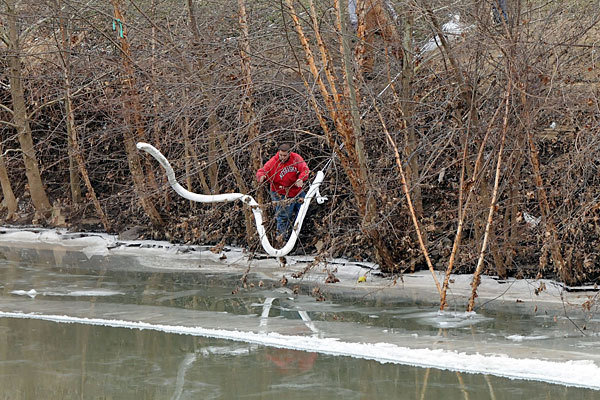
The busted tank is owned by Freedom Industries, which uses the chemical for coal processing. Some 300,000 people have been directly impacted by the disaster, forced to wait in long lines at fire stations to receive potable water. There’s been a constant run on stores for the precious resource as well.

This is a story to often told in Appalachia. The Massey Energy coal slurry spill in Martin County, Kentucky (where 306,000,000 gallons of toxic slurry hit the town) and the TVA coal ash disaster in Kingston, Tennessee, are also part of the history of industrial disaster in the region. This history is wrought with class struggle, environmental degradation and corporatism. From the expulsion of Native Americans to the rise of King Coal, the Hawks Nest incident, the labor struggle, the Battle of Blair Mountain and the wholesale destruction of mountain ecosystems via Mountaintop Removal, Appalachia is on the front lines of the war with the politically connected.

The coalfields of Appalachia have long been home to impoverished people, overlooked by the affluent in the United States. Still, the “War on Poverty” has made its way into the Appalachian hills several times. Most famously, US president Lyndon Johnson singled out the region for his “Great Society” programs, and presidents 42, 43 and 44 have all tried to help the region as well. Instead of offering a new way forward, their programs further damage the area.

Much of the “War On Poverty” has been fought via economic engineering, centralizing the economies of West Virginia and Eastern Kentucky (along with parts of Tennessee and Virginia) into the hands of extractive fossil resource industries — notably coal and natural gas. The mechanization of these industries, however, has reduced the labor force. Specialized labor moving to the region has caused short-term booms and long-term busts. Once an extractive resource is exploited and gone,  communities are left to deal with mono economies and irreversible ecological destruction.

They Poisoned the River for a “Clean Coal” Lie

By Trish Kahle - Socialist Worker, January 13, 2014

Disclaimer: The views expressed here are not the official position of the IWW (or even the IWW’s EUC) and do not necessarily represent the views of anyone but the author’s.

IMAGINE YOURSELF in the rugged countryside of the Appalachian Mountains, where you and your neighbors have lived with a history of poverty and lack of economic development–and you learn that the water piped into your home has been poisoned and can’t be used, even after it is boiled, until further notice.

Imagine trying to run a hospital when the city’s water is unusable–even for hand washing. Imagine having to ration drinking water to school-age children in the fourth most water-rich country on earth.

All of these nightmares and more came true in West Virginia on January 9 after residents reported that their tap water tasted like licorice. The contaminant turned out to be 4-methylcyclohexane methanol, or MCMH–a chemical used to produce misleadingly named “clean coal” through a froth flotation process that “scrubs” the coal prior to burning it in power plants.

The chemical spilled into the Elk River from a 48,000-gallon tank owned by Freedom Industries. The full extent of the leak remained unclear over the weekend. West Virginia Gov. Earl Ray Tomblin claimed the spill didn’t exceed 5,000 gallons, but Freedom Industries President Gary Southern could only say for certain that less than 35,000 gallons leaked out.

Tom Aluise of the West Virginia Environmental Protection Association noted that MCMH cannot be removed from the water–and residents will simply have to wait for thousands of miles of pipelines to be flushed before water safety can be reassessed. “This material pretty much floats on the water, and it’s floating downstream, and eventually it will dissipate, but you can’t actually get in there and remove it,” Aluise said.

That begs the question of why a hazardous chemical that is impossible to clean up if spilled was being stored near a river only one mile upstream from a treatment plant providing water to West Virginia’s capital of Charleston and nine counties that span the surrounding area.

Warsaw Climate Talks Go Up in Smoke

By Chris Williams - reprinted by permission from Truthout, November 21, 2013

Disclaimer: The views expressed here are not the official position of the IWW (or even the IWW’s EUC) and do not necessarily represent the views of anyone but the author’s.

"The smell of inaction" is how Dipti Bhatnagar, Friends of the Earth Mozambique's international program director for climate justice and energy, summed up the atmosphere inside the giant Narodowy Stadium after the first week of the latest round of international climate negotiations, Conference of the Parties, otherwise known as COP 19, taking place Nov 11-22, 2013, in Warsaw.
Given that this is the 19th consecutive year of annual negotiations and with a meaningful global treaty more distant now than it was almost two decades ago, Bhatnagar's olfactory deduction seems likely to be highly accurate.

As the pervasive smell of inaction seeped like a suffocating gas throughout the inside of the conference, outside, the choking effects of coal smoke waft from all corners of a country that obtains 90 percent of its electricity from coal and whose government has pledged to keep it that way until 2060.

As if to emphasize the point, just on the other side of the banks of the Vistula River, a stone's throw from the international climate negotiations, another conference is being held at the Polish Ministry of the Economy. Intent on sending a none-too-subtle message to government negotiators at COP 19, coal industry executives have gathered at the International Coal and Climate Conference, November 18-19, to discuss the future of coal in light of climate change.

If this were a rational system set up to benefit humanity, one might think that, as coal burning releases more carbon than other fossil fuels in addition to small particulates that infiltrate and cause chronic lung damage as well as other toxic chemicals that increase the risk of cancer and cause acid rain - coal industry leaders might be discussing how to shift their investments, to phase out coal and transition to alternative energy production methods that don't rely on burning such a noxious substance.

In reality, the conference was put on for precisely the opposite reasons. Attendees, with the blessing of the Polish government, were there to argue for the future of "clean coal." This technology is known as CCS (carbon capture and storage). And although it seeks to trap and bury carbon emissions from coal plants, it doesn't exist in any meaningful commercial form. Even some supporters harbor increasing doubts that it ever will be made to work on the scale necessary. But, nevertheless, it is being touted as the way to "safely" continue burning coal.

How to Deflate the Carbon Bubble

By Truls Gulowsen - Originally published at OpenDemocracy.net, September 29, 2013

Disclaimer: The views expressed here are not the official position of the IWW (or even the IWW’s EUC) and do not necessarily represent the views of anyone but the author’s.

Last Friday, the Intergovernmental Panel on Climate Change went public with their Fifth Assessment report in Stockholm. The report supplied us with more reasons to dread the coming effects of global warming, and even more reasons to urge politicians to act.
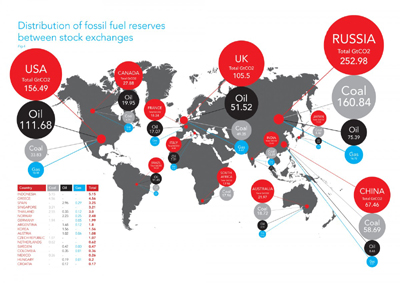
One of the key new features in the IPCC report is the global accumulative “carbon budget”. The IPCC confirms earlier findings that there is an allowence for less than 1000 gigatons of CO2 in the atmosphere for the rest of the century, if we are to avoid dangerous climate change above two degrees warming. This is less than a third of proven fossil reserves, and will be consumed in less than 30 years at current emission levels.

In neighbouring Norway, often described as a “world-leader in the combat against climate change”, a population of just over 5 million reap the profits in being the world's second largest gas exporter and the sixth largest oil exporter. The investments in the sector are growing year by year.


Along with the rest of the world, we are debating how to manage a limited resource and how to achieve the necessary emission cuts to avoid disastrous global warming. 


Along with the rest of the world, we live in a carbon bubble, in which, despite increasingly urgent warnings from scientists and environmentalists, we keep pumping up fossil fuels at record speed, pushing greener industry aside as we do so. In Norway the fossil fuels industry is by far the country's largest, and our reliance on this industry is not just a threat to the green industry, but to our entire economy, as has lately been pointed out by various individuals and organizations, including the IMF.


Our goal is not to get rid of the oil industry tomorrow. Nor is it to set a date for when the last oil worker will be out of a job. On the contrary, we want to keep the industry going for generations, but at a significantly lower level than we see today. To achieve this in a way that does not lead to mass unemployment (an estimated 250,000 people - or one in twenty Norwegians - are involved in the fossil fuel industry) we need a plan that combines both environmental policy and the oil workers' interests. That was the starting point when labour unions and environmental NGOs sat down to draft a plan on how we might realistically deflate Norway's inflated oil industry in a way that also retains the interests of the industry's employees.

Climate Change and Capitalism

By Michael Roberts - Originally published at The Next Recession, September 28, 2013

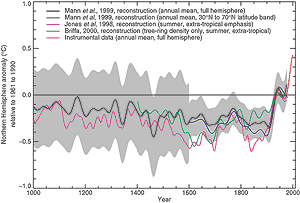
The 5th report by the International Panel for Climate Change (IPCC) was released this weekend. The IPCC brings together hundreds of scientists in the field of climate change to cooperate in drawing up a comprehensive analysis of the state of the earth’s climate and forecasts about its future.  The IPCC report raised its estimate of the probability that human activities, led by the burning of fossil fuels, are the main cause of global warming since the mid-20th century to “extremely likely”, or at least 95 percent, from “very likely” (90 percent) in its previous report in 2007 and “likely” (66 percent) in 2001.

The IPCC said that short periods are influenced by natural variability and do not, in general, reflect long-term climate trends.  So the argument of those whom deny global warming is man-made or is not getting worse cannot rely on the recent slowing of the rise in average atmospheric temperatures in the last 15 years.  The IPCC went on to say that temperatures were likely to rise by between 0.3 and 4.8 degrees Celsius (0.5 to 8.6 Fahrenheit) by the late 21st century.  Sea levels are likely to rise by between 26 and 82 cm (10 to 32 inches) by the late 21st century, after a 19 cm rise in the 19th century.   In the worst case, seas could be 98 cm higher in the year 2100.

The IPCC estimates that a doubling of carbon dioxide concentrations in the atmosphere would lead to a warming of between 1.5 and 4.5 degrees Celsius (2.7 and 8.1F), lowering the bottom of the range from 2.0 degrees (3.6F) estimated in 2007 report. The new range, however, is the same as in other IPCC reports before 2007.  It said the earth was set for more heatwaves, floods, droughts and rising sea levels from melting ice sheets that could swamp coasts and low-lying islands as greenhouse gases built up in the atmosphere.

The IPCC admitted that it was still unclear about the causes for the slowdown in climate change in the past 15 years, but insisted that the long-term trends were beyond doubt and that a decade and a half was far too short a period in which to draw any firm conclusions. The temperature rise has slowed from 0.12C per decade since 1951 to 0.05C per decade in the past 15 years – a point seized upon by climate skeptics to discredit climate science.  Professor Stocker said:

“People always pick 1998 but that was a very special year, because a strong El Niño made it unusually hot, and since then there have been a series of medium-sized volcanic eruptions that have cooled the climate.”

Explaining a recent slower pace of warming, the report said the past 15-year period was skewed by the fact that 1998 was an extremely warm year with an El Nino event – a warming of the ocean surface – in the Pacific.  It said warming had slowed “in roughly equal measure” because of random variations in the climate and the impact of factors such as volcanic eruptions when ash dims sunshine, and a cyclical decline in the sun’s output.

But the deniers of climate change and manmade global warming remain unconvinced. Professor Judith Curry of the Georgia Institute of Technology in Atlanta responded by saying that “Well, IPCC has thrown down the gauntlet – if the pause continues beyond 15 years (well it already has), they are toast.” But Rajendra Pachauri, chair of the IPCC, retorted that the reduction in warming would have to last far longer - “three or four decades” – to be a sign of a new trend.  And the IPCC report predicted that the reduction in warming would not last, saying temperatures from 2016-35 were likely to be 0.3-0.7 degree Celsius (0.5 to 1.3 Fahrenheit) warmer than in 1986-2005.

Capital Blight – Dealing in Doubt, Austerity, and Lung Cancer

By x344543 - September 19, 2013

Disclaimer: The views expressed here are not the official position of the IWW (or even the IWW’s EUC) and do not necessarily represent the views of anyone but the author’s.

The venerable environmental organization Greenpeace has fired a broadside at the science denial wing of the capitalist class with a scathing new report, Dealing in Doubt. This 67 page document argues, convincingly, that all of the claims that global warming is not caused by human activity are manufactured pseudoscience, and furthermore, those responsible are all linked to the fossil fuel industry, the American Legislative Exchange Council (ALEC), and the Koch Brothers. Much of this has happened under the cover of a front group known as “the Heartland Institute”.

The working class (and the broader “99%”) should care a great deal about this report, because (although Greenpeace doesn’t come out and say it) the very same interests that are going to great lengths to deny that climate change is happening at an accelerated pace due to (capitalist) human activity are the very same that are also pushing the broader capitalist class in general to engage in increased class warfare, which includes stepped up austerity measures, union busting, statist repression, and the transfer of wealth from the 99% to the 1%. Likewise, the same forces attempting to spread pseudoscientific nonsense about global warming either mot existing or being the result of “natural causes” are those who tried for years to obscure the truth about the links between cigarette smoking and lung cancer.

The key players in this unholy cadre (other than the aforementioned forces) include a veritable who’s who of right wing and so-called “libertarian” (read market fundamentalist) think tanks, and yes, the Joseph Coors founded Heritage Foundation (whose original purpose was to destroy private sector unionism in the United States) is one of the big contributors to these efforts.

Capital Blight - They Really Don't Know Clouds At All.

By x344543 - September 9, 2013

Disclaimer: The views expressed here are not the official position of the IWW (or even the IWW’s EUC) and do not necessarily represent the views of anyone but the author’s.

A recent discussion among IWW members about whether or not to change the default delivery option for the union's official organ, the Industrial Worker, from hard copy to PDF has touched on a larger debate over the "greenness" of "the cloud."(the many data centers that form the backbone of the Internet).

My attention was drawn to this debate by one of my fellow worker's reaction to the following statement from the current editor of our union's venerable publication, the Industrial Worker in reference to a change in the default option from a paper copy to an emailed PDF:

Go paperless, live in harmony with the earth and help save the union money!"

The union implemented this change to cut costs. The apparent environmental benefits are merely coincidental, though it's gratifying to see that the membership is taking the environmental tenets of the IWW Preamble seriously.

My aforementioned fellow Wobbly took exception to this statement thusly:

From some of what I have read, the physical maintenance of the digital world is anything but green, even though the idea that computers = lower pollution and energy consumption is to be found pretty much everywhere these days.

Below is a link to an article from the New York Times on the subject.  One of the key points is how much of the energy -- about 90-94% -- is wasted just keeping servers idling in case they need to be pulled in as backups.

The specific article he referenced, Power, Pollution, and the Internet actually quotes a slightly lower figure of 88 - 93%, but more about that later.

He then offered the following quotation to emphasize a comparison between data centers and the paper industry:

Nationwide, data centers used about 76 billion kilowatt-hours in 2010, or roughly 2 percent of all electricity used in the country that year, based on an analysis by Jonathan G. Koomey, a research fellow at Stanford University who has been studying data center energy use for more than a decade.

Datacenter Dynamics, a London-based firm, derived similar figures.

The industry has long argued that computerizing business transactions and everyday tasks like banking and reading  library books has the net effect of saving energy and resources. But the paper industry, which some predicted would be replaced by the computer age, consumed 67 billion kilowatt-hours from the grid in 2010, according to Census Bureau figures reviewed by the Electric Power Research Institute for The Times.

Skepticism of any capitalist industry's claims to be "green" should be regarded as healthy, but that skepticism should be followed by careful examination of all of the facts.

Capital Blight: It's Past Time to Get Off the Coal Train.

By That Green Union Guy - April 24, 2013

Disclaimer: The views expressed here are not the official position of the IWW (or even the IWW’s EUC) and do not necessarily represent the views of anyone but the author’s.

A recent debate took place on my personal Facebook page regarding the matter of jobs and the environment, and there is little doubt that it will not be the last.

As you may (or may not) be aware, I have been combing various environmental and labor news sources for stories about campaigns where class struggle and environmentalism have some degree of intersection (or conflict, though the latter is almost always manufactured vy the capitalist class). Most of these I have been posting on the new IWW Environmental Unionism Caucus Facebook Page, but since much of that happens while the only means of information transfer is a smart phone, so often, due to the limitations of smartphone apps, I have to engage in some klunky work-arounds, and sometimes that means that certain bits of information wind up on my personal page first, but I digress...

Last week, I happened upon a statement from a BLET engineer downplaying the dangers of coal dust drifting from coal trains passing through the southern part of the Seattle metropolitan area, and I immediately regarded this as the thoughts of a scissorbill and I said as much. That statement drew a response from another individual, a Facebook "friend" (a former Wobbly turned low-level ILWU leader, by the way), telling me that the coal dust issue was overstated, that the Sierra Club--who was leading the opposition to coal trains there--was hypocritical (due to the latter's having accepted donations from capitalist Natural Gas interests), and that I was insufficiently "solidaric" with my (business) union brothers and sisters. He informed me that the Sierra Club was only canvassing well-to-do neighborhoods in the area and completely ignoring those working class neighborhoods closest to the potential route, which--by the way--had far more immediate and far more serious environmental issues.

Since I am a transportation worker by trade (I'm a ferryboat deckhand, iu510 you know), I figured I might have fired before aiming, so I decided to dig a little further (pun not intended) and see just what was up.

I needn't have held my fire.

Pages

The Fine Print I:

Disclaimer: The views expressed on this site are not the official position of the IWW (or even the IWW’s EUC) unless otherwise indicated and do not necessarily represent the views of anyone but the author’s, nor should it be assumed that any of these authors automatically support the IWW or endorse any of its positions.

Further: the inclusion of a link on our site (other than the link to the main IWW site) does not imply endorsement by or an alliance with the IWW. These sites have been chosen by our members due to their perceived relevance to the IWW EUC and are included here for informational purposes only. If you have any suggestions or comments on any of the links included (or not included) above, please contact us.

The Fine Print II:

Fair Use Notice: The material on this site is provided for educational and informational purposes. It may contain copyrighted material the use of which has not always been specifically authorized by the copyright owner. It is being made available in an effort to advance the understanding of scientific, environmental, economic, social justice and human rights issues etc.

It is believed that this constitutes a 'fair use' of any such copyrighted material as provided for in section 107 of the US Copyright Law. In accordance with Title 17 U.S.C. Section 107, the material on this site is distributed without profit to those who have an interest in using the included information for research and educational purposes. If you wish to use copyrighted material from this site for purposes of your own that go beyond 'fair use', you must obtain permission from the copyright owner. The information on this site does not constitute legal or technical advice.
