

You are here

mine workers

Should the feds bail out coal miners?

By David Roberts - Grist, October 14, 2014

Disclaimer: The views expressed here are not the official position of the IWW (or even the IWW’s EUC) and do not necessarily represent the views of anyone but the author’s.

I wrote yesterday that coal country is largely lost to Democrats, and that’s fine; they don’t need it to put together consistent national majorities.

Lots of people (via Twitter and email) complained that of course those voters are going to the GOP, since at least the GOP offers them sympathy on culture-war issues, while the Democrats offer them nothing. Why should they vote Dem?

Often paired with such complaints is the notion that Dems ought to propose some kind of large-scale federal program to ease the transition of miners and their families away from coal — a bold, populist, New Deal-style development program that would show coal miners (and other rural whites) that Dems care about them.

I was going to do a deep dive on this, but it turns out there aren’t many details or concrete proposals out there, and this kind of thing has a snowball’s chance in hell of passing Congress in a time of (ill-advised) fiscal retrenchment, so I’m not going to do a multi-thousand-word geek-out. Instead, just some idle musings.

LAST BREATH: When a coal miner’s lungs finally gave out, his autopsy proved a top doctor was wrong - giving hope to thousands of other miners. The story of Steve Day and his final vindication

By Chris Hamby - Buzzfeed, October 8, 2014

Disclaimer: The views expressed here are not the official position of the IWW (or even the IWW’s EUC) and do not necessarily represent the views of anyone but the author’s.

After working underground in the coal mines of southern West Virginia for almost 35 years, Steve Day thought it was obvious why he gasped for air, slept upright in a recliner, and inhaled oxygen from a tank 24 hours a day.

More than half a dozen doctors who saw the masses in his lungs or the test results showing his severely impaired breathing were also in agreement.

The clear diagnosis was black lung.

Yet, when I met Steve in April 2013, he had lost his case to receive benefits guaranteed by federal law to any coal miner disabled by black lung. The coal company that employed the miner usually pays for these benefits, and, as almost always happens, Steve’s longtime employer had fought vigorously to avoid paying him. As a result, he and his family were barely scraping by, sometimes resorting to loans from relatives or neighbors to make it through the month.

Like many other miners, he had lost primarily because of the opinions of a unit of doctors at the Johns Hopkins Medical Institutions that had long been the go-to place for coal companies seeking negative X-ray readings to help defeat a benefits claim. The longtime leader of the unit, Dr. Paul Wheeler, testified against Steve, and the judge determined that his opinion trumped all others, as judges have in many other cases.

Today, however, there is final and overwhelming evidence that Wheeler was wrong: Steve’s autopsy.

On July 26, what was left of Steve’s lungs gave out. He was 67 years old. The doctor who performed the autopsy found extensive black lung. With the permission of Steve’s family, I shared his autopsy report with three leading doctors who specialize in black lung and related diseases. Each said essentially the same thing: Steve had one of the most severe cases of black lung they had seen.

“A majority of his lungs had been replaced by scar tissue with coal dust,” said Dr. Francis Green, a professor of medicine at the University of Calgary and one of the world’s top experts on the pathology of black lung.

Dr. David Weissman, who heads a federal agency’s division that certifies doctors — including Wheeler — to read chest X-rays, said it was “very concerning” that a certified reader would fail to recognize a case as severe as Steve’s.

Reached by phone, Wheeler said, “I’d love to talk to you, but the hospital has asked that everything be referred to the legal team.”

A Johns Hopkins spokesperson would not comment on Steve’s case, but noted that the black lung X-ray-reading program headed by Wheeler has been suspended, pending an internal review. The spokesperson refused to provide details about the review, saying only that it “is proceeding as rapidly as possible, and I can assure you that Johns Hopkins takes it very seriously.”

Eight months before he died, Steve filed a new claim for benefits, presenting evidence that the masses in his lungs had grown and his breathing had worsened even further. He underwent an exam by a doctor of the company’s choosing, and even this physician found severe black lung.

Soma Mine was Death Trap, Report Shows

IndustriALL Global Union - Mining.Com, October 2, 2014

Disclaimer: The views expressed here are not the official position of the IWW (or even the IWW’s EUC) and do not necessarily represent the views of anyone but the author’s.

A scathing official report into the Soma mining disaster in Turkey has revealed a catalogue of negligent practices and a complete disregard for worker safety. The comprehensive analysis shows warning sensors were ignored, safety reports fabricated and ventilation systems faulty. Three hundred and one miners were killed in the tragedy in May.

The much-anticipated 126-page expert report, commissioned by the Turkish public prosecutor, clearly states the catastrophe was preventable. While eight high-level managers of the mine’s operating company have already been arrested in connection with the tragedy, the report points the finger of blame at almost everyone involved in the mine, including ministry bureaucrats, with the exception of the miners themselves. “The only innocent group is the workers,” says the report.

The Soma mine is owned by a state-owned company Turkish Coal Enterprises (TKI) and operated by a private company, Soma Kömür İşletmeleri A.Ş.

Polish Miners Block Russian Coal Trains

Reporting by Adrian Krajewski; Editing by Alan Raybould; image from a EuroNews screenshot - Reuters, September 24, 2014

Disclaimer: The views expressed here are not the official position of the IWW (or even the IWW’s EUC) and do not necessarily represent the views of anyone but the author’s.

More than 200 Polish miners blocked trains carrying Russian coal at a border passage in northern Poland to protest against the cheaper Russian coal being brought in at a time when local mines are struggling, mining union leaders said on Wednesday.
Poland, which uses coal to generate about 90 percent of its electricity, produced 76.5 million tonnes in 2013. It exported 10.6 million tonnes but at the same time imported 10.8 million, mainly from Russia and the Czech Republic.

Imported coal proves cheaper than that from Poland’s largest miners such as Kompania Weglowa or JSW. Faced with high production and labour costs, as well as falling prices and demand, Polish mines are suffering losses.

“Right now around 80 percent of tenders for coal supplies to units run from the state budget are won by suppliers of imported coal, because they offer dumping prices,” Jaroslaw Grzesik, leader of the mining Solidarity union, said.

Dominik Kolorz, who heads the Solidarity union in the coal-rich Slasko-Dabrowskie region, told Reuters the miners may block the Braniewo-Mamonowo passage until a government representative is sent to listen to their demands.

Earlier this year Poland said it was considering sanctions on the import of Russian coal. Poland is among the more vocal supporters in the European Union of tougher sanctions on Russia over its intervention in Ukraine.

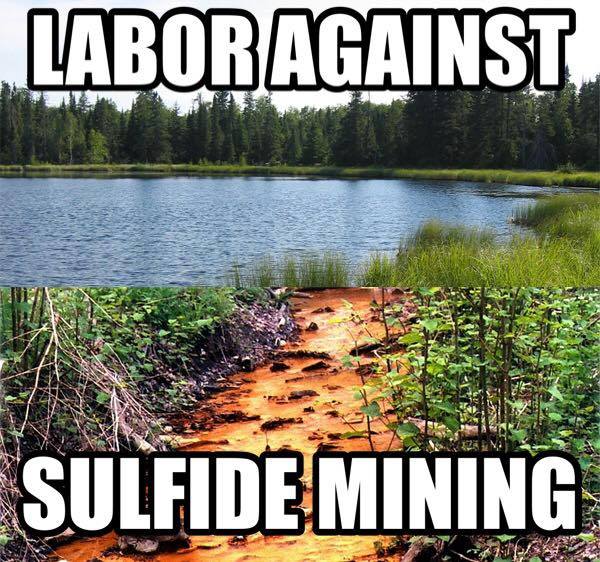
Unions and Crandon Mine

By the Committee of Labor Against Sulfide Pollution (CLASP) - May 1999

Disclaimer: The views expressed here are not the official position of the IWW (or even the IWW’s EUC) and do not necessarily represent the views of anyone but the author’s.

Ecology.iww.org editor's note: this article was published almost 15 years ago. We post it here to show an example of rank and file green unionism. There is now a Facebook Page for Labor Against Sulfide Mining.

To: State AFL-CIO, All Central Labor Councils in Wisconsin, USWA Sub-District 2, Milwaukee Labor Press, Racine Labor, Union Labor News, other labor publications and union bodies.

Brothers and Sisters of Wisconsin labor bodies,

The Canadian mining company Rio Algom has recently again attempted to enlist labor support for its metallic sulfide mine proposal near Crandon. A previous attempt by Rio Algom and its former partner Exxon in 1997 was countered by numerous resolutions by Central Labor Councils and locals against the mine, and in support of a sulfide mining moratorium...Early in 1998, Rio Algom bought out Exxon's 50% share in the project, and renamed its subsidiary the Nicolet Minerals Company (NMC); Exxon still retains rights to 3.75% of the royalties, and $5 million if production begins.

After a single NMC presentation, and without an opportunity to hear opposing views, presidents in attendance at a USWA Sub-District 2 (Wisc.) Presidents' Meeting recently adopted a resolution by a majority vote supporting NMC's proposed changes in the Crandon project. NMC also made a presentation to USWA Local 1527 in February, where NMC was acknowledged as the author of the resolution. NMC Spokesperson Dale Alberts tried to leave a strong impression that local citizens' and tribal concerns had been satisfied by the new mine proposals. Yet when informed of NMC's overtures to unions, and how his position had been misrepresented to union members, Menominee Tribal Chair Apesanahkwat issued a press release denouncing NMC's tactics. Since serious questions remained, opposing views were voiced at the Local's March meeting, when retired local CWA president Bob Schmitz and current Translators' Guild member Kira Henschel shed much light on sulfide mining, and Rio Algom's sordid history in the industry.

NMC's overtures are particularly ironic in light of the highly adversarial relationship between the USWA and Rio Algom:

  • The lung cancer deaths of many USWA miners at the Elliot Lake, Ontario, uranium mines in the 1950s-80s;
  • The recent layoffs of USWA Local 7619 members at the Highland Valley, British Columbia, mine;
  • Continuing layoffs of USWA Local 1114 members at Milwaukee's P&H Mining, a major supporter of the Crandon mine; According to a recent Associated Press article, NMC topped the list of highest-spending Wisconsin lobbyists in 1997 and 1998, with $1.5 million and 4,624 hours. The key NMC ally Wisconsin Manufacturers and Commerce-- no friend of unions--was third on the list with $1.1 million and 15,440 hours.

We see as a model the recent alliance between Steelworkers and environmentalists against the Maxxam Corp., which has decimated California redwoods and been virulently anti- union at its struck Kaiser Aluminum plants in the U.S.

CLASP would again like to thank the Central Labor Councils and local unions that have passed resolutions against the Crandon mine, and for the Sulfide Mining Moratorium Law:

  • Greater Green Bay Labor Council AFL-CIO,
  • Fox Valley Area Labor Council AFL-CIO,
  • La Crosse AFL-CIO Council ,
  • South-Central Federation of Labor AFL-CIO,
  • Wisconsin Federation of Teachers,
  • Green Bay Building and Construction Trades Council ,
  • Racine County AFL-CIO Central Labor Council,
  • USWA Local 1527 (Milwaukee),
  • UAW Local 72 (Kenosha),
  • CWA Locals 4603 (Milwaukee), 4620 (Green Bay), 4621 (Appleton), 4622 (Oshkosh), and 4623 (Fond du Lac);
  • AFSCME / WSEU--Local 82 AFL-CIO (Milwaukee),
  • AFT Local 3220 AFL-CIO (Madison), and others.

We do not know how widespread NMC's efforts to gain union approval have been, so we are both asking for your help in monitoring this activity, and also offering our help to provide another perspective to balance NMC's one-sided campaign of disinformation. We would appreciate any information that you or any affiliated labor bodies may have on NMC's labor-related activities...

A Coal CEO Allegedly Coerced His Employees To Donate To Political Candidates. Here’s Who Benefited

By Emily Atkin - Think Progress, September 25, 2014

Disclaimer: The views expressed here are not the official position of the IWW (or even the IWW’s EUC) and do not necessarily represent the views of anyone but the author’s.

Earlier this month, the United States’ largest independent coal company was slapped with a lawsuit by a former employee, claiming she was illegally fired for refusing to give money to political candidates chosen by her boss. That boss, Murray Energy CEO Robert Murray, allegedly sent letters to his employees asking them to support pro-coal candidates for political office, keeping track of who made the requested contributions and who didn’t. Employees of Murray Energy and its subsidiary companies were aware that failing to contribute could impact their jobs, the lawsuit claimed.

This incident is not the first time Murray has been accused of pressuring his employees to give money to his preferred candidates and his political action committee, the Murray Energy PAC. “The pressure to give begins as soon as employees enter the company,” the New Republic’s Alec MacGillis reported in a 2012 investigative piece. “At the time of hiring, supervisors tell employees that they are expected to contribute to the company PAC by automatic payroll deduction — typically 1 percent of their salary, a level confirmed by a 2008 letter to employees from the PAC’s treasurer.”

Murray has adamantly denied the veracity of the allegations. In a statement to ThinkProgress, a spokesperson called the latest lawsuit “baseless,” “blatantly false,” and “totally concocted,” deeming it an “attempt to extort money from Murray Energy Corporation.” The claims that Murray knows which of his employees donates and who does not are “totally fabricated,” the spokesperson said, a fact that Murray has “repeatedly stated.”

Still, the allegations raise questions about the ethics and legality of Murray Energy employee donations. Federal Election Commission rules state that corporations can’t make their employees donate to specific candidates or parties “as a condition of employment.” If corporations do ask their employees to contribute to certain funds, they must inform the employee “of his right to refuse to so contribute without any reprisal.”

In the latest accusation of coercion against Murray, the former employee cited fundraising letters she received from Murray in late May of 2014. Those letters asked for contributions to four Republican candidates for U.S. Senate: Scott Brown from New Hampshire, Ed Gillespie from Virginia, Terri Lynn Land from Michigan, and Mike McFadden from Minnesota.

Thousands of Workers Begin Strike at World’s Biggest Copper Mine

By Cecilia Jamasmie - Mining.Com, September 22, 2014

Disclaimer: The views expressed here are not the official position of the IWW (or even the IWW’s EUC) and do not necessarily represent the views of anyone but the author’s.

Close to 2,800 miners at Chile's Escondida, the world's biggest copper mine, began a 24-hour “warning” strike on Monday morning as they seek to negotiate better working conditions, Publimetro reports (in Spanish).

Workers belonging to the Sindicato No. 1 union said if talks with the mine owners, BHP Billiton (ASX:BHP) and Rio Tinto (LON:RIO), don’t bear fruit, they’ll stage an indefinite stoppage beginning Wednesday morning.

The 1.2 million tonnes a year operation, located in Chile's Atacama Desert, also provides around 1,900 contract workers with full time jobs.

The news did not affect the red metal prices. London copper futures, in fact, fell to their weakest level in months, losing 1.46% to trade at $6,735 a tonne by 0648 GMT. Earlier they had fallen falling to $6,722.50, the lowest since June.

So far this year copper prices have tumbled more than 8%.

Escondida’s Sindicato No. 1 union carried out a similar 24-hour stoppage over pay and conditions last year. That dispute was quickly settled, but during a two-week strike in the summer of 2011 output of more than 40,000 tonnes of copper was lost, forcing operator BHP to declare force majeure.

News of the strike comes not long after BHP said the mine could substantially increase total output next year to 1.27 million tonnes.

The mine which also produces gold and silver as by-products plays a key role in the Chilean economy, accounting for about for 2.5% of the country's gross domestic product. According to Rio Tinto’s website, in 2012 the mine generated 5% of global copper production and around 15% of the South American nation output.

Black Lung Among Coal Miners At Highest Level In 40 Years

By Kate Valentine - TruthOut, September 16, 2014

Disclaimer: The views expressed here are not the official position of the IWW (or even the IWW’s EUC) and do not necessarily represent the views of anyone but the author’s.

Rates of a deadly form of black lung are the highest they’ve been in 40 years among Appalachian coal miners, according to federal experts.

Scientists from the National Institute for Occupational Safety and Health published a letter Monday in the American Journal of Respiratory and Critical Care Medicine that stated that levels of progressive massive fibrosis (PMF) have risen to levels not seen since the early 1970s among coal miners in Kentucky, West Virginia and Virginia. The high numbers come just 15 years after the “debilitating and entirely preventable respiratory disease” was “virtually eradicated,” the scientists note.

PMF is caused only by breathing in too much coal mine dust, the letter said, so the increase in rates “can only be the result of overexposures and/or increased toxicity stemming from changes in dust composition.” The letter also notes that 2014 marks the 45th anniversary of the Federal Coal Mine Health and Safety Act, which aimed to curb incidence of black lung among coal workers by implementing dust standards. Current rates of PMF prove that exposure to coal dust continues to be a major health hazard for coal miners, however.

“Each of these cases is a tragedy and represents a failure among all those responsible for preventing this severe disease,” the letter reads.

David Blackley, one of the letter’s authors who works at the NIOSH office in Morgantown, West Virginia, told the Charleston Daily Mail that he was “shocked” when he looked at the black lung data.

Whistleblower Warned Company Tailings Pond Would Fail, Lost Job, then Home

By Damien Gillis - Common Sense Canadian, September 8, 2014

Disclaimer: The views expressed here are not the official position of the IWW (or even the IWW’s EUC) and do not necessarily represent the views of anyone but the author’s.

Larry Chambers warned Imperial Metals that its tailings pond was bound to fail – and he was fired for it, the Likely, BC resident told media in Vancouver earlier today.

He and his wife, Lawna Bourassa-Keuster, have now lost their home on once-beautiful Quensnel Lake – too afraid to drink the cloudy and discoloured water, which they brought with them to Vancouver in a jar.

“Christy Clark did come to Likely and at that time, she informed us that she would make sure that Quesnel Lake would be brought back to its pristine state,” said Bourassa-Keuster. “We haven’t seen or heard from her since.”

“We, like most of the residents, live in Likely for its beauty and peacefulness. This is heartbreaking to see.”

The couple didn’t pull any punches when discussing the company’s attitude toward safety during a press conference hosted by the Union of BC Indian Chiefs and featuring a Secwepemc First Nation representative as well. After complaining in writing to the Ministry of Energy and Mines about safety conditions at the mine, Chambers says he received a phone call “saying my services were no longer needed there.”

Chambers described instances of being bullied by supervisors at the mine for insisting on safety standards that were not being properly implemented.

It was an ongoing concern about the size of tailing pond and half the employees there knew there was a problem. This just shows you, as soon as you say something, you’re out of there.

Five coal miners die in Bosnia after quake causes mine collapse

By Cecelia Jamasmie - Mining.Com, September 5, 2014

Disclaimer: The views expressed here are not the official position of the IWW (or even the IWW’s EUC) and do not necessarily represent the views of anyone but the author’s.

Rescuers at Zenica coal mine in central Bosnia freed Friday 29 of the 34 miners trapped underground after a gas explosion that followed a 3.5 magnitude earthquake, which cause the walls to collapse.

Officials halted rescue efforts, believing that five men who remained deep below ground were dead.

Relief among people waiting outside turned to anguish when it became clear that not all 34 men had survived.

Twenty-two other miners managed to leave the pit before it collapsed Thursday evening, AP reports.

Even before news of the deaths emerged, unions and families of the trapped miners claimed management understated the scale of the problem and moved “too slowly” to rescue the men.

Zenica was the site of one of the greatest mining tragedies in Bosnia’s history, when 39 miners were killed in a gas explosion in 1982.

Pages

The Fine Print I:

Disclaimer: The views expressed on this site are not the official position of the IWW (or even the IWW’s EUC) unless otherwise indicated and do not necessarily represent the views of anyone but the author’s, nor should it be assumed that any of these authors automatically support the IWW or endorse any of its positions.

Further: the inclusion of a link on our site (other than the link to the main IWW site) does not imply endorsement by or an alliance with the IWW. These sites have been chosen by our members due to their perceived relevance to the IWW EUC and are included here for informational purposes only. If you have any suggestions or comments on any of the links included (or not included) above, please contact us.

The Fine Print II:

Fair Use Notice: The material on this site is provided for educational and informational purposes. It may contain copyrighted material the use of which has not always been specifically authorized by the copyright owner. It is being made available in an effort to advance the understanding of scientific, environmental, economic, social justice and human rights issues etc.

It is believed that this constitutes a 'fair use' of any such copyrighted material as provided for in section 107 of the US Copyright Law. In accordance with Title 17 U.S.C. Section 107, the material on this site is distributed without profit to those who have an interest in using the included information for research and educational purposes. If you wish to use copyrighted material from this site for purposes of your own that go beyond 'fair use', you must obtain permission from the copyright owner. The information on this site does not constitute legal or technical advice.
